Author: Caroline Baker Dimock
Date: 2.25.26
When Bethany Edmunds talks about broadening participation in computer science, she is not describing a single initiative, policy, or moment. She is describing a philosophy that has shaped nearly every stage of her academic career.
“This idea that everybody should have a space in computer science is what drives me,” she says. “And that computer science should serve everyone.”
Those efforts earned Edmunds, Khoury College’s West Coast associate dean of computing programs, the 2026 SIGCSE Award for Broadening Participation in Computing Education. The award recognizes sustained, impactful work to make computing education more inclusive.
“For about 15 years now, ever since I got my PhD and then started working in academia, I’ve really worked hard to make sure that I look at the systemic barriers to classrooms, starting in my classroom and then expanding from there,” Edmunds explains.
That framing — systemic barriers, rather than individual shortcomings — has guided Edmunds’ work. Rather than focusing solely on recruiting underrepresented groups like female students and students of color, she has consistently asked deeper questions: Why do certain students feel unwelcome? Why do others leave? What invisible barriers are keeping people out?
“There are gates that are being kept, that are keeping people out, that make people feel like they don’t belong there,” she says. “And there are ways that we run our classes that are leading to the homogenous group that graduates from computer science.”
Edmunds has often focused on practical, structural solutions rather than symbolic gestures — rethinking assumptions about computer science students and their needs. This includes reconsidering class schedules and timing, as well as providing childcare at recruitment events.
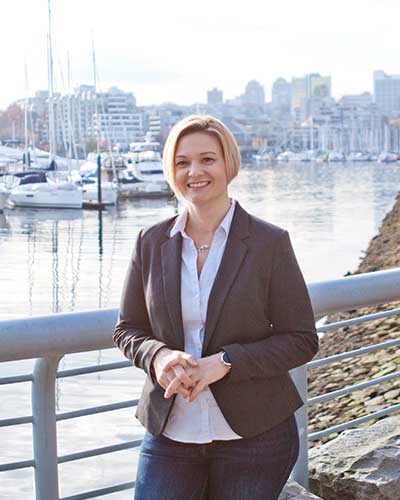
In 2019, Edmunds was asked to help do something rare in higher education: build a campus from scratch. As faculty lead for Northeastern’s Vancouver campus, she had the opportunity to design not just curricula, but a space and a culture. Every decision was filtered through the same guiding question: Who might this exclude?
“It was done with the thought of how do neurodiverse people participate in this environment? How about people for whom English is their second or third or fourth language? How do we make the most of our time together to really focus on the student experience?” she explains.
The result is a campus that Edmunds considers one of her proudest accomplishments. The campus features master’s programs designed to launch people into the world of technology and computer science, including the Align master’s program for students without a computing background. It also offers classes after traditional work hours and caters to students for whom English is not their first language.
Edmunds’s motivation for this work is rooted in how computing shapes the world, and how easily design decisions can exclude entire communities.
“I always feel like computer science is such an important part of our society,” she says. “We make assumptions in our design choices based on our experience. And I think that having a classroom full of different experiences allows us to question those assumptions.”
She points to real-world consequences when those assumptions go unchallenged, such as “not recognizing how this plays into somebody else’s lived experience can lead to exclusion, marginalization, and lack of participation.”
This lack of recognition can range from students creating software that requires a certain number of characters for a name to an app that requires a web connection of a certain speed in order to work.
Beyond campus-wide initiatives, Edmunds has also reshaped individual courses. One of the most meaningful to her was a special-topics software engineering course designed around community partnership.
“The goal of that class was to do a software project for a community that was very different from our typical group … a marginalized community of some sort,” she notes.
In one iteration, the class worked with neurodivergent people, including those with intellectual disabilities. The course led to tangible outcomes, including a Chrome extension designed to make the web more accessible for users with dyslexia. But for Edmunds, the deeper impact was pedagogical.
“What I loved about it was that throughout the process, the students realigned with the customer and recognized how to reach their needs — not just what we assume their needs to be. It’s an exercise in empathy and understanding,” she says.
Edmunds’s academic background is not in education research, but in machine learning. That technical foundation now underpins much of her advocacy around AI ethics and inclusion — work she has carried out through national advisory roles, conference speaking, and global partnerships, including efforts with the United Nations and the University of Liberia to help launch Liberia’s first master’s program in artificial intelligence.
Looking ahead, Edmunds is increasingly focused on lifelong learning and rethinking who gets access to computing education, including how to teach people already in industry to implement more inclusive practices in their workplaces. She also says she sees emerging AI tools not as a threat, but as a potential bridge.
“Some people don’t like the fact that it could take five days to solve a problem,” she says. “So are there ways that we can use AI to have more quick wins [so] people can get excitement from developing computer programs?”
For Edmunds, broadening participation has never been about a single pathway into computer science. It is continually questioning who the field is built for and who it could serve if designed differently. And for that sustained commitment, the SIGCSE award recognizes not just what she has built, but how many doors she has opened along the way.
The Khoury Network: Be in the know
Subscribe now to our monthly newsletter for the latest stories and achievements of our students and faculty
Author: Will Beeker
Date: 2.23.26
Accessibility for the deaf and hard of hearing community is too often an afterthought in software development.
Reese Cantu is combating the problem head-on by combining his interests to create a double-major path that is entirely his own. He’s majoring in computer science at Khoury College and American Sign Language–English Interpreting at the College of Social Sciences and Humanities, with plans to complete his ambitious degree in May.
“It’s something that is brand new for a lot of people. I don’t know that this has been done before at Northeastern,” Cantu says.
Either major is enough to keep most students busy, but ASL and CS are enduring passions for Cantu and he hasn’t wanted to abandon either pursuit. Fortunately, at Northeastern, he hasn’t had to.
Cantu’s interest in ASL took root in third grade when a classmate brought in a book on sign language, which gave Cantu and his friends a way to discreetly communicate with one another behind the teacher’s back. This subterfuge grew into a genuine passion for Cantu, who later created an ASL club at his high school and started attending social events for the deaf, hard of hearing, and signing community.
Meanwhile, Cantu was developing his math and computer science skills, learning programming from his grandfather who was a developer back when the trade still involved punch cards.
“I grew up watching my grandfather make websites, and he taught me little bits and pieces of JavaScript, so I’ve always had this math and science brain going on,” Cantu says.
As Cantu prepared to apply for college, he knew that he wanted to enroll in an accredited ASL program, which narrowed his search to just over a dozen universities. But he also wanted to study computer science. When he visited Northeastern’s Boston campus and saw the Interdisciplinary Science and Engineering Complex, he felt he had found a place where he could marry his interests.
“Northeastern was the only school I applied to,” Cantu says.
After getting accepted, Cantu showed up to orientation with a spreadsheet of the courses he wanted to take to fulfill his double-major dream. Although he worked with Khoury and CSSH advisors to develop a plan, he found the bridging of these two rarely paired fields, both for his major and his career aspirations, was his puzzle to solve.
“The tech industry is moving very quickly,” Cantu says. “A lot of folks know a little bit about sign language, but they don’t really know a lot about deaf folks and the deaf community and what they want or need.”
Cantu’s goal is to work directly with deaf programmers to develop useful technologies centered around their input. As he points out, many innovations in the ASL-CS world involve gloves that translate the motions of hands and fingers to ASL words, but this approach neglects the importance of facial expressions. The raising of eyebrows, for example, is used to indicate a question, and without this kind of information, the richness of ASL is diminished.
Cantu gained further experience with ASL when he completed what he calls a “study domestic” (as opposed to a “study abroad”) at Gallaudet University, a Washington, DC-based liberal arts school for deaf and hard of hearing people with which Northeastern has a partnership. All the professors there are deaf or hard of hearing, and the courses are taught entirely in ASL. He was there for his ASL and Interpreting major but also took several computer science classes.
“Talking about CS concepts in ASL forced me to know my stuff,” Cantu explains. “You don’t get to hide behind vocabulary in the same way you do in English because often, the ASL representation of a concept is a description of what it means rather than one individual sign.”
Acclimating to an ASL-only environment took some getting used to, but the deaf community’s emphasis on inclusivity helped make Cantu’s adjustment much easier.
“One benefit about learning anything in a deaf environment is a cultural attitude of making sure everyone in the room understands what is going on,” Cantu says. “I have never been in a classroom where the teacher and students were so willing to pause and clarify if someone asked for it.”
Back at Northeastern, Cantu recently completed Khoury College’s Professional Practicum Capstone, in which Professors Mark Fontenot and Wendy Truran guide students through real-world application development. In Cantu’s case, he worked with the Massachusetts National Guard’s Explosive Ordnance Disposal Unit to digitize their inventory-taking process, which was previously done on paper. In speeding up the inventory process, his solution freed up cadets’ time for more important work.
Cantu and his group dealt directly with the Massachusetts National Guard to assess their needs. Creating an application for nontechnical users meant Cantu had to flex his interpretative skillset to translate everyday English into technical code. The product was designed to be as user-friendly as possible, something that Cantu, with his emphasis on accessibility, always keeps front and center.
Now Cantu hopes to continue bridging computer science and ASL with his senior capstone project, which aims to assess the state of sign language recognition technology.
“To what extent can computer vision models notate sign language? There’s often so much nuance that’s getting lost,” Cantu says. “Essentially, how can [innovators] make a product that actually works for deaf people?”
The Khoury Network: Be in the know
Subscribe now to our monthly newsletter for the latest stories and achievements of our students and faculty