Author: Caroline Baker Dimock
Date: 06.11.26
Hack Health, a student-led hackathon held in mid-March at Northeastern University, brought together aspiring developers, entrepreneurs, and students interested in health care innovation. Unlike a traditional hackathon, the event connected real-world needs with technical talent by partnering participants with startups and founders.
The event reflected two broader goals. The first was to turn hackathons into more than just short-term competitions by emphasizing collaboration, impact, and direct pathways into industry, as winning teams were offered internships with the startups they collaborated with.

The other was to revitalize Northeastern’s chapter of the Association for Computing Machinery (ACM). Ekam Bhatia, a second-year data science and math combined major who chaired the club in 2025–26, led the executive board of 10 in an effort to provide opportunities for Boston-area students. Bhatia aimed to transform the club into a more engaging and career-oriented community by building a strong software team and fostering connections with startups. He noticed that early-stage founders often lack technical collaborators, while students often struggle to find relevant internships.
“I really wanted to create a bridge to combine that passion where not only would you have technical founders or startups, but also technical students who are looking to create products that actually make a difference,” Bhatia said. “I thought about creating a new kind of hackathon, especially since Boston is really strong in health tech.”
The hackathon had three tracks: physical health, mental health, and educational health. The roughly 60 student attendees divided themselves into small teams, with each focused on different areas within those themes.
Mental health track
Kunj Joshi and Justin Feldman, both master’s students studying computer science, were tasked with building a solution alongside a sponsoring startup, SkipIt. After hearing pitches from the partner startups, Joshi and Feldman were drawn to SkipIt’s mission of helping users avoid triggering content in movies and TV shows. They designed a project that could expand the startup’s existing product and make it more flexible for a wider range of users.
Their project, called Trigger Detect, extended SkipIt’s core idea by introducing customizable triggers, rather than limiting detection to predefined clinical categories. Inspired by personal experiences, such as Joshi’s allergy to bee stings and Justin’s arachnophobia, the team built an AI system that allows users to input specific fears or sensitivities in natural language. The system then converts those inputs into actionable tags using a large language model and applies computer vision techniques to scan video content for those elements. If a trigger is detected in an upcoming scene, the system alerts the user and gives them the option to skip it, making media consumption more accessible and personalized.
As Feldman explained, “Not everything falls into bins of traumas … it’s hard to be so granular when it comes to what a trigger could be for any given user.”
“It might be bees for me,” Joshi added. “It might be guns for someone else. It might be spiders for someone else … It was really a software development problem, a real algorithm problem in computer science.”
Trigger Detect required more than just plugging in AI models. Joshi and Feldman had to design efficient pipelines to process video frames ahead of playback and ensure the system could identify objects accurately in real time. Their approach combined machine learning, computer vision, and core computer science principles, highlighting the importance of strong technical foundations even in AI-driven projects.
Ultimately, their solution stood out for its practicality and innovation, earning them a win in their track and opening the door to an internship opportunity with the sponsoring startup.
Education health track

Om Patel, a master’s student in applied artificial intelligence, partnered with Vamsi Yanamadala, a master’s student in cybersecurity, to develop a category-winning solution focused on improving learning experiences for students. They approached the competition with an interest in combining their technical backgrounds to address challenges in education, particularly for students who struggle with traditional study methods.
Their project, called Focus Flow, is an AI-powered adaptive study session manager designed for neurodiverse students. The tool aims to personalize study sessions by adjusting to a user’s focus levels, learning patterns, and individual needs. Rather than offering a one-size-fits-all approach, Focus Flow uses intelligent systems to help structure study time in a way that maximizes productivity, reduces cognitive overload, and support students who benefit from customized pacing and guidance.
“We wanted something that doesn’t assume every student learns the same way, because that’s just not reality,” Patel said.
The team’s work highlights how AI can be applied beyond traditional productivity tools to create more inclusive educational technologies. Focusing on neurodiversity, Om and Vamsi addressed a gap in many existing study platforms, which often overlook the varying ways students process information and maintain attention.
“The hardest part wasn’t building the model — it was making it respond in real time to how a student’s attention actually shifts during a session,” Yanamadala said.
Physical health track

The winning group in the physical health track group, which teamed up to build an injury recovery and rehabilitation platform, consisted of Phillips Le, a second-year biomedical engineering student at Boston University; Michael Zhang, a second-year computer science student at Northeastern University; and Nghia Trang, a second-year computer engineering student at Boston University.
The group formed shortly before the hackathon began, bonding over a shared interest in health care and technology despite not knowing each other beforehand. Their mix of technical backgrounds helped them approach the problem from multiple angles, combining software development with an understanding of patient needs.
Zhang said the team’s project, Rebound, was designed as a practical recovery tool for users managing injuries, with the goal of making the app accessible to as many people as possible.
“It’s an app that helps injured people, no matter if you’re an athlete or just a normal person … rehabilitate their injuries, serving as an assistant and the connection to doctors and injury rehabilitation services,” Zhang said.
Rebound evolved into a personalized recovery platform that allows users to track pain, complete rehabilitation tasks, and monitor their range of motion using computer vision. It also includes maps to help users find nearby care providers, as well as insurance coverage information to help users access treatment more efficiently.
The team balanced front-end and back-end development under tight time constraints, building systems for health data tracking and computer-vision-based motion analysis, as well as an interface designed to simplify complex medical information. Their work earned them a win in their track and an internship opportunity with AIR Health, a respiratory care startup.

The Khoury Network: Be in the know
Subscribe now to our monthly newsletter for the latest stories and achievements of our students and faculty
Author: Will Beeker
Date: 06.08.26
Over the past academic year, Northeastern partnered with Verizon to put on the Verizon Smart Campus Competition, in which interdisciplinary teams competed to offer new and innovative solutions to real-world problems using Verizon technology. In addition to the invaluable experience of collaborating with Verizon professionals, each of the three winning teams was awarded $3,000.
From 5G to AI, participants used cutting-edge tools to tackle problems like reckless driving, food pantry inventory, and overwhelmed hospitals. This was Verizon’s first time partnering with Northeastern for this competition.
“There’s a kind of integration that’s really specific to Northeastern regarding collaboration and combined majors,” says Lauren Heywood, Khoury College’s former director of partnership relations and student engagement who worked closely with Verizon during the competition. “Northeastern students approach problems from a variety of interdisciplinary areas.”
The three-round competition started with video submissions from 23 teams and continued with a poster presentation. Seven top teams were selected to showcase a 10-minute presentation of their fully formulated plans. Pitches were judged not only on their use of Verizon’s existing technologies, but also on their strategies for implementing the ideas. Teams consisted of three to six students, all second- and third-year undergraduates, with at least three students in computer science or related technical fields.
One unique aspect of the competition was the access to Verizon employees, who acted as judges and mentors.
“Each team was given a resource from Verizon. For about three weeks to a month, they got access to those resources and had several meetings, exchanged several emails. They really acted as support for each team,” Heywood says.
The competition puts Verizon in the forefront of students’ minds as they enter the workforce and gives Verizon access to the next generation of talent. Additionally, the three winning teams, whose stories are included below, will get a chance to participate in the “Winner’s Circle,” a follow-up meeting with Verizon representatives to discuss the future of their projects.
The Real-Time Crash Defense System
Sage Batchelor, Justin Haime, Miles-Kabilito Magoola, Kelsey Hammel
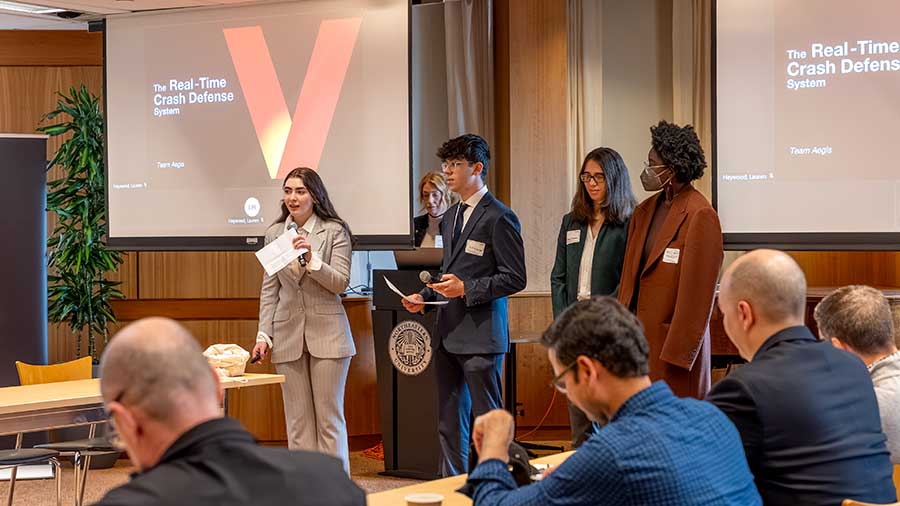
Verizon has many technologies related to safe driving. The students behind The Real-Time Crash Defense System strive to bring those disparate resources together into one unified system to reduce preventable crashes and make roads safer.
Multiple team members recounted their personal connections to road accident deaths, including the tragic death of Jacob Davis, a first-year Northeastern student who was killed by a drunk driver in 2024. Davis was a close friend of third-year data science and business major Justin Haime.
“We were considering a lot of different ideas, but this idea resonated with each of us the most and we felt it had the most potential to do the most good,” says third-year student Miles-Kabilito Magoola, who is doing an independent major combining design, animation, and software development.
The system combines three Verizon technologies: Verizon Smart Intersections, which collects real-time data at intersections to optimize traffic-light timing; Verizon Connect Dashcam, which uses AI to identify reckless driving through dashcams; and V2X, or Vehicle-to-Everything, a communication platform connecting drivers, pedestrians, and traffic infrastructure to send alerts to each other and improve safety.
“The traffic lights will change in such a way so that way there’s no one in the intersection as a reckless driver approaches it, whether that means holding everybody back by making all the lights red, letting a few people through, or stopping people in case the reckless driver is speeding through the light. Hopefully that prevents whatever incident might have occurred,” Haime explains.
The team found that working one-on-one with a Verizon mentor helped keep them focused on the practicalities of implementation.
“It’s one thing to talk to other folks, students, and professors, but we are only at the very start of understanding how the corporate world works,” Magoola says. “So getting that from someone who has both been in these industries for a long time and also understands what we’re trying to go for from a technological side — he really helped us connect the dots.”
While experience with hackathons and co-ops helped prepare the team for the experience, they found the competition entirely unique.
“This is a whole different type of competition,” Haime says. “For six months, you’re constantly thinking about it. It gets you thinking about the whole life cycle of a product, which is not something I’ve thought about before.”
VitaLink
Aran Dharma, Sriganesh Srinivasan, Divya Thoppae
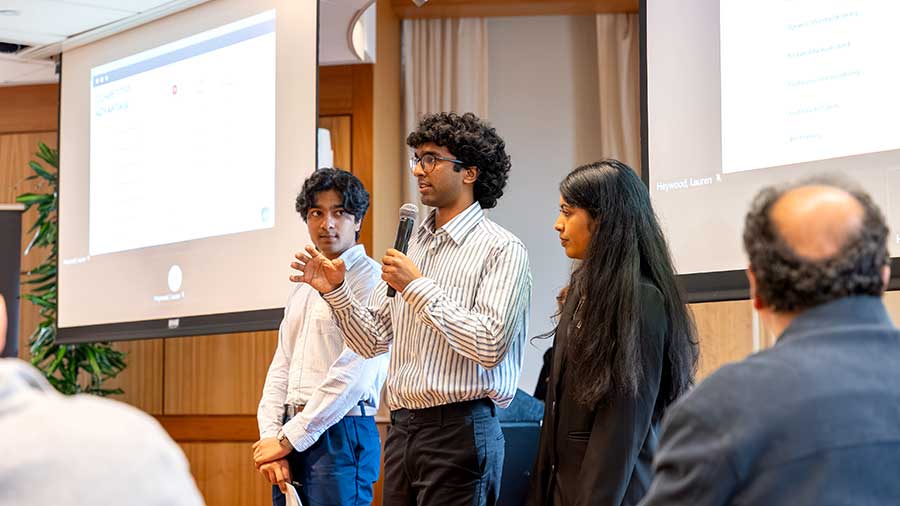
Patient care technicians (PCTs) juggle dozens of patients simultaneously, with vital signs checks often done every few hours. When hospitals get overwhelmed, it’s easy to fall behind on these checks.
VitaLink is a continuous monitoring service that uses a dashboard to alert PCTs when a patient’s vitals change or are likely to change. This can increase response time and help PCTs catch early warning signs in a patient’s deteriorating condition.
The VitaLink team proposes using Verizon’s 5G network to help handle the intense network load that can result from a hospital ward full of internet-connected devices.
The app uses federated learning to train AI models across different devices and servers without sharing actual data, which would help optimize the app’s prediction abilities while maintaining data privacy. It also takes advantage of Verizon’s 5G network slicing technology, which allows for a single 5G network to be partitioned into multiple, customizable virtual networks. Combining these technologies helps create a more efficient and adaptive product that stands out from the competition.
The VitaLink team hopes the app could save up to 10 minutes per patient per day, giving back hours of time to overworked hospital ward staff.
With Boston home to so many hospital workers, it’s no surprise that the team had personal connections to these issues.
“I have a lot of PCT friends and friends in the medical health care space, and every time I talk to them, they’re always recounting the tough experiences they have in the hospital. They work 12-hour shifts and they’re basically always doing the grunt work,” says third-year computer science and business major Divya Thoppae. “Our idea evolved during the competition as we said, ‘OK, let’s go talk to more people to try to understand the space a little more, especially since none of us personally are in health care.’”
Working directly with a Verizon professional also proved invaluable.
“Our mentor really helped us understand the business side of things,” Thoppae says. “Our second round was a poster presentation so it was quite technical, more research based. You’re trying to make that shift toward storytelling to make sure you’re getting the audience’s attention and hitting the serviceable, addressable market. He guided us through that process, since he does that day to day.”
FoodTrace
Jack Dreifus, Benedikt Winkler, Wyatt Bracy, Aidan Kelly, Haylie Pederson, William Riser
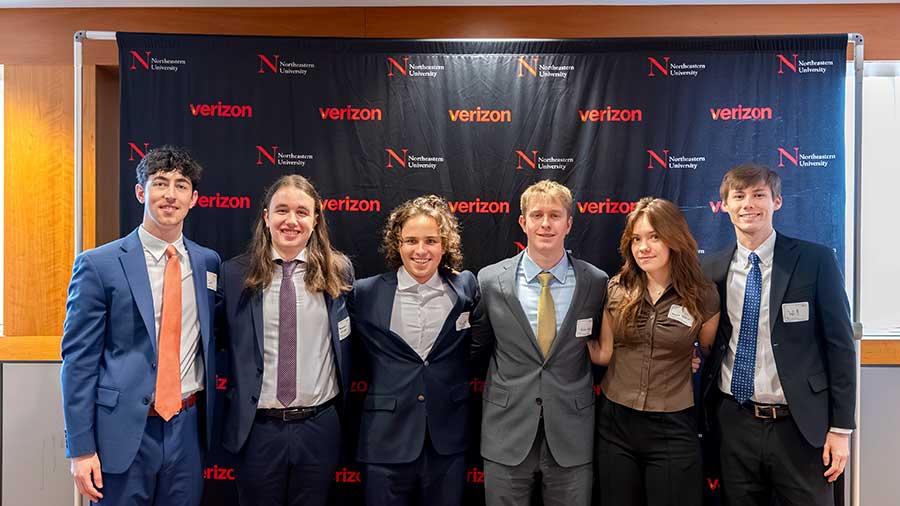
FoodTrace is a live tracking application for food pantries to monitor and inventory their available food supplies. The easy-to-use design uses existing barcode-scanning technology, which enables food pantry workers to scan and track supply items using a smartphone. The scanned item gets uploaded to a database and displayed in a dashboard showing food totals, all backed by Verizon’s 5G network for fast, reliable syncing across pantry locations.
The idea tackles a difficult problem for food pantries: avoiding food waste. Too often supplies can spoil or be distributed unevenly, preventing people from accessing the food they need. The application requires no new technologies and minimal onboarding for food pantry workers, making it practical and viable.
The group points out that one in eight Americans face food insecurity, and that the US wastes $2.4 billion of food annually. They hope that FoodTrace can help put meals back on the table for the most vulnerable among us.
“One of our team members was really inspired to help food pantries because of the recent issues with SNAP benefits and general food insecurity in the US,” says third-year cybersecurity major Wyatt Bracy.
Somewhat surprisingly, there are few inventory-tracking options for food pantries, and the ones that do exist are limited in scope.
“We did some research, and there weren’t any systems that were generally used by food banks that allowed them to both track their inventory and show what food they had available to anyone with allergies — or for people looking to donate, maybe see areas that they could help fill,” Bracy says.
While the Verizon mentors proved extremely helpful to every team, the group’s mentor was uniquely qualified to help FoodTrace.
“Our mentor actually went to culinary school and worked as a chef before coming to Verizon, so she had a lot of insight into what we could do,” Bracy says. “She suggested we could have sensors to monitor humidity and make sure that areas where food is stored are optimal, so things don’t spoil.”
As to what made their project stand out, Bracy says the answer is simple: “I think everyone likes a product that is meant to do a good thing in the world, especially for an underserved area.”
The Khoury Network: Be in the know
Subscribe now to our monthly newsletter for the latest stories and achievements of our students and faculty
Author: Will Beeker
Date: 06.04.26
For Khoury alumna Dipti Kulkarni, technology and sustainability go together like water and plants.
Kulkarni received her master’s in computer science in December 2025 from Northeastern’s Roux Institute in Portland, Maine, where she championed environmental causes and led student groups dedicated to serving the community.
“My interests have always spanned a few areas, but they are connected by a common goal to use technology thoughtfully to create solutions that are both effective and responsible for people and the planet,” Kulkarni says.
Kulkarni was so driven to pursue this work that she chose to leave a comfortable job, family, and friends in India to come to the United States and enroll at Northeastern.
“I never really planned to come to the US, but I started my job during the lockdown. It was a remote job which got very monotonous, and I felt like I wasn’t learning or doing what I really wanted to do,” she says.
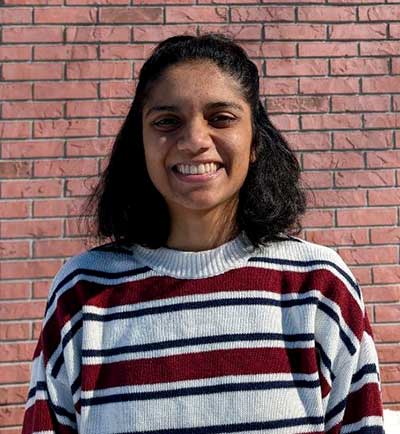
Kulkarni originally intended to come to the Boston campus, but after a fortuitous call with a graduate enrollment officer, she opted for Portland instead. Part of what drew her there was Data for Social Good, a student-led group that uses data-based solutions to address societal problems, particularly in collaboration with nonprofits across Maine.
It wasn’t long before Kulkarni became an events coordinator in the group.
“I was very excited to join the group as soon as I could. The first project I did with them was with Shared Animals Count,” says Kulkarni, referring to a nonprofit that collects and analyzes data on animal shelters. “It was amazing … I got to work with Docker, create a forecasting model for resource allocation in animal shelters, and get feedback from the clients. I also got to work with Jim Sheldon who was an amazing team lead and a great cloud computing professor.”
Kulkarni eventually became a sustainability ambassador at Northeastern, which helped her work with Maine Audubon and Portland Parks Conservancy. During one of these collaborations, she learned about the Animal Refuge League of Greater Portland. With support from her manager, she started volunteering there and continues to do so. During her tenure as an ambassador, she helped Roux staff members Terra Dunham and Cait Enz found Roux Interest in Sustainability and Environment (RISE), a student group that organized community cleanups in collaboration with local partners in Portland.
“I got to be part of conversations surrounding waste management pipelines on campus, and I led a few cleanups, which is how I got in touch with community organizations and some very helpful Portland park rangers,” Kulkarni says.
Kulkarni and RISE also worked with Greater Portland Metro, the largest public transit system in Maine, to promote the use of community transport by giving free bus passes to staff and faculty at Northeastern.
“I was also taking a computer vision course during my last semester with Professor Ryan Bockmon,” Kulkarni says. “His course and encouragement from my advisor Michaela Gill helped me create a trash classification app designed to reduce contamination in our campus’s trash bins.”
Despite her lengthy resume, Kulkarni is modest about her motivation to do this kind of work.
“It’s good stress relief for me,” she says. “It just feels good to be busy doing something that I’m passionate about and maybe helps somebody in the process.”
Kulkarni’s numerous experiences with nonprofits, as well as in more traditional corporate settings, have given her a broad skill set, and each environment comes with its own set of challenges and rewards.
“I find that whenever I work with nonprofits, I feel much better after I complete a task or a project, probably because I can usually directly see the impact of my work. But it can definitely come with its challenges as there might be more hoops you have to jump through,” she explains.
During her master’s program, Kulkarni did a co-op with ATX Advisory Services, becoming the Maine-based business consultancy group’s first ever co-op. Her experience with Data for Social Good aligned with the company’s needs and, after graduating in December 2025, she took a full-time job with the company. She’s enjoying her position but says she still has a lot to learn.
“I think communication has been a big, big learning curve, and working with a bigger team definitely has its own challenges, but they’re very patient with me,” Kulkarni says. “Everyone has been incredibly helpful and generous with their time whenever I have had questions.”
Kulkarni is just getting started in this new phase of her career, and she is excited to see what the future holds.
The Khoury Network: Be in the know
Subscribe now to our monthly newsletter for the latest stories and achievements of our students and faculty
Author: Benjamin Hosking
Date: 06.01.26
Although there have been many studies on the impact of generative AI in K–12 settings, there has been little focus on the ways that AI impacts rural educational settings. Most studies have focused on urban areas or did not describe a setting at all. This has left the unique challenges faced by rural educators out of the conversation on responsible AI policy.
Khoury PhD student Shira Michel and Assistant Professor Mahsan Nourani set out to bridge this gap in human–computer interaction research. Michel, who grew up in rural Pennsylvania, saw her community grapple with educational challenges distinct from those in urban centers. Her family home had no cell service and stable internet access was hard to find.
“There’s an assumption that students across all geographical regions have stability of internet access and can afford subscription costs,” Michel said. “I want to shed light on communities that are underserved. It’s informed by my journey in grad school as a first-generation college student from a low-income rural background.”
Nourani focuses on human-centered and responsible AI. She and her team study how people interact with AI systems personally and within society. They form part of the larger Khoury Vis Lab, a global community of human-centered computing researchers that studies ways to visualize data and build interfaces and visualizations for AI systems.
Michel and Nourani’s study, “Amplifying Rural Educators’ Perspectives: A Qualitative Study on the Impacts of Generative AI in Rural U.S. High Schools,” was presented at CHI 2026. Through surveys and interviews of 31 rural high school educators in Arizona, Maine, and North Carolina, Michel and Nourani found that while some educators use generative AI tools to streamline their work, they face infrastructural barriers, values-driven resistance to adoption, and a lack of access for responsible AI literacy training.
READ: For third straight year, Khoury researchers set new publishing benchmark at CHI
These hurdles became evident immediately as the researchers struggled to find K–12 partners for the study. Rural educators are not online as often and have less established connections with universities; even the definition of “rural” is hard to pin down. The researchers relied on word of mouth to connect with many participants, as well as the outreach of their partners: Ed Finn at Arizona State University, plus Joseph Wiggins, Benjamin Taylor, and Sabrina Parra Diaz at Katabasis — a nonprofit helping low-income children access educational resources.
Katabasis had already worked with rural communities in North Carolina in their mission to connect rural students with technology. ASU helped recruit in Arizona. Nourani and Michel, based in Portland at Northeastern’s Roux Institute, focused on Maine recruitment with help from the Maine Mathematics and Science Alliance.
An initial survey asked questions such as how classrooms changed after the advent of generative AI, whether the educators know what AI was, what their day-to-day tasks were, and how they used AI for those tasks. Nourani and Michel conducted in-depth follow-up interviews with participants on Zoom, gauging their hopes for how AI could serve them and their students. The researchers found that most rural educators believe AI should be reserved for educators only, with a potential for AI to fill gaps and provide complimentary expertise that would otherwise be out of reach due to financial or regional constraints.
“We wanted to hear from educators themselves as people being impacted by these tools, rather than developers and designers,” Nourani said. “Rural educators are not always at the table for policymaking. We need to seek out and bring them into the conversation. In the past three years, every time I’ve met an educator from rural or under-resourced districts in Maine, they were extremely passionate to chat about AI and to be heard. This has always been so inspiring to me and a testament to why we need to support equitable access across the board.”
Nourani notes several challenges she faces as a person trying to use AI and get ideas from a chatbot, even as an expert. Is she good enough to use it? Is she too reliant on the system to write on her own? Rural users, who may be less tech savvy due to having less exposure to these new tools, could struggle even more.
Generative AI has advanced quickly, especially since 2023 when Nourani finished her own PhD. Many human-centered researchers like her are still trying to catch up to the hype, study how to design and deploy these models responsibly, and understand how they impact communities, society, and marginalized groups.
“This research is slow and takes time, and cannot respond to the ever-growing demand,” Nourani said.
Michel sees AI bringing a sense of immediacy and urgency to technology that schools are not used to, and in doing so, it requires a new form of literacy for urban and rural educators alike. Companies building these tools assume schools can easily adopt and use them, but this would require educators to teach students AI literacy when many educators lack the training, knowledge, or confidence to do so.
Rural schools also face distinct challenges such as teacher shortages, especially in science, technology, engineering, and mathematics fields. Overstretched and overworked, teachers are sometimes the only science teacher in a school district, or they may teach across multiple grades and difficulty levels. Schools often prioritize agricultural and experiential learning and don’t yet see value in incorporating AI into career preparation. A lack of standards and policies for AI in K–12 settings leaves schools uncertain about how and whether AI belongs in the classroom at all.
“My personal experience is seeing a lot of people whose traditional path isn’t to higher education,” Michel said. “They stay close by. That path is just as valid, and high school must prepare students for all of it, including AI. AI has already shown itself to be very transformative, but we must be careful of its limitations and trust our own judgment on when and how we use it.”
Michel took a qualitative, thematic approach to the work and relied on critical rural theory, which examines the societal view of rural areas as less desirable than urban and suburban areas. She sees how the conversation they started with rural educators can be expanded beyond those settings to other marginalized populations.
“[Michel] is a brilliant junior researcher,” Nourani said. “What makes her special is how she deeply cares about equity and responsible AI that is democratized across different communities, especially those that are often overlooked.”
“We want to reach out to other communities,” Michel added. “We want to reimagine what good and responsible AI tools look like and give communities a platform to show how they can meaningfully apply it in their settings. When communities are supported and involved in the process, that is when AI can be shaped by users that work for them, instead of given to them.”
The Khoury Network: Be in the know
Subscribe now to our monthly newsletter for the latest stories and achievements of our students and faculty