Author: Madelaine Millar
Date: 03.11.22
In 1922, 14-year-old Leonard Thompson became the first person to receive insulin as a treatment for diabetes. Since then, diabetes has gone from a death sentence to a part of daily life, thanks to rapidly advancing insulin management technology like the Omnipod from medical device maker Insulet. Diabetes is still a serious chronic disease, for some patients even deadly, so any changes to the design of Insulet’s stick-on insulin pump must be carefully tested. That’s where Khoury co-ops like Michael Ruberto come in.
Insulet, located in the Boston area, is a prolific employer of Northeastern co-ops; it even won an employer award from the College of Engineering in 2020. Ruberto—a CS major with a concentration in AI who is set to graduate in 2023—was the first person, though, to fill Insulet’s software test automation co-op position, in the spring of 2021. His experience working on medical devices as part of a small team solidified his interest in the industry, and the tests he helped to build are still helping to ensure the safety of people with diabetes worldwide.
As a software test automation co-op, Ruberto’s day-to-day job mostly involved modifying the Python framework that Insulet uses to run unit tests on the pods’ software and then running those tests. He also had some more autonomous projects, like when he learned to use Android Debug Bridge, a platform to write software and tests for apps on the Personal Diabetes Manager (PDM), an Android device that wirelessly controls how much insulin the Omnipod pump delivers.
“I had to spend a lot of time researching and trying to brush up on that technology, so the experience for me was really enlightening about what it’s like to learn something on the job as opposed to in a classroom environment,” said Ruberto.
College of Engineering student Alec Warren had an embedded software engineering position with Insulet in Fall 2021. He agreed that working at the company allowed for a lot of autonomy. He spent his six months developing a new microcontroller to be used for internal testing, and he managed to get the tool functioning, though not finished, by the end of his co-op.
“(Working on the microcontroller) reawakened my passion for embedded software engineering and working with circuits,” said Warren. “It definitely showed me that I don’t really want to work in front-end design, because it’s just not nearly as fun or fulfilling as what I was doing.”
While technical competency was important to both co-ops’ success, the soft skills they built in their Khoury classes was what nabbed the job. Ruberto found his experience pair programming for courses like Fundamentals of Computer Science 1 and 2 (CS 2500 and CS 2510) gave him a big leg up in learning to work with his small test automation team. His supervisor Wyman Washington was even more impressed with his eagerness to learn.
“From the outset, I really enjoyed that Michael asked a lot of questions. He wasn’t afraid to admit something when he didn’t know,” said Washington, a senior staff software engineer at Insulet. Had Ruberto wanted to do another co-op at Insulet, Washington “would have loved to have him back.”
While he didn’t end up going back, Ruberto’s experience developing tests for the Omnipod software solidified his desire to work in the medical device industry. It has also pushed him to seek out more opportunities to work on small teams like Washington’s. He’s currently doing his second co-op at Remix Therapeutics, which develops small molecule therapies designed to reprogram RNA processing.
“Part of what drew me to (Remix Theraputics) is the team I was working in at Insulet was very tight knit,” said Ruberto. “That showed me I did really enjoy that environment and working in a small group.”
The work Ruberto did at Insulet has had an impact even after he’s gone. One hundred years after the first successful diabetes treatment with insulin, the testing Ruberto developed using Android Debug Bridge is still ensuring the quality of the pods used by a quarter of a million people, including Khoury News’ own Jane Kokernak, senior communications advisor at the college. She remarked the her Omnipod insulin pump system does more than sustain life: “Its simple design and reliability give me peace of mind when it comes to my diabetes.”
Ruberto encouraged other Khoury College students to apply to the software test automation co-op at Insulet, particularly if they prefer to work collaboratively.
“I really enjoyed (Insulet), and I would definitely recommend working there,” said Ruberto. “Everybody who I worked with there was great to work with, and it was a really supportive environment.”
The Khoury Network: Be in the know
Subscribe now to our monthly newsletter for the latest stories and achievements of our students and faculty
Author: Aditi Peyush
Date: 03.09.22
Artificial intelligence, or AI, takes the stage in contemporary discourse on technological solutions to pressing problems. Developments in AI have simplified everyday life, like unlocking a phone with Face ID, editing with Grammarly, or searching the web with Google.
However, there are limitations to AI. Issues—such as bias and exclusion—arise as a result of the implementation and use of these systems.
Founded in 2016, the Cybersecurity and Privacy Institute at Northeastern University (CPI) is leading the charge to understand the impacts of AI and other emerging technologies. The institute is made up of researchers from Khoury College of Computer Sciences and the School of Law who collaborate with leading universities, tech companies, and defense contractors.
READ: Collision Conference 2021: Khoury faculty on ethical and responsible AI
Recently, the CPI welcomed a new member to their team. Meet Amba Kak, senior research fellow at the CPI, who is also currently senior advisor on AI at the Federal Trade Commission (FTC).
Kak joined the CPI from her role as the director of global policy at AI Now, a research institute affiliated with New York University. At AI Now, Kak designed, developed, and executed the institute’s globally-oriented policy research agenda that focused on algorithmic accountability. And at the FTC, as senior advisor on AI, Kak is working with the agency’s chief technology officer and technologists as part of an informal AI strategy group. Kak also partners with policy experts across the agency to provide insight and advice on emerging technology issues.
Kak’s passion to translate scholarly research to policy action led her to the CPI. She called the CPI “an interdisciplinary community of researchers who are motivated to find policy windows for their research.” Intentionally using the word “windows,” Kak continued, “I really like that metaphor because it gets at those pivotal opportunities for translating bold ideas into action that may not have been visible—or at all possible—before.”
Merging the worlds of law and social technology
How did Kak find herself in tech policy? Back in law school, Kak was drawn to a course around internet regulation. Reminiscing, Kak said, “In a sea of decade-old statute and settled precedent, it was so motivating to learn about a field where the legal questions were mostly open. In fact, there was no consensus on the pre-legal normative question of ‘what type of futures do we want in the first place?’”
Kak didn’t stop there. She went on to study at the University of Oxford as a Rhodes Scholar, where she pursued advanced degrees in both law and the social science of the internet. On the latter degree, Kak explained, “I think legal training gives you a specific set of skills […], but I also think it can limit your lens and imagination in some ways. At the Oxford Internet Institute, I got to expand the tools of analysis I applied to any particular issue. That kind of interdisciplinary lens is especially valuable in this field.”
At the Oxford Internet Institute, Kak wrote her master’s thesis on zero-rated plans. These plans, like Meta Connectivity’s Free Basics, offer access to a restricted selection of websites for users without a data plan or at reduced rates. These plans sparked a policy debate about net neutrality and gave Kak a policy window for her research, she explained, “On one hand, people said, ‘Everyone’s going to get stuck in the walled garden, they’re going to think that Facebook is the internet.’ On the other hand, people said, ‘Some internet is better than none.’” The ethnographic research that Kak conducted served as a reminder that “policy debates can often result in pitting abstract theoretical propositions against each other. I learned the value centering research around the communities that are directly impacted by these developments—and to always leave room to develop and adjust our arguments to those learnings.”
Ensuring accountability in AI
AI is the future, or so we’ve been told. Kak challenges this platitude by drawing attention to the bigger picture. “The futuristic rhetoric on AI can be a bit of a distraction. AI systems are intertwined with systemic and historical inequities, and using these systems in social contexts can disguise or obscure these larger issues.” Continuing, she said, “There’s also a fair amount of tech-solutionism in the field, as if there’s no problem that AI can’t fix—whether it’s poverty or mental health. It makes you wonder if AI is a solution in search of a problem.”
As a policy researcher focusing on technology regulation, one of her goals is to remind different audiences that these technologies are not immune to scrutiny. Kak said, “Many interested parties will project that technology trajectories are inevitable, so as an antidote we need to emphasize and remind people that technology must work for people and not the other way around.”
Why does accountability take the stage in the discussion of AI? Kak argues that it’s because the stakes are high. “AI systems—whether they’re used in private or public contexts—are having real, material impacts on people. They’re affecting their access and the quality of basic opportunities, services, and benefits,” she argued.
Joining the CPI and advocating for fair technology
At the CPI, Kak finds herself among distinguished computer scientists who design and analyze complex systems. She’s excited to use this research to inform policy and understand what systems need to be put in place to prevent abuse of these technologies.
As she joins the team, Kak is “personally excited to learn from and grow with this community.” Between the FTC and the CPI, she’s got her hands full—but Kak continues to roll up her sleeves.
The unanswered questions and potential policy solutions drive her research and advocacy efforts. She explained, “I think we’ve moved in the last decade from abstract questions about AI ethics to ‘the moment for action is now.’ How can we practically hold companies and other actors accountable for their use of technology?”
Her advice to technologists? “To have a healthy amount of skepticism and humility about what tech can change on its own—divorced from broader social context and histories.” This means making room for other kinds of expertise and knowledge. She concluded, “I think we need more technologists to cede space for broader forms of expertise and deliberate over the impacts of technologies before—not after—they are developed.”
The Khoury Network: Be in the know
Subscribe now to our monthly newsletter for the latest stories and achievements of our students and faculty
Author: Tracy Miller Geary
Date: 03.07.22
Northeastern students are known for their remarkable ideas, but outside of the classroom it can be challenging to scramble for resources to bring their ideas to fruition. Based on his own experiences as a student at the Khoury College of Computer Sciences, alumnus Chris Jelly (BSCS ’14) recognized the need for a dedicated fund to support students’ self-directed projects.
With this need in mind, Jelly created the Jelly Incubation Fund for Khoury College in 2017 with a $25,000 donation. He has characterized the fund’s purpose as “no-strings-attached cash grants to students with unique, self-directed ideas that are related to computer science in some way.” He views the fund as a conduit for compelling student ideas and projects.
Back when he was an undergraduate, Northeastern had funding opportunities for students outside of the classroom, such as IDEA and the Provost’s Award, but nothing that worked specifically the way the Jelly Fund works. “Lots of students want to build their own product or conduct research, so I wanted to create a fund that would be all-encompassing,” Jelly explained.
The fund is open to full-time Khoury College undergraduate students. In their proposals, which are assessed on the scope of the proposed idea and its relevance to both the college and the student applicants, they provide an outline of their project, including a budget, timeline, and a defined goal. Expenses typically covered by the fund include supplies, equipment, lab space, labor costs, or personal remuneration.
Collaborations with the Khoury College major gifts team and central university advancement, along with donations from parents, staff, and alumni of Northeastern, helped the Jelly Fund to award over $20,000 in project money in 2020 alone. Jelly also reached out and developed a partnership with Amazon’s Web Services (AWS) so that each grantee automatically receives an additional $5,000 in AWS credits via AWS Activate. These credits can be used for web services from infrastructure technologies like compute, storage, and databases–to emerging technologies, such as machine learning and artificial intelligence, data lakes and analytics, and Internet of Things.
Jelly is involved in the selection of recipients of the Jelly Fund, and he serves on the selection committee along with faculty, staff, and alumni. He credits Doreen Hodgkin, former associate dean of Khoury College, with the idea of having students apply to the fund instead of him personally selecting specific projects.
A showcase of funded student projects
One of the many fund recipients is Code4Community, a student-run organization dedicated to providing custom software solutions to local non-profits at no cost to them. The club partners with organizations needing software to increase their efficiency, scope, and ultimately their impact. (To learn more about Code4Community, go to c4cneu.com.)
Club president, data science major Floris Dobber, reported that Code4Community is immensely grateful for the financial support they’ve received. “The Jelly Fund donation has made it possible for us to provide our services to our partners at no cost. Their donation, and the associated AWS credits, covers all our development costs and allows us to use industry standard development environments,” he said.
Preston Rakovsky, a computer science and business major and another Jelly Fund recipient, has created an iOS app called “Food Flock,” which seeks to solve the age-old problem of where to go out to eat. “Users can swipe through a collection of these cards with their partner, until all individuals swipe right, or ‘match’, on the same restaurant,” Rakovsky explained. “Because of the Jelly Fund, we were able to host our app on cloud resources, purchase design assets and, once we go live, we will be able to use the remaining funding to market and advertise our app on various social media platforms.”
Full details on their project can be found at https://prestonr.xyz/papers/foodflock
Along with collaborators David Malakh and Daniel Guddemi, another recipient, Zachary Galeaz, explained that, while still a work-in-progress, his project CodeSprout is, at its core, an interactive e-catalog of programming projects. The design is full of specialized features and integrations that make it easy to engage and spark collaboration with peers in software development.
Galeaz, a computer science major, stressed that the support of the Jelly Fund has been essential to CodeSprout’s development. “We’ve used some of the AWS credits we were given to test out various platform configurations that we would have never been able to use as third-year college students, giving us experience with enterprise-level applications that you definitely wouldn’t get in a college class,” he said.
Positive effect on experiential learning
Student recipients of the funding are unanimously grateful to Chris Jelly and the Jelly Fund team. Khoury College leadership is grateful, too, for how the grants help bring student ideas to life.
“The Jelly Fund has made it possible to fuel our students’ entrepreneurial spirit and creativity while supporting their experiential learning goals and preparing them for the world of work. Khoury College and the students are grateful for Chris Jelly’s generosity and his ongoing support of our students,” said Ben Hescott, Khoury College teaching professor and associate dean of undergraduate education and experience.
There are plans to expand the fund and make more grants available to more students. Last year, Chris Jelly and Marina Moskowitz, who graduated from Northeastern in 2019 with a BS in computer science and entrepreneurship, created special Giving Day challenges: for every 100 gifts Khoury College received, Moskowitz made a $1,000 gift to the Khoury Dean’s Fund. Additionally, for every 250 gifts the college received, Jelly made a $5,000 gift to the Jelly Incubation Fund.
As significant as the Jelly Fund is with regards to financial support, the fund goes a long way as a positive motivator at a critical time in new project’s development. Galeaz stressed, “Just the simple fact that someone looked at our idea and decided it was good enough to fund has caused us to stick with the project.”
The Khoury Network: Be in the know
Subscribe now to our monthly newsletter for the latest stories and achievements of our students and faculty
Author: Kelly Chan
Date: 03.07.22
Last Friday, Carla Brodley, who serves as executive director of Northeastern University’s Center for Inclusive Computing as well as dean of inclusive computing, presented the results of a paper titled “Broadening Participation in Computing via Ubiquitous Combined Majors (CS+X)” at the 53rd SIGCSE Technical Symposium. The forum, held this year in Providence, R.I., is an opportunity for educators and researchers to display new work in analyzing computing programs and their curricula.
The paper, co-authored by Benjamin J. Hescott, Jessica Biron, Ali Ressing, Melissa Peikin, Sarah Maravetz, and Alan Mislove, studied how pursuing two disciplines in one of Khoury College’s combined majors impacted student interest as compared to studying one computing major.
“The idea of combined majors with computing, data science, and cybersecurity is that computing is relevant to every discipline, and the ability to combine it with another area increases what you can do in that other area,” Brodley said. “For example, someone who does journalism and computer science has more careers that they can pursue, in addition to just doing journalism or just working at a tech company—such as becoming a journalist who writes about tech or helping create the software that customizes news feeds for consumers.”
Their most significant finding was that having combined majors was a driving factor in the growth of women’s representation in computing majors at Northeastern.
Northeastern University currently offers 42 combined majors that include one of Khoury College’s main computing disciplines: computer science, cybersecurity, or data science. Of those, 29 have been created in the last seven years with the goal of increasing gender diversity.
“We thought, ‘What if we combine majors that have been historically favored by people who identify as women? Then maybe we can change the demographics of computer science, while also creating the interdisciplinary thinkers that the world needs now,’” said Brodley, who initially joined Northeastern in 2014 as dean of Khoury College of Computer Sciences with this goal in mind. “And the results have been stunning.”
For Fall 2020, the research team found that 44.6% of Northeastern’s 2,800+ computing students are pursuing combined majors, and of that percentage, 39% are women. For the Fall 2021 incoming first-year students, women made up 46% of the students pursuing combined majors, while women were only 23% of those pursuing a non-combined computing major. These numbers surpass the 2020 IPEDS report that revealed only 21.5% of U.S. computing graduates that year were women.
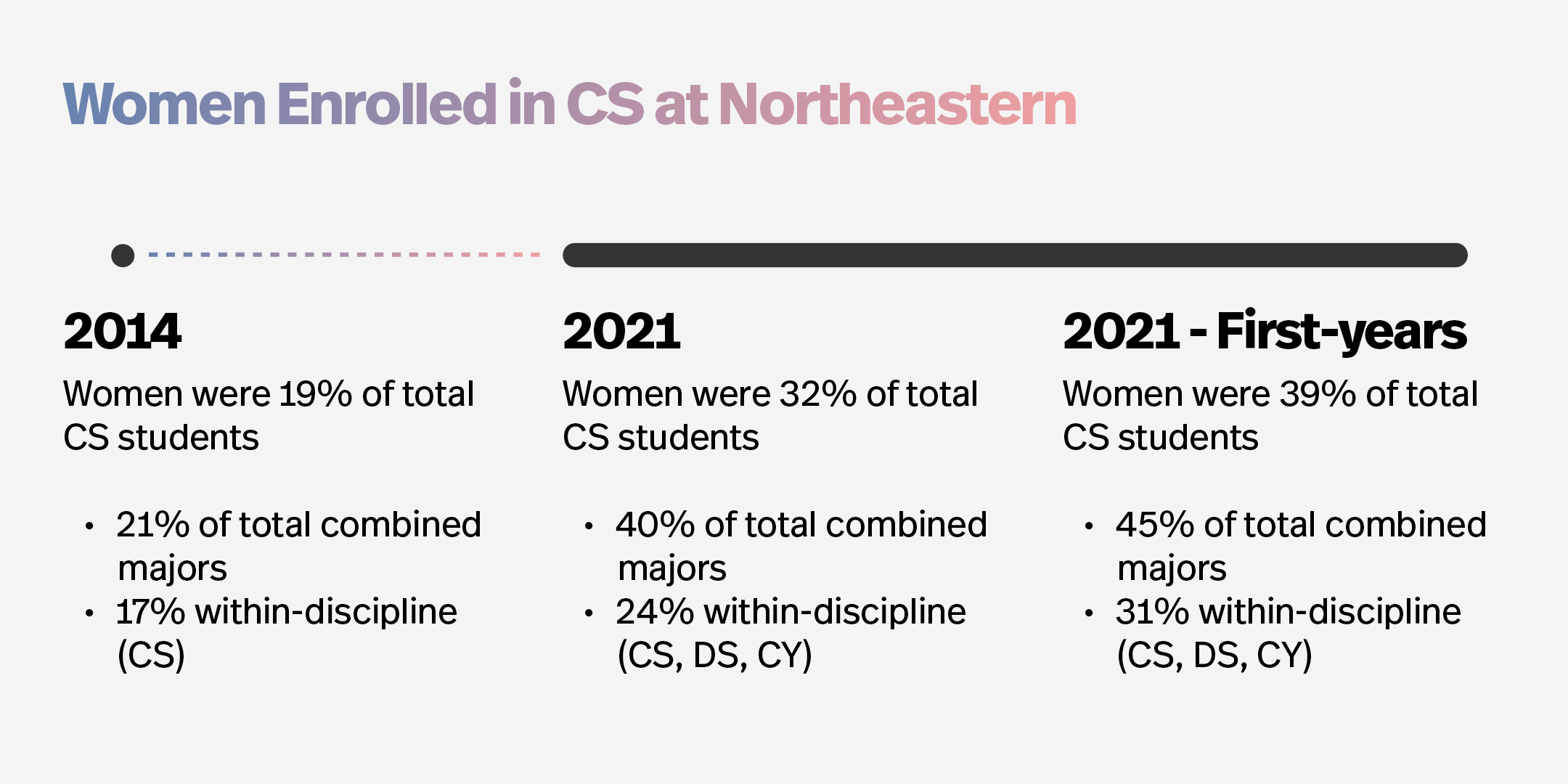
Brodley also noted that Northeastern did not “lean into” women applicants, as women make up approximately the same percentage of the incoming class as that of total applicants.
Overall, the goal of the paper is to expose other educators and people in academia to the benefits of interdisciplinary computer science and how it could improve gender diversity in their own programs. In addition to the formal paper presentation, Brodley hosted a “Birds of a Feather” discussion at the symposium with Professor Valerie Barr of Mount Holyoke to dive into interdisciplinary computing and how to implement it at other institutions. Close to 50 computing faculty attended the discussion with explicit interest in creating interdisciplinary majors at their own institutions.
“The goal was to write the paper in such a way that people could not only see the progress in diversifying computing by creating and scaling our combined majors,” Brodley said, “but also to lay out all the advantages, barriers, and considerations if you want to create one of your own.”
The Khoury Network: Be in the know
Subscribe now to our monthly newsletter for the latest stories and achievements of our students and faculty
Author: Milton Posner
Date: 02.16.22
Between the constant emails, Facebook-like features, and the stress of resumé comparisons, it’s easy to see LinkedIn as a chore. Faced with free time during the pandemic, and believing in the power of community and education, Urvin Desai saw educational potential in it.
Desai, now a master’s student at the Khoury College of Computer Sciences, embraced LinkedIn’s computer science community and its learners. By the time he arrived in Boston in September 2021, he’d spent months educating others through video lectures, collaborations, and interview sessions.
“It was all new,” Desai said. “I was a student teaching the public.”
Desai began his computer science journey several years ago, as an eager high schooler in India. He enjoyed it immediately, particularly because his professors began the instruction from scratch.
“It was something completely new,” he recalled. “Once you start, it doesn’t stop. It felt like home.”
After obtaining his undergraduate degree in computer science, Desai worked as a software developer at NTT Data Services, an IT service management company. But as he watched his colleagues and friends pivot to graduate studies, he decided to join them. A colleague turned him on to the idea of studying abroad, and Desai’s extensive research brought Northeastern into focus.
“I was interested, and I thought, ‘Why not dive deeper?’ This will help me learn a lot of things I won’t learn by working,” Desai said. “I saw the research that was going on, and co-op was the major highlight.”
Like many international admits in 2020, Desai faced pandemic-related visa holdups. He deferred his start date to September 2021 and plugged the gap with short-term internships.
Before then, Desai had used LinkedIn the same way most people do: he’d update his profile and that was about it.
“As soon as I deferred, I got time and thought, ‘Why not network?’” he remembered. “Instead of sending random annoying messages, I posted some technical and motivation-related things. People saw that and my followers increased.”
The student becomes the teacher
Networking can be its own goal, but Desai had bigger plans. During his time as a volunteer mentor at iNeuron—an AI-oriented product developer and education platform—he and his colleagues had taught computer science concepts in marathon video sessions to about one thousand students.
“I taught data and business analytics on weekends,” said Desai, who also did project work for iNeuron. “Even to people with 15 or 20 years of professional experience, I would teach them SQL, Power BI, Tableau, statistics, Python.”
Desai’s SQL lessons, totaling almost four hours of material, have garnered 22,000 views on YouTube since the spring of 2021. He also did two collaborative sessions with iNeuron founder Krish Naik, who clocks in at more than half a million YouTube subscribers.
The iNeuron students became a treasure trove of LinkedIn connections for Desai, whose profile now registers nearly 7,000 followers. In addition, he created a LinkedIn group for Northeastern students and reached out to his fellow incoming Huskies individually.
With his LinkedIn footprint large enough to attract speakers and an audience, Desai pivoted to one-on-one sessions—combination interviews and discussions—with industry professionals. The first was an hour-long session with Daliana Liu, an Amazon data scientist Desai had connected with on the website.
Desai and his speakers always have topics and questions in mind. But he also surveys his attendees ahead of time to hear what they are interested in hearing.
“If the topic is vague or the students aren’t interested in it, there is no use in doing it,” he explained. “After the session, I provided another survey asking what things I should improve. Because I’d never done this before.”
“It was quite weird,” he added, “but that experience helped me. I learned public speaking. I’m more confident talking to people now.”
His next session was with Mark Freeman, a data scientist at software company Humu. They discussed Freeman’s projects, searching and interviewing for data science jobs, and how to succeed in those jobs.
“He went from health care to being a data science student,” Desai said of Freeman. “So explaining his journey was really motivating to people from different backgrounds.”
WATCH: Data Science Talks with Urvin Desai (YouTube)
Initially, Desai would connect with people, get to know them and their work, and ask to hold a session once the friendship had formed. Now, he says, he doesn’t even need to ask.
“They come to me,” he said, citing the example of Lending Tree data analyst Eric Sims. “I like interacting with people, and when they reach out themselves, it feels great, like I’m on the right track.”
Lessons from industry and academia
Other things have gotten easier too. Desai’s arrival in Boston from India lessened the time zone challenges of coordinating with US-based speakers and attendees. After chatting with Khoury College’s Seattle-based Business and Outreach Director Mary Trimarco, Desai sent an official email about his sessions to Khoury’s current and incoming students. He also reached out individually to hundreds of students from other Northeastern colleges, aiming to build on the 100 or so attendees he’s gotten for each session so far (additional students ask for recordings later).
Throughout, he’s kept a consistent vision of who he wants to talk to and why, a vision strikingly reminiscent of the co-op ethos that attracted him to Northeastern. He wanted to supplement the academia-derived knowledge of Khoury College’s professors with the industry-derived knowledge of working professionals.
The session experience certainly helps Desai in another of his endeavors, as he is now a TA for the same Khoury College “Database Management Systems” course he took online while still in India. He forged a strong connection with his professor, Martin Schedlbauer, who encouraged him to apply.
“It’s good interacting with the students and getting to know their approaches and points of view,” Desai said of his TA role. “I enjoy talking with people and learning new things.”
These lessons ought to serve him well on his first co-op, which Desai plans to do this year ahead of an expected 2023 graduation. He’s interested in being a business or data analyst, one who blends marketing with the central theme of his instructional pursuits: explaining important concepts to interested parties.
Before the pandemic, he was just a student. When the pandemic hit, he became a teacher. Now, he gets to be both.
The Khoury Network: Be in the know
Subscribe now to our monthly newsletter for the latest stories and achievements of our students and faculty
Author: Kelly Chan
Date: 02.11.22
Alex Grob started his journey at Northeastern as a computer science student in 2013. After his 2017 graduation, he accepted a staff job at Khoury College of Computer Sciences. Recently, he was promoted to senior systems programmer and project manager for the college, where he works on software development projects to optimize processes for faculty, staff, and students. In this interview, Khoury News sat down with Grob to discuss his current role, his fascination with cyberlaw, and advice for current Khoury students who want to get involved on campus.
How did you come to work for Northeastern’s Khoury College?
In my last year as an undergrad, I was a TA for CS4500 and CS5500, and the professors I was TAing for said, “Hey, we could really use your help after you graduate. Would you want to work here?” And that’s how that happened. So I went from being a TA to doing this full-time, helping out with the course logistics and all the course technology needs. This became somewhat involved as I supported the course in providing the architecture needed for students to build applications that not only mimicked what they might encounter in the future career but also a place to showcase their skills. That has disappeared mostly now, as classes have changed.
Our interim dean, Alan Mislove, then approached me and asked if I was interested in helping out with the Khoury Admin Portal that he started building. Back then, two and a half years ago, it was mostly just course scheduling, but it started growing to TA hiring and a lot of faculty-related administrative work. It has just kept growing and growing, and that’s where we are today.
How have you grown as your role has evolved at Khoury College?
Working in a team is very different from working individually. I think that’s been the biggest growth for me — working on larger scale projects, but also on larger teams. It leads back to what I really liked while working with students [as a TA], which was seeing them grow. Now I see my co-op students grow, where they come in and obviously have little experience with what we’re doing. Then by the end of it, they’re very self-sufficient, and they can tackle anything at that point that we throw at them. They’ve been awesome that way, just seeing them grow from having only worked on small, contained class projects to a codebase that is used by a large population daily and the related maintenance tasks that come with supporting such an application.
I know you have also just finished your master’s degree in cybersecurity at Khoury College. How did you decide to pursue cybersecurity?
It’s been a long interest from when I was much younger and started cracking Windows passwords on my personal machine — nothing illegal. I just had a curiosity of how [computers] work and messing around with computers and seeing what happens. Back then, I would also read about large breaches in the news, and it’s just always concerning. How do these large companies lose data or get breached? How is that possible? Then I just started digging more into that.
I think what really kicked it off for me is when I was on co-op at State Street. My boss had extra training credits from a yearly training budget, and what really stood out to me was a course through EC-Council called ethical hacking (CEH).
A lot of it was focused on social engineering, as the weakest link in most organizations is just the human. You can social engineer people to give away passwords or leak data. That was really something that stuck with me because they were talking about how you counteract social engineering. How do you train people to see these things, like phishing emails or scam-type emails? How do you actually prevent people from clicking on them? Technology is constantly evolving, but the human element isn’t. With so much of our work world revolving around email, it’s just such a faucet to errors or breaches.
Within cybersecurity, you have a particular interest in cyberlaw. What is cyberlaw, and why did it interest you?
Cyberlaw in general is the laws and regulations concerning computer devices. How do we legislate to situations that we now have, like border searches of cell phones? During the start of the pandemic, I took Khoury College’s cyberlaw class where they talked about how we apply case law to new situations because there’s generally a lack of legislation that is specifically written for our current digital age.
What motivates me now with cyberlaw is that we’re in this era where there’s not a lot of legislation, at least not in the U.S. We rely on good faith from not only the government, but also companies that store data on you. Think of Facebook. Are they really making a good faith effort to keep your data safe? And on the flipside, should the government have all these rights to spy on you? There are arguments pro or against, but it raises questions like, who really needs your data? And how does your data differ from something that’s physically in your room versus digitally on your computer?
How does your passion for cybersecurity and cyberlaw play a role in your current job at Khoury?
I’m in a position to decide what data we store because I build applications. With that, I have to ask, “What data do we need — necessarily need — to do this function?” and “What data do we not need?” A lot of it is governed by rules and regulations, but I think there’s also just an ethical obligation not to store data you don’t need.
Thinking more along the lines of privacy, I see what data we really need to provide services to our faculty, staff, and students, and we err on the side of caution. We try to store the minimal amount of data possible, and I think that’s very important to us. We don’t store personalized things, and we limit [the data to] exactly to what the program that we’re building needs to do to ideally have the best security around.
What do you recommend for interested students to learn more about cybersecurity and cyberlaw, or to get involved on campus?
I personally enjoy reading from Ars Technica, which is a more generic tech blog, and I enjoy their high-quality reporting. Also, a big thing of what I keep an eye out for, which is really specific to my job, is Common Vulnerabilities and Exposures, or CVEs, which are just essentially reported issues in software.
There’s also a really cool student group, called NUCCDC, and they go to cybersecurity competitions. I have a few friends who are involved, and they always speak so highly about it. They learn skills that are hard to learn otherwise in the classroom because they’re hacking real things in a safe environment-type situation that is extremely hard to replicate in a classroom.
Also, I work with NU Sandbox, which is quite a large student club that works on projects for the university, third parties, and for the college. For Khoury, they mainly work on the Office Hours app. As an undergrad, I used to be a part of Northeastern’s ACM club, one of the main computer science associations, and they have weekly meetings where they have networking and speaker series to get people to connect.
Students should definitely get involved because a) it’s fun and b) you can make a difference. It doesn’t need to be a difference on an international scale. You can just make a difference in people’s lives around you, as big or as small as you want it to be. You can have a lot of impact with your software — that’s the beauty of computer science.
The Khoury Network: Be in the know
Subscribe now to our monthly newsletter for the latest stories and achievements of our students and faculty
Author: Kelly Chan and Sarah Olander
Date: 02.10.22
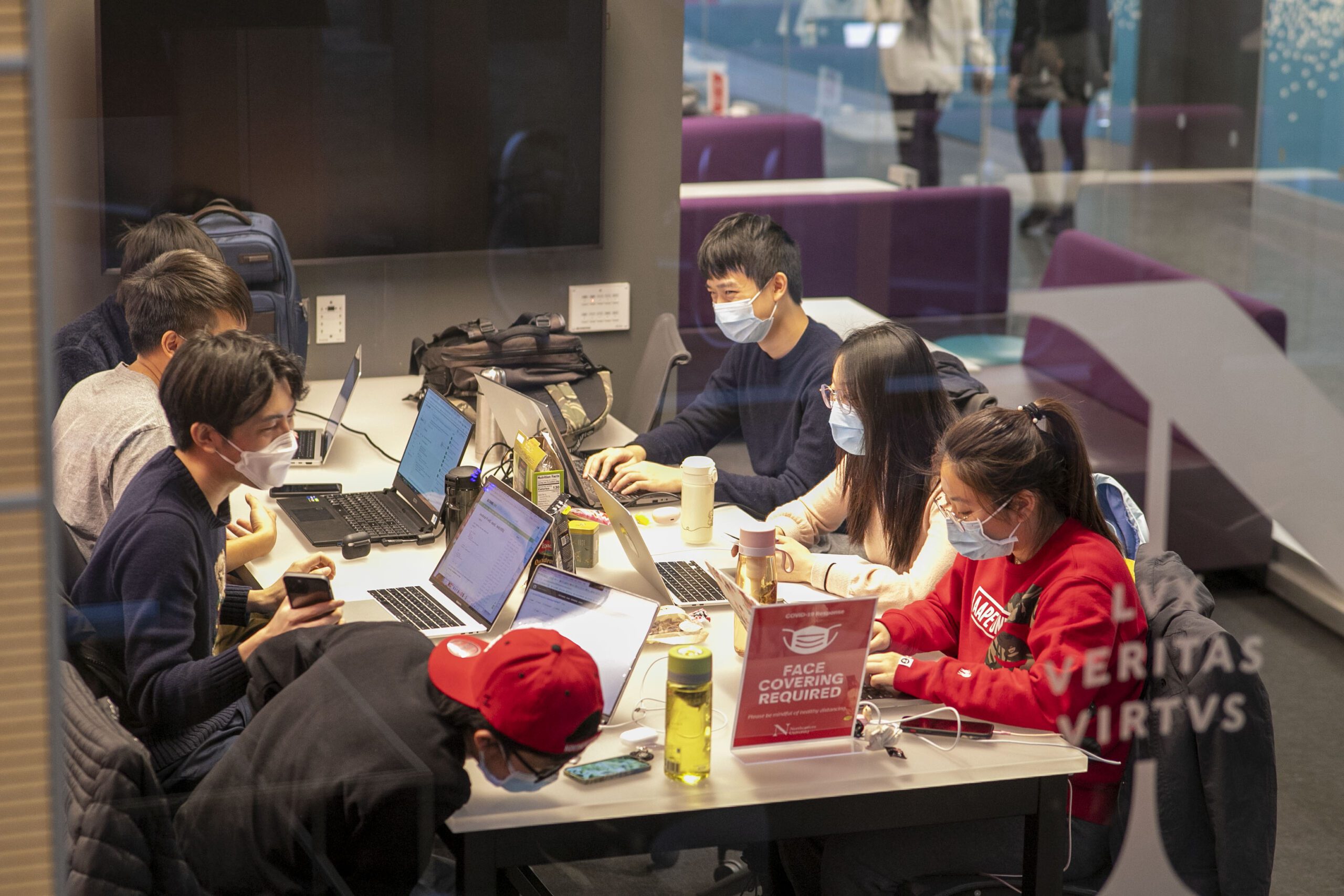
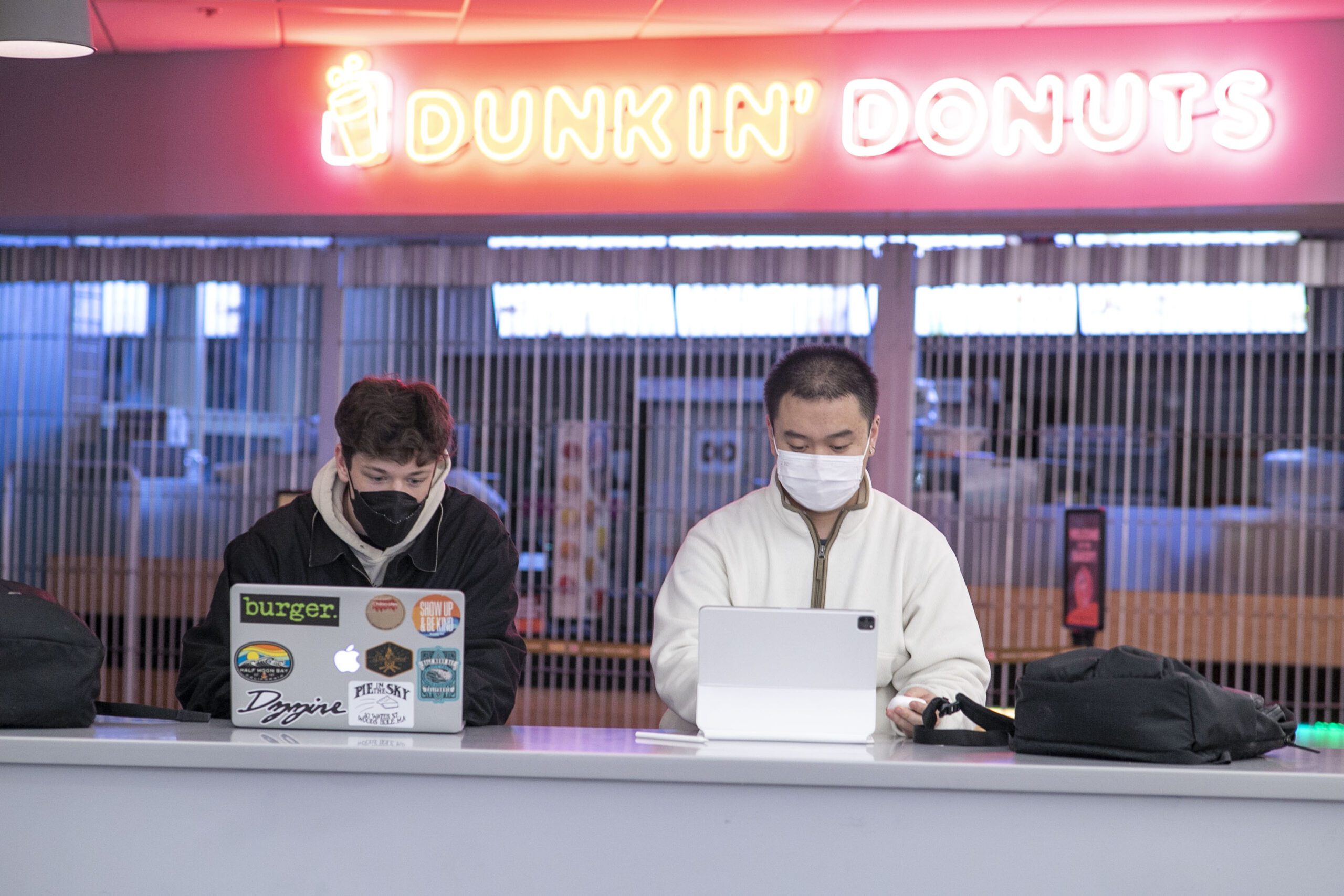
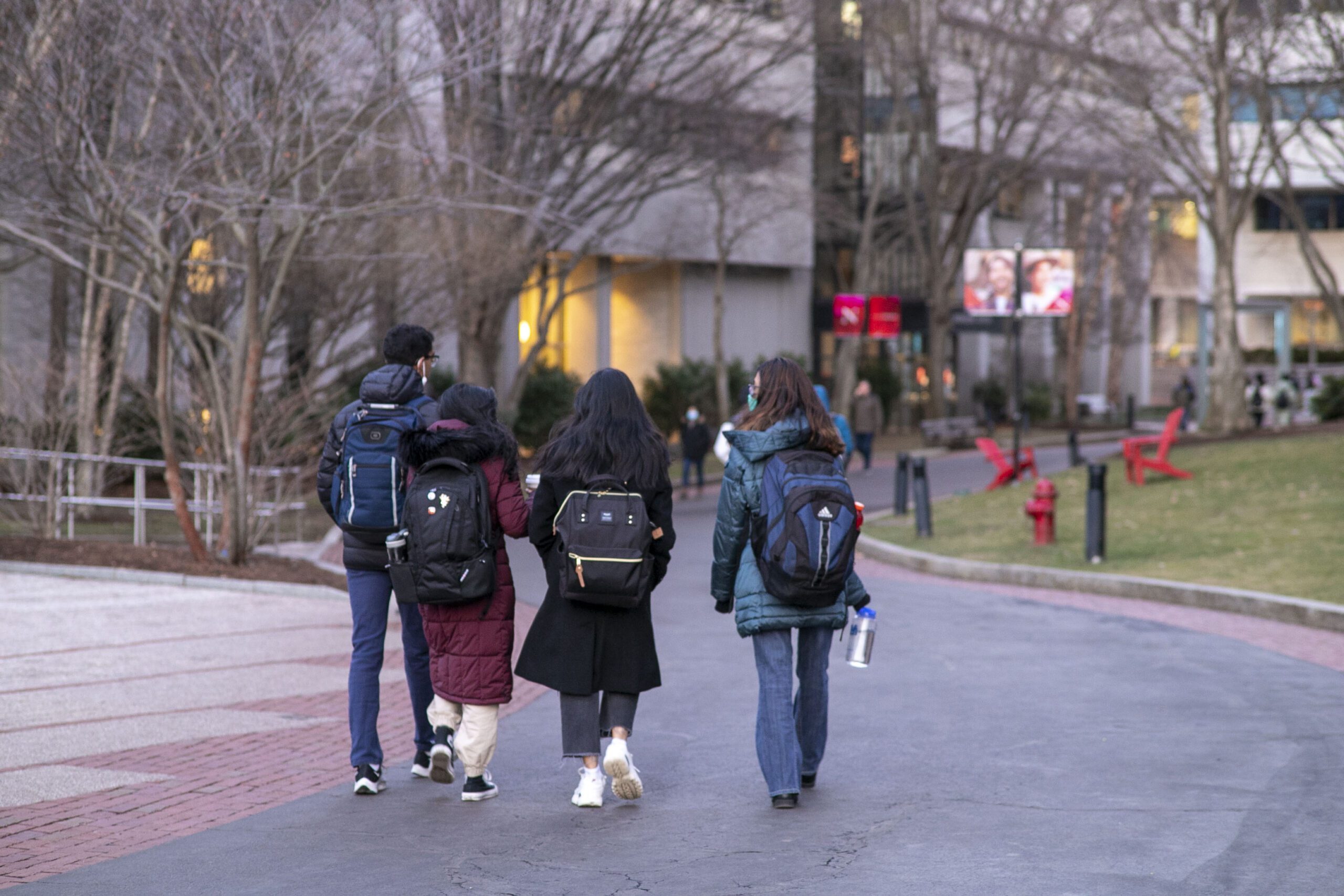
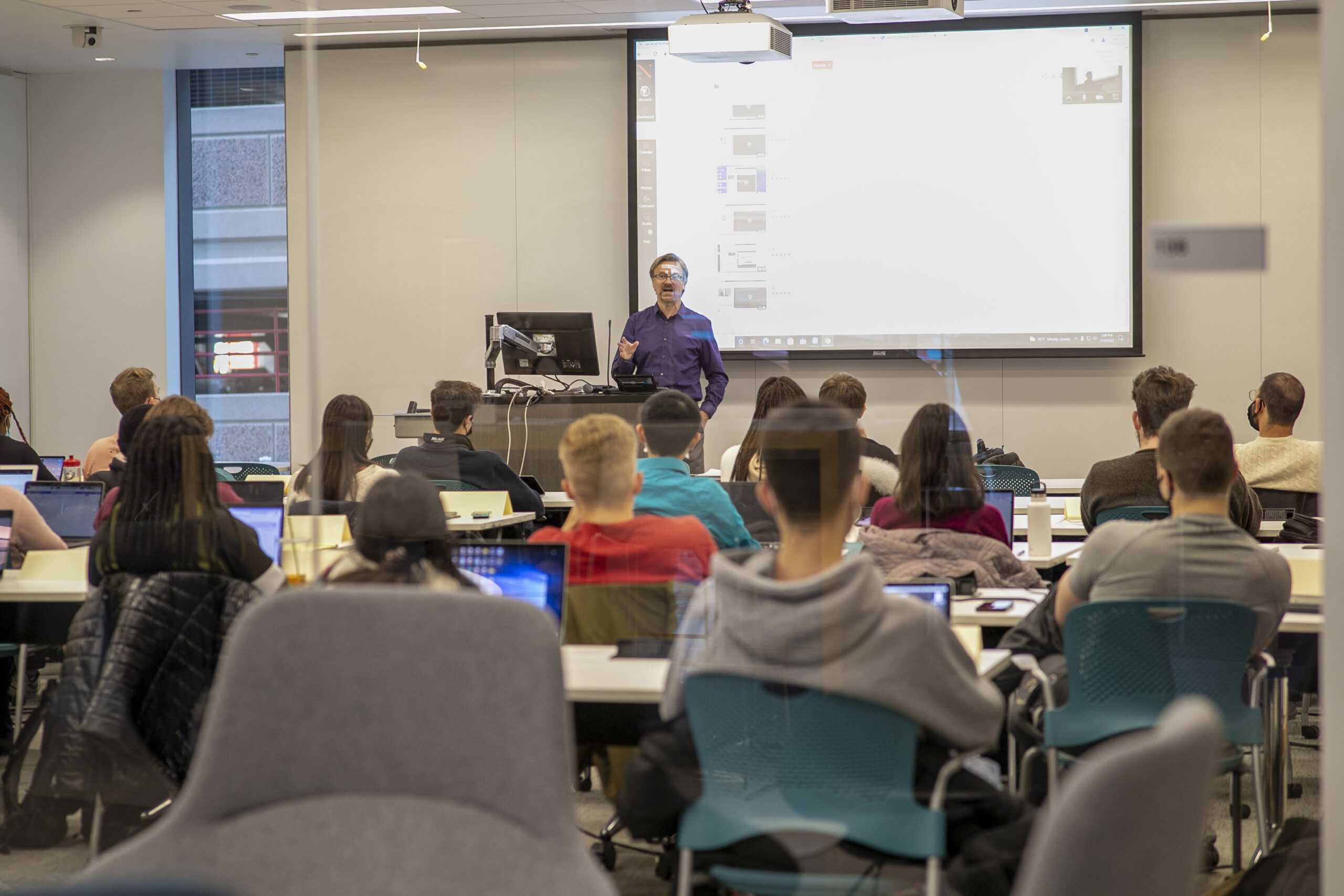
Two of our photographers, Northeastern students Kelly Chan and Sarah Olender, roved around campus during the first wintry weeks of the Spring 2022 semester, looking indoors and out to see familiar scenes and students in action. We first featured their photos on our Facebook and Instagram channels. Enjoy them again!





The Khoury Network: Be in the know
Subscribe now to our monthly newsletter for the latest stories and achievements of our students and faculty