Author: Milton Posner
Date: 05.27.22
Northeastern University’s 2021 graduation season proceeded in a way that any graduate would have found unbelievable when they first joined the university.
With the COVID-19 pandemic in full force, graduates commenced at Fenway Park with limited family attendance. The Khoury College of Computer Sciences, like many of Northeastern’s constituent schools, went virtual for its celebration, with graduates tuning in from across the world.
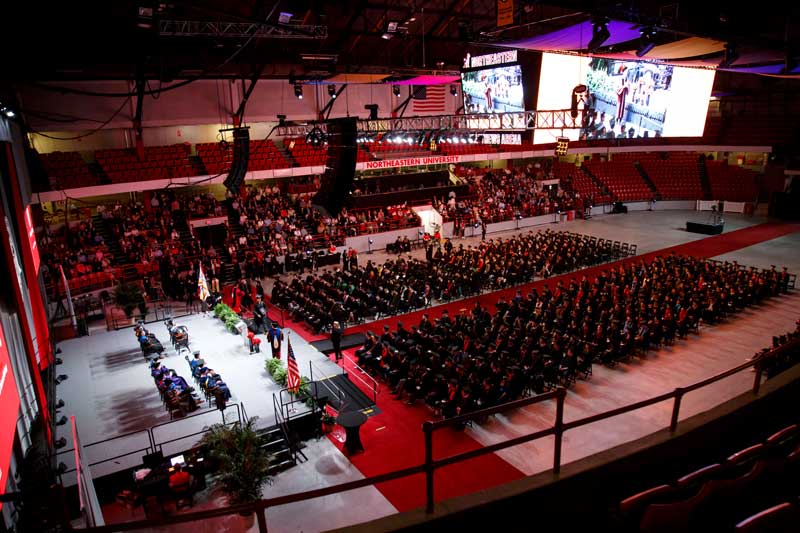
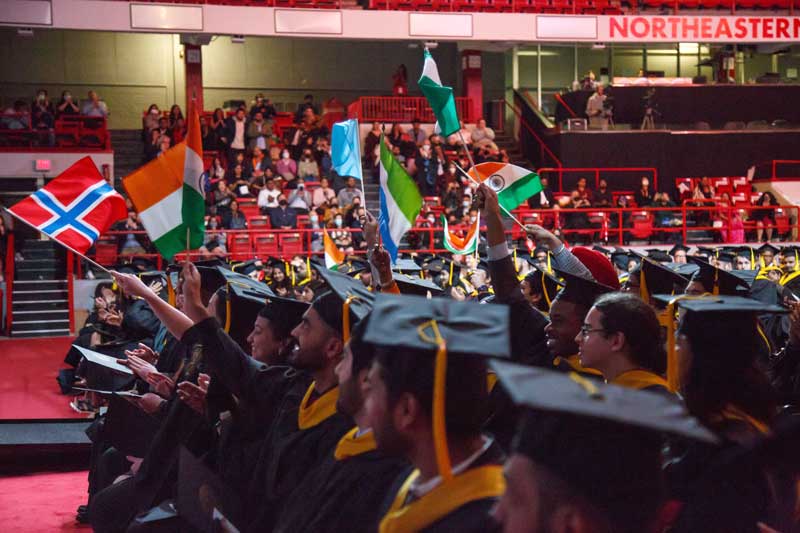
What a relief it was then, when Khoury College’s departing undergraduate and graduate students gathered on May 11, 2022 in a well-decorated Matthews Arena to celebrate themselves, each other, and the institution — in person this time.
The technical and the ethical
“I want to spend a few minutes talking about what comes next,” Dean Elizabeth Mynatt said in her first Khoury College commencement address. “Not just the immediate next — new job, new city — but how you build upon your Khoury foundation to launch your career and your life.”
Mynatt’s message mirrored her distinguished alumna address at North Carolina State University five years prior. It was one half cautionary tale about the dangers of irresponsibly wielded computer science, one half exhortation to the graduates to oppose bad actors.
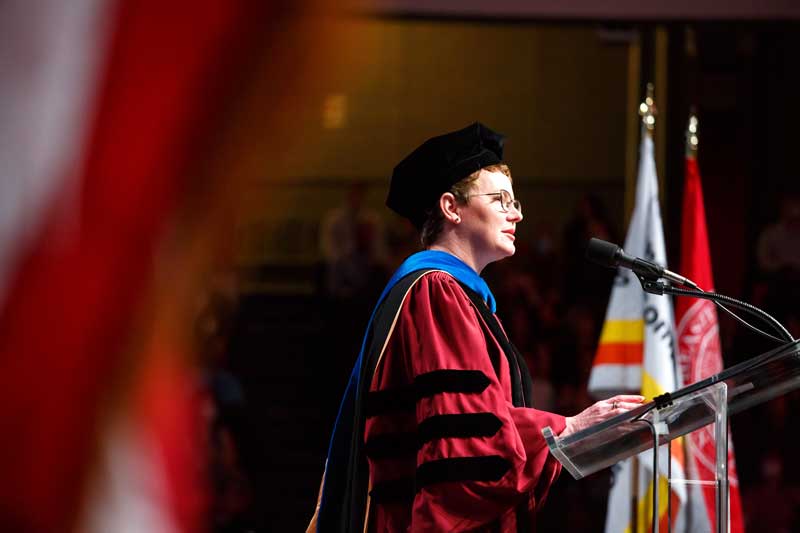
“Computing touches so many aspects of everyday life. It touches almost every industry, from health care to commerce to transportation to manufacturing and more,” Mynatt told the graduates. “Akin to engineering and bridge-building, we have a special obligation to safety and security, and these obligations are more important now than ever.”
Mynatt cited security breaches, data theft, cyber warfare, ransomware, and the mass collection and misuse of personal data — sometimes for discriminatory ends — as growing threats.
“Security is no longer a specialized obligation; it is now the job of every computer scientist,” she continued. “If security is our engineering obligation, then protecting privacy is our Hippocratic Oath.”
It was that comparison that prompted Mynatt to pen an oath she’d originally proposed in her NC State speech, one exploring the computer scientist’s obligation to their fellow humans given the field’s great capacity for benefit and harm. Each graduate received a take-home copy of the oath at their seat, and Mynatt recited it to conclude her address.
READ: Dean Mynatt proposes oath for computer scientists at Khoury College graduation
“My call to you is to be purposeful in your decisions,” Mynatt said. “Your values for how you serve society are your own. Just know that your profession calls you to integrate those values with your professional practice.”
From Netflix to Nairobi: The graduates weigh in
A pair of ceremonies requires a pair of student speakers and, in this case, a pair of extended metaphors.
Undergraduate speaker Gwen Friedman, a combined computer science and interaction design major, drew inspiration from her immediate future as a UI engineer at Netflix.
“Our Khoury experience has been a bit like bingeing a great show on Netflix,” she quipped. “It flew by, I have a hard time telling seasons apart, and it kept me up way too late staring at a screen. But we kept coming back semester after semester, wanting more.”
READ: Roommates, friends, and now graduation speakers
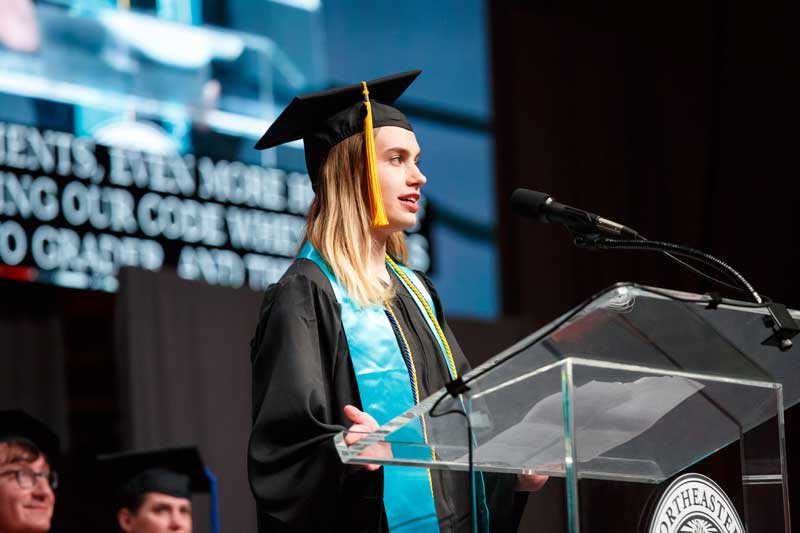
Co-ops were akin to sampling shows until you found a fit. Job searches mirrored a fervent search for your next favorite show. And friends and family inquiring, ‘Have you graduated yet?’ resembled Netflix asking ‘Are you still watching?’ during a late-night binge.
“All of us should be proud of what we have accomplished at Khoury College,” Friedman said. “The biggest, lasting impact we can have is nurturing these connections with each other. It’s always more fun to watch TV with friends. So out into the world we go, carrying these connections with us.”
While Friedman looked to her future for a parallel, graduate speaker Devina Raithatha looked to her past. She compared her Khoury College experience with her family’s safaris in Nairobi National Park, which juxtaposes expansive plains with the comforts of the nearby Kenyan capital where Raithatha grew up.
“Despite having gone on over 1,000 safaris in my lifetime, I can attest that nothing can prepare you for each unique experience,” Raithatha said. “Even if you take a familiar path, you won’t have the same experience. Each new juncture leads you to an unimaginable variation.”
She’d know better than most. After five years in Northeastern’s business administration program, Raithatha entered Align, Khoury College’s master’s program for students without computer science backgrounds. It was there that she found a similar sense of novelty and awe in a place she had already grown to call home.
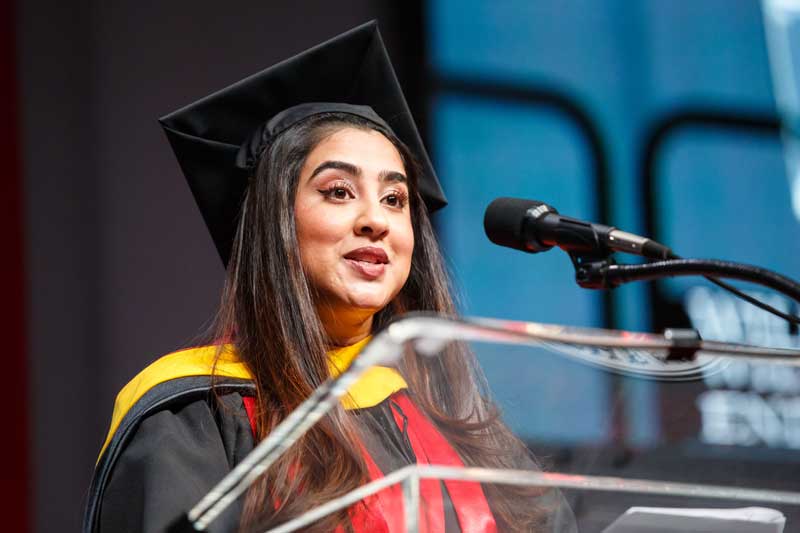
“Even though I had never written a single line of code in my undergraduate years, I asked myself, ‘How different can this be?’” Raithatha said. “Little did I know that no amount of preparation or anticipation would be enough.”
It was a safari all over again, only with a Khoury community of students, TAs, advisors, and faculty instead of her family. But this time, Raithatha understood that accepting whatever comes was the key to absorbing the most knowledge and having the most fun. The smorgasbord of titles she earned along the way — including president of the Graduate Women Coders, executive vice president of the Graduate Student Government, and ambassador for Women Who Empower — attest to the quality of the philosophy.
“I have learned the importance of navigating and pivoting during the journey, welcoming uncertainty, and celebrating the inevitable surprises along the way,” Raithatha said, before imploring her fellow graduates to continue building communities that are “nurturing, dynamic, and beneficial for all of us.”
WATCH: Khoury Class of 2022 Recognition Ceremony Video
Awards, degrees, and a send-off
A handful of Khoury College graduates walked away with more than just a diploma.
University honorees included undergraduate students Max Daniels (Hodgkinson Award) and Fiona McCrae (Compass Award), plus graduate students Josh Miller (Outstanding Graduate Student Award in Humanics), Everlyne Kimani (Outstanding Graduate Student Award in Research), and Devina Raithatha (Outstanding Graduate Student Award in Leadership). Raithatha also netted a Huntington 100 nomination, as did undergraduates Chloe Gold, Conner Nilsen, Dania Alnahdi, Harsh Sethia, Jaana Dominique Tabalon, Maitreyee Joshi, Margaret Morehead, Max Daniels, Rahul Suryadevara, and William Stenzel.
Khoury College handed out its own awards too, with Kevin Hui (Outstanding Co-op) and Jaana Dominique Tabalon (Khoury/CAMD Special Achievement for Combined Majors) joining a litany of peers:
| Award | Undergraduate | Graduate | PhD |
| Community Service | Ryan Drew | Rajwinder Singh | Alexi Turcotte |
| Teaching | Rahul Topper | Maria Clara Soares Bezerra | Benjamin Nye |
| Research | Xuyang Li | Ian Dardik | Lydia Zakynthinou |
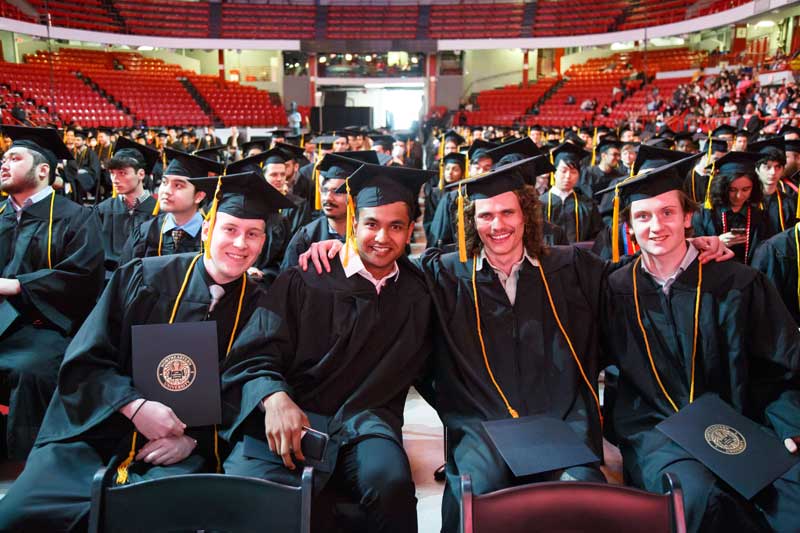
And after the candidates crossed the stage one by one in the world’s oldest hockey arena, Associate Dean Benjamin Hescott had the last word.
“Today you go forth as a Khoury graduate, a member of society with an obligation to use computer science to enhance society, to protect the dignity of our users, respect the privacy of all people, to make a positive impact on this world,” Hescott said. “Now let’s get to it.”
The Khoury Network: Be in the know
Subscribe now to our monthly newsletter for the latest stories and achievements of our students and faculty
Author: Milton Posner
Date: 05.17.22
It’s hard to reckon with just how quickly Wordle became universal. The game’s extended sphere now encompasses hundreds of different themes and languages.
Northeastern sports, however? Not nearly as universal.
“It is a bit of a niché interest,” said second-year Khoury College of Computer Sciences student and WRBB sportscaster Justin Diament. “We’re not the most sports-inclined school and we don’t have the largest fan base, but that means the people who are involved tend to be extra invested. They carry the support for the teams on their backs.”
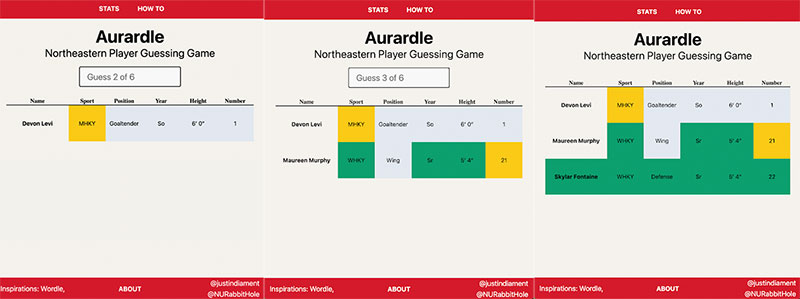
The ethos that turns observers into contributors is exemplified in Diament’s new project: Aurardle. Whereas Wordle users triangulate an unknown word through shaded letters, Aurardle users attempt to guess an unknown Northeastern athlete through shaded attributes: sport, position, year, height, and jersey number.
Diament was the best man on campus to design such a game. He had gravitated toward computer science at his pre-engineering high school, and he has always been passionate about sports.
“I’m an unfortunate Jets, Mets, and Knicks fan, and when you are, their history is one of the only things to latch onto,” Diament explained.
When he transitioned to Northeastern, his mother, aware of his passion for sports talk, suggested he check out the student radio station.
“At first I thought, ‘Well, I’ll be on some shows, talk some pro sports,’” Diament recalled. “But game broadcasting, especially for basketball, was far too enticing.”
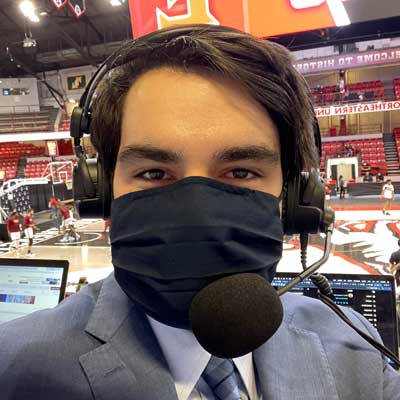
Diament dove straight in, rising to become WRBB’s lead men’s basketball play-by-play voice in the fall of 2021, adding web and technical director duties shortly thereafter, and being named the incoming sports director in early April.
In February, he created the Northeastern Sports Rabbit Hole, a Twitter page where he showcases nuggets from his deep dives through Northeastern sports history. It’s a way, he said, to satisfy his curiosity and document material that might otherwise remain tucked away on elusive old forums.
Then a new idea emerged. During a back and forth in the WRBB Sports Slack group about MLB- and NBA-themed Wordles, fellow broadcaster Daisy Roberts half-jokingly suggested a Wordle based on Northeastern sports. For the group, it wasn’t a serious notion.
“But then I thought, ‘I could probably make this,’” Diament said. “I figured I’d throw together a little Python script—nothing fancy or good-looking, but people could play it if they wanted.”
A night and a half later, Diament had a functioning game, albeit one that required users to download and run the script themselves.
“I got a lot of good feedback, and I thought, ‘I’ve been looking for a CS project, but haven’t been inspired by anything in particular,’” Diament said. “I figured I could convert it into a real, better-looking website that anyone could access without following lengthy download instructions. Once I started, I had to go through with it.”
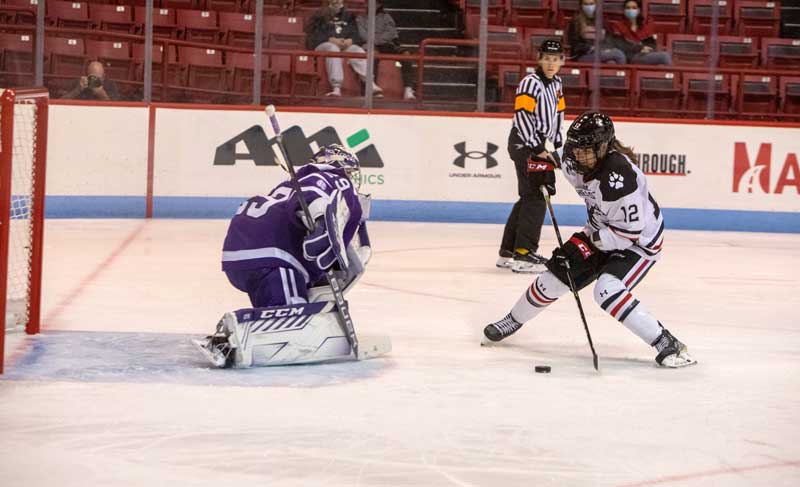
By this point, the project needed a name. While WARDle (for Northeastern women’s hockey forward Tessa Ward) was floated, it would mirror the MLB-themed WARdle, named for baseball’s Wins Above Replacement statistic. So Diament named it for Ward’s teammate, three-time Hockey East First Teamer Chloé Aurard (pronounced aw-RAR).
Next, Aurardle needed the appearance and front-end functionality to make it easy to share and play.
“I was hoping to keep some of the same logic, but I needed the game to run on the front end of the site,” Diament said. “Beyond a well-constructed list of the athletes and their attributes that I’d drawn up, it required a full rewrite.”
The road to these improvements ran through a number of programming languages and front-end development tools—HTML, CSS, JavaScript, Flask, jQuery—that Diament was inexperienced or unfamiliar with. To craft a site that operated smoothly, he learned those concepts on the fly through trial and error.
“It helped to have a whole fleet of WRBB Sports people play and bug test it, to do things you might not think to do when you’re the one setting it up,” Diament added. “It was great to get that feedback and diagnose those issues before sending it out.”
“I was afraid it wouldn’t look up to professional standards,” he continued. “Because if I was going to put this kind of time into it, I wanted it to look nice and play smoothly. I think I achieved that, and I was happy to see everybody enjoy it so much.”
There are still improvements Diament wants to make. For instance, the Aurardle window resets after the user leaves the page; he’d like it to return the user to their results if they visit the page after playing the game that day, as most other Wordle games do. Diament also plans to update the rosters yearly.
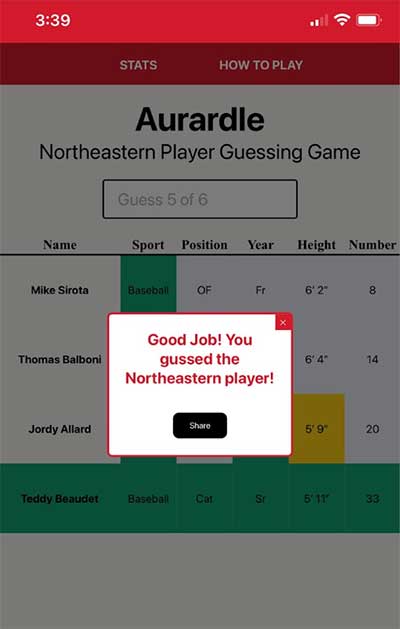
He may add new Northeastern teams as well, although he is cautious of making the game too difficult by expanding the athlete pool too far. The game currently includes the teams WRBB covers: baseball, men’s and women’s basketball, and men’s and women’s hockey.
For now though, he’s largely content with his first independent project.
“It’s always great to see people enjoying something that you made,” he said. “To create something that shows off that enjoyment of the teams was fun, and perhaps something to grow the space a little bit—to show that there are people who care about these teams, their success, and their history.”
Disclosure: The author and the subject are friends and former WRBB broadcast partners.
The Khoury Network: Be in the know
Subscribe now to our monthly newsletter for the latest stories and achievements of our students and faculty
Author: Paul Murphy
Date: 05.13.22
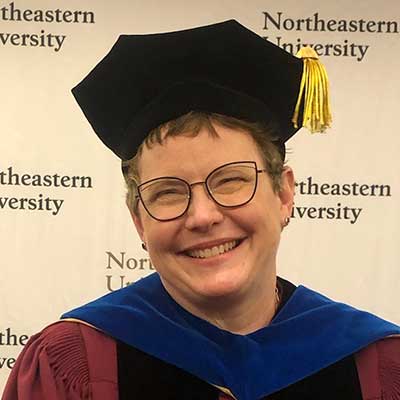
During her Khoury College Commencement Celebration speech on May 11, Dean Elizabeth Mynatt recognized the vital contributions computer scientists make to society—and the moral responsibility the work carries. That’s why she shared her vision of a computer science oath with the graduating class of 2022.
“Computing enables people to communicate and connect,” Mynatt told the graduates. “It steers the operations of planes, trains, and automobiles, as well as the news that you read and the items that you purchase. It enables medical diagnosis and treatment and so much more. And the decisions you make, whether you’re a startup entrepreneur or building enterprise systems for the largest international company, will impact the daily life experiences of humankind.”
Given the magnitude of this responsibility, Mynatt proposed a seven-point oath to guide graduates’ future work. She first conceived of the idea while addressing the graduating computer science class at North Carolina State University in 2017, then expounded on it in scholarly publications. It’s a recognition that unlike many other fields—medicine, finance, and business among them—computer science lacks a professional oath that graduates take upon entering the field.
Mynatt sees Khoury College taking the lead in further developing the oath, with the hope that one day computer science graduates everywhere will commit to its principles.
“Now more than ever, this oath is essential to guide the work we do on behalf of the larger society we serve,” Mynatt said.
The oath Mynatt shared:
Today, I join the ranks of computer scientists worldwide.
I will remember that I remain a member of society, with special obligations to all my fellow human beings.
I will design and build computing systems that enhance the quality of daily life for individuals and for society.
I will protect the dignity of users and others affected by computing systems, respecting the diversity of all cultures, and safeguarding against threats to health and safety.
I will respect the privacy and rights of all people and recognize the special role I have in judiciously collecting, storing and using their information, and creating systems that aim to shape their behavior.
I will work for fair wages; honorably guarding my reputation and my colleagues in our work practices, while respecting the intellectual contributions of others.
I will improve the public understanding of computing and its consequences.
May I always act so as to preserve the finest traditions of my field, and may I long experience the joy of inventing the future through my endeavors.
The Khoury Network: Be in the know
Subscribe now to our monthly newsletter for the latest stories and achievements of our students and faculty
Author: Paul Murphy
Date: 05.06.22
Ever since they received an email requesting applications for commencement speakers, Northeastern students Gwen Friedman and Victoria Napolitano knew they were interested.
“What if we spoke at Fenway together? That would be so much fun,” Friedman recalled.
While spending time in New Hampshire over winter break, the roommates of two years brainstormed ideas and crafted a preliminary draft focused on imposter syndrome, the feeling of doubting one’s abilities and accomplishments that women in STEM often experience.
Throughout the spring semester, Friedman and Napolitano workshopped their speech with family and friends, collaborating and gathering inspiration from one another. Hesitant about its direction and content, they ultimately did not submit their draft, and the deadline passed.
But the pair’s interest in sharing their stories remained. During spring break, the roommates found a second chance as the speech submission deadlines for their individual colleges quickly approached.
“While hiking in the Grand Canyon, Victoria and I made a pact.” said Friedman, who will graduate with a bachelor’s in computer science and design. “Why not? I’ll do it if you do it.”
In just a couple of days, the two students pulled ideas from their original work and finalized two new speeches. Both wanted to share stories and lessons that connected to their particular college. Friedman’s, for instance, discusses the importance of a support network during her time at Khoury College and how that network will factor in as the students become alumni.
“We were sitting in our living room when we got separate emails from Khoury College and the College of Engineering that our speeches were chosen. We screamed out loud,” laughed Napolitano, who will graduate with a bachelor’s in mechanical engineering and a master’s in engineering management.
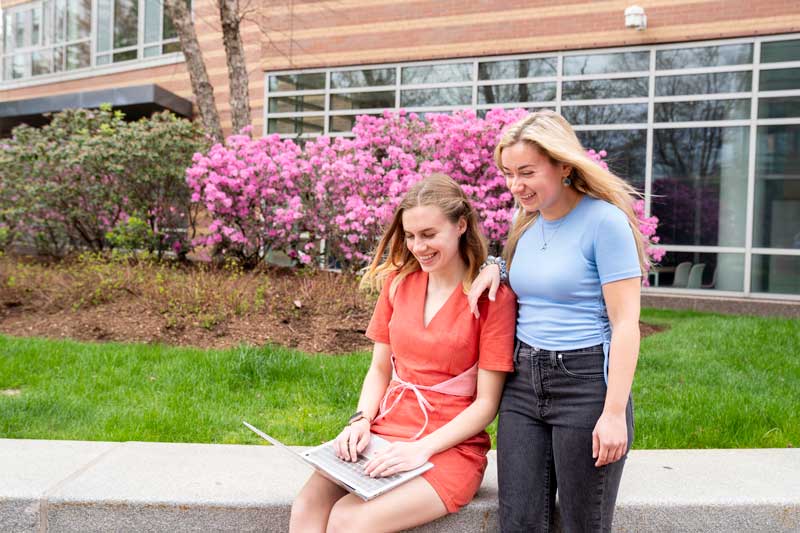
For Napolitano, public speaking comes naturally after years of theater performances and pitch presentations. For Friedman, it’s more of a stretch.
“I have zero public speaking experience,” Friedman explained. “I would not have done this when I first came to Northeastern. I’m definitely pushing myself.”
Napolitano will deliver her speech first at the College of Engineering’s ceremony on May 10, and Friedman will share her remarks the following day. They plan to cheer each other on from the audience.
“We will have each other’s speech memorized by the time we deliver them,” Friedman laughed.
Napolitano added: “Being a graduation speaker is amazing, but the cherry on top is sharing this journey together.”
The Khoury Network: Be in the know
Subscribe now to our monthly newsletter for the latest stories and achievements of our students and faculty
Author: Madelaine Millar
Date: 04.26.22
For their app development project, Johanna Nguyen and her groupmates wanted to work on something close to their hearts. It didn’t take the four long to find a connection.
“All of our parents were immigrants, and they all had the personal struggle of figuring out how to get education in a new country where they didn’t really speak the language,” explained Nguyen, a junior at Braintree High School. “We thought about what we really cared about, and immigration and helping immigrants was a big one.”
This sort of commonality is typical of student interactions at Northeastern’s SMASH Academy. In fact, it’s designed into the program.
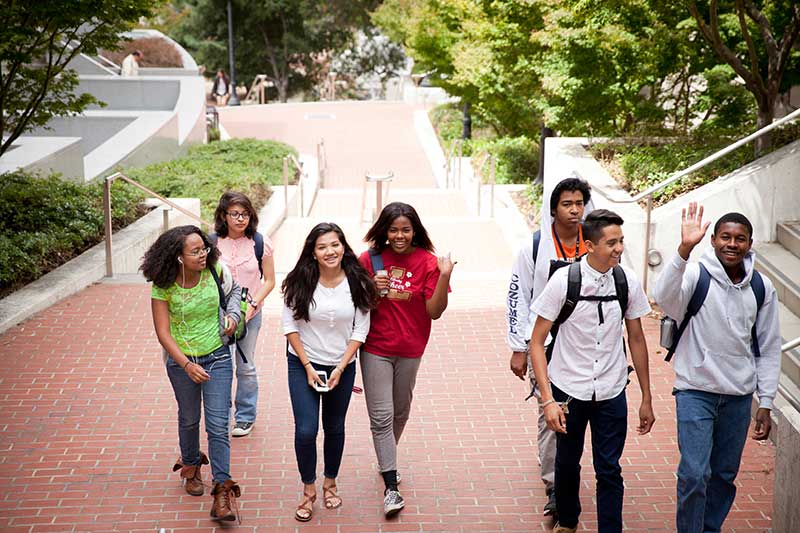
SMASH Academy is a free national program that prepares high-achieving students from groups traditionally underrepresented in STEM to pursue college studies and careers in STEM. The program launched at UC Berkley in 2004 with a focus on local low-income and first-generation students, and it has since expanded to ten universities across the United States.
Northeastern joined the program in 2020 with support from the Akamai Foundation. With new support from Boston-based home security company SimpliSafe—a contribution of $50,000 per year for three years—Khoury College is preparing to welcome SMASH scholars to a hybrid residential–virtual summer program for the first time in 2022.
SimpliSafe’s connection originated when Chief Technology Officer Don Nelson sat in on a SMASH information session led by Carla Brodley, then dean of Khoury College. Nelson was instantly intrigued and wanted to get involved.
“We’re an inclusive brand. We want everyone to be safe,” said Laura Young, SimpliSafe’s associate public relations manager. “And if we want to make everyone safe, we need to have as many diverse voices as possible. This is a program that’s going to allow us to do this and hopefully introduce new people to the world of engineering and technology.”
Immersion in STEM projects and college prep
All SMASH Academy students—whether at Northeastern or elsewhere—enroll in ninth grade in classes of 35, then participate in three years of educational programming, concentrated mostly during the summer, to help them build STEM skills and college preparedness. Classes are divided into three buckets: integrated STEM learning projects where students design solutions to social issues; a college success preparatory program to help students navigate things like financial aid and university applications; and a STEM concentration—in the case of SMASH Northeastern, computer science.
Founding Site Director of SMASH Northeastern Jo Browne said that when many people hear about supplemental academics, they mistakenly believe the program must be remedial. SMASH, he said, is far from that. Instead, the rigorous program works to put academically advanced students from historically underrepresented groups on even footing with their more advantaged, often white peers. It also aims to build community and provide diverse role models in whom students can see themselves.
Johanna Nguyen’s project was a part of the integrated STEM learning projects bucket. She and her groupmates took the skills they had built over the previous two years in subjects like coding and data analysis to build an app that helps immigrants and English-as-a-Second-Language speakers learn to enroll themselves or their children in the Boston Public Schools system. The app, which was originally proposed by Immigration Family Services Institute, won the class-wide project competition and went on to compete against SMASH Academy projects at other East Coast university sites.
“This was an awesome connection between a local organization and students on social justice work,” Browne said.
Technology learning projects, social justice, and community
All the SMASH projects focus on social justice and community. Bryan Ayala, a junior at Excel Academy High School, worked on an app called Neighborly to help connect evicted neighbors with more affordable housing during the height of the pandemic. It also allowed people to share their eviction stories and get help from the community.
“It was a great experience to be a part of this [SMASH Academy] community. They were people just like me, and many of them also shared very similar goals to me,” Ayala said. “It really helped me step out of my comfort zone, helped me build confidence with talking to people and meeting people.”
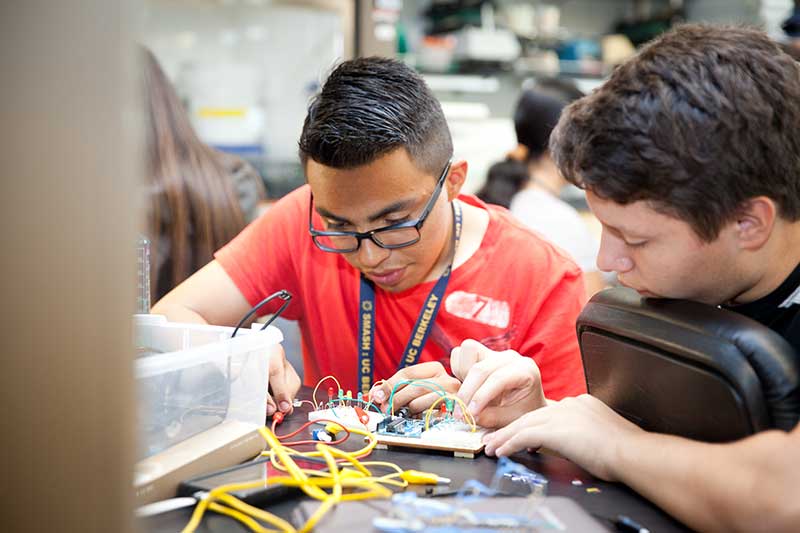
Project-based learning isn’t the only avenue SMASH Academy offers for students like Ayala and Nguyen to explore their skills and passions. Workshops and presentations from local STEM professionals and nonprofit organizations also help students experiment with professional applications for their new skills. GreenRoots, a community-based environmental justice organization in Chelsea, is one such partner; the Boston Area Research Initiative (BARI) is another.
“They were using data that they collected to analyze the demographics of the greater Boston area,” Nguyen said of the BARI-led summer session she attended. “I really saw that data analysis can be applied not just to real life around the world, but real life in my community.”
SimpliSafe’s commitment to diversity in tech
Alongside the program’s academic goals, Browne has a broader vision for SMASH Academy: making its local, diverse students feel more welcome at Northeastern and across STEM.
“Here’s this broader vision that we’re on the way towards realizing, where folks can see a bunch of these students from Dorchester, from East Boston, from other surrounding areas sitting and working and engaging in computer science right here in this [Northeastern campus] space and know that they’re also welcome,” Browne said.
While the vision hasn’t been realized yet because of the pandemic and the virtual setting, it is a vital force in the program’s mission.

“Ultimately we want to see the face of STEM careers shifting and being more inclusive of folks who have historically been left out,” Browne said.
That vision of inclusivity is a big part of the reason SimpliSafe selected SMASH for their donation.
“In the tech industry, there are a lot of individuals—particularly people of color, people from lower socioeconomic backgrounds—who really get shut out of tech for lack of opportunity,” said Leah Press, associate director of people operations at SimpliSafe. “With SMASH really working towards giving those scholars that opportunity, it aligns with what SimpliSafe is trying to do—to give everyone a chance to be a part of our mission, to make everyone feel safe.”
SimpliSafe has committed $150,000 over the next three years for the Northeastern SMASH Academy to use as it sees fit. It is also working to connect SMASH students with SimpliSafe engineers as mentors.
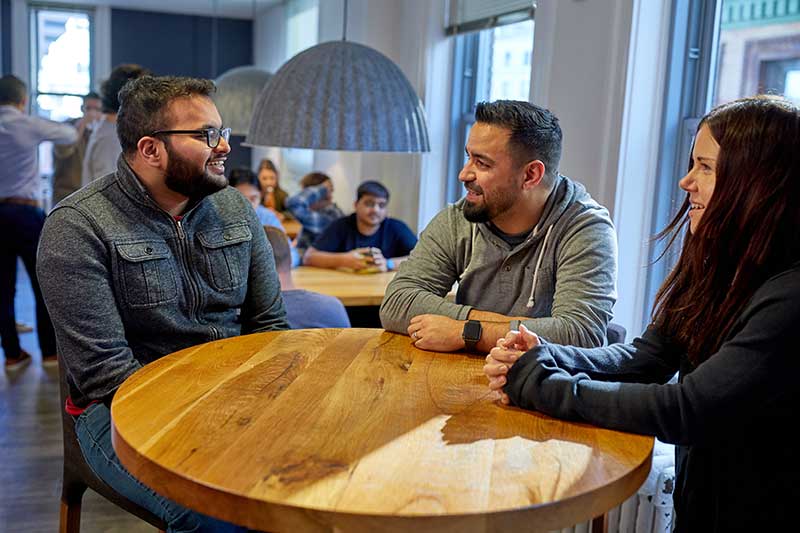
“I think where the mentorship piece comes in is getting insight into what is available. What does it mean to be an engineer?” Browne said. “Getting students to appreciate that, for one, but also the multitude of paths that people take to get where they’re going … It usually isn’t linear, there are a lot of things that come up, a lot of things to overcome. One of the values of having a long-term relationship is that folks get to be a little bit more vulnerable about their journeys—where they fell and where they got up again to ultimately succeed.”
Summer on campus with Khoury faculty and industry mentors
Laney Strange, associate teaching professor and director of broadening participation at Khoury College, commended the students’ ability to study and build a community online, but notes that in-person attendance will improve the student experience.
“Along with three other Khoury faculty members, I co-taught a computer science elective for SMASH scholars last July, and it was the highlight of my entire summer,” Strange said. “It was still remote, which has its limitations, so I’m excited to bring scholars to campus, see and work with them in person, and have them experience true Northeastern life.”
As the program continues to grow and develop, Nguyen has some simple advice for younger students.
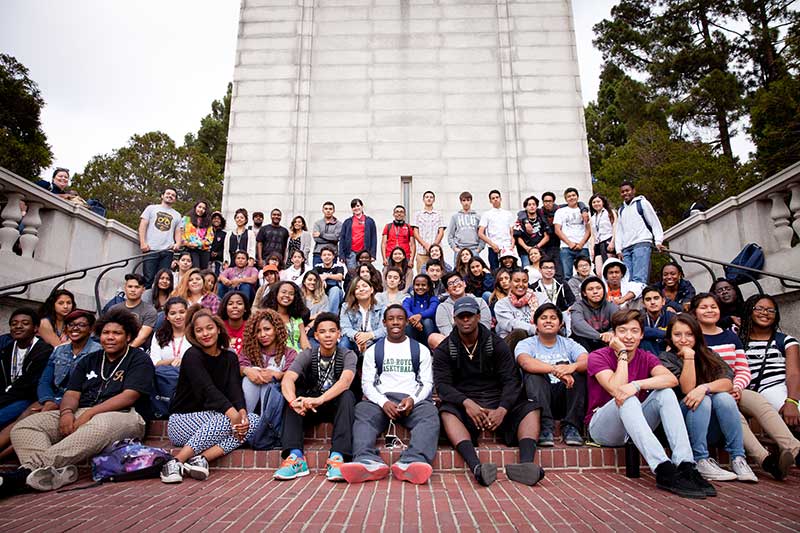
“Please, please, please apply to SMASH. It’s an amazing program; you get to meet adults that are your role models and students that share the same interests as you,” Nguyen said, emphasizing that the application and program are both free.
SimpliSafe’s Laura Young spoke with the same enthusiasm about SMASH and the value it places on incorporating role models from industry into the program: “Not only is that going to fire up the student, it’s going to fire up that engineer as well.” She added that a mentoring relationship has as much of a “meaningful impact” for their engineering team as it does for students.
Jo Browne, commenting on the “win-win” potential of the SMASH mentoring piece, agreed, noting, “There’s sort of two sides of sharing that get to come out in this kind of experience.”
Jane Kokernak and Aditi Peyush contributed to this story.
The Khoury Network: Be in the know
Subscribe now to our monthly newsletter for the latest stories and achievements of our students and faculty
Date: 04.26.22
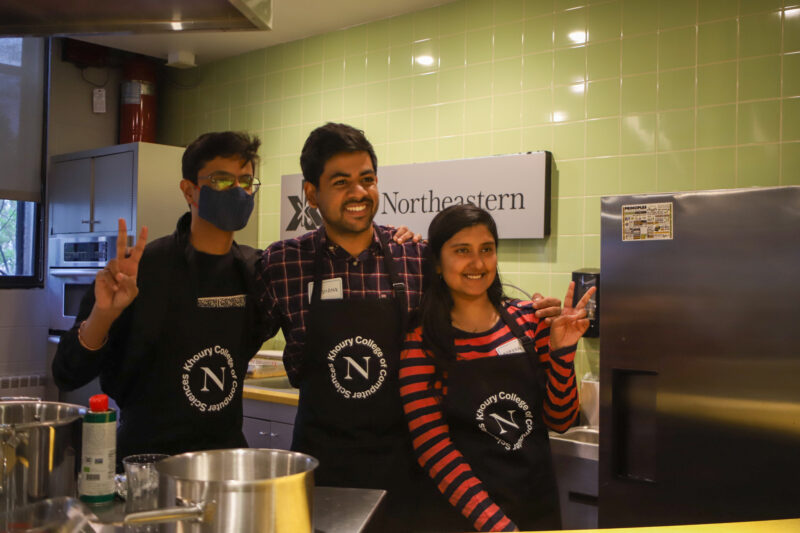
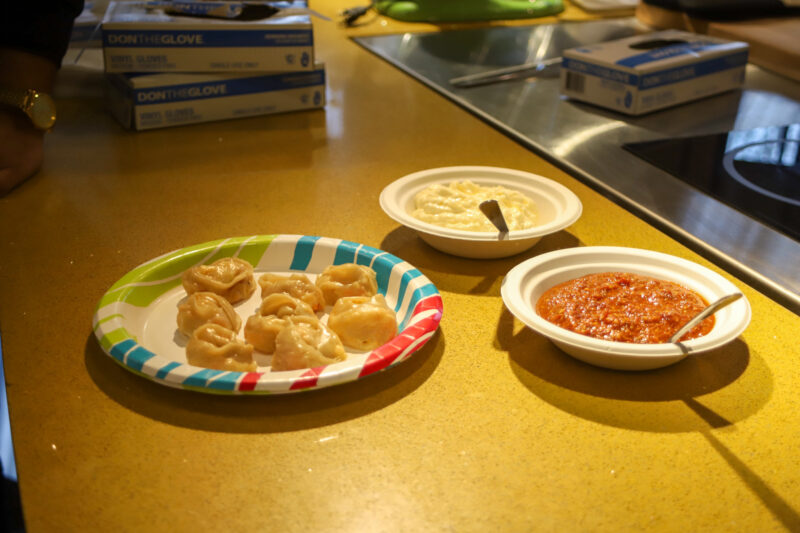
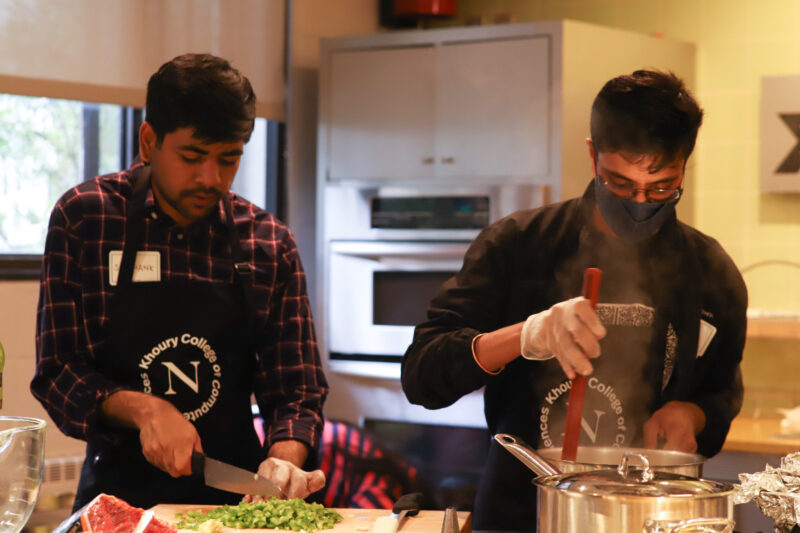
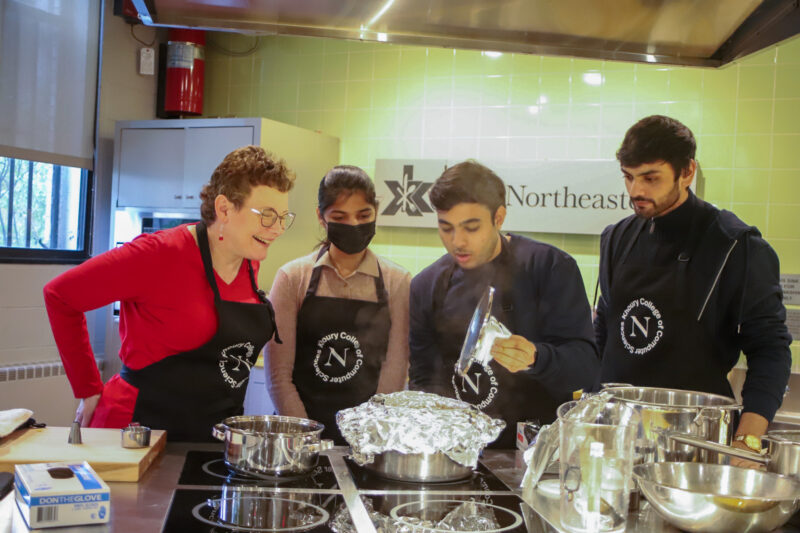
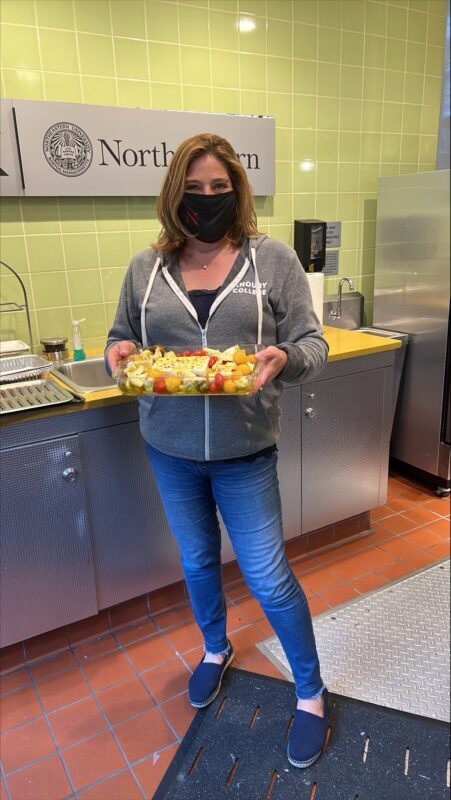
One of our photographers, Sarah Olender, captured moments of Khoury Cooks on Northeastern’s annual Giving Day this past April 14. We first featured highlights of the day on our Instagram and Facebook. Enjoy them here, too!
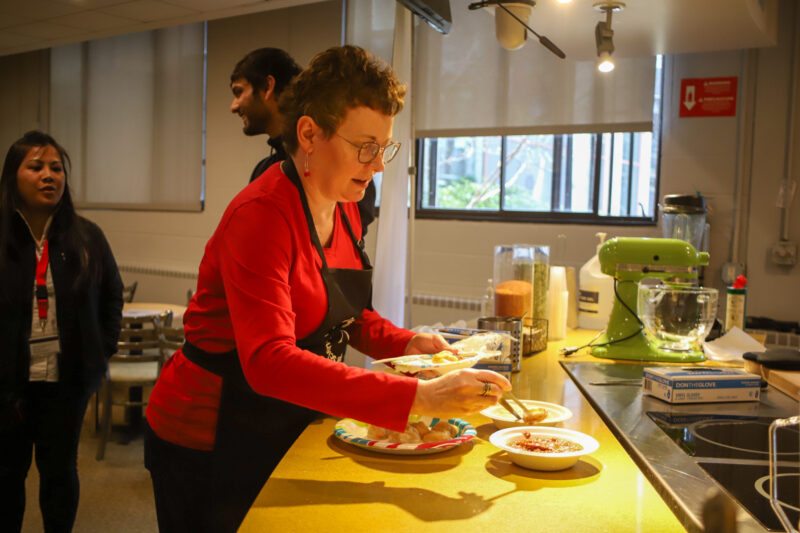
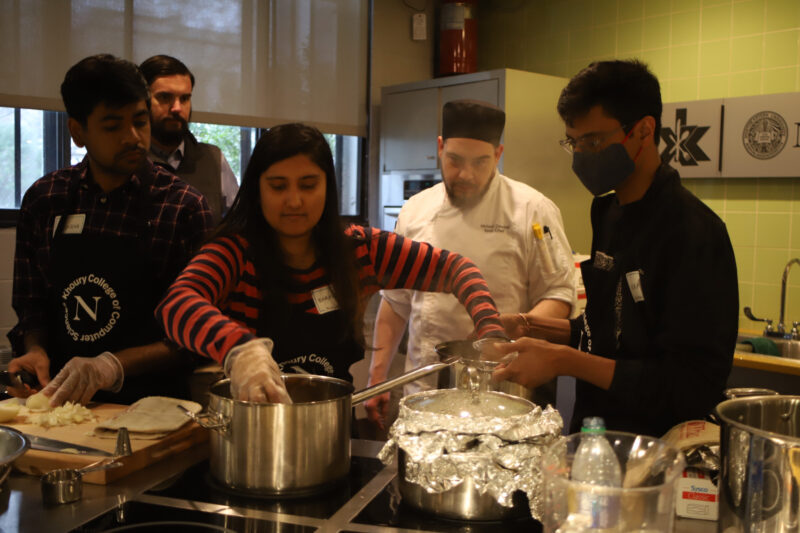
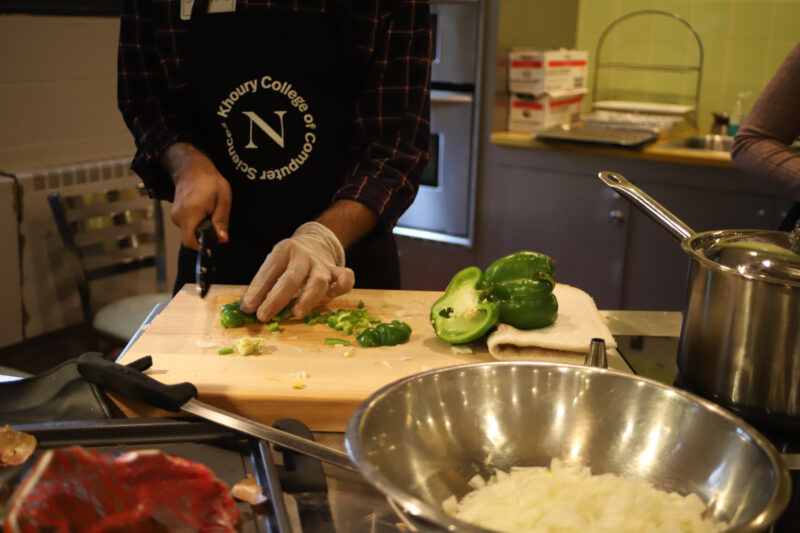
Photo: Sarah Olender (2022)
The Khoury Network: Be in the know
Subscribe now to our monthly newsletter for the latest stories and achievements of our students and faculty
Author: Khoury Staff
Date: 04.22.22
The Khoury community rallied in the kitchen and across the country to raise more than $43,000 for student scholarships, support, and clubs during this year’s Annual Giving Day. A highlight of the day were live cooking events in the Xhibition Kitchen on the Boston campus, bringing together groups of students, staff, and faculty to cook in support of a variety of student funds.
To spark healthy competition, the College offered a challenge match to the three student clubs that generated the largest number of gifts. The club Sandbox came in first place with 30 gifts, followed by Girls Who Code, Northeastern University Loop club (11 gifts), and Women in Technology (9 gifts).
Khoury Giving Day also marked the launch of the new Doreen Hodgkin Student Emergency Fund, named after a long-time Khoury employee who recently retired. Eighty-eight people made donations to the fund, raising $18,900 for Khoury students. The total also includes a generous $10,000 match gift from Roxanne Donovan and Tom Scarangello, parents of a recent Khoury College graduate.
“This year’s Giving Day brought the Khoury community together to cook and celebrate our students,” said Dean Beth Mynatt. “It was so much fun to be in the kitchen and to raise funds for our students. I am thrilled by the successful launch of the Doreen Hodgkin Fund.”
Video and pictures from the day came be seen on the Khoury Cooks Giving Day 2022 Highlights Reel.
The Khoury Network: Be in the know
Subscribe now to our monthly newsletter for the latest stories and achievements of our students and faculty