Author: Kelly Chan
Date: 06.27.22

At Khoury College of Computer Sciences, Nicole Bekerian is known for her leadership as associate director of marketing operations and events management. But last fall, she added another title: business owner.
Bekerian, a Husky double Northeastern-degree holder with a passion for entrepreneurship, has applied her business knowledge to simply the best, which offers a variety of handmade necklaces, earrings, and bracelets that are designed for simplicity and versatility. In an interview with Khoury News, she shares her inspiration for her brand and her takeaways from the journey.
Why did you start your jewelry business?
I have always wanted to be a business owner. I did my undergrad at Northeastern; for both of my co-ops, I managed a salon on Newbury Street, and I stayed there for two years post-grad. I thought that maybe I’d own my own salon one day.
Unfortunately, in March 2021, I lost my beloved dog Gibbs. I asked myself “what I should do?” since I bought a house right before the pandemic. I was so used to a schedule that revolved around taking care of Gibbs’ needs.
That May, I went down to my uncle’s house in Florida to get some fresh air and salt water, and at the airport on the way home, I decided it was the perfect time to start a business and that I needed to stop making excuses. I had a lot more time, and I wanted to do something in honor of Gibbs because he was such a big and positive part of my life. I pitched it to my parents in the airport, and my mom said, ‘I love it. Do it.’
I launched STB in October with the signature bracelet in honor of Gibbs, which is made with black onyx stones for protection and 11 spaces for his 11 years. A portion of the sales gets donated to a local animal shelter or rescue in his name.

When did you find your passion for jewelry-making?
I started selling jewelry in college just to try it. I couldn’t find things in stores that I wanted to wear, so I taught myself with YouTube videos, some books, and practice — a lot of practice.
What qualities or elements are important to you in creating your products?
I mainly work with gemstones and crystals because of their healing properties. With everything that’s happened in the pandemic, we all could use a bit of extra healing. For the necklaces and earrings, I use all sterling silver or gold-filled jewelry so that it will last, and I work to keep it affordable.
Everything I do is also very simple. I remember when I was in Florida, I was out shopping, and I realized that I have a specific taste because I don’t want to buy one thing for one outfit. I want something I can use regardless of the location, event, or what I’m wearing. So, I focus on simple designs that match your look regardless of where you are.
What inspired the name?
“simply the best” comes from a few inspirations. First, everything I design is simple. Then, everything ties back to Gibbs, and he really was simply the best. I also love the reference to “Schitt’s Creek.”
How have your experiences at Northeastern played a role in managing your new business?

At Northeastern, I went to the business school and concentrated on marketing and management. From my time managing the salon on Newbury Street, I learned how to run a small business, which was incredible.
Then there’s my Khoury role and my master’s degree from Northeastern, which is in education with a focus in higher ed administration. I’ve been working at Khoury College for the last 11 years, so I’ve had many different roles from budgeting to branding to project and event management.
How has starting your new business influenced your Khoury role?
It’s given me even more respect for my teammates, as I’ve had to put on everyone’s hat and figure everything out. Normally at Khoury, we all work together to get something done, like changing the website, so it’s given me a lot more insight into different roles.
What have you learned through this journey so far?
That I’m stronger than I think. I was pretty broken after losing Gibbs. It was just me and him for 11 years, so it was hard adjusting. I’m also pretty proud of myself for actually starting a business because I’ve talked about it for years. It just shows that sometimes you just have to start, dive in, and keep going.

I also realized how many small business owners were already in my life. I got so much support and advice from them, and it was uplifting to know that while I’m starting this alone, there are many people in my life who are supporting me.
What are your main goals for your business?
My five-year goal is to have a brick-and-mortar storefront — I already know what I want it to look like. I currently have pieces in six different Massachusetts locations, but I want to continue to expand to different stores across the country.
To see the full range of products, visit simply the best’s website and Instagram.
The Khoury Network: Be in the know
Subscribe now to our monthly newsletter for the latest stories and achievements of our students and faculty
Author:Madelaine Millar
Date: 06.21.22
The Conference on Human Factors in Computing Systems, or CHI, is the premier conference in the world of human–computer interaction. Each year, hundreds of papers, workshops, and late-breaking works are accepted, and in 2022, 11 of those works came from Khoury College of Computer Sciences researchers. Their studies cover everything from crowdsourced work and chatbot interactions to supply chain crises and apps to promote Black health. Read on for summaries of their work, or check out the CHI website to learn more.
Interactive Fiction Provotypes for Coping with Interpersonal Racism
or “Creating technology that doesn’t make more problems than it solves”
- Alexandra To — Northeastern University
- Hillary Carey, Riya Shrivastava, Jessica Hammer, Geoff Kaufman — Carnegie Mellon University
In previous studies, To and her colleagues ran workshops where BIPOC imagined and designed racism-navigating technologies. The researchers then distilled those ideas into three provocative prototypes or “provotypes”: a Racism Alarm that blares when racist speech is detected, a Smartwatch Ally that pushes affirming notifications and advice, and a Comfort Speaker that soothes and sympathizes later. If you can spot problems with those ideas, you’ve figured out the point of the study; the question isn’t “can it be built,” but “should it?”
Study participants explored the provotypes through an interactive fiction about a college student navigating microaggressions. In the abstract, BIPOC participants wanted tech tools to help them ascertain that racism had really happened. The Racism Alarm provided certainty, but when it was used in the narrative, participants felt like their privacy had been violated and their agency taken away. The researchers created design recommendations for future racism-related tech, as well as a new process to discover the harm a piece of technology might cause before it hurts real people.
Collecting and Reporting Race and Ethnicity Data in HCI
or “Who cares about race, when, and why?”
- Yiqun T. Chen, Katharina Reinecke — University of Washington
- Alexandra To — Northeastern University
- Angela D. R. Smith — University of Texas at Austin
To and her fellow researchers reviewed CHI proceedings from 2016 to 2021 to determine that just three percent of research on human–computer interaction collects race or ethnicity data from participants (up from 0.1 percent before 2016). Most researchers who collected race or ethnicity data did so because their study was about race or ethnicity.
In those few studies that did ask, about two thirds of participants were white, but noticeably more nonwhite people were included from 2020 onward. Larger studies tend to skew whiter because they often crowdsource using platforms with many white users, like Amazon’s Mechanical Turk.
So why does that matter? People of different races don’t always interact with the same technology in the same way, but you won’t know that if you don’t know who you’re asking.
Juvenile Graphical Perception: A Comparison between Children and Adults
or “What do kids see when they look at a graph?”
- Liudas Panavas, Tarik Crnovrsanin, Tejas Sathyamurthi, Michelle Borkin, Cody Dunne — Northeastern University
- Amy Worth — Ivy After School Program
- Sara Cordes — Boston College
Fun, colorful graphs are a popular tool for engaging young learners, but do children think about data visualizations the same way adults do?
These researchers studied a group of 8-to-12-year-olds and a group of Northeastern students to try to answer that question. The researchers gave both groups the same tasks with age-appropriate instructions; for instance, if a circle is 100 units big, how big is a second, smaller circle? The tasks covered five ways to compare different types of data on a chart: position along a common axis, position along an unaligned axis, area, length, and angle.

Both children and adults gauged relative values the best when looking at two dots on the same graph (like a scatterplot) and least accurate when looking at areas and angles. This means children generally think about data visualizations the same way adults do, just less accurately. The researchers also developed design guidelines for making graphics for kids, including using grid lines to aid accuracy.
How do you Converse with an Analytical Chatbot? Revisiting Gricean Maxims for Designing Analytical Conversational Behavior
or “Talking to Slackbot isn’t like talking to your friends”
- Vidya Setlur — Tableau researcher
- Melanie Tory — Roux Institute, Northeastern University
If you’ve been on the internet for a few years, you’ve probably bamboozled a chatbot with a question a human would have understood just fine.
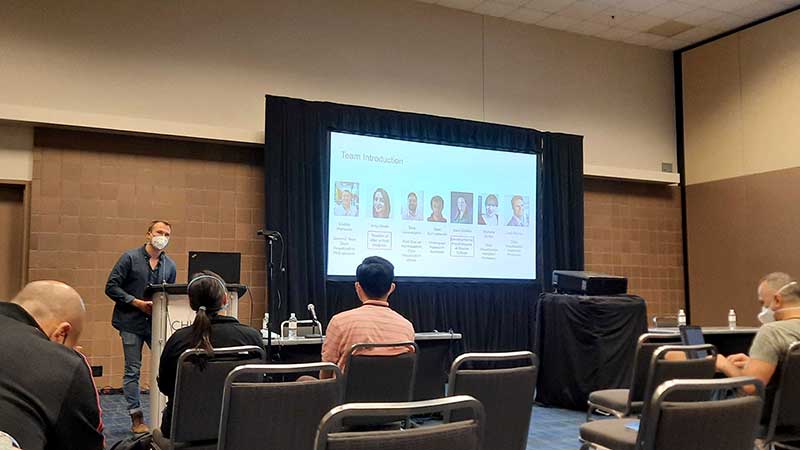
To learn how to design better chatbots, Setlur and Tory studied how people explore data using chatbots. They did a “Wizard of Oz” study with a researcher behind the curtain pulling the chatbot’s strings, plus a study with actual chatbot prototypes. Study participants explored a data set about the Titanic, asking questions by typing over Slack, chatting aloud with a Bluetooth speaker, or speaking questions to an iPad’s data visualization bot.
The researchers found that while the four Gricean Maxims that govern good communication still applied — responses should be relevant, precise, clear, and concise — people expected more. For instance, a good chatbot should understand the same question phrased differently, and distinguish a follow-up question from a new one. They also found that people use different chatbots differently; when chatting out loud, users tended to ask for simple facts, while visual responses encouraged them to ask “how” and “why.” The researchers concluded with new design guidelines.
To Trust or to Stockpile: Modeling Human-Simulation Interaction in Supply Chain Shortages
or “For those still working through 2020’s toilet paper”
Honorable mention: top five percent of CHI papers
- Omid Mohaddesi, Jacqueline Griffin, Ozlem Ergun, David Kaeli, Stacy Marsella, Casper Harteveld — Northeastern University
Let’s play a game. You’re a pharmaceutical wholesaler; you and your competitor buy medications from two factories and supply them to two hospitals. An algorithm recommends how much you should stock, but one day there’s a crisis at one factory and you’re hit with a shortage. Do you trust the computer system, or do you buy extra just in case? And what if you know exactly how much medicine the factories have left?
The 135 players in the study generally fell into three categories: “hoarders” who bought extra medication from the beginning, “reactors” who bought extra medication once the shortage began, and a much smaller group of “followers” who continued to trust the program. Subjects generally paid less attention to algorithmic recommendations when facing a shortage. The “reactors” and “followers” could be convinced to trust the system when it described the manufacturers’ inventories, but that information made the “hoarders” buy even more as more inventory became available.
The study also presented a new way to use simulation games in studies. The researchers characterized people into groups (reactors, hoarders, and followers) and the supply system into states (stable, supply disruption, and recovering from disruption). By finding common states in dynamic behaviors, they could study the interactions of human and supply chain behaviors.
Effect of Anthropomorphic Glyph Design on the Accuracy of Categorization Tasks
or “Do people sort data better when it’s smiling?”
- Aditeya Pandey, Peter Bex, Michelle Borkin — Northeastern University
A categorization task is when someone uses multiple features to figure out what something is, like a doctor diagnosing the cause of a headache. While research has shown people better remember data visualizations that look like people, does better recall make for better categorization?
These researchers presented participants with four simple data visualizations; three pixels in a box, a flower, a human figure, and a human face. Each glyph had seven possible permutations; the flower might have only one petal, or the face might be missing eyes and a nose. The researchers categorized the permutations into two families: those with many features (a box with all three pixels) and those with few features (a figure reduced to only a torso). The participants, not knowing what the families were based on, categorized permutations based on their similarity to glyphs already in the family.
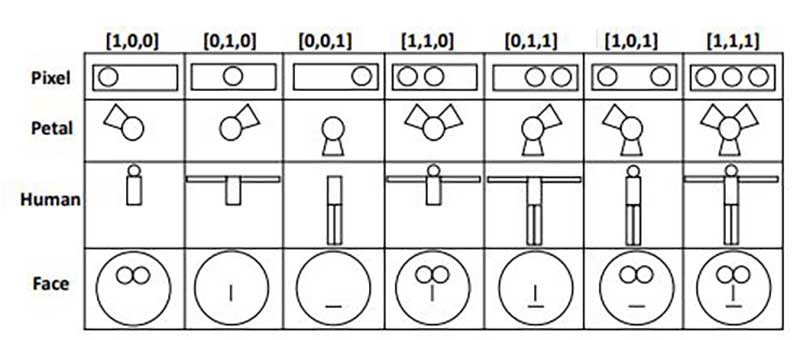
The more human-like the glyph, the worse people became at categorizing it. While they easily noticed that boxes with one pixel should go in a different family than boxes with three pixels, participants tended to categorize human-like glyphs based on a single feature, such as whether the face had eyes. As a result, the researchers recommend using human-like visualizations when one element is more important than the rest and avoiding them when all features are equally important.
REGROW: Reimagining Global Crowdsourcing for Better Human-AI Collaboration
or “What could better crowdsourcing look like?”
- Saiph Savage — Northeastern University
- Andy Alorwu, Jonas Oppenlaender, Simo Hosio — University of Oulu
- Niels van Berkel — Aalborg University
- Dmitry Ustalov, Alexey Drutsa — Yandex
- Oliver Bates — Lancaster University
- Danula Hettiachchi — RMIT University
- Ujwal Gadiraju — TU Delft
- Jorge Goncalves — University of Melbourne
Savage’s previous research revealed serious problems with crowdsourced labor. Workers are often paid poorly doing work that doesn’t build skills, and spend many unpaid hours chasing down work and payments. Many workers distrust popular crowdsourcing platforms that don’t provide benefits, firm contracts, or ownership of the worker’s own data.
READ: Faculty research on AI and invisible labor honored for critical real-world impact
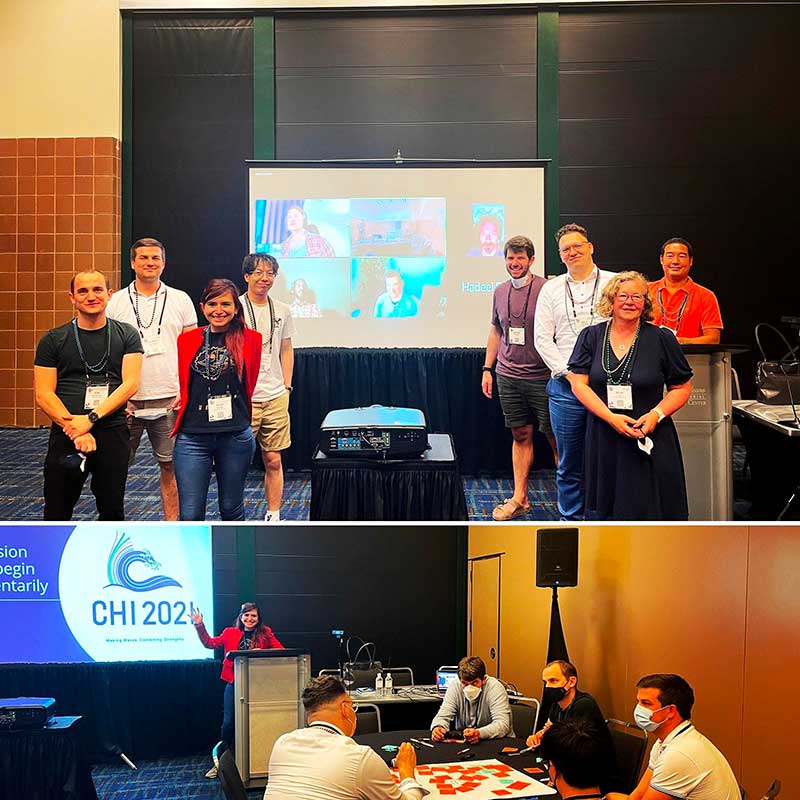
In this workshop, researchers from all areas of CHI presented, discussed, refined, and re-presented diverse crowdsourcing improvements. They discussed topics such as using AI to match tasks with workers, improving workers’ flexibility to allocate their time, and the biases within crowd work.
A Virtual Counselor for Breast Cancer Genetic Counseling: Adaptive Pedagogy Leads to Greater Knowledge Gain
or “Learning about breast cancer on a budget”
- Shuo Zhou, Timothy Bickmore — Northeastern University
Genetic counseling shows people how likely they are to get certain diseases — in this case, breast cancer — and helps many survive through preventative care or lifestyle changes. Genetic counselors are expensive though, often out of reach for the low-income people at the greatest risk. The researchers wanted to know whether an animated, computer-generated genetic counselor that adapted to a patient’s medical literacy and way of learning could help to fill that gap.
Enter Tanya, a digital counselor who determines things like how much her users already understand, whether they prefer to learn from experts or studies, and whether they prefer visuals or narratives. Then, Tanya tailors a half-hour counseling session to show each woman her risk level and how she can protect herself.
To see if Tanya worked, the researchers had some women use a version of Tanya that didn’t adapt to their needs, or that gave them risk information without really having a conversation. He found that participants learned the most from the fully-featured Tanya and liked her best, although any genetic counseling helped them to learn something.
Community Dynamics in Technospiritual Interventions: Lessons Learned from a Church-based Health Pilot
or “Social media for health and holiness”
- Teresa K O’Leary, Dhaval Parmar, Timothy Bickmore — Northeastern University
- Stefan Olafsson — Reykjavik University
- Michael Paasche-Orlow — Boston University of Medicine
- Andrea G Parker — Georgia Institute of Technology
For years, these researchers have worked with Black churches to co-design an app that supports religious Black people’s health. In this four-week study, the researchers put the app ChurchConnect into the hands of two congregations, aiming to refine it further.
ChurchConnect features a digital counselor named Clara who offers everything from scripture and guided meditation to health education, goal-setting help, and counseling. While participants generally liked Clara, they loved the prayer wall, a social-media-style feature where they could request prayers from, and offer support to, fellow community members.
The researchers found that spiritual and social health were big priorities for users, not just physical or mental health. They also identified some problems; for instance, reaching out for prayers publicly can make it obvious when you don’t receive support.
Barriers to Expertise in Citizen Science Games
or “Why no one you know folds proteins for fun”
Josh Aaron Miller, Seth Cooper — Northeastern University
In Foldit, players try to fold proteins into novel structures, which researchers can crowdsource to learn about proteins and potentially incorporate into new medicines. You have to be really good at the game to make anything useful though, and getting good isn’t easy. The same is true of Eterna and Eyewire, which study RNA design and neuron reconstruction. Miller and Cooper wanted to know how people learn these games and what makes them quit, then craft design principles accordingly.
READ: Two game-focused Khoury researchers are turning amateurs into scientists
By talking to Foldit, Eterna, and Eyewire players, they discovered that the path to expertise is a cycle; players learn formally from a tutorial, then from their own exploration, then from other players. Thus, issues such as a limited tutorial, difficult user interface, or exclusive community could drive players away before they gain the expertise to contribute useful designs. The researchers developed guidelines — such as collaborating with professional UI designers and including encouraging social spaces in the game — to help researchers design appealing games.
Shifting Trust: Examining How Trust and Distrust Emerge, Transform, and Collapse in COVID-19 Information Seeking
or “In social media we trust?”
- Yixuan Zhang, Joseph D Gaggiano — Georgia Institute of Technology
- Nurul M Suhaimi, Stacy Marsella, Nutchanon Yongsatianchot, Miso Kim, Jacqueline Griffin — Northeastern University
- Yifan Sun — College of William & Mary
- Shivani A. Patel — Emory University
- Andrea G Parker — Georgia Tech & Emory University
Do you trust information from your social media feed? Odds are your answer is more nuanced than it was a few years ago. When a new source of information arises, it takes a while for people to figure out how much to trust it.
These researchers studied how people changed the way they sought information about COVID over time by asking the same questions every two weeks for four months in 2020 through surveys and interviews. They found that people went to social media for coronavirus information less and less over time, both because they didn’t trust the platform and because they didn’t trust the people they followed on it. When people saw conflicting stories on social media, they became frustrated and relied on the platforms less. Over time, participants used social media to learn about COVID less, and those who continued to use it trusted it less, largely because they were afraid they were being exposed to misinformation.
The Khoury Network: Be in the know
Subscribe now to our monthly newsletter for the latest stories and achievements of our students and faculty
Author: Madelaine Millar
Date: 06.09.22
Sitting on top of a fiberglass boat in a swimming pool in Fort Lauderdale, Florida, was a pile of mock cargo. Sitting in a much drier part of the building were five members of Northeastern University’s competitive cybersecurity team determined to knock it off into the water.
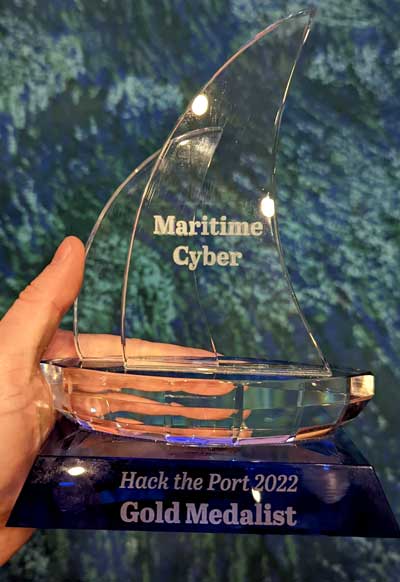
First, the team found a misconfigured network switch, exploited it to gain access to the boat’s private network, and traveled through to the pump controllers. By activating one pump and leaving the other switched off, the team tilted the boat — first a few degrees, then enough to dump the cargo unceremoniously into the pool. After four more days of similar performances, Northeastern beat out 31 other teams to take home first place.
It may sound like a soggier version of WarGames, but this is the world of competitive cybersecurity. The niche, highly competitive sport pits teams of students and cybersecurity professionals against one another in a race to secure, break, and re-secure computer systems. At the end of anywhere from a few hours to a few months, everyone leaves with a deeper understanding of cybersecurity and a wealth of new industry connections — but only one team leaves with the trophy.
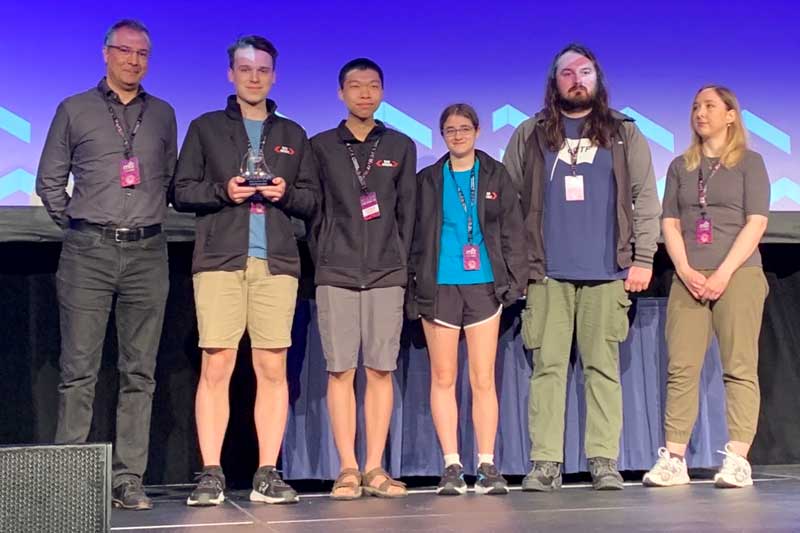
Hack the Port, the US Cyber Command’s five-day competition that involved flipping cargo off of the boat and other challenges related to supply chain operations, is a style called Red Team/Blue Team. Competitors are split into two sides: a “Red Team” that attempts to break into a system and a “Blue Team” that defends it. There are other competition styles too, such as Capture the Flag, a style in which Northeastern’s teams have also proven dominant.
READ: NUSec competitive cybersecurity team clinches a third — and final? — win
“This is my very first Red Teaming event; it was pretty complex,” said Hava Kantrowitz, a third-year cybersecurity major with a concentration in cyber operations. “You need to understand your attackers and be able to think like your attackers in order to protect your system, so being on the Red Team and actually thinking like an attacker [helps you go] back to your own system.”
Hack the Port began on March 21. A few days earlier, at the Collegiate Cyber Defense Competition (CCDC) Northeast Regional, Kantrowitz and her teammates had performed the defensive Blue Team role. At CCDC, industry professionals play the Red Team, working to break systems protected by student Blue Teams.
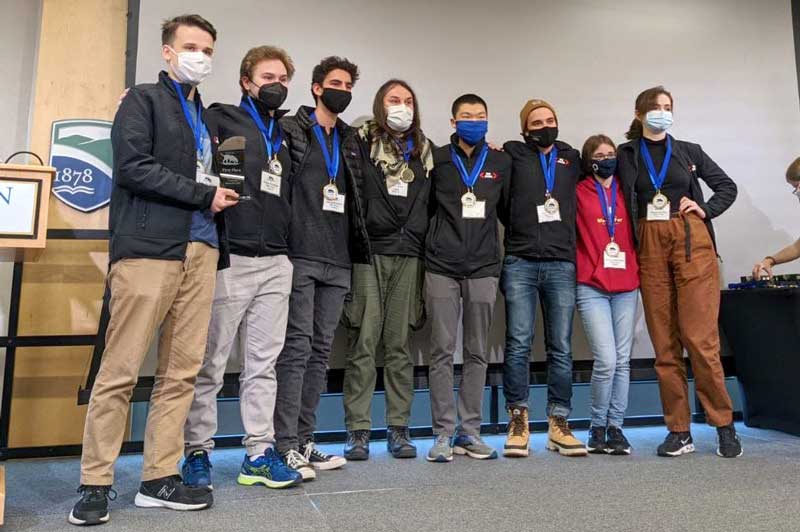
Northeastern’s small competitive cybersecurity community is highly skilled and highly welcoming, swapping team members for different competitions depending on availability and interest, so the CCDC and Hack the Port teams share many members. For instance, the CCDC team is coached by Dennis Giese, a doctoral student who came in second last year at the 6,000-person National Cyber League competition and received an award for his creative use of hardware at this year’s Hack the Port.
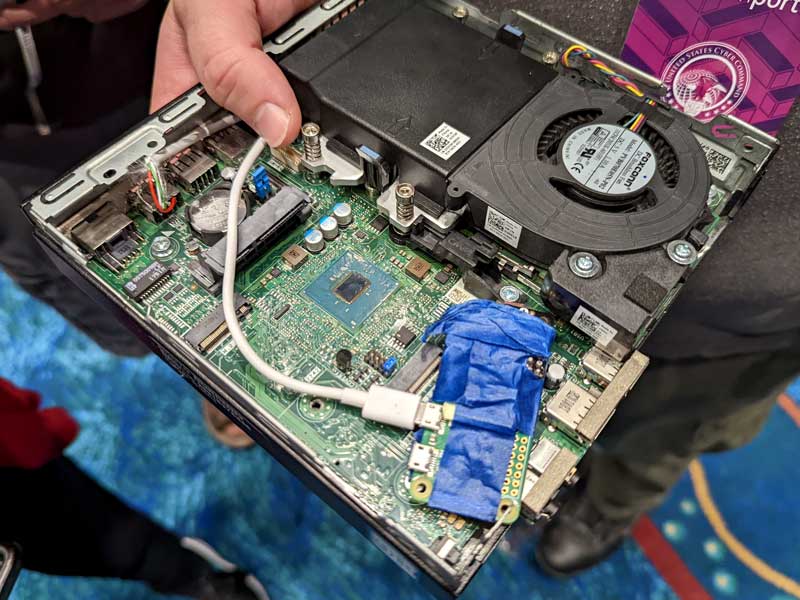
Giese prepares the team by giving out weekly homework, including setting up servers and creating virtual machines which he and his teammates then try to break. He also has the team cross-train on Linux, Mac, and Windows systems so they can adapt to anything that gets thrown their way.
“It’s helpful if everyone has at least some basic knowledge of how to set up things. It would be bad if we had seven or eight machines where we needed to change the Windows password, and only two people knew how to do that,” Giese said.
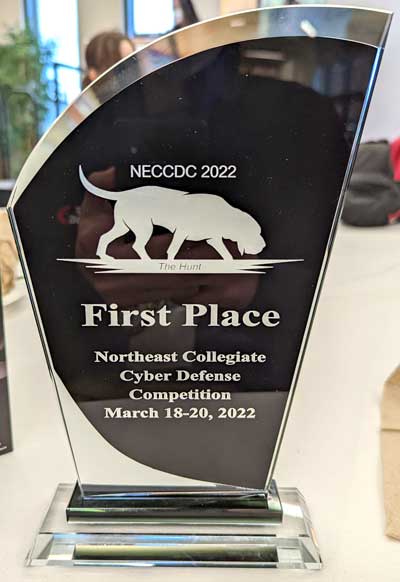
The intensive prep pays off though; Northeastern placed first out of 17 teams at the CCDC Northeast Regional competition too. The team was one of ten national qualifiers out of more than 200 collegiate cybersecurity teams from around the country. Although they did not place in the top three, they described the event as a challenge where they learned a lot to carry forward into their future cybersecurity work.
But what consistently stands out to Guevara Noubir, Khoury College’s executive director of cybersecurity programs and advisor to Northeastern’s cybersecurity teams, is not necessarily the winning. It’s the passion.
“We end up having a lot of students who really dedicate themselves to learning about cybersecurity. They have a lot of expertise. Then, they get the opportunity to practice as a team,” Noubir said. “When you have a team of people who enjoy working with each other, they get very excited.”
Cybersecurity competitions have helped the competitors find their place in the working world too, as Kyle Sferrazza — who graduated in May with a master’s degree in cybersecurity and who captained the CCDC team — can attest.
“I want to make an impact in the cybersecurity industry and doing all of these different kinds of competitions is helping me learn what kinds of things I like, the kinds of things that I don’t like, and the kinds of things that I’m good at,” Sferrazza said. “[Hack the Port] was the first competition where I went somewhere and hacked into stuff and I really enjoyed it … I’d like to continue to pursue the Red Team-ing side.”
For Kantrowitz, who works in a security analyst position that began as a co-op at health tech company Hologic, the impact is even more direct. She describes a cybersecurity competition like CCDC as jamming the entirety of her job into one day, so when problems come up in her work — for instance, when a crypto miner camped out on one of the company’s servers — she can use solutions she learned at CCDC nearly verbatim.
“One of the things we do in CCDC is, we have a generalized incident response plan where we check common areas where people might have gotten into our systems,” Kantrowitz said. “I ran through the same exact checklist at work and was able to find the issue, patch it, and fix all of our systems.”
The team doesn’t do it just to nab better jobs, though; from their passionate discussion of the sport to the friendly, welcoming community they’ve worked to build, it’s evident that this is a labor of love. That doesn’t mean it’s easy, but to Giese, it’s all worth it when a tricky problem finally falls into place.
“You have planned in your head what you want to do days before, and then you do it on that day and something doesn’t work. And then it takes you a while, but you finally manage to succeed, it works, and you get the points — it’s a huge kick,” Giese said. “It’s just amazing.”
The Khoury Network: Be in the know
Subscribe now to our monthly newsletter for the latest stories and achievements of our students and faculty
Author: Tracy Miller Geary
Date: 06.02.22
The theme of this year’s Khoury College of Computer Sciences DEIAB (diversity, equity, inclusion, accessibility, and belonging) Speaker Series is Why I Belong in CS. The series, a mix of in-person and virtual events, hosted University of Florida professors Jeremy Waisome and Kyla McMullen for a podcast on March 30.
Waisome and McMullen host Modern Figures, a conversational-style podcast they created that elevates the voices of Black women in computing. Their podcast is presented by the Institute for African-American Mentoring in Computing Science in collaboration with the National Center for Women & Information Technology. Through Modern Figures, McMullen and Waisome share stories about women and girls in computing, aiming to reach students where they are and dismantle the idea of the stereotype-advancing “single story.”
Each podcast follows a similar trajectory to tell the story of each guest—childhood, education, work experience, present career, and future goals—with a focus on who pointed them towards computing. They want their podcasts to be understood by everyone, regardless of how much experience listeners have with computing and technology. They especially hope to engage with high schoolers and encourage them to consider computing-related fields.
The podcast opened with a question posed by moderator Bethlehem Mesfin, a Khoury College master’s student. Mesfin wondered if a combination of external and internal factors, as well as a lack of representation, can lead to imposter syndrome in academia. McMullen brought up a seminar she had attended in graduate school in which every student raised their hand when asked if they’d ever felt guilty of imposter syndrome. She had realized that at times, “all of us think we don’t belong here.”
When asked to reflect on their journeys, Waisome referenced her skill at networking and building relationships. She encouraged people who are shy or have a hard time talking with others to tell people what you are passionate about so they’ll remember you later when they’re writing a grant proposal or hear about an award.
“Advocate for yourself!” Waisome said. “Knowing what you need to be successful is a hard thing to ponder, but it is something that’s important for us to consider.”
McMullen noted that besides networking and community building, she wished she had known it was okay to admit to not knowing something.
“Oftentimes people have access to resources or know things you don’t know,” she said. “Let people know what you’re working on or struggling with so they can help.”
One podcast, two women, many voices
“We started [our podcast] because we were having a lot of conversations about the lack of support for Black women in computing,” Waisome said.
McMullen noticed that the factors that keep Black students in general from pursuing computing are much more pronounced for Black women who are even more underrepresented and do not always feel welcome in the field.
“I think of Black women in computer science as unicorns,” she said. “The Modern Figures logo has a unicorn horn on it for a reason.”

“There’s nothing special about the Black experience keeping you from doing this,” she continued, noting how important it is for aspiring computer scientists to know the stories of women who look like them. “If you can see it, you can be it.”
Waisome mentioned that a majority population often takes things—like belonging in computer science—for granted because they are constantly reassured.
“As a Black woman, if you don’t see Black women in computing, you may wonder, ‘Is this the right thing for me?’” she said.
With regards to breaking barriers, Waisome pointed out that unequal access to education, healthcare, or transportation inhibits upward mobility.
“In general and in STEM,” she said, “there are a whole lot of barriers before you get anywhere close to academia.”
Although programs exist that aim to boost underrepresented groups, Waisome said there is often “no input from” or “consideration of the population they’re trying to serve.” She likened it to creating a human-centered design without actually speaking to people about their needs. Growth has been slow because “we’re not involving the communities that we’re trying to support.”
McMullen agreed, adding, “There is also slow growth because the people who are in charge of creating or facilitating these programs often see this sort of work as charity work.” Often the people who need the programs the most aren’t the ones who show up: “You see yourself preaching to the choir and it’s hard to grab the people who actually need it.”
Closing advice
“The first thing is to surround yourself with community. Find like-minded individuals who are trying to follow the same path as you,” Waisome emphasized. “They don’t have to look like you, but they have to have that same motivation and drive. Number two is finding a mentor. Not just one; find as many as you think you need for where you’re trying to go.”
McMullen also stressed the importance of community, and of having someone who can hold you accountable.
“It’s so important, like the proverb: ‘If you want to go fast, go alone. If you want to go far, go together,’” she said.
Mesfin agreed: “I can say I’m still here today because of all of the people that have helped me, so shout out to all of my community!”
View the entire discussion here using passcode “qH@jfR8G”.
The Khoury Network: Be in the know
Subscribe now to our monthly newsletter for the latest stories and achievements of our students and faculty