Author: Milton Posner
Date: 07.25.22
Ten years ago, Alex Gamero-Garrido had little reason to assume he would be any sort of computer scientist.
He was working as a positioning engineer on a seismic streamer vessel surveying the oceans. His upbringing screamed “policy” while his undergraduate degree read “electronics engineering.” And for a gay Hispanic man, the predominantly white and straight CS field was not the obvious path.
Fast forward to 2022, and it’s clearly been the right one. In addition to his Northeastern Future Faculty Fellowship and Microsoft Dissertation Grant, the Khoury College of Computer Sciences postdoctoral researcher was recently selected for the prestigious Ford Foundation Fellowship, which strives to boost faculty diversity at American universities. It’s all validation, he says, that he truly belongs.
The Ford Foundation Fellowship recognizes those who “demonstrate academic excellence, a commitment to pluralism, and a strong interest in teaching and research.” Let’s go one by one.
Academic excellence
“It was definitely a journey to computer science,” Gamero-Garrido said with a knowing laugh. After signing off the steamer ship, he pivoted first from electronics engineering to a master’s degree in tech and policy. Then, after a fellow tech-and-policy-focused MIT student introduced him to traditional computing methods, Gamero-Garrido pivoted again.
Now, “in general, I study access networks. That’s the common denominator,” he said. “When you look at how access networks connect to the rest of the world, you get a sense of who information is exposed to, who is compromised, and who can harm users.”
Despite his CS pursuit, the son of a community college professor and a financial regulator never strayed far from public service and policy. For his doctoral thesis, Gamero-Garrido examined the internet infrastructure of numerous countries to identify which ones were most vulnerable to privacy infringements via transit networks, which are internet providers that connect other networks (rather than consumers) to the internet. Potential infringements like large-scale government surveillance, selective censorship, or foreign espionage are all the more concerning since transit networks are often unknown and unaccountable to consumers. Gamero-Garrido’s conclusion: most at risk were African and Latin American countries — including his native Venezuela — with centralized telecommunications infrastructure. Overlooked by existing research, these countries are greatly exposed to privacy infringements because network traffic primarily flows through a few transit networks in its journey between providers and users.
“When networks connect to each other in the United States or Europe, they primarily have direct agreements, and there are many connections between network operators. No individual link becomes a tapping point for the entire country,” Gamero-Garrido explained. “For these [African and Latin American] countries, there is typically one large network that every other network needs to transit through.”
An added bonus: as he was becoming the first in his family to earn a doctorate, Gamero-Garrido presented his results at the Latin American and Caribbean Network Operators’ Group in his native Spanish. It was a welcome development for a rising researcher in a field where diversity is lacking.
A commitment to pluralism
For Gamero-Garrido, diversity extends beyond inclusivity for inclusivity’s sake. It’s also about producing better scholarship.
“There are technical problems and research questions that would not be asked if the field didn’t have diversity,” he said, noting CS’s paucity of female workers and students relative to many other fields. “There is a good amount of evidence that diversity leads to more creative solutions and investigating previously unknown or overlooked problems. The field is now pushing for diversity for this purpose rather than just for representation, equity, and justice, which are of course also important.”
As a gay Hispanic computer scientist, Gamero-Garrido lives at the intersection of two underrepresented identities, and has found nearly no space that caters to both. But he also knows that he’s privileged to be in the field’s gender majority, and has worked to promote inclusion through mentorship and service. He served on the board of Graduate Women in Computing during his doctoral days and has attended several women in STEM events, finding them among the most inclusive CS communities he has encountered.
“As a Hispanic gay man who faces a very different set of challenges, getting involved with these groups has given me a much broader perspective of why inclusion is important and who is harmed when it doesn’t happen,” Gamero-Garrido said.
A strong interest in teaching and research
Upon completing his PhD, Gamero-Garrido joined Khoury College as a postdoctoral researcher under the mentorship of David Choffnes, executive director of the Cybersecurity and Privacy Institute and member of the Mon(IoT)r Lab. Gamero-Garrido had dealt with privacy implications for his doctoral thesis, but now, under one of the country’s leading privacy experts, he joined the CPI and Mon(IoT)r Lab, learned about browser measurements, and figured out how to get effective proxy data for user behavior. He also started paying the mentorship forward.
“From the start, Alex has been a generous and active mentor to several Northeastern students, helping them to engage in research and contribute to our projects,” Choffnes said. “One of his mentees is starting his PhD at USC this fall, in no small part due to Alex’s guidance.”
When he’s not mentoring students or working as a TA for networks courses as a precursor to his desired tenure-track professorship, Gamero-Garrido is hard at work on his policy- and privacy-themed network research. Right now, he’s using internet measurements to determine how well companies comply with privacy laws that restrict data transfers between Europe and the US.
As the summer winds down, Gamero-Garrido expects to complete that project and pick up the one at the heart of his Ford Fellowship. Like his doctoral thesis on large-scale network resilience, this new research addresses a confluence of understudied networking access issues.
Many rural communities in the United States struggle with subpar internet connectivity, and slowed economic growth as a result. Public discussion has rightly pinpointed deficiencies in the “last mile” access networks that connect the users themselves to the internet. But Gamero-Garrido cautions that fixating only on the components that users interact with omits less visible inequities in connectivity, reliability, and resilience elsewhere in the chain. The internet’s “backbone” and the transit providers that connect the networks to that backbone can house inequity too. This variance in connection strength and routing diversity means that an internet user can be doubly advantaged or doubly disadvantaged.
In this way, rural American regions experience the same vulnerability as the countries Gamero-Garrido studied for his thesis: low routing diversity that makes an internet connection more prone to failure or attack. This is especially vital for K-12 schools, where unreliable connection quality and stability can lead to a poorer education.
“If you are a fourth grader in a rural town, even in a place like Massachusetts, you’re probably receiving internet access from a network operator that itself is connected to only one other network,” in contrast with more connected networks in urban areas, Gamero-Garrido said. “There’s a centralized link that, should it fail, then you lose internet connection.”
For the next year, Gamero-Garrido will quantify the routing diversity of the wide area networks that serve US students, determine how often underserved users get content through networks with low routing diversity, and study correlations between routing diversity and network speed. He’ll also identify networks owned and operated by schools and examine the routes that school content takes. Because the agreements governing these networks are secret, he’ll need to jump through numerous technical hoops to identify the schools and reveal the fabric that connects them to the rest of the internet.
“We hope to highlight that it’s not enough to invest in the access networks. You need to ensure that the end-to-end connection is robust,” Gamero-Garrido said.
The goal is to identify inequality to inform policy — where regulators allocate subsidies, which underserved institutions get broadband funds, what infrastructure network operators deploy, and which actions education advocates demand. Not a bad research niche for a policy wonk who originally didn’t see himself in CS at all.
“When I entered computing, I felt like I had a very soft focus and a very soft set of skills. I don’t know if it was internal or the environment, but that was the perception I had,” Gamero-Garrido recalled. “I spent a lot of time trying to make myself into a traditional computing person, and the reality is that I can’t, because there’s a perception that computer scientists are of a certain identity that I don’t belong to.
“So I think getting this award has given me some validation in bringing this broader emphasis of policy. It has provided me some relief that I do bring value to the field as a computer scientist from a non-traditional background.”
The Khoury Network: Be in the know
Subscribe now to our monthly newsletter for the latest stories and achievements of our students and faculty
Author: Tracy Miller Geary
Date: 07.18.22
Millicent Li, an incoming Khoury College of Computer Sciences doctoral student, has been awarded the prestigious National Science Foundation (NSF) Graduate Research Fellowship. It is the country’s oldest fellowship program directly supporting outstanding graduate students in STEM, and the NSF receives approximately 12,000 applications for 2,000 fellowships.
“I was visiting a few friends in the Bay Area and had just gotten back from our trip from Big Sur,” Li said. “We were at the airport and I saw the news on my phone and found that I had actually won the fellowship. I was elated!”
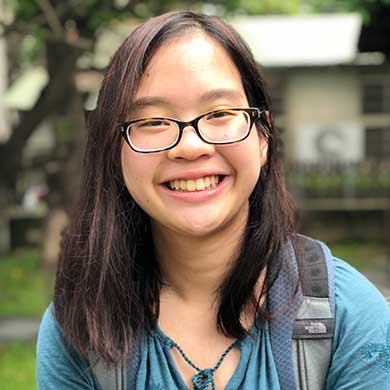
Her proposal involves elements of healthcare, natural language processing (NLP) and human-computer interaction (HCI), particularly creating solutions that bridge the gap between AI’s lofty aspirations and the actual utility medical practitioners want.
“I envisioned working on improving trust in how medical practitioners, such as radiologists, interpret decisions made by AI,” Li said. “Since medical applications tend to require more trust between AI and human users, it’s important to provide some kind of explanation for the decisions that AI might make.” Li noted that the recipients of the NSF fellowship are chosen not just on the strength of their proposals, but by their achievements as well.
While pursuing an undergraduate degree in computer science at the University of Washington, Li worked on many hardware and ubiquitous computing (ubicomp) projects.
“One influential project used facial arteries to do continuous blood pressure prediction. This is a tricky task because arteries in the face are thin and don’t give much of a signal, so doing a lot of signal processing is required,” Li said. “In the operating room, detecting heart rates through facial arteries can be advantageous in surgeries that only give you facial arteries. Furthermore, quick detection of blood pressure drops can make a huge difference in the surgery.”
While an undergraduate, Li held internships at high-profile companies, including Microsoft, Google, and Expedia. During her two summer stints at Google, she first worked on back-end work, then moved to ranking systems for Google Assistant. It was after her second summer at Google that she decided to go to graduate school, but she wasn’t sure what research area to pursue. A subsequent internship with the Microsoft Research Biomedical NLP team helped her realize she was interested in the intersection of NLP and healthcare.
Li was accepted into Northeastern in 2021 but deferred her acceptance for one year to work as an AI Resident at Meta (formerly Facebook) researching natural language processing. The program let her spend time working with mentors who helped her design a research question and explore her interests. Most recently, she has focused on understanding large language models and how to extract more information from them.
Li will continue at Meta through the summer, and said she could see herself returning there at some point. She noted that “I do enjoy the work that I’m doing and the freedom that I have alongside this work.”
At Northeastern, Li will work with her advisor, Byron Wallace, and connect with others who share her research interests.
“When I was looking at PhD programs, his goals for his research and mine were really related, so I thought we were a good match,” Li said. “I, like Byron, believe in applications-based research, and so healthcare was a natural area … I’m definitely open to more interdisciplinary research work, too.”
“Millicent is poised to do groundbreaking work at the intersection of natural language processing, healthcare, and human–computer interaction,” Wallace said. “Her selection for the NSF Graduate Student Research Fellowship reflects the promise of this interdisciplinary research direction, and her very apparent potential as a researcher well positioned to execute such work.”
Because Li’s interests have changed over time, she’s lived in worlds ranging from NLP to healthcare to HCI to ubicomp and learned what each area is lacking.
“People tend to push the boundaries for what works in NLP, but never think about how deployable these systems actually are,” she said. In healthcare, she’s found that a lot of systems aren’t made for a diverse body of users. In HCI and ubicomp, she’s seen that “there isn’t as much work in the space of integrating AI with HCI to build systems that people trust.”
While Li believes that AI will not replace human care, she does hope people will become more trusting of the benefits of AI in healthcare.
“I think the word ‘trust’ has been thrown around a lot in these research areas recently, and because of how impractical to deploy these AI systems tend to be, it’s become more popular of an issue to observe,” she said. “Trust is just one formalism I’ve used to tie NLP, HCI, and healthcare together, but I’m sure there are many more that I’m excited to explore.”
The Khoury Network: Be in the know
Subscribe now to our monthly newsletter for the latest stories and achievements of our students and faculty
Author: Milton Posner
Date: 07.11.22
The ‘a-ha’ moment was someone else’s conversation.
At an assistive technology conference, Rupal Patel spotted a little girl and a grown man chatting in identical voices that were not their own. Both were speech impaired, and like the hundreds of other attendees, they were speaking through assistive devices that offered only a few generic, computerized voices.
The precise timbre and tone of our voices reflect our bodies, our upbringings, our thinking — in short, our identities. For millions of speech-impaired people worldwide, that expression of identity is gone … unless someone builds it for them.
In the years since that conference, Patel and her collaborators have worked tirelessly to harness whatever residual vocal abilities a person has left, combine them with audio supplied by voice volunteers, and produce a customizable voice that actually sounds like the person using it.
“This was use-inspired research. People couldn’t speak, and as a clinician, I wanted them to have a voice that sounded like them and not like an ATM,” Patel said. “That’s seeing a problem and saying, ‘technology can help us fix this.’”
After seven years in the lab and another eight as the company VocaliD, the operation was recently acquired by AI platform Veritone. The acquisition begins a promising new chapter for a research effort that has maintained the same ethos for almost two decades.
“Professor Patel’s research demonstrates how computer science improves the quality of life for people across a wide spectrum, in this case individuals dealing with speech impairments,” said Khoury College Dean Elizabeth Mynatt. “By making this technology more widely available, the voices of many are now more authentically heard.”
Speaking of which …
When the ‘a-ha’ moment arrived in 2002, Patel was uniquely suited to seize it. She had studied speech and speech disorders since her doctoral days at the University of Toronto in the late ‘90s, and was a year away from joining Northeastern University. She was awarded a National Science Foundation grant in 2007 to work on personalized synthetic voices for speech-impaired people, work she quickly began in collaboration with Khoury College student Michael Everett. Here, her interdisciplinary appointment between the Khoury College of Computer Sciences and the Bouvé College of Health Sciences proved essential. The interdisciplinary approach is woven into the fabric of each college, reflected in their academic programs, faculty appointments, and research labs.
“We’ve always had students from both fields interacting together,” Patel noted. “This project doesn’t happen if you’re just in the silo of health science or just in the silo of AI. We were bringing together students from different places to help solve big problems.”
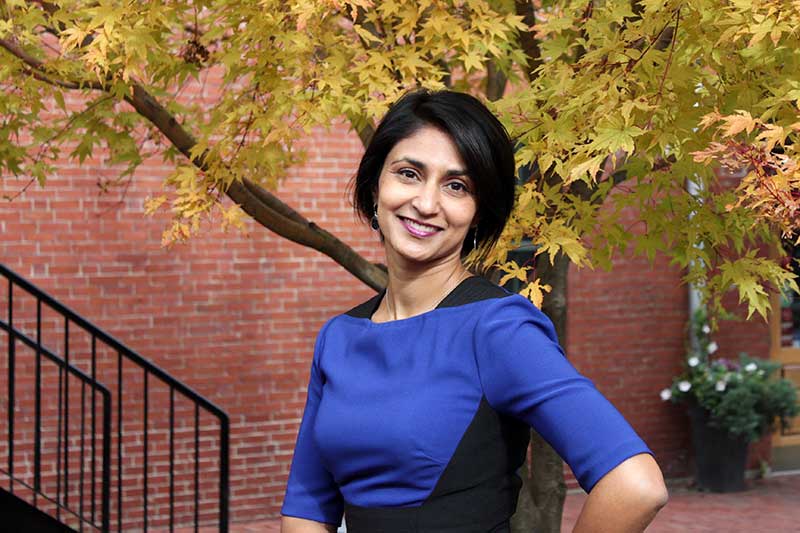
And the problems were indeed big. While the idea of crafting synthetic voices had existed for generations, it had always required a deep vault of audio recordings to use as building blocks.
“What was different about VocaliD was doing that without lots of audio,” Patel said. “Someone with a speech impairment can’t give you much audio, and it’s not good or clear audio. We figured out how to take whatever the person could still do with their voice so it would sound somewhat like them, and then find a voice donor similar to them in age and accent and other things, who would record a larger dataset. Then we’d blend those voices together.”
This sort of voice mixing was novel and workable, but incredibly resource intensive. The VocaliD team used concatenative synthesis, an audio clipping and pasting process which required countless lab hours and hundreds of thousands of dollars — all to produce one voice.
“In the last seven or eight years, massive advances in machine learning have revitalized the whole speech synthesis field,” Patel said. “Now you can make a synthetic voice with less data that sounds far more natural, and that’s controllable and configurable. It’s a categorically different, completely new technique.”
Any boost in efficiency was welcome for the team, which had aimed to balance company profitability and accessibility since VocaliD’s founding in 2014. The original mission was purely social; users paid for the voices, albeit with plenty of subsidy from National Science Foundation and National Institutes of Health grants. Then, about two years ago, VocaliD began its purely commercial voice talent enterprise, in which voice actors record a few hours of content, VocaliD builds and licenses the AI voices, and both parties profit. During the recent acquisition talks, Patel ensured that commercial considerations wouldn’t crowd out the social mission.
“We always wanted to make diverse, inclusive voices for people who needed it the most, people who aren’t heard,” Patel said. “That’s the essence of who we are; it’s why we’ve won awards and been a market leader. We’re not just compromising the use purpose for scale. It was really important not to sell the company to just anybody, but to find the right fit.”
Target acquired
The right fit, as it turned out, was Veritone, which offers a truckload of award-winning, AI-powered services across a wide range of industries, from energy to finance to retail.
“What was acquired was the entire company, and the entire ethos of the company,” Patel said. “It was really important, both for me and for them, that we didn’t abandon the social piece. Veritone does other social good projects with AI, so it fits their ethos as well.”
The two companies first collaborated to create a voice model of legendary news anchor Walter Cronkite for use in educational programs. The project helped Veritone understand what VocaliD could do, and later, what VocaliD could provide for Veritone: greater control over the voice creation lifecycle, and thus better efficiency, scale, and voice offerings. Veritone was impressed, and brought the eight-year-old company on board.
“I’m excited to see that VocaliD now has the home, capabilities, and research to reach a much larger platform,” Patel said, “both for the social piece and the commercial piece without which the social mission could never survive.”
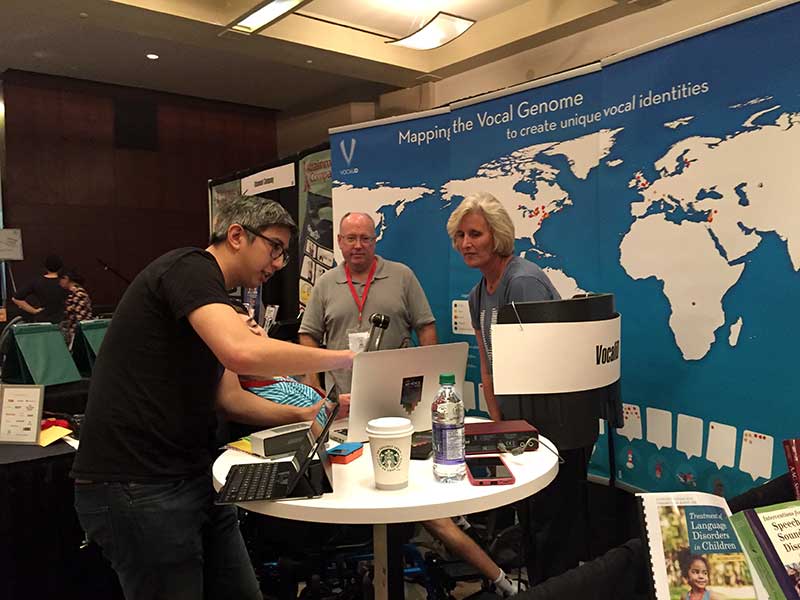
In her new role as vice president of voice and accessibility, Patel can work to balance the commercial with the social. She’ll be joined on Veritone’s Commercial Enterprise team by the rest of the VocaliD crew, including recent Khoury College graduate Teo Boley. Boley’s role will primarily focus on integrating PARROT STUDiO — the VocaliD AI-generated audio creation platform for which he was lead developer — into Veritone’s suite.
The acquisition hinges on the continuity of both VocaliD’s projects and its principles. Among those principles is one Patel emphasizes in part because so many venture capitalists and angel investors turned her away when she pitched it years ago: universal design.
“If you create something that helps a small group of people with a special need, usually it will have something we can all benefit from,” Patel said. “I think VocaliD is a perfect example of that. If we focus only on problems for the mass majority, we leave behind a bunch of people.”
“I think people don’t give enough importance to the fact that if you can help those in real need, we can change the wider world,” she added. “I think that’s the story and the spirit of Khoury and Bouvé coming together.”
The Khoury Network: Be in the know
Subscribe now to our monthly newsletter for the latest stories and achievements of our students and faculty