Author: Madelaine Millar
Date: 08.22.22
If Tina Eliassi-Rad is one thing only, it’s curious.
Her time as a young researcher at the Lawrence Livermore National Laboratory felt like being a kid in a candy shop. She learned how scientists use massively parallel computer systems to simulate complex phenomena such as supernovas and worked with an interdisciplinary group of researchers to develop statistical models. She loved figuring out how things fit together, but it wasn’t until a global tragedy struck that she understood how she could focus that skill.
“When 9/11 happened, there was all this talk about ‘if we could have only connected the dots,’” she said. “Our government put a lot of money into network science and machine learning and data mining on graphs and networks — that changed the direction of my research.”
Today, that research takes Eliassi-Rad from social implications of artificial intelligence to evolution to cybersecurity. She is the director of RADLAB, where she recruits students from the Khoury College of Computer Sciences and the Network Science Institute, and she has ongoing grants and projects related to complex networks, machine learning, and data mining sponsored by the National Science Foundation, Department of Defense, Volkswagen Foundation, and MIT Lincoln Laboratory, among others.
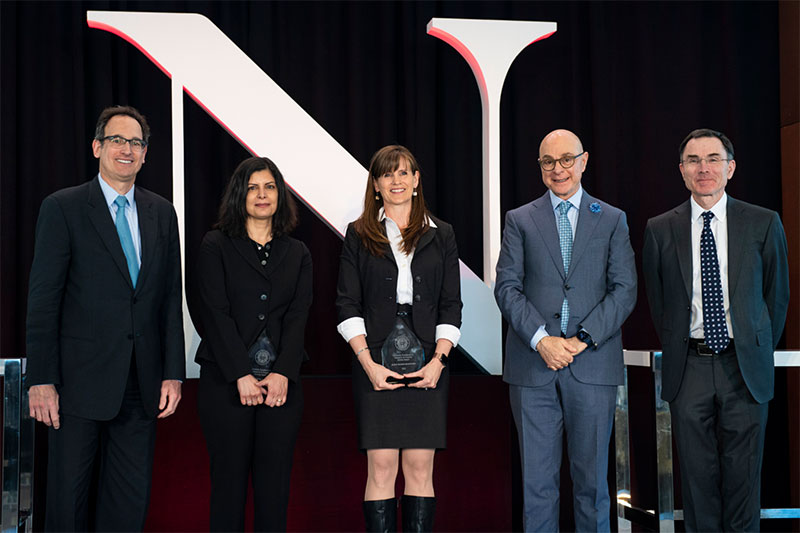
In fact, the diversity, quantity, and significance of Eliassi-Rad’s research recently earned her Northeastern’s Excellence in Research and Creativity Award, making her the fifth Khoury College researcher among the nine all-time winners. The current that carries her there — and through the broader stream of her research — remains machine learning, network science, and the interaction of the two in society.
Two networks and a map
If you’ve tried to drive around Manhattan and Boston, then you understand the basic difference between a simple grid-like network and a complex network. While simple networks are easy to navigate, complex networks have lots of nodes interacting in many different — and often messy — ways. Complex networks are a lot more useful for modeling real systems though, like how information flows through communities.
Take Eliassi-Rad’s 2022 publication Information Access Equality on Network Generative Models. Previous research established that mechanisms like preferential attachment (“the rich get richer”) and homophily (“birds of a feather flock together”) mean that information like job opportunities or medical resources don’t always make it to minority populations in time to be useful. Eliassi-Rad and her co-researchers demonstrated how both the structure of social networks and the way information spreads matter for information access equality. They observed that when more people in the majority group have relationships with people in the minority, information spreads more equally, but less efficiently.
It’s a lot more complicated than that, of course. For Eliassi-Rad, modeling the network is what helps her to appreciate that complexity.
“There are folks who like to work on text data, or on images or video. I just like to work on complex networks,” she said.
It’s impossible for an employer or a medical provider to go out into the community and tell every single person about an opportunity. Understanding how information spreads on various networks can help community builders develop complex networks with more equal information access.
Taking algorithms to school
Imagine two people in a complex social network of Facebook friends. They have hundreds of mutual connections but aren’t friends themselves. An algorithm might conclude that the two probably don’t like each other very much. It might also speculate about why they aren’t friends, but online friendship networks are not as complete as the real-world complex network they represent. The algorithm’s predictions are based on learning from incomplete data.
The data doesn’t have to be randomly incomplete, though. That’s the jumping-off point for the 2021 paper Selective Network Discovery via Deep Reinforcement Learning on Embedded Spaces, in which Eliassi-Rad and her MIT Lincoln Laboratory colleagues present an AI model to discover the missing pieces of a complex network. Their model, called Network Actor Critic, explores an incomplete complex network and finds the relevant missing data by asking a limited number of questions.
For instance, consider a city where some people have a sexually transmitted disease. Health officials aren’t aware of every infected person, so their social network is incomplete. Network Actor Critic learns to ask specific questions about the social network of people who have tested positive in order to learn about the missing people.
Eliassi-Rad stressed that AI researchers can only make an algorithm better, never perfect.
“No machine learning algorithm is 100 percent sure. If you come across one that is, there’s some problem,” she said. “Modeling the world is a complex thing; there’s always some uncertainty.”
An eye on AI
Our society is infused with machine learning algorithms recommending who to date, what to buy, what news to read, and more. These recommendations influence social, economic, and political processes, the data from these processes is fed back into the algorithms, and around and around we go.
In heterogenous societies such as the United States, not everyone is represented equally. Thus, machine learning algorithms don’t perform equally for everyone, which is a real problem when they operate in fields with little room for error like medicine and criminal justice.
“If you think about machine learning algorithms, they’re like prescription drugs. They operate differently on different subpopulations, they have adverse effects,” Eliassi-Rad said, noting that the CS field routinely, and problematically, applies them universally. “Perhaps these algorithms should have warning labels.”
As she has spent more time in the world of AI, Eliassi-Rad’s interest in the ethics of the discipline has grown, and this year — together with her graduate student David Liu and a team of researchers — she conducted her first qualitative study (to appear at the 2022 AAAI/ACM Conference on Artificial Intelligence, Ethics, and Society). Their publication, titled Examining Responsibility and Deliberation in AI Impact Statements and Ethics Reviews is a breakdown of 327 ethics reviews and impact statements from Neural Information Processing Systems 2021, a top-tier AI and machine learning conference.
READ: David Liu’s interdisciplinary machine learning research journey
The team found a stunning lack of accountability. Researchers rarely felt they controlled whether their algorithms were used for the public good, and many felt it wasn’t their responsibility to mitigate the harm their tools could cause in the first place. By that logic, the responsibility falls to the user rather than the industry collectively.
“It makes a lot more sense if the community comes together and says, ‘Okay, what are the professional norms?’ There are certain problems we should not be working on,” Eliassi-Rad said. For instance, it would be wildly unethical for police to predict crimes with an algorithm and arrest would-be perpetrators, but there’s also nothing preventing someone from building such a tool.
In addition to her research, Eliassi-Rad teaches a freshman honors seminar called “Algorithms that Affect Lives” where students inquire into where algorithms are infused into society, how they function, and what their motivations and shortcomings are. Eliassi-Rad also dispels the misconception that AI is inherently better or more objective than a human being.
“People don’t think about the incentives of algorithms being used in criminal justice, or in healthcare,” Eliassi-Rad said. “Is it to provide you better healthcare, or is it so the doctor can spend only 10 minutes with you, as opposed to 15? Is it really for better patient care, or is it for them to make more money?”
As her recent award implies, Eliassi-Rad isn’t slowing down any time soon. Despite her busy schedule though, she’s committed to making time to continue to teach about the potential — and potential ethical dangers — of AI.
“The public needs to know how AI works,” she said, “because the population that’s more informed can decide what kind of society they want to live in.”
The Khoury Network: Be in the know
Subscribe now to our monthly newsletter for the latest stories and achievements of our students and faculty
Author: Sarah Olender
Date: 08.15.22
Amy Luo and Edwin Morris led almost parallel lives, finding academic inspiration, long-term relationships, and career direction during their stints at Northeastern. Now, years removed from their time on Huntington Avenue, their paths have finally intersected.
Both Khoury College of Computer Sciences alumni now work at Datadog, a software company based in New York that monitors platforms for security breaches. Datadog’s software acts as an observability service for cloud infrastructure; customers can use it to monitor app performance, troubleshoot issues, and track user sessions, among other things.
This sort of work wouldn’t have been common ground for Morris and Luo had they not each changed academic tracks and acquired combined majors that suited their interests.
Morris was a combined interactive media and computer science major for his first two years at Northeastern but realized he was more inspired to design websites.
“It was in the logic and computation class that I figured out I didn’t want to do computer science exactly, or that it wasn’t my interest,” Morris said. “Instead, I wanted to make websites and I was interested in making websites look good.”
Morris switched his degree to graphic design but kept a computer science minor so he could still learn about front-end website development.
“Graphic design kind of seeps its way into making stuff on the web no matter what you do,” Morris said. “Khoury College definitely helped me refine what ended up being an important part of my career, which was front-end development.”
Unlike Morris, who dropped the computer science major during his Northeastern journey, Luo picked it up.
“I came into Northeastern as just a design student,” she said, “but that was the year they released this new combined major, and a lot of my friends were also in computer science.”
So in a typical college student fashion, Luo took a computer science course to be with her friends and ended up loving the subject. She switched to a combined interaction design and computer science major, accepted a co-op at Datadog, and enjoyed it so much that she went back after graduation. She still works with the same Datadog team that she started with.
Even though they took very different paths to get there and didn’t overlap at Northeastern for even a semester, both ended up with a Northeastern degree and at the same company. Luo is a software engineer, while Morris is a staff product designer. Because of the collaborative aspects of designing software aesthetics, they work on the same team — the dashboards team — to make the website and software look great.
“I get to use both sides of my combined major,” Luo said. “Even though I am a software engineer, I get to work closely with Edwin and other product designers. I get to implement cool visual features and a lot of the interaction design part.”
As Morris and Luo continue to find success in their post-Northeastern careers, they have also both found themselves still in romantic relationships initiated at Northeastern. Morris is married to a Northeastern alumna, and Luo is in a long-term relationship with the friend who initially convinced her to try computer science.
But aside from romance, Morris and Luo are grateful for the Khoury College education that set them up to have successful careers.
“I feel like [the Khoury College co-ops] gave me an opportunity to figure out what I wanted and didn’t want to do while in college,” Luo reflected. “Even though front-end development was not in the core computer science curriculum at Northeastern, after my first internship, [I took] something I was interested in and did other extracurriculars at Northeastern like Scout, where I got that experience, worked with designers, and worked on web-based projects.”
While most Khoury College friendships begin in the hallways and classrooms of West Village H, Morris and Luo both appreciate that they were able to connect at Datadog.
The Khoury Network: Be in the know
Subscribe now to our monthly newsletter for the latest stories and achievements of our students and faculty
Author: Milton Posner
Date: 08.08.22
Each year, the Khoury College of Computer Sciences attracts talented, enthusiastic students who go on to success in academia, industry, or their communities, and sometimes all three. Most arrive at Northeastern knowing they’ll pursue computer science in some form.
Stephen Alt arrived without a clue what his major would be, but five years later, you’d never guess. With a new computer science and physics diploma in hand and his master’s degree a year away, his ever-ballooning portfolio centers on one theme: merging his software skills with robotics to better the world.
Finding My Way
“Someone once told me, ‘Computers are just zeros and ones,’ and before I came to college, that was legitimately all I knew,” Alt said. “I never knew how to code. I never knew what a programming language was.”
Alt did know what he wanted to address when he arrived at Northeastern in 2016, though. After losing his father at an early age, he’d been raised by his mother and grandmother. Through dozens of visits to museums about underrepresented minorities and hundreds of volunteering hours, the two instilled in Alt the importance of social justice.
“From a very young age I was aware of social wrongdoings,” Alt said. “I wanted to give back to the world, to cherish my life and do things that benefited those around me.”
At the start of his sophomore year, Alt declared a double major in computer science and physics. He saw humanitarian potential in robotics — particularly when blended with software advances — as a way to perform dangerous assembly-line and mining work often done by children.
Not that this newfound computing interest meant he was good at it.
“I was confused because my mind wasn’t open enough,” Alt admitted. “You don’t recognize how everything runs off of computer algorithms.”
But Alt soon met other struggling students, befriended them, and grew with them. Once he grasped the scope of the field, the concepts seemed more rational, and his insecurities dissolved. Alt says he finally found his confidence during “Fundamentals of Computer Science 2” with Professor Leena Razzaq, who he considers a confidant and role model.
“He’s a good student, and very serious,” Razzaq said of Alt. “He found some of the stuff difficult, but he put in the work and did pretty well.”
By this time, Alt had also found the interdisciplinary zone where he could make his positive global impact. Robotics engineering was the body and software was the brain, and using artificial intelligence, he wanted to give the body the brain it deserved.
RIVeR Flows in You
“Humans need to get off the planet. We have to go to space.”
That speech, which inspired a first-year Alt to join Northeastern’s Robotics and Intelligent Vehicles Research (RIVeR) Laboratory, was given by the lab’s founder and director Taskin Padir. The lab focuses on human–robot teaming while allowing students to explore sub-missions.
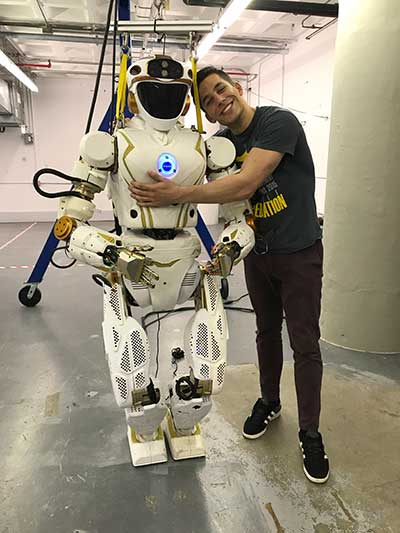
What most attracted Alt was Valkyrie, a robot NASA designed as a space-traveling, task-assisting companion for its astronauts. The RIVeR Lab had acquired a Valkyrie robot during Padir’s first year at Northeastern, and more than 100 students, including Alt, have worked on motion-related algorithms and behaviors for it since.
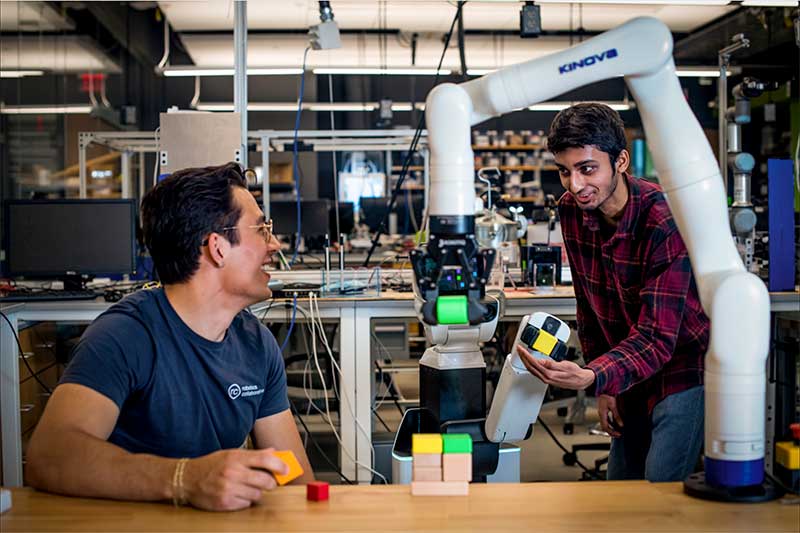
“Getting a humanoid robot to walk is extremely challenging, so we focused on improving the control system,” Alt explained. “Working on this robot contributed a lot to my passion and opened my eyes to the potential of robots to help humanity.”
It also began his RIVeR Lab journey.
“I told Professor Padir, ‘This is what I want to do with my life,’” Alt recalled. “He’s super supportive, an amazing mentor just like Professor Razzaq. He invested a lot into me and was extremely patient.”
“I have one prerequisite: commitment,” Padir said. “When Stephen first showed up, he had no idea about robotics. But he impressed us by saying, ‘I’m ready to listen and learn.’ That can-do attitude kept him going.”
His attitude also helped Alt overcome major hurdles, namely a lack of original research experience that initially confined him to minor lab tasks.
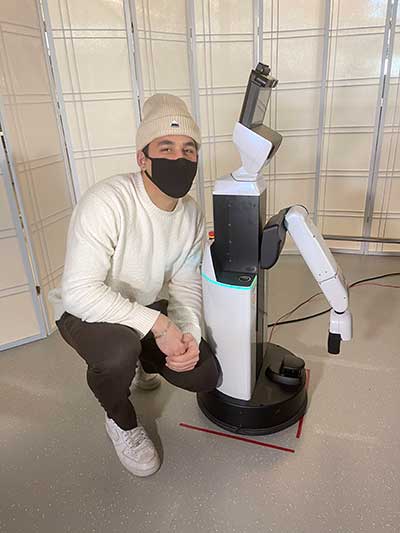
“Joining the lab changed my life. My best friends are all PhD students in this lab; they’re like brothers and sisters to me,” Alt said. Murphy Wonsick, Velin Dimitrov, and Tarik Kelestemur “mentored and supported me and taught me how to research. They never gave up on me and that really motivated me.”
In Alt’s fourth year, he collaborated with Wonsick, Kelestemur, and Padir to improve object recognition models inside virtual reality headsets, making them more accurate and detailed, and thus making the user feel more like they’re walking in the robot’s shoes. Further advances could eventually allow human users to avoid dangerous environments by sending robots instead. The team’s paper was accepted at the elite IROS robotics conference in September 2021.
That same month, Alt got his first taste of robotics competition at the renowned Avatar XPrize in Miami. As pandemic mitigation measures highlighted the value of remotely controlled robots, Northeastern’s team rose to the challenge by crafting “Robalto the Husky,” an arm-and-mobile-base robot that can perform numerous physical tasks. While most competitions have teams showcase their creations, Avatar XPrize judges put the robots through their paces themselves, emphasizing the importance of user-friendliness.
“We combined the unique mechanical engineering technology developed by Professor Peter Whitney with our expertise in systems and algorithms, and exited the semifinals as the top-ranked American team, trailing only the Germans and Russians,” Padir said. “Stephen was a key player. I sometimes call him ‘the nudger’ because he keeps track of what needs to be done and has that energy to motivate the whole team.”
The team won $150,000 in semifinals prize money, which the RIVeR Lab used to recoup project costs and fund the team for finals this fall. Should they place in the top three, they will win between $2 and $5 million, enough for each team member to pocket a hefty chunk.
“The great thing is, our system has so much room for improvement,” Alt said, citing the robot’s base and human interaction. “This is mind-blowing … What an incredible experience!”
Nor was it the only one. A couple of months earlier, Alt had spent his summer at the International Elite Summer School in Robotics and Entrepreneurship in Odense, Denmark. Of Northeastern’s six participants, he was both the only Khoury College student and the only undergrad among a cohort of engineering doctoral candidates.
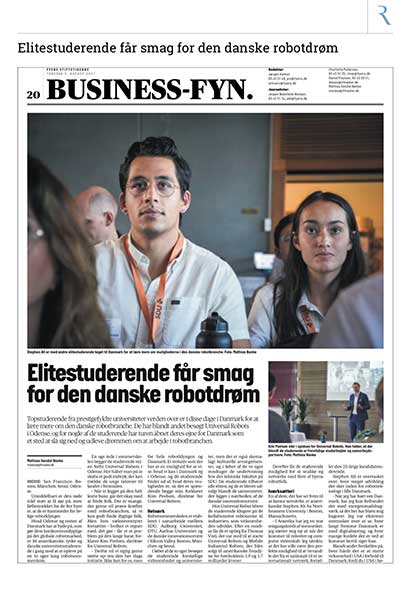
“It was conference style; the best roboticists from the European Union came and spoke about their research, and we got to tour the big robotics companies,” Alt said. He also worked on a project with a Danish professor who had started a company to detect early-onset arthritis, and whose software boasted an 87 percent accuracy rate. Alt and his fellow students developed a deep-learning-based addition that improved the accuracy to 94 percent.
The local scientific culture was also key. As Alt’s trip companion Syed Mohammad Asjad noted, Danish companies generally invest in each other and share resources rather than competing. The cross-cultural program shares that collaborative ethos, as Alt discovered when he discussed his projects and interests with the CEO of manufacturing giant Universal Robots. The CEO’s response: gifting Alt one of his company’s $30,000 robot arms.
“I learned a ton and met amazing people,” Alt concluded. “Diversity and inclusion is so core to me, and this was a group of people from all over the world. Just incredible.”
With You There to Help Me
So far, Alt’s most direct contributions to social justice have come not through robotics, but through teaching. He began working as a TA in the fall of his sophomore year, in the class where he’d recently found his computer science mojo: Fundies 2 with Leena Razzaq.
“Stephen was an awesome TA, and very helpful,” Razzaq said. “He was really great with the students. I’d always hire him whenever he was available. I think the students really liked him, and could talk to him without feeling judged.”
“I believe that teaching people is the best way to spread knowledge and expand your impact,” Alt said. He applied similar lessons as a teaching fellow for computer science and physics courses. “I want people to learn from my mistakes so they can avoid those mistakes or power through them … the main thing I did through these experiences was to build confidence in others.”
Alt has also taught in the lab. The RIVeR Lab’s open-ended setup, in which ambiguity fosters collaborative problem-solving, encourages young roboticists to become mentors.
“Stephen’s mentors took him under their wings, he persevered, and now he’s a mentor to many undergrads,” Padir said. Alt took to the role “very naturally, because that’s how he was trained. Someone mentored you to learn a new skill and added value to your career or personality, and now it’s your turn.”
Alt’s teaching experience hasn’t been confined to campus. In 2018, he joined a local branch of Girls Who Code, where, for three years, he designed curricula and taught typing, mathematics, functional programming, object-oriented programming, web development, game development, and web design in the under-resourced neighborhood of Dorchester. He noted that many of his students later earned admission to elite technical high schools.
“These girls would come to us not knowing how to type, and we were trying to teach them how to code,” Alt said. “It’s extremely humbling and rewarding because you become more than a teacher. You’re creating a family.”
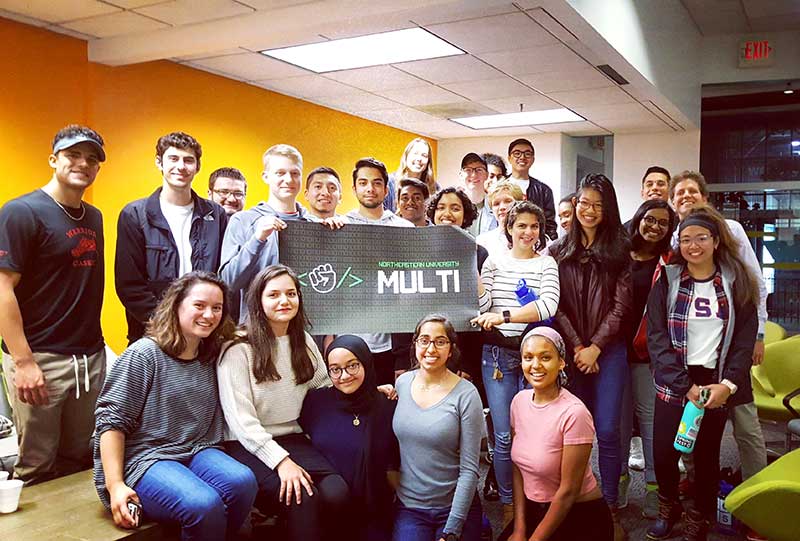
By fostering diversity in computer science, Girls Who Code shares something with Multi-diverse Unified Leaders in the Technology Industry (MULTI), a student organization Alt co-founded in 2017. He cited his own struggles fitting in and stacking up in computer science classes, challenges that often compound for minority students.
“I saw the impact of sexism at an early age, which allowed me to see the impacts of racism and other social issues,” Alt said. “We needed to create a club for people who were struggling, to show the importance of support and diversity in the tech industry.”
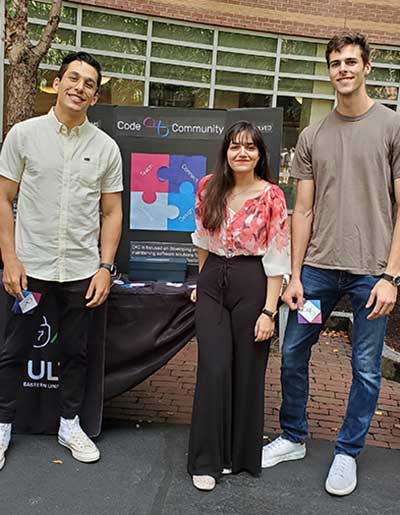
And just to round things out, Alt co-founded and led Code4Community, a student club that develops and maintains free software solutions for Boston nonprofits that otherwise couldn’t afford them. Among others, they have designed web apps for Speak for the Trees Boston, which aims to enlarge and improve Boston’s urban forest, and Lucy’s Love Bus, which strives to boost quality of life for children with life-threatening illnesses.
READ: Khoury College student club gives back to Boston through code and design
Throw in a couple of co-ops at IBM Research and a stint as a Khoury Advisory Board liaison, and it’s a resounding undergraduate résumé for a computer scientist with lofty interdisciplinary and humanitarian goals.
“Teaching and helping others is super important to me, so I always want to make sure I’m doing that,” Alt said, citing classes, a research lab, a start-up, or a mix of the three as possibilities. “Hopefully I’ll work on projects that are beneficial to the world.”
The Khoury Network: Be in the know
Subscribe now to our monthly newsletter for the latest stories and achievements of our students and faculty
Author: Kelly Chan
Date: 08.01.22
Anusha Arora, who served as president of Northeastern’s Computer Science Mentoring Organization this past year, is passionate about welcoming computing students into their discipline and empowering them to learn about the variety of paths they can pursue.
The student group, also known as CoSMO, had an overwhelming number of mentees join this year, with around 75 students this past spring and more than 100 in the fall.
“As a first-year student, it could feel really intimidating since I hadn’t done anything related to computer science before college,” said Arora, now a rising fourth-year computer science and business major. “CoSMO was a very inviting space. I didn’t feel like I needed prior experience, and I could easily show up, learn, and meet other people. That’s the environment that we want to continue to create.”
For five years, CoSMO has aided computing students in their transition to Northeastern and to computing majors. Kene Muogbo, vice president this past spring and now a club advisor, emphasized his primary goal as a mentor is to relieve students of their worries about the future, especially about getting a co-op.
“I’ve heard a lot of mentees talk about how they felt more comfortable being at Northeastern [because of CoSMO],” said Muogbo, a rising fourth-year computer science major. “Everybody stresses that first semester of their first year because everything’s new, and having somebody that they can reach out to and talk to was the most alleviating thing.”
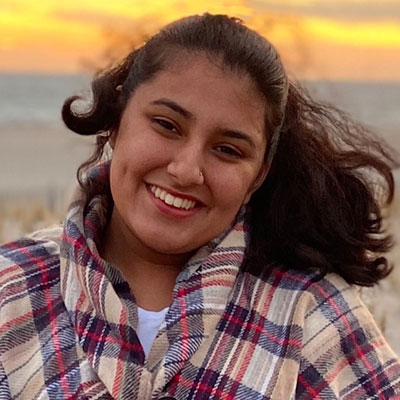
At the start of each semester, the CoSMO e-board pairs mentors with mentees. Mentors build relationships with their mentees, providing support and answering questions about the mentee’s major and field, from course advice to co-op applications.
“Trying to find that perfect [mentor] for somebody — it’s tenuous, but it’s really fun because I love to hear them come back and tell us, ‘Oh yeah, I love my mentor,’” Muogbo said. “It makes me feel like I can help them out.”
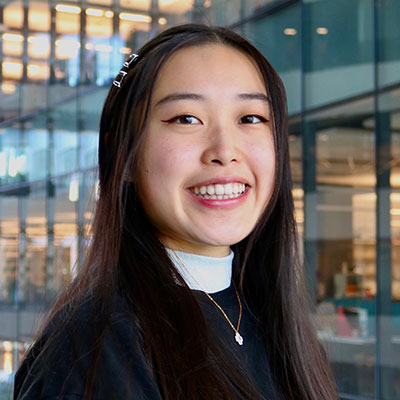
Rachel Li, a current mentor and the president of Northeastern University’s Women in Tech (NUWIT) this past spring, shares Arora and Muogbo’s enthusiasm and dedication to the program.
“As a freshman, I realized it’s important to have a mentor to guide you, especially since I was in data science. It was a really new major, so I didn’t know a lot of people that were also data science,” she said. “Now that I’m eligible to be a mentor, I want to be that for someone else who is finding their way.”
For the last year, CoSMO has worked to improve its collaborations with other computer science clubs, including the Game Development Club. Its biggest collaboration is a triad with Li’s NUWIT and Multi-Diverse Unified Leaders in the Technology Industry (MULTI). Through this partnership, CoSMO mentees can have mentors in NUWIT and MULTI, which facilitates more conversations for students from marginalized groups in tech.
“Because there’s a lack of representation of women in tech, not a lot of girls go into it because they don’t see themselves in the field, or they don’t see a role model that they can look up to,” Li said. “So being a mentor, I can show underclassmen that this is a path they can pursue and there are people here to help them on their journey.”
While mentorship is its main focus, CoSMO also hosts events to introduce students to necessary tech skills, other people in their major, and different career paths. For example, every semester, it offers workshops on GitHub and on behavioral and technical interviews.
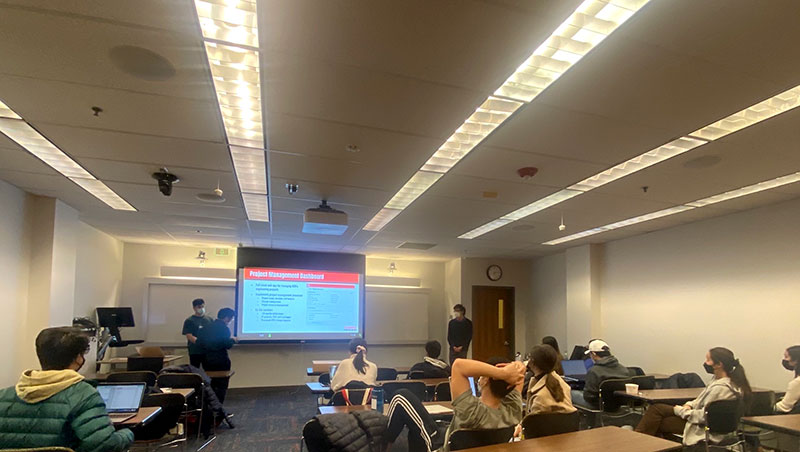
“Showing people the different options in tech can give them an idea of what they want to do with their degree, or introduce something they’re interested in learning more about,” Arora said.
These workshops were what excited first-year mentee Hamsini Sivakumar the most. Since she joined the organization in the fall, it’s helped her learn new skills to transition into college.
“Last semester, I remember I went to this résumé workshop, and it was really helpful,” she said. “They taught us how to properly format our résumés and what things we needed to include, because it’s very different from a résumé we’d use in high school.”
CoSMO also recently launched its own podcast on Spotify called CoSMOcast, which aims to virtually connect and mentor students. The podcast will feature students, alumni, faculty, and tech professionals discussing their experiences working in computer science and providing advice to those entering the field. In August, CoSMO plans to release a new episode targeting incoming students.
Muogbo found that conducting interviews for this podcast inspired him and eased his post-grad concerns.
“I was able to hear [the guests’] stories, their problems that they faced when they were in my shoes, the problems that they face now, and how far they’ve gone,” Muogbo said. “I was impressed with how well that they were doing, and it gave me hope for whatever the future holds for me.”
Overall, the organization’s impact goes beyond its main mission.
“CoSMO is more than just receiving help and guidance on your career or what you should be doing,” Sivakumar said. “It’s also about building a relationship with your mentor, and that relationship is very nice because they’re more than just a mentor — they’re your friend.”
The Khoury Network: Be in the know
Subscribe now to our monthly newsletter for the latest stories and achievements of our students and faculty