Author: Milton Posner
Date: 12.12.22
On a sunny, late spring day in the southern Utah desert, more than 100 miles from the nearest hospital, an astronaut lay motionless. Time was running out.
He needed help at that moment, someone to discover and deliver him from a parched and unforgiving landscape. What he got was a robot sidling up to him and unceremoniously dropping a water bottle onto his chest.
The astronaut, it bears mentioning at this point, was a mannequin. The time running out had more to do with a competition than the astronaut’s vital signs. And the eager, water-bearing bot was designed by the Northeastern University Mars Rover Team, a student organization of engineers and software aficionados devoted to building the best desert-roaming vehicle possible.
Ninety-nine university teams from around the globe applied to attend the 2022 Mars Society University Rover Challenge, in which teams complete as many equipment servicing, autonomous navigation, and object delivery tasks as possible within the allotted time. Northeastern’s vehicle, Watney Mark 3.0 — a nod to Mark Watney from The Martian — was one of 36 that passed the system acceptance review round and made it to the competition in Utah. There, Northeastern placed 16th, a strong finish for an on-the-rise squad rebounding from the graduation of numerous leaders.
“It felt like our first time. No one was legacy; no one had been to the competition before,” says team leader Garrit Strenge, a fourth-year computer science and computer engineering student. “None of the parts worked at the start of the year, and to see everything come together, to see the team drive the rover and control the arm, it was an incredibly proud moment.”
The collaboration that produced that moment was complex and frenzied, a delicate dance between the mechanical team that crafts the hardware, the electrical team that wires it together, and the software team that codes the vehicle’s controls and behaviors.
“We’re controlling the rover from the lowest-level, closest-to-bare-metal code all the way up to high-level UI code,” Strenge says. “The software team has to think about absolutely everything and how it integrates together.”
This year, that team is the domain of software co-leads Shannon McInnis and Brooke Chalmers, both computer science majors at Khoury College. McInnis focuses on firmware, and spent much of the previous academic year working on the rover’s all-important arm.
“It was brand new and we didn’t have any software for it, so the biggest challenge was just getting it to move at all,” McInnis says. Because the team’s feature-rich motor controllers are intended for the FIRST Robotics Competition, she “had to figure out how to use their libraries in ways that weren’t necessarily intended.”
Initially, the team planned to control the arm with an Xbox controller, the same way they control the vehicle’s driving and the arm’s gripper. But McInnis had a more ambitious idea: a miniature arm whose movements the vehicle arm would mimic.
“The arm has six degrees of movement, and it’s hard to translate that movement onto an Xbox controller. You could only move one joint at a time, which makes it less precise and extremely slow; plus, if you mess up one move, you have to go back,” McInnis explains. “I was really happy when the model arm worked because it took so much effort.”
It was, Chalmers adds, an “intuitive way to get it working.” The team is now augmenting the arm for Watney Mark 4.0, which is where Chalmers’s control UI specialization takes over.
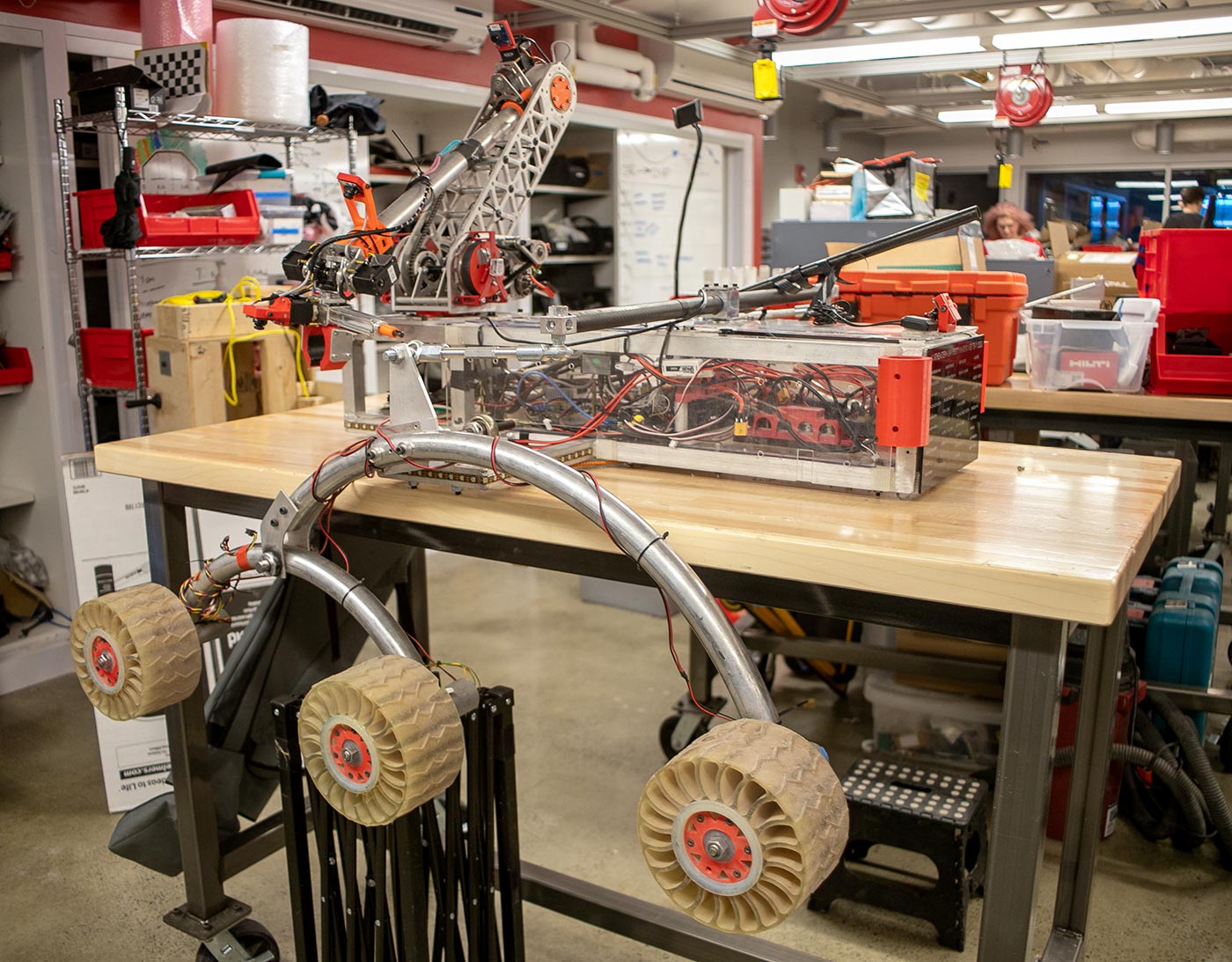
“We’re going to try to add inverse kinematics; that way we can tell the arm to move to a given position, and the arm will figure out its joint position along the way,” she says.
The arm is one of many planned improvements. Unlike last year, the team is starting with a working rover, affording them the bandwidth to add higher-level features. Chalmers wants to use computer vision for the autonomous challenge, combining it with GPS data so the rover can better pinpoint markers in the desert. She also wants to fully integrate the existing stereoscopic cameras, boost processing power to support the sensors, and increase the driver’s capability.
Such features, the team emphasized, are ends in and of themselves — but they do improve their competition chances. After a last-minute virtual competition left the team to develop their rover in a simulation in 2021, they returned to Utah in 2022. The 12-person crew — one expert for each rover part — earned their strong overall finish despite the occasional scramble, and they relished the chance to bond with each other.
“My favorite part of my Rover experience was being off in the AirBnB in Utah,” Chalmers says, recalling a night of component testing illuminated by rental car headlights. “Building up to that, it felt like I’d been working in a professional setting. So it was really cool to get to know people on a personal level and spend all my time with them.”
And this year, the team expects last year’s progress to compound, especially since they can start practicing sooner.
“You don’t need the technically best robot. It can be pretty janky, but if you’ve practiced controlling it and know exactly how it works, you can outperform someone with a perfect rover who hasn’t practiced with it,” Strenge notes. “I think a podium finish is definitely doable.”
That finish will rely on the same sponsors that supported the rover’s construction and enabled the team to attend the competition last year: Khoury College, the College of Engineering, the College of Science, and the student body.
“Sponsors allow us to do bigger things and allow more people to get this experience,” Strenge says. “A lot of the equipment costs a lot of money, and it’s great to give these students the ability to work with real-life, practical equipment and software.”
But a podium will also require fresh talent — motivated students who buy into the group’s mission and work. To incorporate those students quickly, the software team tries to make their onboarding useful for coding vets and newbies alike.
“We want people without technical experience to be able to join,” McInnis explains. “We make sure everyone has things to work on, that it’s enjoyable, that they feel supported, and that we can answer their questions.”
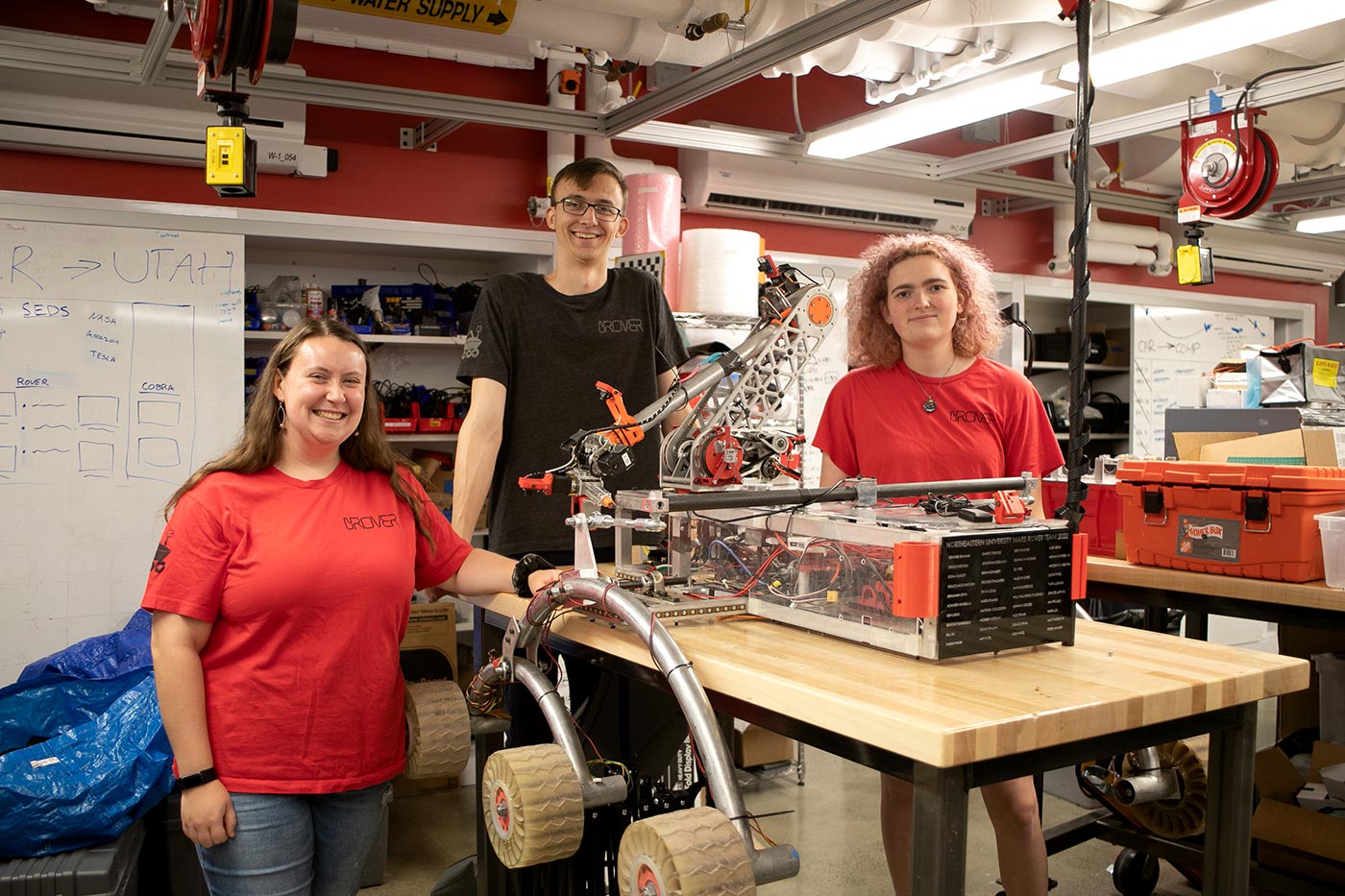
“It augments the classroom side of things,” Chalmers adds. “We work with version control, manage collaboration, pass down knowledge through a wiki — practices that show up in co-op and beyond. Getting experience with those things through Rover is a great way to learn.”
The software team’s members agree. The club’s internal surveys reflect a unanimous feeling that Rover bolsters members’ collaboration skills, and a majority believe their participation helped them to achieve in classes, earn co-ops, and sharpen their skills in numerous coding languages.
“None of us would be on this team if not for the help we’re getting from classes, but the stuff you learn here is practical experience you don’t get in the classroom,” Strenge says. “It’s like you’re working at a real company. The experience is second to none.”
The Khoury Network: Be in the know
Subscribe now to our monthly newsletter for the latest stories and achievements of our students and faculty
Author: Attrayee Chakraborty
Date: 12.06.22
One January evening, as he compiled his code for the tenth time, Vivek Kanpa smiled to himself when a program he wrote to analyze massive amounts of molecular data finally yielded a hit. He was amazed at what unfolded in front of his eyes: there was a potential way to find new protein targets for cancer immunotherapies using data science. He could use personalized medicine to help solve the world’s most unsolvable problems, and he could achieve this by marrying data science with biology.
Kanpa, now a fourth-year student, had been looking for a way to bridge the problem-solving gap between computer scientists, clinicians, and biologists in precision medicine research. So when he heard about the George J. Mitchell Scholarship, it was a no-brainer: he had to apply.
The Mitchell Scholarship is funded by the United States and Ireland, and gives Americans aged 18–30 the opportunity to pursue a fully funded year of postgraduate study in Ireland or Northern Ireland. Kanpa has been nominated as one of twelve scholars in the 2024 class, and his motivation is clear.
“I knew this could accelerate my goals in working at the interface of data science and biology,” Kanpa said. “Going to University College Dublin next year for a fully funded program on artificial intelligence in medicine will give me access to state-of-the-art biopharmaceutical resources, specifically in Ireland, where personalized and equity-based healthcare seems to be the next generation of medicine.”
Kanpa always had a penchant for biology, but not always for computer science.
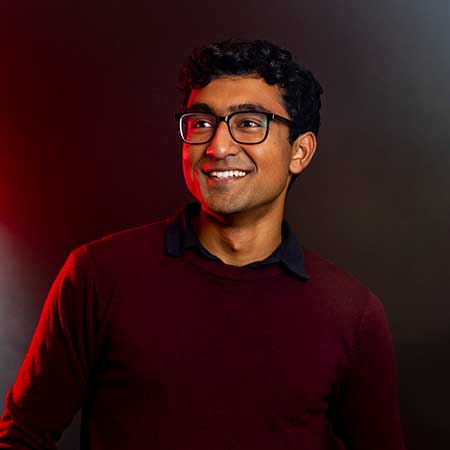
“Despite both my parents working in computer science, I didn’t feel it was for me, even in high school,” Kanpa said. “Khoury College’s approach to teaching computer science to a diverse audience is what pulled me in. The coursework was applied to other disciplines such as biology and environmental science, which changed my outlook towards computer science. Khoury College has enabled me to combine healthcare and data science; I never really felt that I was working on computer science in isolation.”
Soon, Kanpa found himself pursuing a double major in data science and biology along with a minor in math. Besides the class experience, Khoury College’s co-op program was instrumental in fueling his ambitions. In his first co-op with Takeda’s Global Biologics team, Kanpa performed a lot of data automation, web development, and software development.
While questing for innovative solutions at Takeda, Kanpa was exposed to Northeastern’s Apfeld Lab, commonly called the “Worm Immortality Team” because of its work on neuronal tissue aging in a species of tiny worm called C. elegans. Kanpa found a high similarity between the lab’s data processing and his Takeda work, and he soon joined the lab, where he improved the team’s Pharedox software package to automate processing for massive chunks of high-throughput data. This software was used to generate intensity maps of the worm’s morphology, which plays a role in understanding the neuroendocrine signaling that protects humans from diseases like Alzheimer’s.
“Again, I found myself working at the interface of biology and data science to ask questions previously impossible without computer science,” Kanpa said. “I was always interested in making an impact on healthcare, and using my skill set in computer science helped me to stay at the forefront of cutting-edge research.”
Kanpa notes that Northeastern faculty have supported and motivated him immensely. He specially credited College of Science Professor Javier Apfeld, who encouraged him to apply for opportunities such as the PEAK Experiences Trail-Blazer Award. This award supported Kanpa’s part-time research on oxidative stress mechanisms, and it helped him compare his work with already-generated data to his work creating new data during lab experiments. Kanpa believes it was the turning point in his career, the moment he first carved a niche for himself at the intersection of biology, machine learning, and big data.
READ: Combining health research with CS, Devashish Sood earns PEAK Experiences Award
Armed with this multidisciplinary kit, Kanpa ventured forth to his current co-op at Revolution Medicines, where he works to predict drug permeability and unlock potential cancer treatments, all using a machine learning process called Graph Convolutional Networks.
“At Takeda, I was fully grounded in data science, specifically automation. I never set foot in biology labs or saw how experiments worked,” Kanpa said. “That is why I applied to RevMed; I wanted to get hands-on experience in labs. I wanted to learn directly from everyone at RevMed.”
Getting into a lab with little experience in hands-on bench work was a challenge, but Kanpa’s RevMed teammates brought out the best in him.
“This co-op made me realize my work values,” he noted. “I have learnt things about myself such as knowing where I’d thrive, what I value, and what my priorities are.”
To Kanpa, winning the Mitchell Scholarship feels like the culmination of years of classroom study and all he’s learned in co-op. He hopes to pursue a doctorate in developing computational tools and machine learning models to make precision medicine the new reality, and thinks the scholarship will help him become even more curious.
“I think about the kindness, patience, and enthusiasm that my mentors and professors showed me; this is as much their achievement as it is mine,” Kanpa said. “Representing Northeastern and my mentors is a big honor, but at the end of the day, I’m just a science nerd trying to think differently about the data we have to answer the same questions as everyone else.”
The Khoury Network: Be in the know
Subscribe now to our monthly newsletter for the latest stories and achievements of our students and faculty
Author: Sarah Olender and Milton Posner
Date: 11.21.22
On Tuesday evening, as the light of the November sky gave way to the speckled lights of the surrounding buildings, the cleared-out roof of the Columbus Garage morphed into a racetrack.
Northeastern Electric Racing was showcasing their all-electric, formula-style race car, and behind the wheel of the zooming car were Northeastern President Joseph E. Aoun and Khoury College Dean Elizabeth Mynatt.
“I’m very excited to be out here,” Mynatt said, before joking, “All of my Mario Kart experience will come in handy.”
Aside from the test drives, the software team spotlighted FinishLine — the resource management platform they designed and built — and celebrated the club’s exponential growth in recent years.
“This event represents a commitment to interdisciplinary projects, and it recognizes the club’s impactful student opportunities,” NER President James Chang-Davidson added. “We’re honored to celebrate the work of thousands of undergrads across the College of Engineering, Khoury College, the D’Amore-McKim School of Business, and beyond by having President Aoun and Dean Mynatt take our car for a drive.”
For the test drives of (in order) Aoun, NER Chief Electrical Engineer Matthew McCauley, and Mynatt, see Sarah Olender’s photos below. For more information about NER’s engineering and software journey, as well as their recent success at a famed NASCAR track, check out Khoury News’ recent story on the club.
The Khoury Network: Be in the know
Subscribe now to our monthly newsletter for the latest stories and achievements of our students and faculty
Author: Khoury Staff
Date: 11.18.22
On November 3, the London campus hosted the second stop of a yearlong, global celebration of Khoury College’s 40th anniversary. As one of the world’s first colleges of computer science, Khoury College launched its 40th year in late September on the Boston campus, and network celebrations are planned for the remainder of the 2022-23 academic year.
Dean Elizabeth Mynatt opened the November 3 event by welcoming close to 100 students, alumni, faculty, staff, and Khoury leadership to the London campus. The event marked the new dean’s first visit to the London campus, but she plans on being back regularly given the important role the campus will play in Khoury’s academic and research activities.
Mynatt stressed the College’s goals of ensuring its education and research “focuses on the needs of underserved populations and on how computer science is interwoven in every industry and every aspect of society.” Mynatt also shared impressive data about the College’s incoming freshman class: 46% women and 24% students from underrepresented populations.
Ben Hescott, Senior Associate Dean of Academic Programs and Student Experience, emphasized the continued impact Khoury has in the field given its “amazing students, accomplished faculty, and significant footprint in the U.S. and around the globe.” Hescott stressed to the students in attendance the many opportunities they have in front of them given the College’s combined majors and 600 co-op sites. He shared inspirational stories of the work Khoury students are doing across the world.
Since London is a hub for network science, a leading research area for Khoury College, the event also featured an interactive presentation by leading network science researcher Ginestra Bianconi. Bianconi spoke about the interdisciplinary nature of network science and its relevance to many aspects of daily life from education to health care.
A networking reception followed the speaking portion of the program—with many students and faculty continuing to discuss topics brought up at the event as well as socializing with Khoury colleagues across the network. The evening event was proceeded by various advising activities for the Khoury first year students in London, as well as planning meetings with London campus leaders and network partners.
“For students based here in London, I think it’s a really exciting experience,” explains Rob Farquharson, CEO of the London campus. “They’re living right in the heart of a diverse and exciting city. London is a global city with a huge range of nationalities and ethnicities represented here. It’s very much an immersive experience, an exciting experience in a different culture.”
The Khoury Network: Be in the know
Subscribe now to our monthly newsletter for the latest stories and achievements of our students and faculty