Author: Zorain Nizamani
Date: 01.10.23
One evening, as a girl binge-watched CSI: Cyber, she pondered the question many young people tackle: What was she was passionate about? And as she noticed the digital forensics and cybersecurity ideas sticking with her, she found her answer.
Fast forward a couple of years, and this girl found herself as a third-year cybersecurity major co-oping at NCC Group. This is the ambitious story of Sara Takhim, who, through stints at IBM, New York City Cyber Command, CACI International, and Code Ninjas, has grown her passion in an ever-growing field that offers new things to learn every day.
That passion began with a middle-school computer obsession and continued with Takhim’s pursuit of professional internships and certifications in high school.
“I am fortunate enough to have a dad that works in the fintech space, so he is pretty aware of cybersecurity,” Takhim said. “He was kind of my advisor, and I cannot thank him enough for where I am right now.”
In her recently concluded co-op at the NCC Group, Takhim was a security consultant who advised clients on how to keep their data safe and secure.
“I was a penetration tester; I worked with other consultants to look for vulnerabilities within the client’s web applications, or their internal and external networks,” Takhim said. “We found these vulnerabilities and provided our clients with recommendations on how to fix them. It was pretty insane!”
The goal, Takhim adds, was protecting the client’s data using the three pillars of security: “Confidentiality is protecting data, making sure that someone who doesn’t have permission to see certain information cannot see it. Integrity is ensuring data isn’t altered or changed. Availability is ensuring the service is always available for whoever needs it in that point in time.”
Takhim also explained how hackers tend to get creative with their tactics.
“Hackers are always trying to do something different and quirky and are trying to find new vulnerabilities,” Takhim said. “There is always a new update being released or a new technology, and they are always going to find a back door in terms of how to break into it and exploit it.”
Apart from her co-op, Takhim was lucky enough to intern with IBM in the summer of 2022.
“I was specifically on the incident response side of things,” she recalled. “I did engage in a ton of training, including preparing interns for an actual breach. I led the data breach response for the simulation that we were going through.”
But Takhim’s impact isn’t limited to the workplace. She is also the president of Northeastern University Women in Technology (NUWIT), a student organization that uses community events, mentoring, and networking to support women pursuing technology, information science, and computing.
“I’ve always been big into leadership; I’ve always held leadership positions and tried to make an impact, whether it’s my hometown, my high school, or Northeastern,” Takhim said. “It’s always been a part of who I am. I knew that I wanted to have some sort of leadership position, and NUWIT was the place that spoke to me the most.”
READ: Former NUWIT President Rachel Li mentors new CS students at CoSMO
Takhim explained that after joining NUWIT virtually as a first year in 2020, she knew she wanted to contribute more, to help others grow and gain exposure. She quickly started getting visions of what she could do as a leader.
“I could immediately sense it was a community that was bigger than myself. The entire goal of the organization was to help others in the field with making connections and learning more about technology in general,” she said. “In my sophomore year I was elected as an outreach coach, so I was the one out there planning meetings and assigning different tech talks.”
“I was elected president for this school year, and I couldn’t have been happier,” she continued. “It’s all about helping others in the field — women and gender minorities specifically — to break into the field, learn about new technology, and make connections.”
Throughout, Takhim’s innate leadership abilities have helped her adjust in her roles at NUWIT, and that adaptability should serve her well in a challenging field that keeps her on her toes.
“There is so much to read up on, at certain points I feel like I know such a little fraction of cybersecurity,” Takhim conceded. “You always feel like you aren’t doing enough sometimes, but in the end, when you find a critical vulnerability, you feel like it pays off.”
Takhim plans to continue working within the cybersecurity ambit, and after drawing inspiration from the passion of her Khoury College professors, she hopes she can inspire other students and young professionals to undertake this deep, ever-growing field.
From a girl binge-watching CSI: Cyber to a cybersecurity professional helping clients find vulnerabilities in their computer programs and protect themselves from hackers, Takhim has come a long way. And she’s just getting started.
The Khoury Network: Be in the know
Subscribe now to our monthly newsletter for the latest stories and achievements of our students and faculty
Author: Attrayee Chakraborty
Date: 01.10.23
If one word could best describe Jona Fejzaj, it would be curious.
Curiosity is what led Fejzaj, a recent transfer student, to represent Northeastern in Moving the Cities, a weeklong international program where students think as innovative entrepreneurs to address regional and global challenges. The mentoring of international coaches, along with the support of German and Brazilian universities, helps undergraduates devise unique solutions and tech-based business plans — all with an international perspective.
This year, seven Northeastern students collaborated in multicultural teams, developed innovative ideas, and sharpened their entrepreneurial skills in the hybrid event, and Fejzaj was one of them. During the two-week program, the Khoury College computer science and mathematics student teamed with students from Germany and Chile to develop sustainable transportation solutions. Her computer science background, when meshed with her teammates’ communication and engineering specialties, gave the team a well-rounded problem-solving perspective.
“I want to work on ethical computing and making sure that the programs and software we develop can be used fairly and equitably.” — Jona Fejzaj
Fejzaj had transferred to Northeastern after changing her major to CS and realizing that she needed a flexible program where she could study her preferred topics. When she learned of Northeastern’s participation in Moving the Cities, she found a similar flexibility, this time with a global component.
“I was always interested in exploring sustainability,” Fejzaj explains. “After transferring to Northeastern, I wanted to meet people all over the world, and to experience something meaningful, but also something worth learning from.”
Fejzaj and her team, seeking a fast, elegant, and efficient mobility solution for students, designed sCOONIv — a scooter that universities could lease to students who lived far from campus. The team derived inspiration from the city of Santiago in Chile, where, their research showed, most students wait 10–30 minutes for public transport and over 50 percent of riders spend more than two hours on public transit. One of Fejzaj’s teammates spent a lot of money on private transportation as well.
“That made us think: why should they wait for the bus if they can have an option for an affordable scooter to reach their schools?” Fejzaj says.
Understanding the problem’s global scope, Fejzaj and her team devised a business idea for procuring and distributing scooters to students at an affordable rate. “That way, we could partner with universities to procure the scooters and lease them out to students where public transport is unpredictable,” Fejzaj explains.
The team had developed a marketing model: a single up-front payment by students to ensure 24/7, affordable, convenient availability of scooters. The plan aims to benefit both students and universities through its reliability and image value, respectively. Fejzaj’s team even planned the execution of the idea; either the schools could manage their fleets, or the team could manage it for them.
But this level of detail didn’t come easily. The team had to brainstorm ideas, predict execution glitches, think about how to connect and verify users — preferably through a QR code — and build a business model fair for all stakeholders.They also envisioned that the user experience could be enhanced by building an app.
“The app could help students match up with scooters on a subscriber-based platform, all while keeping the universities in the loop,” Fejzaj explains. “We imagined that an app could be a convenient and fast option for students, especially when they are running late for classes.”
The more Fejzaj experienced Moving the Cities, the more convinced she became of the program’s benefits.
“I had always thought of working and moving abroad. With this global multicultural exposure, my dream to live in as many countries as I can has been reinforced,” she says. “This will be a life-changing experience for anyone who hasn’t worked in cross-collaborative teams before. Even though it may seem nerve-wracking, you’ll eventually come up with an idea and meet people you wouldn’t meet otherwise, which is always a way to learn things.”
And armed with those lessons, she’s ready to pivot to her longer-term goal: applying her CS skills to solve problems affecting people across cultures, climates, and beliefs.
“I want to work on ethical computing and making sure that the programs and software we develop can be used fairly and equitably,” Fejzaj elaborates. “The wide spectrum of applications makes computer science a unique tool in answering problems, and makes life interesting for me as a student because I know I will be learning to solve a new problem every day.”
The Khoury Network: Be in the know
Subscribe now to our monthly newsletter for the latest stories and achievements of our students and faculty
Author: Milton Posner
Date: 12.21.22
This piece is the third in a series on Khoury College’s 40th anniversary celebrations, a series that also covers events in Boston and London.
As Khoury College planned its 40th anniversary celebration tour, each of Northeastern’s global campuses brainstormed how to mark the occasion. In diverse Vancouver, where the enduring influence of Indigenous peoples rings loudly, the choice was clear: the college’s mission of “CS for Everyone” would seize the spotlight.
As Khoury College planned its 40th anniversary celebration tour, each of Northeastern’s global campuses brainstormed how to mark the occasion. In diverse Vancouver, where the enduring influence of Indigenous peoples rings loudly, the choice was clear: the college’s mission of “CS for Everyone” would seize the spotlight.
So last week at the Vancouver campus — through a dean-to-dean fireside chat, a workshop of local tech business leaders, and a showcase of student research projects — Khoury College’s students, faculty, staff, and industry partners celebrated their commitment to leveraging computer science for societal good. After just three years of operation, the Vancouver campus had plenty to celebrate.
“Northeastern is brilliant because it says, ‘You’re not going to be a franchise. You’re going to take what Northeastern can give you, then build out while considering your campus community,’” said Steve Eccles, CEO and dean of Northeastern Vancouver. “It’s a gift.”
In the fireside chat opposite Khoury College Dean Elizabeth Mynatt, Eccles highlighted the college’s support of the Vancouver campus by explaining that the second employee he hired — typically an assistant or operations director — was instead a director of computing programs.
“Bethany Edmunds brought not just expertise in the field, but also industry connections and a vision of computer science for positive impact,” Eccles said. “It was a brilliant fit, and Khoury College has helped us scale to the point where we welcomed 170 graduate students in computer science this academic year.” Many of those students are enrolled in the Align master’s program, which provides an on-ramp to computer science for students who studied something else as undergraduates.
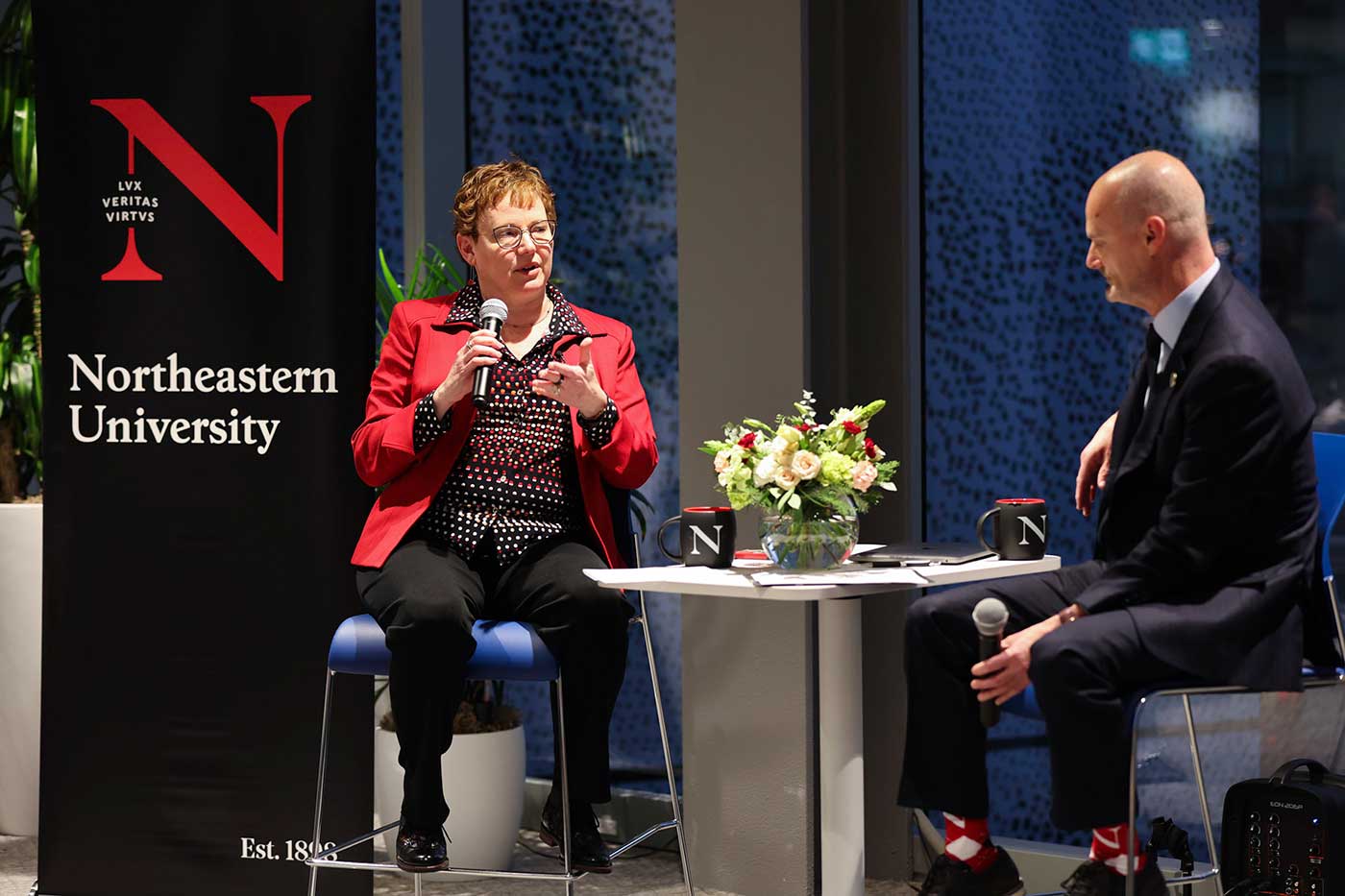
“For computer science to be for everyone, it has to be accessible to a wider population than it traditionally has been,” Mynatt explained, noting the hundred plus different undergraduate degrees that Aligners hold. “Align lets students add computer science, not just move to it. Our partners love that because not only are they hiring someone with amazing computer science skills, they’re hiring that holistic package of existing passions and interests amplified with computer science.”
Many Aligners come from groups underrepresented in computer science, further reflecting the “CS for Everyone” ethos. Edmunds and Mynatt explained that pursuing this goal means avoiding “tech saviorism,” the tendency of researchers and firms to design tech solutions for use by vulnerable populations without consulting those populations about their challenges, traditions, and needs. So at the anniversary celebration’s workshop, Edmunds and Mynatt collaborated with local business leaders who had forged relationships with vulnerable communities and made an impact.
“We want to partner authentically with marginalized communities, to work in a way that’s respectful and doesn’t do harm, and to figure out how we as software developers can do a better job developing for everybody,” Edmunds said. “It’s a good starting place to bring in leaders who know how to work with communities in a respectful, honest, and equitable way.”
From insights learned from these leaders, Khoury College aims to craft best practices for developers working with marginalized populations. By baking these lessons and practices into the curriculum, Edmunds said, the rhetoric becomes actionable.
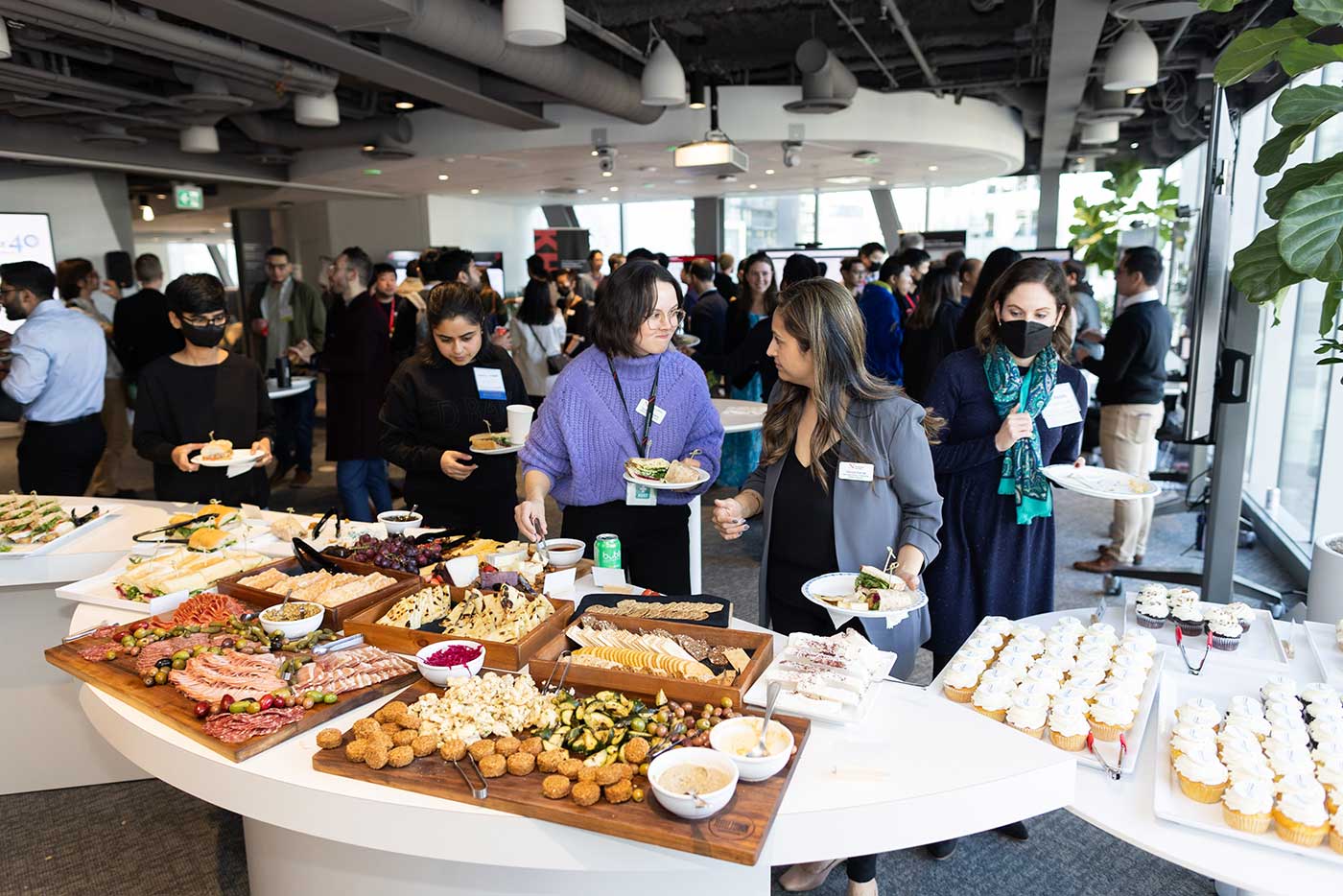
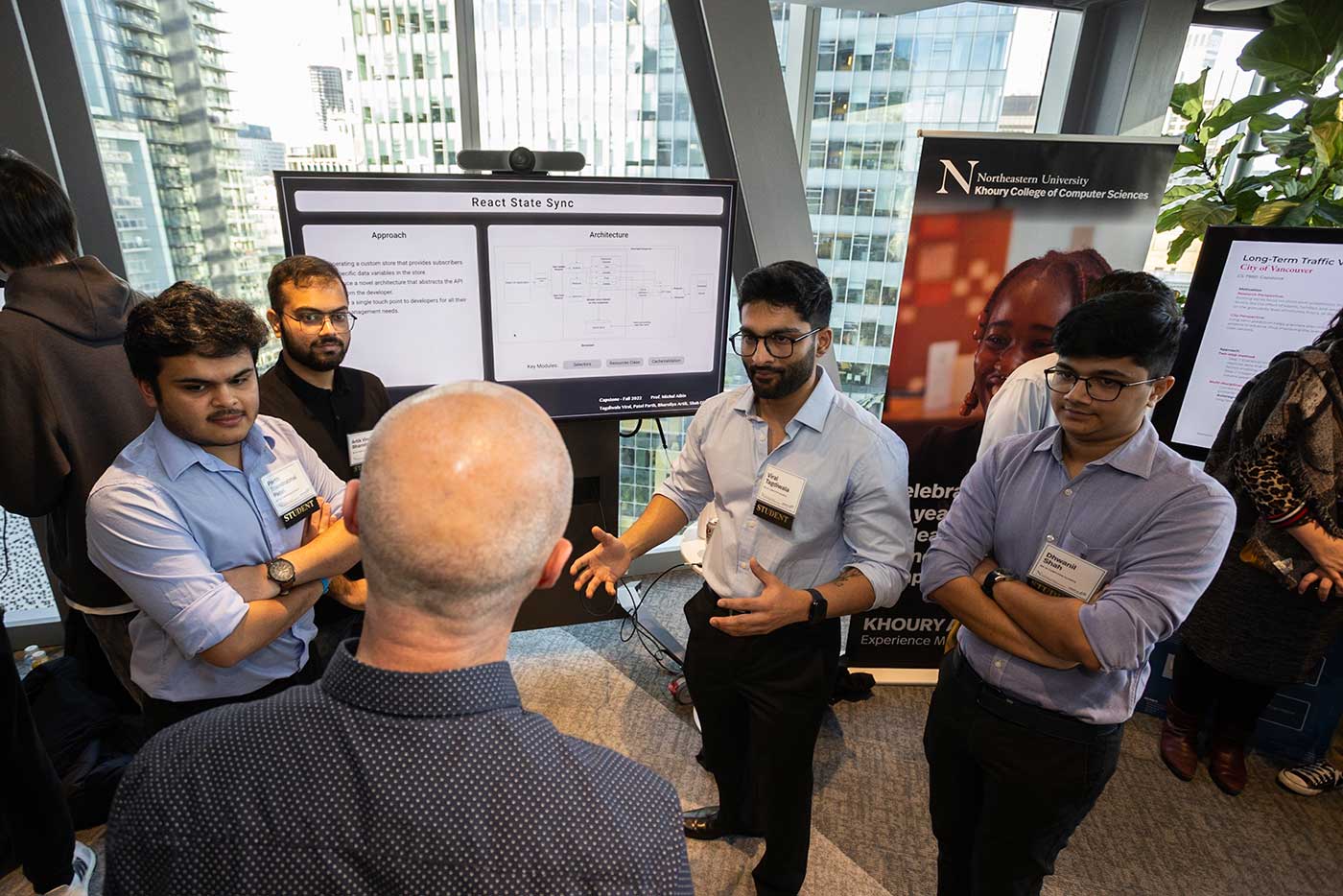
Then came the celebration’s culminating event, in which the Vancouver master’s students showcased their end-of-program research projects, many of which stemmed from collaboration with industry partners in attendance. One such partner, Bill Lakeland of cloud-based drone footage company Spexi Geospatial, was even announced as a 40 for 40 honoree for his work turning student projects into more immersive, longer-term initiatives. The goal, Edmunds notes, is to enrich the students’ education by having them apply research to partners’ actual needs rather than classroom examples.
READ: 40 for 40 profiles honor people integral to Khoury College’s success
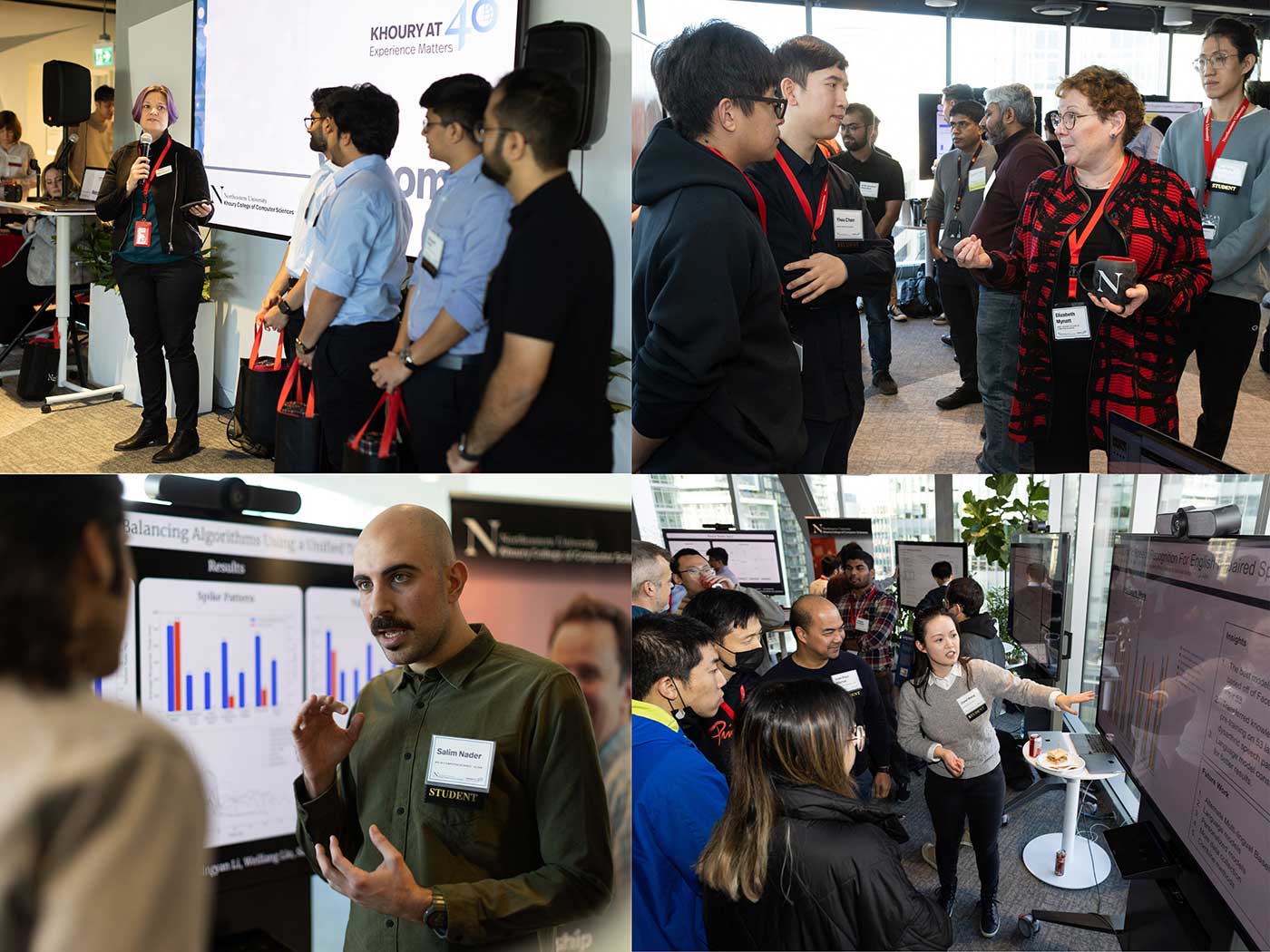
“When companies come to hire our graduates, they see that those graduates did projects that matter, that they applied their skills and had an impact,” said Michal Aibin, the faculty lead and mentor for the capstone course that facilitated the showcase projects. “We saw industry partners amazed by these projects. We’re seeing more and more projects coming, more partners, more industry and research funding. The Vancouver campus is growing, and it’s a great place to see and be seen.”
“We’re showing that campuses outside of Boston aren’t satellites. This is research outside of Boston, and while it’s different, it can thrive, here and everywhere,” Edmunds added. “The 40th Anniversary shows that each campus has its own identity based on where it is. In Vancouver, there’s an ‘every company is a tech company’ feel, and you can see that in the companies supporting the tech ecosystem at the student showcase.”
For her part, Mynatt saluted the campus’s research as representative of a larger shift.
“Computer science researchers traditionally had a bit of a chip on our shoulder compared to engineering and mathematics. We had to prove that we could build things, and that sheer act of creation fueled the industry and community,” Mynatt said. “But we were creating brighter and faster and shinier things for ourselves, and focusing on a more rarified set of values and perspectives. Khoury College is shifting that ‘creation for myself’ perspective to ‘innovation that benefits everyone.’
“When we make that commitment, we conduct research in fundamentally different ways, and we can’t do this by ourselves,” Mynatt continued. “We have to create partnerships and commit to teaching our students what it means to work with vulnerable populations. We need a long-term commitment to co-creation with our partners, and a respect for their values.”

For Khoury College in Vancouver, that long term looks bright. Eccles cited a slew of exciting developments-to-be, including the growth of the campus’s space, student body, and international ranks; appeals to potential computer scientists in underserved rural British Columbia; and the presence of local entrepreneurs on campus to give students access to mentorship and a creative hub. Mynatt added that she’d love to see New-England-based undergraduates become “citizens of the world” by encouraging participating in summer programs in global campus locations like Vancouver.
“We have these fantastic leaders and partners; as a group, we can move the needle and improve society,” Edmunds said. “It’s not only that we can; Khoury College feels that it’s an obligation.”
The Khoury Network: Be in the know
Subscribe now to our monthly newsletter for the latest stories and achievements of our students and faculty