Author: Milton Posner
Date: 01.30.23
It’s not that Devon Levi doesn’t understand what a “normal” college hockey player is supposed to do. He understands just fine; he just doesn’t care.
During TV timeouts, as his teammates huddle and strategize, Levi drops to his knees and meditates on the ice à la Qui Gon Jinn in The Phantom Menace. After posting one of the best goaltending seasons college hockey had ever seen, the Buffalo Sabres prospect opted against turning pro, choosing instead to remain in college and develop on his own timeline.
And at Northeastern, Levi’s initial coach, Jim Madigan, was the first to see just how unusual he was.
“He asked me, ‘What are you planning on majoring in?’ I said, ‘Computer science’ and he just said ‘What?’” Levi recalls with a wide smile. “He said, ‘I don’t think any Northeastern hockey player has ever taken computer science before,’ and I said, ‘Oh, alright. I guess I’ll take on the challenge and be the first.’”
Madigan had coached Northeastern men’s hockey for nearly a decade at that point, and had guided the 90-year-old program to its greatest sustained success. He had seen a lot, but he had never seen this. Amid a sea of skaters who typically pursue general studies, business, or communications, here was Levi — unbothered by the weight of expectations and eager to forge his own academic path. While he eventually added business to his now-combined major, he kept computer science, which makes his workload tough to balance even by elite student-athlete standards.

Levi’s computing drive began just as his passion for hockey did: with his father. Laurent Levi is a process automation engineer, a managing partner of the Montreal-based Higrowth Engineering Group, and a believer in AI’s potential to spare humans from tedious work. As the manager of SHAIN, the company’s intellectual automation division, Laurent spearheaded an AI platform that converts recorded conversations into structured reports to provide managers with enhanced R&D intelligence.
“He showed me the business and explained that this part of school is part of the future, and that there’s so much opportunity in the field after you graduate,” Levi says. “He convinced me to try it out, but I knew it wasn’t going to be easy.”
Levi was correct. His freshman year at Khoury College found him rebounding between the rink and his dorm room, working to balance hockey with Fundamentals of Computer Science 1 (“Fundies”) — two things legendary across the Boston campus for their difficulty.
“It was nuts,” he says. “But I’ve figured out how to manage that a bit better now that I’m a third year. I can have fun with my teammates, get my studying done, and play hockey.”

That balance is hard-earned. During the season, Levi typically wraps up his classes around 1:30 p.m. and heads straight to Matthews Arena for a four-hour practice. Monday, Tuesday, and Wednesday nights are crucial; if Levi can square away his coursework in time, he’s free to focus on his Thursday game prep and his Friday and Saturday games, at least one of which typically demands travel. Sunday, the team’s NCAA-mandated off day, is another homework day, lest Levi fall behind before the start of the next week.
“I don’t have the luxury of studying as long as other students do, so I’ve got to pay attention and try to get the material down in class. That way, I can maximize my time outside the rink, rather than playing catch-up,” Levi says. Juggling midterms, finals, and his three weeks in Beijing with Team Canada during last year’s Winter Olympics, he added, makes the whole thing trickier. “When I’ve been away, my professors have extended deadlines and helped me get the work in. I can’t thank Khoury College and Northeastern enough for that; they’ve been super supportive.”
But Levi hasn’t just balanced computer science and hockey; he’s blended them. When he was sidelined with a fractured rib in 2021 and unable to step on the ice, he used VR platform Sense Arena to improve his puck tracking. He found the device so smooth and realistic that he still uses it for warm-ups, and says it has piqued his interest in pursuing similar hockey-and-computer-science projects down the road.
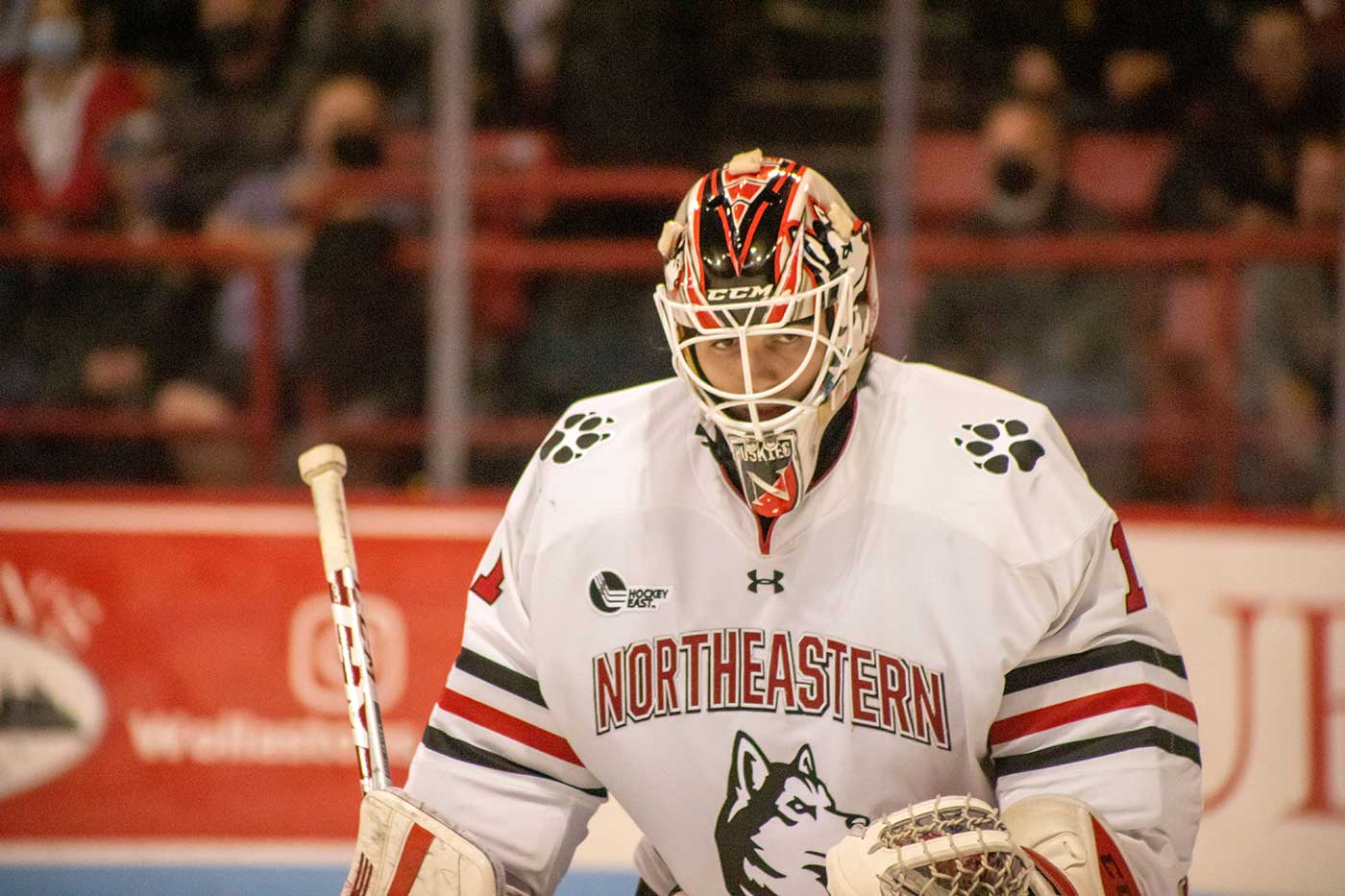
Levi has also found two pertinent overarching lessons at the nexus of these two passions. One comes courtesy of Marco Raimondo, Levi’s goalie coach from back home in Montreal, who compared hockey games to tests in class: the more you study during the week, the higher your confidence, and the better your performance.
“[Levi] has an engineer’s mind, where things add up to a final answer; that’s how I see him compute the game,” Raimondo told The Athletic in July. “He always does these little things that prove that he’s special. He’s that much different than everybody else.”
The other lesson is more on the nose.
“The way you learn to approach CS problems is applicable in life, and to my sport,” Levi explains. “There will always be problems when you’re playing — you’re getting scored on, something’s not going right — and it’s like there’s a bug in your code. You’ve got to find the mistake and fix it.”
The success of Levi’s lessons is inarguable. In the World Junior Championship with Team Canada, he stonewalled top international talent with a record .964 save percentage. Last season, he won the Richter Award as college hockey’s best goalie, posting outlandish numbers and launching the Huskies to their first-ever Hockey East regular-season title. This season, he broke the team’s career shutout record, accomplishing in 41 games what former record holder Chris Rawlings couldn’t do in 123.

His stock didn’t start sky-high by NHL standards; at six feet even, Levi is at least two inches shorter than most elite goaltenders, which helps to explain why he stayed on the 2020 draft board until the Florida Panthers selected him sixth to last. After the Panthers traded his rights to the Sabres, Levi exhibited the same forge-his-own-road approach he’s always shown, content to marinate and develop at the college level. He hasn’t decided when he’ll go pro; he’s enjoying his time in college, and the Sabres haven’t rushed him, confident in his growth strategy. After all, he’s made unexpected, atypical decisions about when to jump levels before, and — powered by stellar athleticism and clever positioning in net — exceeded all expectations.
But as he prepares for his first Beanpot and looks forward to a career in the NHL, Levi doesn’t expect to turn his back on computer science. He intends to continue pursuing his degree even if he goes pro at the end of this year, his third at Northeastern.
“Jim Madigan’s been awesome about providing players the opportunity to do online school and extend classes for as long as they need to get their degrees,” Levi said of the coach who recruited him, now Northeastern’s athletic director.
And after years of his father impressing on him the importance of blending business savvy with coding know-how, Levi is excited to explore the “whole world of things” he can do with a computer science and business degree.
“You can’t play hockey your whole life. It comes to an end by age 40, and I can’t see myself sitting around doing nothing when I’m 40,” Levi says. “I’m trying to get my degree, but it’s also about doing something with it later in life. I know I’ll look back and be happy that I put in the work and grinded for a few years. For the rest of my life, I’ll have the opportunity to do what I want to do.”

The Khoury Network: Be in the know
Subscribe now to our monthly newsletter for the latest stories and achievements of our students and faculty
Author: Milton Posner
Date: 01.26.23
Navigating the second year of his master’s degree at Khoury College nearly a decade ago, Herman Saksono — in collaboration with community groups around Boston — was zeroed in on a prevalent problem.
Although exercise greatly reduced physical and mental health issues, Black Americans and those from low-socioeconomic-status (SES) families were having a harder time meeting recommended exercise levels than white Americans were. Many factors fueling this disparity — like a lack of free time, exercise facilities, and walkable neighborhoods — were beyond Saksono’s purview as a computer scientist. So he zeroed in on an area where he could make a difference.
Historically, digital health interventions haven’t helped low-SES populations exercise more, and Saksono cited limited social support as a critical inhibitor. So he developed Storywell, an app where community members could augment their fitness data by sharing their exercise success stories on a neighborhood map. Intrigued with the motivating impact he found, and convinced that computational tools could make exercise more communal and attainable, Saksono resolved to continue.
In the years since, Saksono has taken many steps forward, first from a Northeastern PhD to a Harvard postdoctoral fellowship, then to a recent joint appointment between Khoury College and the Bouvé College of Health Sciences. Now his exercise research is poised to leap forward again, courtesy of a grant from the Google Health Equity Research Initiative. Along with collaborator and Bouvé psychology professor Jessica Hoffman, Saksono has received $50,000 — plus more than 100 Sense 2 devices from Google subsidiary Fitbit — to support Storywell’s next phase.
“Health social support technologies are often very dated and health information sharing looks like online forums. We’ve used the same format for decades and there are opportunities to go beyond that,” Saksono says. “I’m interested in new ways of connecting people to make them healthier, using algorithmic messaging to connect exercise buddies, and exploring different modalities of health information sharing.”
The app’s philosophy is based on social cognitive theory, the idea that people can better develop new behaviors if they see others model those behaviors.
“That concept comes from psychology, but people in human-computer interaction are interested in using computational tools to support it,” Saksono notes. “We couldn’t do this project without Northeastern’s interdisciplinary nature. I come from computer science, but I work with professors in design, health sciences, and psychology to connect the project with lessons learned outside computer science.”
“What makes this work so innovative is that people who live in the same neighborhoods will encourage each other by sharing their experiences and success related to physical activity,” Hoffman added. “We’ll collaborate closely with community members to design and test the app. This collaboration is essential to develop useful interventions that appeal to users and meet their needs.”
This is where community partners, including Smart from the Start and the Mattapan Food and Fitness Coalition (MFFC), become essential. Vivien Morris, founder and longtime chairperson of MFFC, said that they strive to make healthy, culturally relevant food available to all residents, and to promote spaces and opportunities for exercise in a community overwhelmingly composed of people of color.
“People [in lower-income neighborhoods] want to be more physically active, but they may have less time or fewer resources to support that compared to people in wealthier neighborhoods,” says Morris, citing government funding, parks, and green spaces as key resources. “We’ve been active in advocating for more resources to encourage people to spend more time outside.”
Years ago, as Saksono worked on a doctoral dissertation with similar goals, the MFFC connected him with community members who could speak to the realities of communities like theirs — how health could be improved, how devices could help, and how they could connect culturally with residents.
“Because of these long histories of discrimination and inequity, people have reason to expect that people bringing advice don’t have their best interests at heart,” Morris notes, citing health research efforts that harmed community health when they could have bolstered it. “That’s why engaging people, listening to their voices, understanding their history and current experiences as you analyze their environment — all of those things can make people happy to engage with new projects, ideas, and implementations.
“We’re excited to continue working alongside Herman Saksono on these projects. He’s doing great work and we know it’s going to benefit our community.”
Saksono and Hoffman will begin by identifying motivating, culturally relevant, health-related storytelling practices through focus groups with members of marginalized Boston communities. The information gleaned will inform the design of the Storywell 3 app, which will prompt users to record a story about their exercise achievements using the new audio storytelling feature. Through Fitbit output and interviews with participants, the researchers will determine the relevance of this mode of storytelling to the community; the effect of storytelling and story listening on participants’ relaxation, joyfulness, and motivation; and most importantly, whether Storywell 3 promotes physical activity in marginalized communities.
“All of my projects use technology to support health efficacy, and one way to do that is to support marginalized communities in coping with health barriers,” Saksono says. “By sharing their own strategies on being active and healthy, community members can contextualize health recommendations into something more actionable.”
Saksono has already open-sourced Storywell, so communities and researchers can use it anywhere with any fitness sensor. He also hopes that the app can facilitate activism storytelling, where people tell stories of their struggles against structural issues.
“Stories can be part of a movement to challenge the lack of investment in public goods, and they can help people feel like part of a collective trying to make things better,” Saksono says. “Digital technologies can make that more powerful.”
The Khoury Network: Be in the know
Subscribe now to our monthly newsletter for the latest stories and achievements of our students and faculty
Author: Zorain Nizamani
Date: 01.23.23
In Kevin Fu’s lab, researchers shoot lasers at computers to manipulate them and take control. They trick voice-controlled systems into hearing phantom voice commands by shining a small laser pointer at them. They can even shake smartphones to co-opt their sensors. Through all of this, Fu aims to protect medical devices from cybersecurity threats, to use his superpowers for the collective good in a field he helped to establish.
And as he joins Northeastern in January with a joint appointment between Khoury College and the College of Engineering, that medical device security work has made Fu into something else: a Fellow of the Association for Computing Machinery (ACM).
“I am honored to be elected to this august group of computer scientists. It means a lot to be recognized not just for my medical device security work, but also for the work my lab members have done in medical device security and embedded security,” Fu says. “It’s an honor to join a group that began with many founders of computer science.”
“I’m excited for Kevin and this important recognition of his leadership and impact in the computer science community,” says Khoury College Dean Elizabeth Mynatt, who earned the ACM Fellowship herself in 2015 for contributions to health information technology and human-centered computing. “This honor reflects both the significance of his research contributions and the real-world impact of his unique work. I look forward to the new paths he’ll chart as an educator and researcher at Khoury College.”
Although Fu’s interdisciplinary research portfolio spans everything from cryptographic systems to cardiology and regulatory affairs, his most recent research pertains to the physics of computer security, which is pivotal for safeguarding computers.
“I look at how to protect computer systems from lasers and acoustics and radio waves, such that a would-be adversary couldn’t take control of those systems,” Fu explains. He offers the example of a laser pointer, which, if shined on and off at the right rate through a glass window, could easily deceive voice-controlled assistants. “I teach students how to use physics to defend computers from these types of attacks. Students in my embedded security class learn how to use lasers to take control of microphones from 100 meters away.”
Apart from its intricacy, underlying Fu’s work is the ubiquity of computers and their role in our everyday lives. And wherever a computer system is present, so is the threat of hacking and malware. So predictably, Fu’s work isn’t confined to academic journals, as demonstrated by his stint as the inaugural Acting Director of Medical Device Security at the US Food and Drug Administration.
“Medical device security goes beyond just research papers and gets into the area of public policy,” Fu notes, “for instance, working with Congress and the White House to provide advice regarding science, technology, and engineering so they can make better policy decisions.”
Outside of medical devices, Fu’s work revolves around DNA-like forensic analysis of photographs.
“Using the physics of light and sound, my colleagues and I can extract functions of room audio from still images,” Fu says, explaining that audio is unwittingly modulated onto image sensors when someone speaks near a smartphone camera. “We are presently exploring commercialization of this patent-pending technology, which could exonerate or implicate defendants in a manner similar to DNA evidence. Our technology can determine with high certainty whose voice was speaking behind the camera, even when it was muted.” The team’s paper will be presented in May at the IEEE Symposium on Security and Privacy.
As he joins Northeastern after a decade at the University of Michigan, Fu says he values the university’s philosophy of interdisciplinary research and experiential education, including the co-op programs.
“It dovetails really well with my vision for medical device security and having students work together with industry for their studies. Very practical,” he says. “It’ll go well with the idea of ‘computer science for everyone’ because healthcare should serve everyone. I hope to help with that mission of trustworthy healthcare for everyone.”
Fu also founded the Archimedes Center for Health Care and Medical Device Cybersecurity, which helps medical device manufacturers, pharmaceutical manufacturers, and health care delivery organizations — all FDA-regulated industries — with basic training in Operational Technology cybersecurity engineering.
“Archimedes is moving to Northeastern and one of the key reasons is experiential learning. I have always been trying to set up more formal co-op programs, and that’s part of Northeastern’s core philosophy,” Fu says. “It’s will open up better-paying career opportunities for students, and it will be rewarding to see devices saving lives. Learning won’t only be from textbooks; students will visit surgical operating rooms and learn how computing helps patients.”
This sort of instruction reflects the ethos Fu also brings to his research, the same one he brings to his traveling medical device security seminar series for HBCUs and community colleges: spread whatever knowledge you gain to others.
“These opportunities will help my Northeastern students begin successful careers,” Fu says. “I also value the importance of diversity, equity, and inclusion, and I want to show students that there are many career opportunities available to those who enjoy both computing and helping people.”
The Khoury Network: Be in the know
Subscribe now to our monthly newsletter for the latest stories and achievements of our students and faculty