Author: Paul Murphy
Date: 02.13.23
This piece is the fourth in a series on Khoury College’s 40th anniversary celebrations, a series that also covers events in Boston, London, and Vancouver.
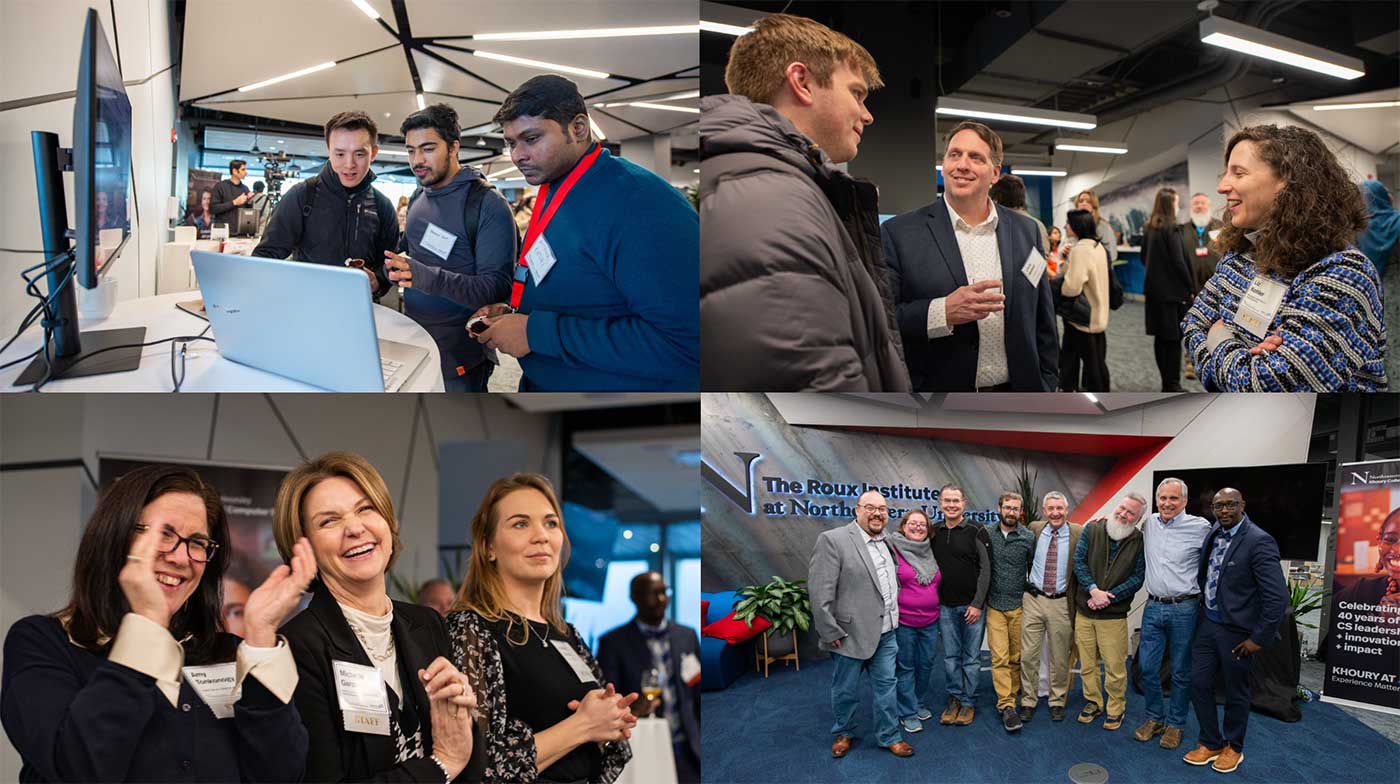
While the temperatures outside dropped to record lows this past Friday, the mood inside Northeastern University’s Roux Institute in Portland, Maine was warm and festive as more than 100 Khoury College students, alumni, faculty, and staff celebrated the college’s 40th anniversary at the seaside campus.
The Portland event was the fourth in a yearlong series of celebrations that will culminate in Boston on May 16. Each event highlights the unique contributions its host campus makes to Northeastern’s global network; for the Roux, it was the growth and diversification of Maine’s economy through technology.
“The premise of the Roux Institute was to build a tech and life science economy for the state of Maine,” began Mike Pollastri, senior vice provost and the Roux’s academic lead. “Talent is all over the world, and yet opportunity does not exist everywhere.”
Khoury College was the first Northeastern college to partner with the Roux when the Institute opened three years ago, and now offers five master’s programs enrolling 283 students there — a number that is expected to significantly grow over the coming years.
“By embracing our mission of computer science for everyone, we are empowering a set of leaders that can go out into the world and say, ‘This is how computer science should be in the world. These are the benefits that should accrue to all of society,’” Khoury College Dean Elizabeth Mynatt said. “The Roux Institute exemplifies this mission of computer science for everyone.”
Mynatt cited the many ways Khoury College and the Roux collaborate. At Roux, Khoury offers master’s programs in computer science, data science, and cybersecurity, along with its innovative Align programs for students with no tech background. There are seven full-time Khoury teaching faculty, three full-time research faculty, and two part-time faculty — a number that has continued to grow over the past three years. Additionally, over the last two co-op cycles, 12 Maine companies have brought in Khoury students, and several additional companies are working with Khoury faculty.
Following Mynatt’s remarks, she and Chris Mallett, the Roux’s chief administrative officer, participated in a lively discussion about the future of computer science and the ways it can grow and attract local businesses in Maine. During the networking reception that followed, students shared their work in web development, data visualization, security, and artificial intelligence — all done in partnership with Maine-based companies, entrepreneurs, and nonprofits.
Guests stayed well beyond the scheduled end time, none too eager to face the cold winds swirling just beyond the lively discussion taking place indoors.
The Khoury Network: Be in the know
Subscribe now to our monthly newsletter for the latest stories and achievements of our students and faculty
Author: Attrayee Chakraborty
Date: 02.07.23
By the time he finished his PhD in 2012, Byron Wallace had begun to understand computer science’s potential to revolutionize medicine. Wallace realized that machine learning and natural language processing (ML/NLP) could be his tool kit to make that revolution happen — by helping domain experts to make sense of unstructured data.
“I found many issues inherent to using ML/NLP in health care were not really addressed by industry work and most mainstream academic research,” Wallace says. “Such problems mostly revolved around model interpretability and human-in-the-loop systems, and this led me to different questions which keep me going even today.”
And now, after winning 19 research awards and publishing more than 60 scientific articles in top-tier conferences, Wallace has been awarded Northeastern’s Sy and Laurie Sternberg Interdisciplinary Associate Professorship for his work encompassing NLP in health care. Previous Khoury College winners include Olga Vitek, Amal Ahmed, and Engin Kirda.
“I feel honored to receive the award, especially knowing the great people who have held the title before,” Wallace says. “I feel I have a lot to live up to, and this award is representative of the kind of interdisciplinary research Northeastern supports.”
This support will help him conduct difficult preliminary research and recruit domain experts for interdisciplinary work.
“I can use this support as seed funding to go down riskier paths, which otherwise I would have refrained from going down on,” Wallace says. “For example, I can use this funding to hire domain experts who can provide annotations on model outputs that might highlight issues with current approaches. This might eventually drive the development of new NLP methods more appropriate for those domains.”
One example, Wallace notes, is the evolution of NLP systems that can now spit out very plausible text, which medical practitioners can use to synthesize medical evidence and make better decisions for patient treatment. Wallace’s program RobotReviewer uses different extraction and classification models to gauge the reliability of clinical studies, and he intends to take it a step further.
“Imagine NLP systems that can pull relevant data from clinical reports to deliver meaningful information,” he says. “A very large language model, for example, can answer medical questions such as, ‘What is the best evidence-based treatment route for a particular condition?’”
Wallace visualizes such models providing narrative answers to clinical questions, summarizing the risks and benefits of treatment routes. But implementing NLP systems on vast amounts of data is challenging. One cannot completely trust the accuracy of the text generated by such systems, and how best to automatically measure that accuracy is an open research question. So Wallace aims to enlist medical domain experts who can analyze the NLP outputs and shore up this gap.
Wallace has also collaborated with radiologists at Brigham and Women’s Hospital to use NLP and ML to analyze diagnostic imaging data.
“Often, key insights about patient health are mentioned in unstructured notes which go unnoticed,” Wallace says. “We want to develop ML/NLP models to provide unbiased synopses of these notes to supplement their conclusions from image analysis for disease diagnosis, thereby saving physicians time and effort.”
Wallace believes that ML/NLP can suggest alternate results, opening up physicians to other possibilities and helping them cross-question their initial conclusions.
“Imagine if an ML/NLP system says to a doctor, ‘You are correct, but based on other symptom data that I have encountered, these were the diagnoses documented,’ and the system goes on to provide evidence-backed data to be considered by physicians”, Wallace explains. “This can help medical practitioners eliminate recency bias — a phenomenon where we believe that recent events shadow objective evidence, thus leading us to incorrect or incomplete diagnosis.”
“We are thinking of employing systems that can offer alternative diagnoses to physicians based on similar data collected by programs. This can reduce the inherent bias that physicians bring to the table,” Wallace adds. “These models can help to create a fruitful collaboration between the texts already there and the doctors who don’t have time to read them.”

In addition to his feats in academic research and consulting, Wallace is a passionate professor.
“I enjoy teaching students how to apply computer science across disciplines, and hope to get folks interested in CS who might not otherwise have considered it,” Wallace says. He particularly likes teaching “Practical Neural Networks,” which covers data science research published as recently as a few months ago. “With a strong understanding of the fundamentals of neural networks, which are in many ways quite simple, students can really delve into much of the latest research and appreciate the issues that are still outstanding.”
On the other end of the spectrum, Wallace teaches “Programming with Data,” an introductory course in data science.
“I think it highlights Northeastern’s mission to support interdisciplinary studies,” Wallace says. “We’ve had students come in from digital humanities and biology, for example, to learn programming skills that can help them better engage with their own discipline. Seeing students explore new career paths that they didn’t even know existed is always wonderful.”
In this same vein, Wallace has mentored many undergraduate and graduate students. Having graduated two doctoral students last year — with one now working with Amazon and the other as a professor — Wallace believes that guiding each student is a different experience.
READ: PhD student Millicent Li uses NLP to bridge AI aspirations with medical practice
“Given the interdisciplinary type of work I do, I have some students more interested in applications of NLP/ML (especially health care), while others are involved in more core technical research,” Wallace says. “I try to figure out where they see themselves and work with them accordingly to set goals for research output, publications, internships, and conferences that will help them reach their potential.”
Wallace believes that the award will help him develop health-care-driven ML/NLP at Northeastern.
“I am thankful to Khoury College’s leadership for supporting my projects,” Wallace says. “I hope to keep contributing, supporting, and mentoring students to come up with creative solutions using computer science.”
The Khoury Network: Be in the know
Subscribe now to our monthly newsletter for the latest stories and achievements of our students and faculty