Author: Paul Murphy
Date: 04.07.23
There was much to celebrate as Khoury College took its yearlong 40th anniversary celebration to Seattle on March 30. The Align master’s program, launched on the Seattle campus, has now been part of the Khoury portfolio of offerings for ten years — growing from 11 students in 2013 to 1,906 students at seven Northeastern campuses today.
“It’s an amazing success story,” said Khoury College Dean Elizabeth Mynatt.
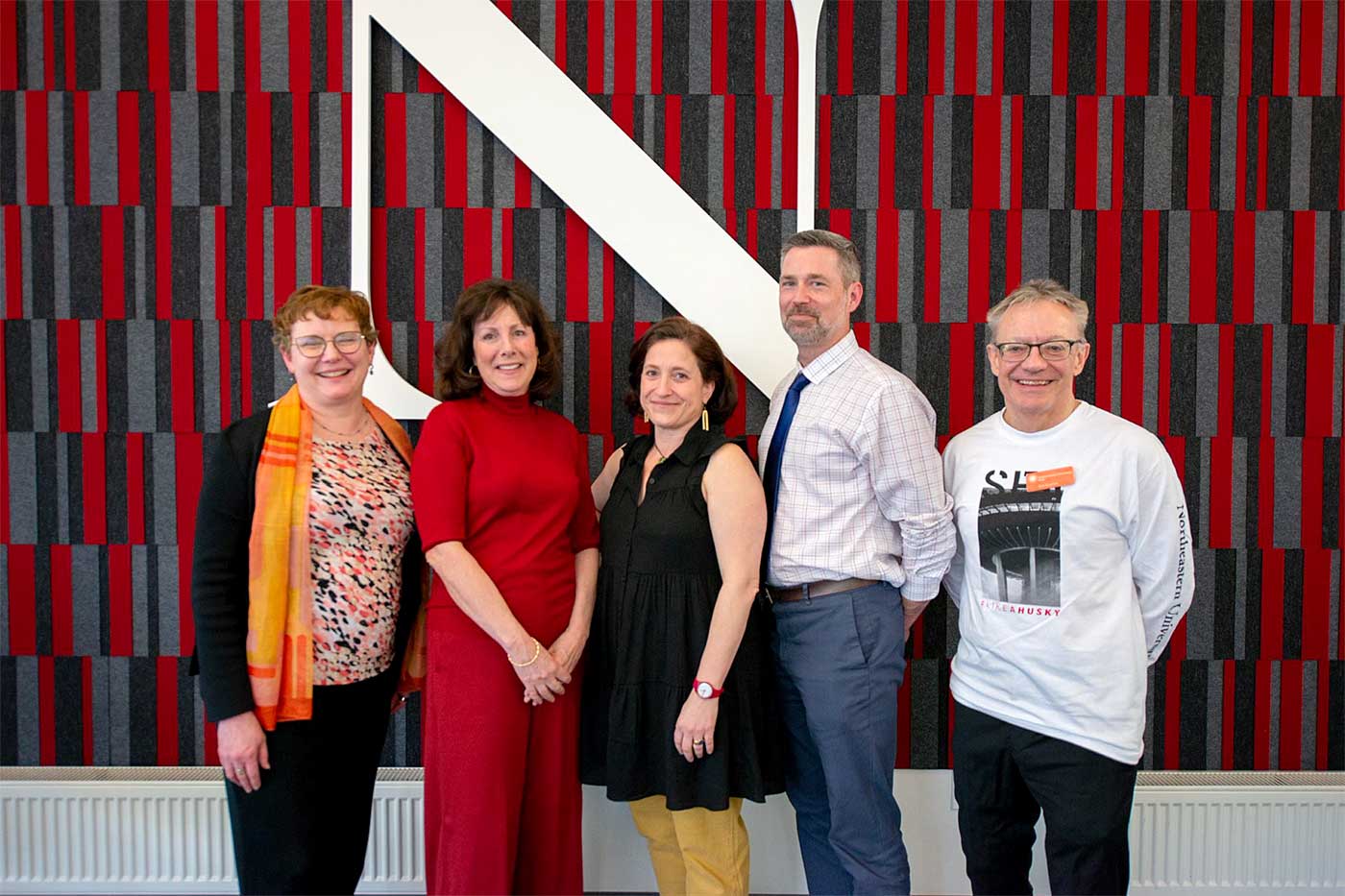
In recognition of Align’s unprecedented success, five of its architects were honored with the “40 for 40” distinction for their contributions in launching and growing it: Carla Brodley, Larry Finkelstein, Catherine Gill, Ian Gorton, and Bryan Lackaye. Each played pivotal roles in developing the curriculum, securing funding, and expanding the program across Northeastern’s global network of campuses.
READ: Innovative Align master’s program celebrates ten years of transitioning students to tech
Two local business partners were also honored for the critical scholarship and operational funding their organizations provided to the program: Daron Green, who worked at Facebook in the early years of Align, and Laurel Yamaguchi, Pivotal Ventures lead for women and tech innovation.
“Facebook’s intent was to try and move the needle at a national level by investing in a program that demonstrably provided an on-ramp for a more diverse pool into computer science,” Green said.
Added Yamaguchi: “What was interesting to us is how Khoury College was using best-known practices to recruit, retain, and graduate women and underrepresented groups in computing. It was really encouraging.”
An alumni panel moderated by Brodley, former Khoury College dean and current executive director for the Center of Inclusive Computing, underscored the impact the Align program is having on the world of computing. Drew Jelani, Vy Nguyen, Eddie Wang, and Maggie (Mingzhe) Xu, all early graduates of the program now working in the tech field, shared stories about their time in the program and how it changed the course of their careers.
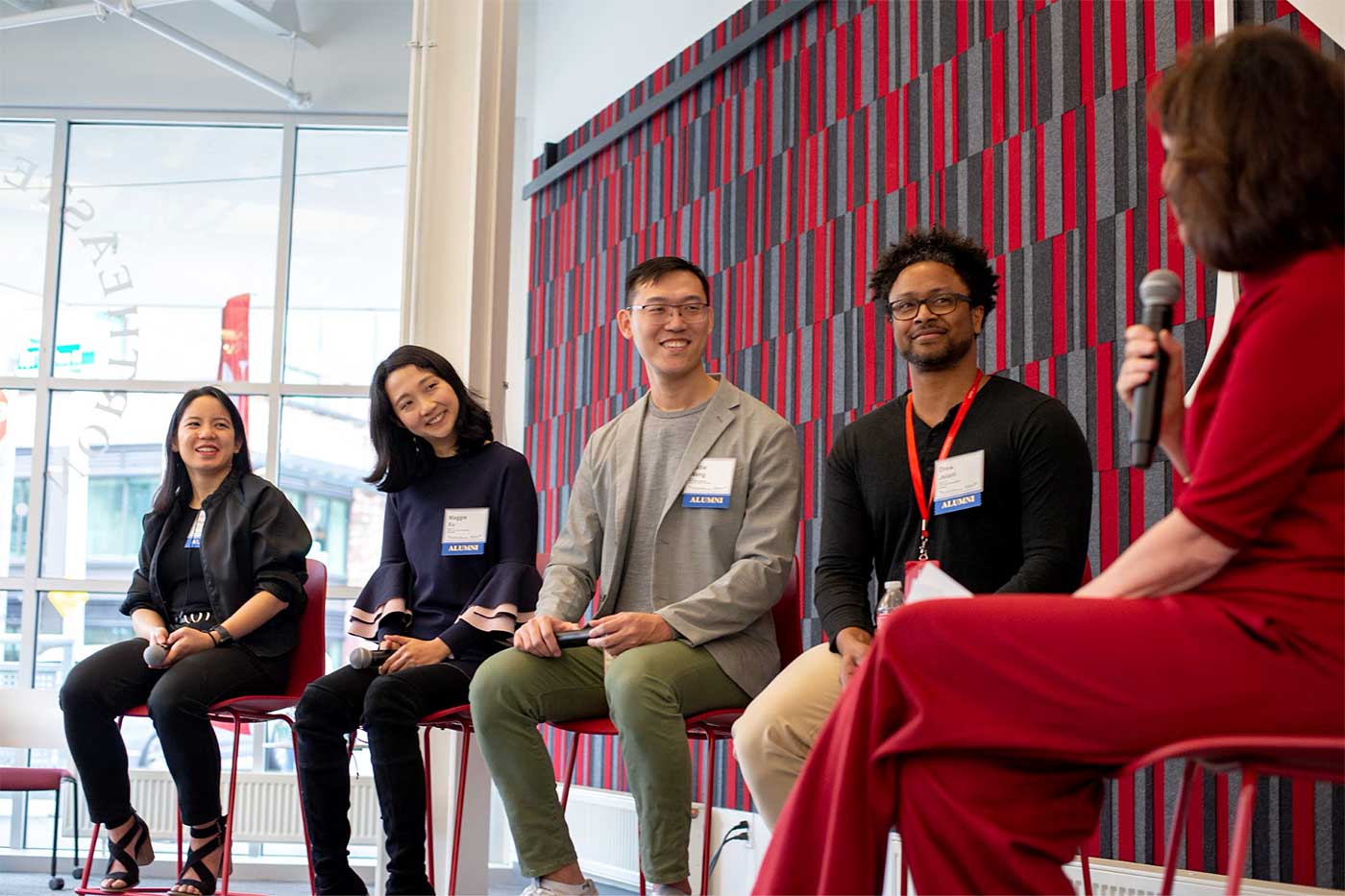
“If I were to describe my life in general, it’s a consecutive series of very impulsive choices,” Jelani shared with the audience of more than 100 people. “Joining the Align program was one of those very impulsive choices, which also happened to be one of the best impulsive choices that I’ve made.”
Immediately following the panel, Jodi Tims, associate dean for network programs, detailed the growth of the program across the network, attributing its success to Khoury College’s committed team of campus leaders, faculty, and staff.
“The support that they give our students is just absolutely, absolutely amazing,” she said. “The programming they provide, the advising they provide, all these things give an extra boost to students to make it through and succeed.”
Women in tech panel/honorees
Prior to the evening program, Dean Mynatt hosted a women in tech panel for students. The panel featured three Seattle tech leaders: Cathy Sullivan, principal lead product manager for Microsoft; Amy Hutchins, founder and chief product and technology officer for Unearth Technologies; and Nida Beig, group product manager for Amazon Web Services. The trio shared stories about their personal journeys in tech as women, provided advice to the more than 100 students and guests in attendance, and emphasized the importance of support networks and workplace mentorship to their success. The panelists also stressed the important responsibility both women and men have to mentor new employees entering the workplace.
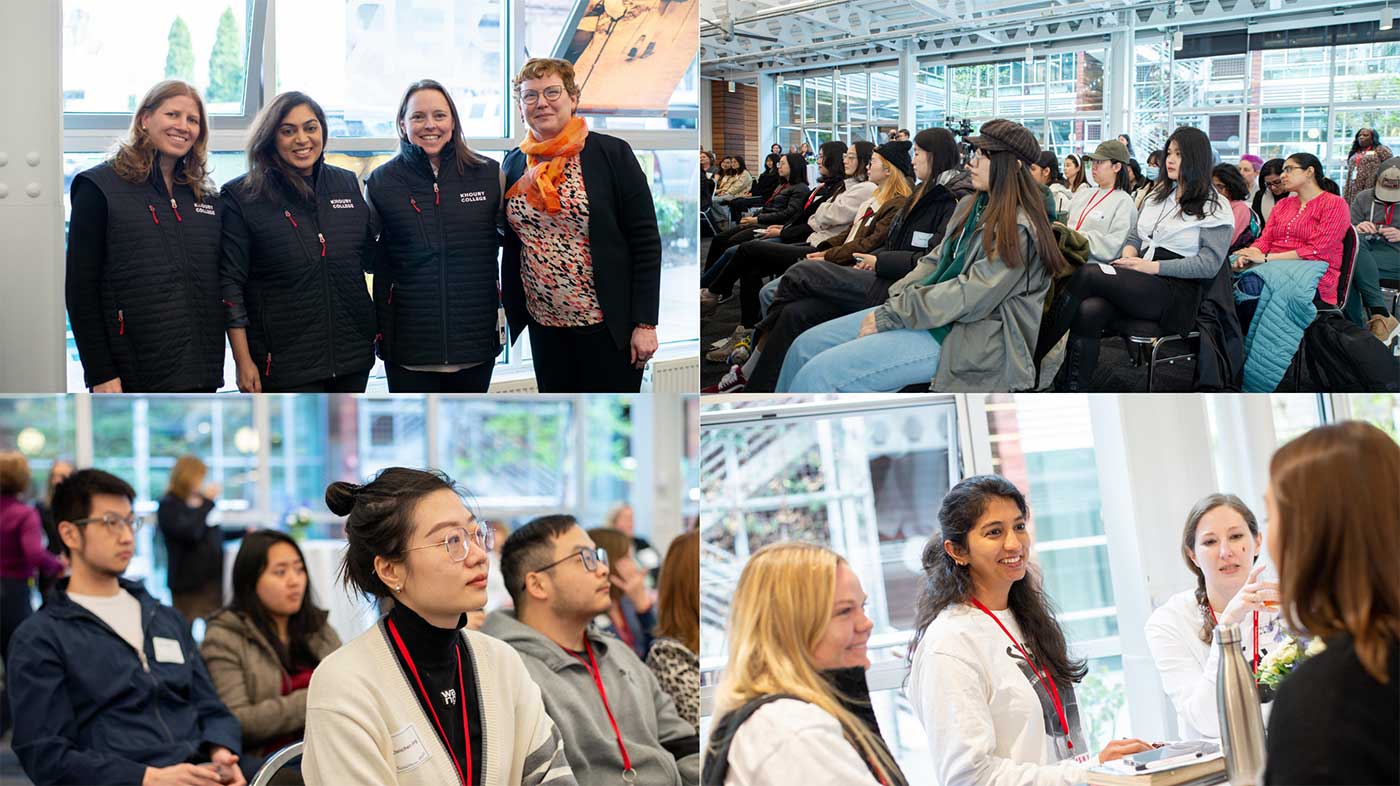
At the afternoon event, two local tech leaders were honored with the “40 for 40” distinction. Both women have been key partners to Khoury College’s success in Seattle, according to Mary Trimarco, director of Align partnerships. Through her WiT Regatta Conference, Melody Biringer collaborates with Khoury College to bring together women in tech from around the world for a week of connection in cities such as Seattle and Vancouver. The second honoree, Padmaja Vrudhula, has worked with the Align team to provide co-op opportunities, lead math tutorial sessions, speak on panels, and mentor students.
Long after the panel and awards concluded, students mingled with the tech leaders to ask questions and learn from their years of tech expertise.
The Khoury Network: Be in the know
Subscribe now to our monthly newsletter for the latest stories and achievements of our students and faculty
Author: Milton Posner
Date: 03.31.23
If the Align program was a good idea from the jump, it certainly wasn’t an obvious one.
Generally speaking, both computer science and master’s programs are notorious for their rigor. So to combine the two into a program for students who had never studied computer science at the university level? There was no guarantee of success.
But ten years after the program welcomed its first learners, it hasn’t just succeeded; it’s soared and scaled, segueing cohort after cohort of curious students to tech. And as Khoury College turned its eyes toward Seattle for the latest stop of what Dean Elizabeth Mynatt called “our 40th anniversary tour,” those eyes also turned to Align, which counts Seattle as its birthplace.
As part of the proceedings, five 40 for 40 honorees — Carla Brodley, Larry Finkelstein, Catherine Gill, Bryan Lackaye, and Ian Gorton — were lauded for their pivotal roles in the origin and development of the program, which has since expanded to Northeastern network campuses across the country.
“What is so exciting about Align is the scale and how built-for-purpose it is,” says Gill, executive director of Northeastern’s Center for Inclusive Computing. “We’re not shoehorning you into anything. This program was designed for you.”
Putting down roots
In its infancy, Align was not limited to computing. It originated as one of several professional master’s programs for students with a wide array of backgrounds, wherein a set of shared prerequisites could lead to a degree from one of a handful of Northeastern colleges.
“Khoury College’s master’s in computer science was discipline-specific enough that it didn’t really meld with anything else,” explains Lackaye, who currently works in Northeastern’s Office of Global Network and Strategic Initiatives, and who previously wore a variety of admissions, advising, oversight, and logistics hats over 14 years at Khoury College.
Khoury College boasted the university’s largest master’s program at the time, and the college’s hires and national reputation, Finkelstein notes, were on the upswing. So driven in good part by Philomena Mantella, then the CEO of Northeastern’s global network, the new initiative spun off into a Khoury-only program and began to search for a home.
“We had a lot of students doing co-ops in Seattle, and I thought it would be a good opportunity to build research collaborations,” explains Finkelstein, the college’s dean from 1994 to 2014, who also noted the local presence of Microsoft, Amazon, and Google. “There’s so much high tech in Seattle and a shortage of personnel, so it was a natural fit for students who wanted those jobs.”
Besides opportunities for students, the city’s up-and-coming tech scene also provided tons of highly capable, innovative faculty candidates.
“People who were working across the street — people who students wanted to learn from — could bring their expertise into the classrooms,” Lackaye adds. “Seattle was a thriving and growing city 10 years ago, a precursor to what it is now: a place that almost feels like you’re landing in the future.”
But despite the large potential personnel pool, Finkelstein notes, it still took a wide-ranging effort to find faculty who liked to work during the day and teach in the evenings, and to build curricula to support them.
“To get these faculty to teach the courses we wanted to offer out here, it took a lot of collaboration with the faculty in Boston,” Finkelstein remembers. “Developing graduate curricula from scratch is a lot of work, and it helped to have faculty who could help with that.”
By the time the first 11 Align students arrived in Seattle in 2013, the program had started to approximate its current form. But big changes were still ahead.
Support, success, scaling
“The original idea was that students could switch between STEM areas with just a one-semester bridge,” says Brodley, who took over the dean’s position from Finkelstein and held it through 2021. “But to increase not just diversity of demographics, but also diversity of thought, we wanted to take people from every undergraduate major.”
The philosophical shift meant the bridge would be widened to two semesters to ensure students could adjust. Soon afterwards, esteemed Williams College professor Andrea Danyluk oversaw another bridge restructure, aiming to replicate the foundation of the undergraduate CS curriculum so that students could then delve into upper-level master’s concepts. In time, this progress fostered an expectation of what it took to cross the bridge.
“You’re turning a history major into a computer scientist in two semesters; why wouldn’t it be hard?” Gill says. “In the beginning, we’d tell students, ‘We’ve got you, you’ve got this, come on in.’ And we had to refine that to, ‘It’s a lot. You’re going to have to work hard. We think you can do it; here are all the supports.’”
And those supports, both inside and outside the classroom, proved critical.
“Master’s programs tend not to be invested in from a resource perspective the way undergraduate and doctoral programs are,” Lackaye explains. “Much to Larry and Carla’s credit, they realized we needed overinvestments compared to what master’s programs traditionally get. That way we could not only create a space for it to evolve, but we could work with students individually out of the gate to make sure as many as possible got through.”
Financial support came from the National Science Foundation, from philanthropists including Pivotal Ventures, and from companies including Meta, Google, Wayfair, Charles River, Dell, and numerous others — about $10 million in total. Gill drove much of the fundraising, and it was that effort, Brodley says, that allowed Khoury College to make the first semester nearly free for Align’s pioneering cohorts, and “let students try the program in a way that wouldn’t damage their long-term financial health.”
READ: Daron Green, who helped arrange Meta funding for Align, earns 40 for 40 honor
As the fundraising continued to bear fruit, a team led by Brodley, Lackaye, Gill, Danyluk, and Gorton (the Seattle campus’s director of computing programs) worked to channel that investment into resources. The college added multiple dedicated recruiters for Align, a rarity in an academic world where each recruiter typically works across an array of programs. It created co-curricular supports to foster a welcoming environment and retain students, including an identity series of speakers who had come to computer science in unusual ways. It doubled down on its advisor ranks. And it got a major assist from the existing infrastructure in Seattle.
“I don’t know that the concept would have worked if the campus personnel — the dean, the associate dean, the student services folks, the events and operations folks — hadn’t bought into the program too,” Lackaye says. “We invested in college- and program-based infrastructure, but campus leadership went out of their way to create an environment that greatly contributed to making sure students got through and felt supported.”
The funds also helped beget enrollment, and once Khoury leadership saw Align graduates landing positions at top tech firms — to rave reviews from the hirers — that enrollment begat expansion.
“In the beginning, there was a bit of resistance to bringing the program to Boston after we’d proved it worked in Seattle. Some faculty thought it might be ‘dumbing down’ computer science,” Brodley remembers. “But over time, the faculty became really excited about teaching, say, an AI class where their students had studied psychology, neuroscience, sports management. The conversations were so different than they were with CS-only backgrounds. They grew to love having this diversity of thought in their classrooms.”
Around the time the program made the jump to Boston in 2016, it also changed its name — sort of. What began as ALIGN, an acronym for Accelerated Learning Into the Global Network, became Align, a double entendre based on the students aligning their undergraduate backgrounds with computing, as well as the program’s goal of aligning the demographics of the tech world to the demographics of the country.
The university-wide scaling came rapidly after that. Silicon Valley in 2017. San Francisco in 2019. Vancouver and Portland, Maine in 2020. Arlington, Virginia this spring. Oakland and Miami this coming fall. The student ranks have similarly swelled, going from about 250 in the fall of 2017 to well over 1,800 now. Those students hail from more than 150 different undergraduate majors, most of which aren’t STEM-related. Many of the roughly 1,000 program alumni who preceded them have gone on to positions at top tech companies, with Google and Amazon leading the way. Align, one of the first programs of its kind, had developed an unmatched scale and reach.
“It’s a psychological and intellectual lift, and we had to make that case to folks,” Lackaye said of the program’s expansion. “Once we had a diverse set of students in the classroom it became easier to recruit a broader array of people because we had proof. We could say, ‘This program is working for people just like you; come join us.’”
The ripple effect
Like many fields with sizable gender gaps, gender inequality in computer science begins at the foundational level of education and filters upwards.
“Experience in computing is unevenly distributed at the primary school level. Girls are less likely to take CS classes or do coding camps in the summer; they’re consistently about 20 percent of those participating,” Gill notes. “So when you get to university, why would that 20 percent magically become some other number? What you need are ways for people to discover computing at the postsecondary level.”
That’s exactly what the Align program has become — a bridge program that embraces diverse people and perspectives to do its part in closing that gap. Despite women comprising just 27 percent of the American computing workforce and 20 percent of the computing undergraduate degree earners, in Align, they’re a majority — 54 percent.
“Carla took the concept of Align and started to push her team to think about it as an access play for women and people from populations historically underrepresented in tech,” Lackaye says.
This ethos was baked in from the start, and the “overinvestment” in recruiting and marketing allowed the team to make good on its diversity aims. By the program’s second year, more than 40 percent of its students were female — twice the proportion of women in the college’s direct-entry master’s program. Brodley credits Northeastern and Khoury College’s existing academic and diversity reputations, while Gill cites the program’s additive quality, which helps students to realize that their undergraduate degree isn’t the whole story.
“By creating new pathways and allowing people to come in when they’re ready to add CS, we’ve seen more than 50 percent women take us up on that invitation,” Gill says. “In 2019, when I saw three consecutive intakes of more than 50 percent women, when I saw we matched the gender demographics of the country, that was a really big deal.”
Now ten years in, the program’s reputation continues to grow. Brodley says that some current faculty members applied to teach at Northeastern in the first place out of affinity for Align and its mission. She’s also heard from leadership at top co-op employers that Aligners’ diversity of thought has been a welcome addition.
“It’s an extremely attractive option for a lot of companies,” she says. “The world is increasingly interdisciplinary and this is a natural way to get someone who thinks in two disciplines.”
And as Northeastern exports its master’s education and diversity principles through the Center for Inclusive Computing and the MS Pathways to Computing Consortium, the Align program, ground zero for the success of those principles, keeps humming along.
“Align is ‘You’re entering a field that traditionally looks like this, but we’re using this program to change that,’” Lackaye says. “That dialogue started 10 years ago and is still going on today.”
For a sampling of stories about Align students, check out:
- Bioengineering to data science: How LeAnn Mendoza found her way to Align
- Small humans, big dreams: How Align’s parents juggle kids and computer science
- Align students Molly Beck and Shital Waters win “Women Who Empower” Awards
The Khoury Network: Be in the know
Subscribe now to our monthly newsletter for the latest stories and achievements of our students and faculty
Author: Milton Posner
Date: 03.27.23
Beginning in 2009 and continuing for the next 12 years, the MIT-hosted North East Database Day was an annual chance for database researchers across the northeast United States to gather, connect, and showcase their work. But shortly after the 2020 event, the COVID-19 pandemic arrived to scuttle the following two years.
Then, on March 10, 2023, the event was finally held for the 13th time, with Northeastern University playing host for the first time. Roughly 200 database researchers from industry and academia — including professors, postdocs, and PhD students — convened in the Interdisciplinary Science and Engineering Complex for a day of presentations, talks, posters, and socializing.
“We thought it would be a good opportunity for Northeastern to have a leading role in this,” says Khoury College doctoral student Nikos Tziavelis, who co-chaired the program alongside MIT’s Brit Youngmann and El Kindi Rezig. Tziavelis’ PhD advisor Wolfgang Gatterbauer and MIT’s Sam Madden co-organized the event, which received funding from Khoury College, Northeastern’s Institute for Experiential AI, and the DATA Initiative within the D’Amore McKim School of Business.
“Especially for students, it can be tough to meet professors and even other students from outside their university, even though we are pretty close geographically,” Tziavelis says. “And this is an excellent opportunity to do that.”
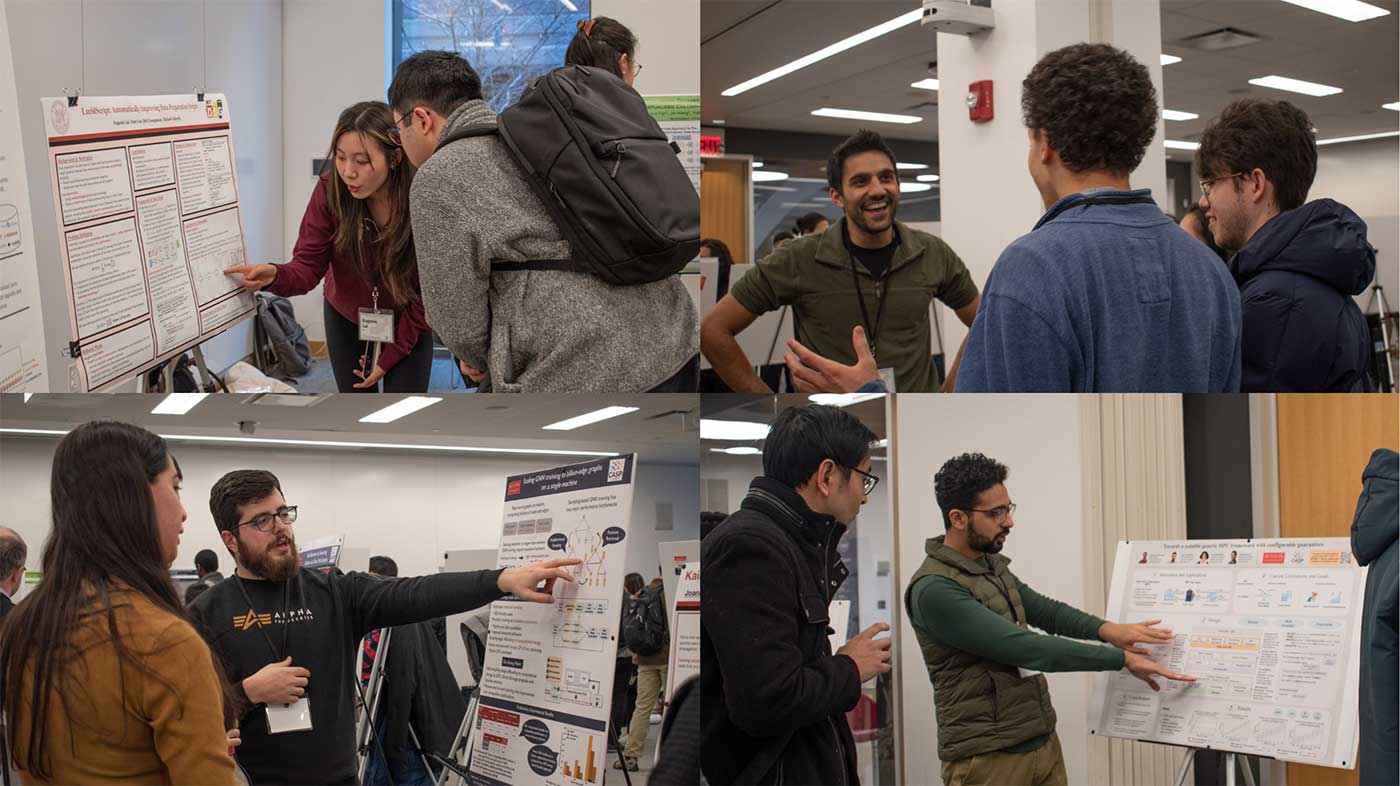
The program consisted of 21 presentations and talks, including keynotes on knowledge graphs and human data interaction, as well as presentations on self-designing storage engines, interactive visualization interfaces, enterprise software, and more. Then came an afternoon poster session in which more than 40 researchers — mostly doctoral and postdoctoral researchers — displayed their work and discussed technical details with observers.
“The role of the main international database conferences like SIGMOD, PODS, and VLDB is in being a venue to present work,” Tziavelis said. “This event isn’t as large, but it’s another opportunity to present your work, to show others what you’re doing, and to develop collaborations.”
Tziavelis added that the industry professionals in attendance, apart from bringing interesting ideas to market, are doing innovative research work. They want to present it somewhere, build connections with universities, pitch their ideas, and draw on human capital in the Northeast. Gather all the attendees together, and the result is an event where the field’s local thinkers can connect and collaborate.
“I reconnected with people I hadn’t seen in many years,” he says. “It was a refreshing experience after years of inactivity, isolation, and Zoom conferences due to COVID.”