Author: Madelaine Millar
Date: 05.07.23
It might start with something as simple as an itchy sweater.
A neurotypical person could manage this annoyance, but to an autistic person with sensory processing issues, the sweater can feel like steel wool scouring their arms. Individuals with profound autism might also lack the ability to pinpoint what is causing their discomfort or the verbal skills to ask for help taking the sweater off. Discomfort can quickly become pain, then panic, and the person begins to “melt down” — screaming, crying, hitting themselves or the people around them, anything to alleviate the distress. It’s often not until the meltdown has begun that the autistic person’s family, friends, or caregivers realize there is a problem.
How much suffering could be spared if that autistic person could communicate their discomfort to the people around them, even just minutes before it becomes unbearable?
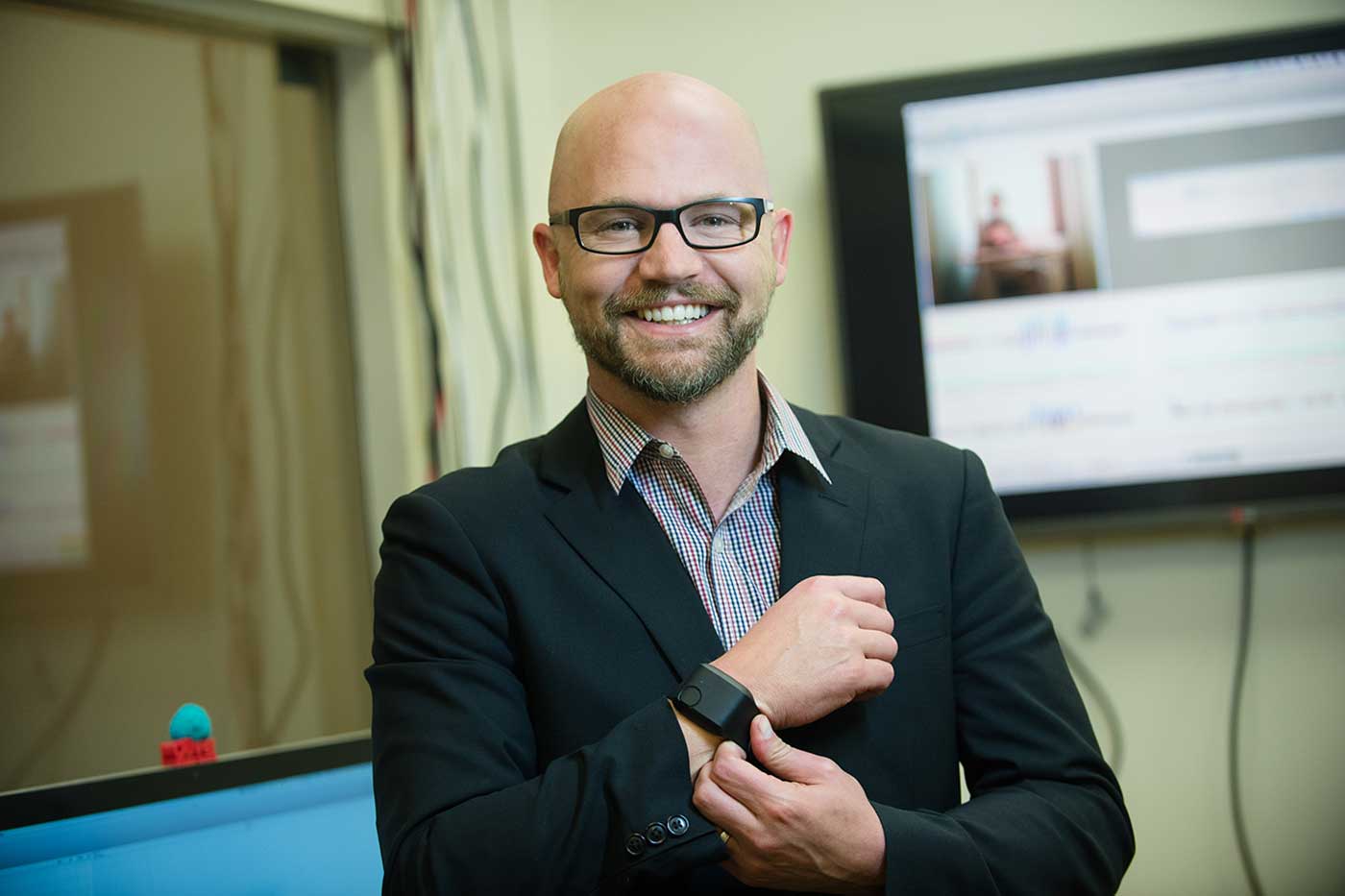
Enter Matthew Goodwin — an interdisciplinary associate professor jointly appointed in the Khoury College of Computer Sciences and the Bouvé College of Health Sciences, a founding member of the Personal Health Informatics doctoral program, and director of the Computational Behavioral Science Laboratory. His research uses wearable sensing and machine learning to develop tools and techniques that make life easier for autistic people and their caregivers. Goodwin recently received major grants from the National Science Foundation (NSF), Department of Defense (DOD), and National Institutes of Health (NIH) to work on predicting aggressive behavior minutes before it occurs in minimally verbal autistic youth, as well as helping more cognitively able autistic people regulate their stress through paced breathing, progressive relaxation, and other strategies.
“People with profound autism are a segment of the population I think we need to support the most, and yet we have the least amount of information to guide us in their needs and what the best interventions are,” Goodwin said. “It creates a focus and urgency to use computer intelligence to advance our understanding and care for human health.”
Smart and Connected Health
Most severe behavior management techniques focus solely on stopping behaviors already in progress by any means necessary. “That tends to be major sedative medications,” Goodwin explained, “which can cause weight gain, impact working memory, and reduce learning potential. Or autistic people get mechanically restrained; they wear braces so they can’t bend their arms to hurt themselves or others, or they wear helmets so that when they hit themselves, the force is reduced.”
Mechanically restraining a child in distress is traumatic for everyone involved, and the constant possibility of having to do so prevents families from engaging in public activities together. The alternatives, though, are worse.
“If the meds or mechanical restraints don’t work, or if the stress on a family becomes too great as that child becomes stronger than them, they’ll get pulled out of their homes and educational settings. They’ll find themselves in group homes, hospitals, the ER, or psychiatric inpatient units,” Goodwin continued, “These are not long-term solutions — these are acute crisis management facilities.”
To potentially avoid these devastating outcomes, Goodwin’s long-term vision is to alert autistic people and their caregivers of rising stress using data from commercially available, wrist-worn, wireless devices that measure real-time changes in the body’s cardiovascular, electrodermal, and physical activity, to avoid or preemptively manage overwhelming stimuli and distress in their environments. By developing machine learning and predictive analytics techniques and applying them to this data, Goodwin and his team can forecast aggression toward others, self-injury, and meltdowns three minutes in advance with 80 to 90 percent accuracy.
The NSF Smart and Connected Health study, the first of Goodwin’s recent grants, focuses on enriching his behavior prediction models with advanced machine learning methods,intended to reduce reliance on humans to label behavioral data. Working with the Marcus Autism Center at Emory University, Goodwin and his team will spend the next four years testing their new models on biosensor data gathered in an outpatient clinic.
The fact that computer science and machine learning techniques have scaled his research as much as they have encourages Goodwin. From the beginning, he aimed to create tools and aids for disenfranchised people whose unique experiences of the world prompted him to reconsider everything from small talk to knowledge acquisition. Now he finds himself engaging in work with enormous potential considering that one in 36 children is diagnosed with autism by the age of eight.
“I didn’t set out to be a quantitative person or a machine learning person. I went to the places that seemed like they had tools and methods that can answer questions about a very complex clinical condition,” he said. “Most parents [of autistic children] will say to me, ‘If I could have this capability, it would be priceless. It would be a game changer for our ability to lead a more normal life and have some hope that our child will be as independent and self-determined as possible.”
Regulating Together
Autistic people’s experiences can be roughly categorized into three groups, Goodwin explained. The first group,those targeted by the Smart and Connected Health study, have autism that severely impacts their daily lives and independence. This group often has significant social, cognitive, and verbal challenges; physical and psychological comorbidities; and difficulty self-regulating.
Members of the second group have more mental and verbal abilities, but still deal with depression, anxiety, and stress management issues; it is for this group that Goodwin’s other research is designed. (The third group has even more social, cognitive, and verbal abilities, fewer comorbidities, and greater independence.)
Regulating Together is a program developed at Cincinnati Children’s Hospital that teaches cognitive behavioral techniques, progressive muscle relaxation, and stress-reducing mindfulness activities to parents of autistic children. The parents are trained to teach their child these techniques, perform them together, and hopefully manage stressful situations that might trigger a meltdown. The program performed well in a smaller, randomized clinical trial, and Goodwin and his colleagues at Cincinnati Children’s Hospital are now conducting a more extensive, four-year follow-up study with support from the DOD. Goodwin’s role is to collect and process ambulatory psychophysiological signals such as heart rate, heart rate variability, and electrodermal activity to determine Regulating Together’s impact on participants’ physical stress reactions before, during, and after the intervention.
The third and final study, supported by the NIH, asks a simple question: Would adding a dog to the Regulating Together program help? It’s been established that emotional support animals can benefit people with mental health conditions. Goodwin and his collaborators seek to determine whether Regulating Together methods have an even greater impact on participants’ stress reactions when a friendly puppy is in the room.
Because Regulating Together can be conducted in the home by parents, Goodwin points out, the barrier to entry is lower, allowing more autistic people — including those who are more significantly impacted — to access this service.
“It’s not like medicine, where you take a pill that works for some time, contradicts with other drugs, has side effects, and you get dependent on it,” Goodwin said. “These approaches are highly scalable. You can train parents to train their kids. It’s not expensive; it doesn’t require dependency. If we determine it’s effective at a large scale, it will be easier for many people who don’t have the same financial resources to get the same benefit.”
His more verbally able autistic research participants have been similarly encouraged by this approach.
“Most will say, ‘I’ve had such a hard time demonstrating to people that I’m not bad. I experience the world differently, and this is how I cope with it. You’re providing evidence that I’m not a bad or broken person; I just have a harder time managing the world,’” Goodwin relayed.
Goodwin’s focus has always been on that outcome: giving autistic people better tools and support to lead richer, happier, and more independent lives.
“When we talk about equity, diversity, and inclusion, we’re often thinking about race or sex, but diversity is also variation in the human experience,” Goodwin said. “I’d like to see these solutions get into the hands of the people who need them most — those who really need this tech and can’t afford it, those who are struggling in life.”
The Khoury Network: Be in the know
Subscribe now to our monthly newsletter for the latest stories and achievements of our students and faculty
Author: Milton Posner
Date: 04.24.23
This article is part two of a two-part feature. Read part one, “As cyber attacks surge, the Defense Department turns to universities for cybersecurity grads.”
Charlie Deane and Simran Arneja took wildly divergent roads to cybersecurity.
After taking an early interest in robotics and hardware, Arneja landed a high school internship at the US Military Academy. There she was exposed, she says, “not just to military robots, but to the atmosphere of cybersecurity, and how cybersecurity expertise was used in the military.” She emerged from the internship bent on bolstering her security background.
Though his father’s cybersecurity career exerted some influence, Deane’s spark came during the pandemic, when he began reselling merchandise to pass the time.
“To bypass rudimentary restrictions on e-commerce sites I had to rotate IP addresses, or else the site would block me,” Deane explains. “So I figured out how to source hundreds of thousands of IP addresses, set up infrastructure in Ashburn, Virginia, and create proxies that looked like residential addresses. All of that boosted my knowledge of cybersecurity.”
Several years later, the pair found themselves at Khoury College — Arneja a rising fourth-year CS and business administration major, Deane a rising third-year CS major. When the Department of Defense, Air Force Research Laboratory, and Griffiss Institute partnered with Northeastern and other universities to form the VICEROY DECREE program, both students saw their chance to supplement their computer science studies with cybersecurity courses.
“I’m a big advocate for the program because it’s really interesting, especially if you’re taking only one degree,” says Arneja. “It’s great for people who are interested, but aren’t sure if they want to do this as a major yet.”
Undergraduate Northeastern students ideally apply to VICEROY DECREE during their second or third years. The timeline ensures they have both the background knowledge and the schedule bandwidth required to complete the program, says Jose Sierra, VICEROY DECREE’s principal investigator. Faculty consider applicants’ grades, interest in cybersecurity, and post-program plans, and will prioritize students who are veterans, ROTC, women, or members of groups underrepresented in the field.
Once admitted, a student takes 8–10 credits of VICEROY DECREE courses in addition to their existing degrees; the program’s scholarship covers the extra tuition. Students have free reign to take whatever VICEROY DECREE courses interest them through Northeastern or a partner university, be they strategic foreign languages like Russian and Arabic or technical topics like “Malware Analysis” and “Applied Cryptography.” Each university has their own course offerings based on their existing specializations: Northeastern in data science, Northern Arizona University in cryptography, the University of Houston in physics and the electromagnetic spectrum, and the University of South Carolina in advanced networking.
Arneja began her VICEROY DECREE coursework with a data science class at Northeastern and will take a class through another institution in the fall; she says the program helps her squeeze in courses that otherwise wouldn’t be a logistical fit. For his part, Deane took a cryptography course through Northern Arizona University that focused on public infrastructure, asymmetric cryptography, and elliptic-curve cryptography.
“It was very challenging at first, and I wasn’t sure what I’d gotten myself into,” Deane recalls. “But it was invaluable. I learned a lot about the cryptographic infrastructure that powers our modern systems and secures our communication, as well as the math behind it.”
Arneja hopes to involve herself in research, as VICEROY DECREE opens the doors to some labs that would normally be limited to graduate students. For her, it’s all about being on the cutting edge of defense technology.
“The appeal of this program is the defense aspect, which I’ve always been interested in, but which can be difficult to get into,” she says. “I like the idea of being involved in something I can’t talk about because it’s light-years ahead of what commercial companies are doing … making aircraft disappear off radar, mind puzzles in defense. That’s part of why I’m doing the program; I get to dip my feet into research in that area.”
Deane’s long-term goal is to found his own company crafting cybersecurity solutions for government and enterprise needs in a world of increasing internet turmoil. But first, he wants to stretch his legs in a DoD role.
“The only way to enter the realm of cybersecurity on a global stage is at a government facility or defense contractor,” Deane says. “Defense contracting, the military, the NSA — it all seems very daunting. So hopefully VICEROY DECREE will open locked doors and let me talk to people I need to talk to.”
VICEROY DECREE offers students like Deane and Arneja mentors — typically graduate or doctoral students who are also veterans and defense industry employees. Students change mentors each semester and can match with someone whose career aligns with their interests. Arneja’s current mentor works at Raytheon, where Arneja is considering employment post-graduation.
“He has access to a lot of networks and people, which is very helpful because I’m interested in many different things,” Arneja says. “I would definitely want to take advantage of his vast network, tour some of the facilities, see the inner workings of companies like Raytheon — just because I’m trying to figure out whether I want to pursue the engineering side or more cloud-based stuff.”
“We met up every week to discuss life, and he helped me set goals and stay on track,” Deane says of his mentor, a graduate fellow researching machine learning models for 2D quantum materials and condensed matter physics on graphene. “You have someone you can bounce ideas off of, talk to on a casual and professional basis, and who can help you align what you’re doing in school with your professional and defense-related goals.”
And the students aren’t the only ones setting up a future in cybersecurity.
“The goal for Northeastern is to be a leader in cybersecurity research and education, to be an institution whose graduates are truly experts in cybersecurity, and to create awareness that Northeastern is the place to be for cybersecurity,” says Aanjhan Ranganathan, the program’s co-principal investigator. “It’s great to see folks across different universities join under a single umbrella, and from Northeastern’s standpoint, it’s great to lead such a project.”
The Khoury Network: Be in the know
Subscribe now to our monthly newsletter for the latest stories and achievements of our students and faculty
Author: Milton Posner
Date: 04.24.23
In recent years, sectors all across the American economy have been calling for computer science graduates to join their ranks.
But the cybersecurity sector isn’t just calling. It’s howling.
As cyber attacks leave the United States, its businesses, and its people increasingly vulnerable to data breaches, ransomware, and IP theft, the country’s need for cybersecurity workers is dwarfing its talent pool. In 2022, the US cybersecurity workforce grew by five percent, but the gap between supply and demand swelled by nine percent; an estimated 410,000 cybersecurity jobs remain unfilled. If the pipeline doesn’t expand dramatically and soon, the gap could persist for a generation.
To better defend against cyber attacks and weapons that use the electromagnetic spectrum (EMS), the Department of Defense (DoD) has partnered with 19 universities, the Air Force Research Laboratory, and the STEM-talent-and-defense-tech accelerator Griffiss Institute to train the coming generation of cybersecurity experts. The result is the VICEROY program (Virtual Institutes for Cyber and Electromagnetic Spectrum Research and Employ), which groups its university partners into six virtual institutes; each institute is awarded $1.5 million over two years to boost their cybersecurity, EMS, cryptography, and data science offerings in line with DoD workforce needs.
The Northeastern-led virtual institute, dubbed VICEROY DECREE (DoD Electromagnetic and Cyber Research and Experiential Education), also includes Northern Arizona University, the University of Houston, and the University of South Carolina. About 25 students from the four universities have joined the program; the eventual target is 60. The Khoury College faculty driving the program are leveraging Northeastern’s experiential learning focus to offer Northeastern’s VICEROY DECREE students exclusive co-op and research opportunities.
“The same problems industry has are even bigger for the DoD, so the program is geared toward DoD and defense industry jobs,” says Jose Sierra, principal investigator for VICEROY DECREE and associate director of Khoury College’s information assurance and cybersecurity program. “VICEROY DECREE takes students who are interested in cyber and gives them the skills and knowledge they need. They can specialize and get advanced skills that they wouldn’t have without the program.”
“It’s supposed to be a virtual institute, so you can be at any of the partner institutes and still take classes from the other universities remotely,” adds Aanjhan Ranganathan, VICEROY DECREE’s co-principal investigator and a Khoury College professor specializing in EMS-related cybersecurity. “Another differentiating aspect is the addition of the non-technical focus, including courses like Chinese and Arabic. It’s a holistic education.”
Both researchers note demand for versatile cybersecurity graduates is soaring. Sierra is troubled by the growing volume and scope of cyber attacks against companies, and by malicious actors targeting vulnerable institutions like hospitals that they previously didn’t think to prey upon. Ranganathan points out that many of the targeted systems were designed for functionality, not defensibility, and that retrofitting these systems to be secure requires even greater intervention from cyber professionals.
But the rise in attacks alone doesn’t account for the workforce gap.
“Cybersecurity is a relatively new field, especially in terms of system security and of treating cybersecurity as a profession,” Ranganathan says. “It’s also an interdisciplinary profession. You’ll need your computer science background, but if you want to work with security and privacy in medical data, wireless systems, robots — you’ll need domain knowledge.”
Northeastern is among the pioneers of a small number of interdisciplinary cybersecurity programs nationwide, and because they’ve all ramped up recently, there are only so many cybersecurity graduates in circulation. But the pipeline is poised to grow, and VICEROY DECREE’s captains want everyone to know it.
Enter the first VICEROY DECREE Annual Symposium, an all-day, hybrid event held on February 9 and 10 which primarily targeted CS students and defense industry professionals.
“There was the networking part: bringing Northeastern students together with students from Houston, Northern Arizona, South Carolina,” Sierra says. “Students could share their research and course projects, which helped to link the institutions together.”
Symposium students participated in a cyber pitch competition, where they proposed solutions for cybersecurity-related challenges. The event also featured master classes, panels, and presentations on topics ranging from Google data centers and autonomous machines to post-quantum cryptography and defense-related cybersecurity challenges. Speakers included industry researchers, Army and Air Force officers, and faculty from all four universities, including Sierra and Ranganathan.
“By inviting industry and DoD folks into the symposium and making them aware of the VICEROY DECREE program, we can help students to be recruited when they come out of the program,” Ranganathan explains. “Industry folks can see there’s a specialized EMS and cybersecurity program from a top cybersecurity research university like Northeastern, so you start to build a pipeline for students to be hired after graduating.”
To read about those students and their experiences in VICEROY DECREE, click here for part two.
The Khoury Network: Be in the know
Subscribe now to our monthly newsletter for the latest stories and achievements of our students and faculty