Author: Milton Posner
Date: 05.10.23
Both undergraduate student speaker Sanjana Mishra and Dean Elizabeth Mynatt wanted to be perfectly clear: they, not AI, wrote the speeches they delivered for Khoury College’s commencement ceremonies held Saturday at Matthews Arena. Undergraduate keynote speaker Rich Miner accepted assistance from a bot in framing his speech, but said he rejected its jokes.
Despite the jest with which the trio floated their remarks, the banner-headline potential of generative AI was one of several arrows pointing to the key theme of the festivities: how can computer science be leveraged to benefit society? In the graduate ceremony held in the morning, then again in the afternoon undergraduate ceremony, Mynatt and the speakers posed those questions and more, charging the graduates to think not just of the achievement they’d earned, but of the opportunity that awaits them and responsibility they now bear.
Graduate ceremony
“You are entering the field of computer science at an exciting time. You are also entering at a time when we, as a society, are grappling with some difficult questions regarding our personal privacy and the technologies under our charge,” Mynatt reminded the graduates, citing ChatGPT, driverless cars, and personal-data-heavy advertising algorithms as ethical thickets. “I am confident that your education at Khoury College has provided you with the knowledge, tools, experiences, and conviction to tackle these thorny issues … I ask you to remain resolute in the belief that computer science is for everyone, and that everyone should benefit from computer science.”
To that end, Mynatt returned to the computer scientist’s oath she debuted at last year’s commencement — a seven-point guide to ethical conduct modeled after those taken by medical professionals and engineers upon entering their respective fields. This year, students recited the oath for the first time, pledging to respect the dignity, privacy, and diversity of all those touched by technology.
“Computing technology is rarely neutral due to how deeply computing is ingrained in our society,” Mynatt added. “It is imperative that we harness what we learn and discover to better the world we inhabit.”
But societal responsibility was far from the only charge to the class of 1,076 master’s students, 41 percent of whom were female. Mani Sundaram, the graduate ceremony’s keynote speaker and an executive vice president at cloud computing company Akamai, brought the perspective of his own career, which he began after graduating Northeastern with his computer science master’s in 1999. At that time, the internet boom was opening countless new jobs for computing graduates, and between his programming, managerial, and startup roles, Sundaram discovered the value of a strong technical foundation and close collaboration with users.
“I can’t think of a better learning environment than a startup where you learn to wear different hats every day,” Sundaram said. “It’s a great way to learn soft skills such as handling stressful situations, motivating employees, and juggling multiple responsibilities.”
READ: Mani Sundaram receives 40 for 40 honor
He also noted the importance of community, and not just as an end unto itself.
“The hours you spent studying have paid off and will continue to pay off, but the time you spent with your classmates as a member of this international community will also serve you extremely well as you take on your roles as next-generation computer scientists,” Sundaram noted. “Keep those connections and keep making more, because it’s that perspective that will help you understand what this internet of people needs from you today.”
That sense of community also marked the speech of student speaker Alanna Pasco, who graduated from the Align program after also earning her undergraduate degree from Northeastern.
“We are a network, and in non-technical terms, that’s a community,” Pasco reminded her fellow graduates, before shouting out her fellow first-generation college graduates. “Nothing could have prepared me for the relief that flooded my body when I saw for the first time that I was not alone in my struggles navigating the first-gen college experience. That relief gave me conviction that I belonged.”
Undergraduate Ceremony
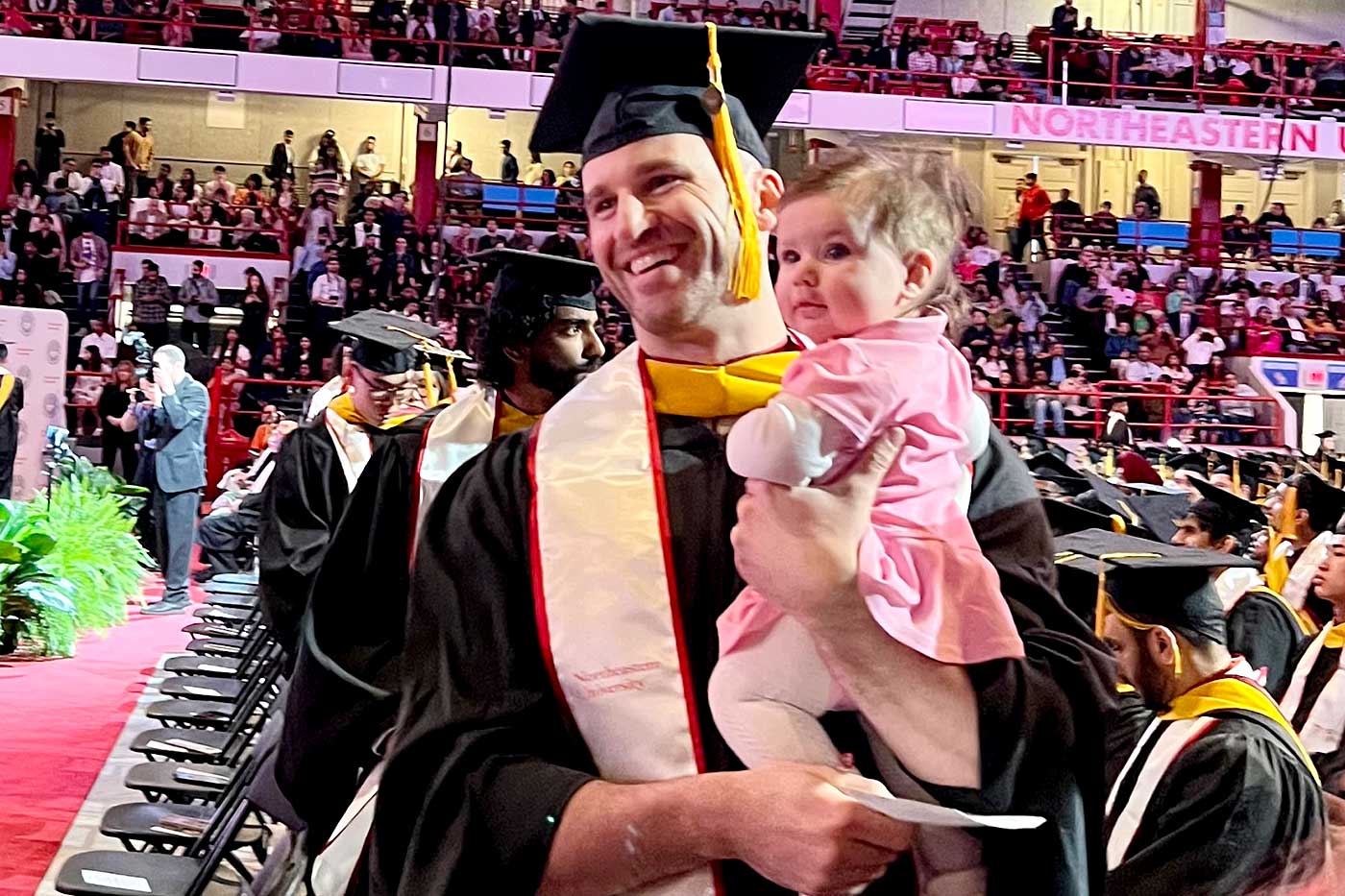
Some elements remained the same in the afternoon ceremony, including Mynatt’s social responsibility charge and the graduates’ taking of the oath. But a few differences stood out, none more so than the inclusion of Android co-founder Rich Miner, who delivered his speech from — in all likelihood — the same spot where his grandfather, an immigrant and first-generation college student, graduated from Northeastern in 1930.
“You are graduating at a unique moment when generative AI is propelling your chosen field to unprecedented heights,” Miner told the 666 graduates, who represented more than 70 countries and dozens of combined majors. “I’ve spent four decades observing the ebb and flow of technological cycles, and this one is different. It’s a perfect storm.”
So as computers become more adept at talking to us in the languages we use among ourselves, Miner prescribed bold vision and strong community as essential for what comes next.
“Surround yourself with inspiring people who share your passions. Never stop looking, learning, and adapting, so that you’ll see opportunities as they start to emerge,” he advised. “And especially while you’re young, take risks.”
Undergraduate speaker Sanjana Mishra staked her speech on risk-taking as well, but did so using Ratatouille and the f-word. Yes, that Ratatouille. And no, not that f-word.
In recalling Chef Gusteau’s quote, “You must try things that may not work … your only limit is your soul,” Mishra said she was reminded that cooking and coding aren’t too different. “They both require a pinch of creativity, a dash of experimentation, and a healthy serving of patience,” she said.
That philosophy, she noted, meant that the f-word (failure) was an evitable growing pain.
“Khoury College was not a cakewalk. We were challenged and tested — not unlike the code we were writing — and pushed to do better than our best. And we stand here before you as the graduating class of 2023 because we took these failures in stride,” Mishra said. “Thank you, Khoury administration and faculty, for teaching us to be creative and imaginative problem-solvers with soul, and for teaching us that it’s okay to try things that may not work.”
That effort and problem-solving built communities, which, as fellow undergraduate speaker Blake Heyman noted, deepened even as students forged their own academic paths.
“I feel so lucky that I got to experience the depth, richness, and warmth of connection through the communities I found at Khoury College,” Heyman professed, citing his experiences as a leader of Out in STEM and as a member of the student-run software consultancy Sandbox. “I wasn’t just coding networks; I created them for myself.”
And as Heyman and his fellow graduates prepare for their professional pursuits, Mynatt is confident those networks will extend the Khoury experience into lifelong pathways.
“I have seen how supportive our students are of one another, and I hope you continue to nurture the connections you have made here,” Mynatt said. “I wish all of today’s graduates good health, professional success, and a sense of purpose and joy as you take your Khoury degree into the world and make a difference in the path you choose.”
The Khoury Network: Be in the know
Subscribe now to our monthly newsletter for the latest stories and achievements of our students and faculty
Author: Milton Posner
Date: 05.05.23
This piece is the sixth in a series on Khoury College’s 40th anniversary celebrations, a series that also covers events in Boston, London, Vancouver, Portland, and Seattle.
Given Northern California’s reputation as a hub for technology research and innovation, it should come as no surprise that the California stage of Khoury College’s 40th anniversary tour had three stops to make.
It began on April 15 with a networking reception for alumni at one of Northeastern’s newest additions to its global network, Mills College in Oakland. There, Dean Elizabeth Mynatt reminded the attendees of the role of each Northeastern campus in furthering the college’s learning, research, and inclusion goals.
“The Khoury story is being lived out on these campuses with faculty, students, and staff who are making it their own; that empowerment is fundamental,” Mynatt said. “Our global university system is a foundation and structure that empowers our researchers to have impact. We can impact policy because we’re based in Arlington. We can impact First Nations because of our presence in Vancouver. And now we’re here in Oakland. Other universities don’t know how to do this, but we know, and we’re leveraging our strength.”
Mynatt also cited the responsibility of computing researchers and professionals to society.
“We have an obligation to prepare our students to become leaders in the field, to make them not just technically skilled, but able to wrestle with hard decisions, and with the lack of responsibility taken on by some of the inventors within computer science,” she added. “At the 50th, 60th, or any future anniversary, what will they say about the choices and commitments we’re making today? I think what will matter most is doubling down on our commitment to “computer science for everyone.”
Three days later, the celebration stopped in San Francisco for a faculty and student lunch, where Khoury leaders had the opportunity to interact informally with students pursuing their CS master’s. Then, that night, the Bay Area festivities culminated with a celebration, faculty panel, and student research showcase in San Jose, one also attended by local industry partners.
“What we’ve seen in this 40th experience is that this is not about cookie-cutter Khoury, or about replicating Boston here, there, and yonder,” Mynatt observed. “Every campus has unique strengths because they’re engaged in their local communities and with their own local partners, and they’re bringing their own leadership to the table.”
The college also recognized five local 40 for 40 honorees: Greg Waters, a Khoury alumnus whose first company shared its space with Northeastern’s first Bay Area campus, and whose current company operates out of Northeastern’s Kostas Research Institute in Burlington, MA; Chris Lambert, former chief technical officer at Lyft; Crista Lopes, who helped pioneer aspect-oriented programming research as a Khoury doctoral student and went on to co-develop an award-winning, open-source, 3D virtual world; Praful Mathur, who helped found entrepreneurial student organizations at Northeastern and has founded multiple companies since; and Natasha Noy, an AAAI Fellow who researched at Stanford for 15 years before joining a data-focused Google team.
The event proceeded with a panel of professors John Alexis Guerra Gómez, Jeongkyu Lee, and Ricardo Baeza-Yates, along with alumna and NASA software engineer Aida Sharif Rohani. Among the spotlighted topics were the panel’s desire for students and doctoral researchers to travel seamlessly between campuses for learning and collaboration; they also spoke to the ability of a master’s thesis to instill skills valuable in academia and industry, including thinking critically, running experiments, and embracing uncertainty in one’s work.
“This research involving faculty and master’s students in the network was very different from what many people envisioned when they thought about university research,” said Jodi Tims, associate dean of network programs, professor of the practice, and moderator of the panel.
The evening concluded with a showcase of 18 student research projects all conducted under the guidance of faculty mentors. They included an application to aid in scientific writing, a mechanism for automatically labeling insect legs, and a data pipeline for a music streaming app.
The Khoury Network: Be in the know
Subscribe now to our monthly newsletter for the latest stories and achievements of our students and faculty
Author: Madelaine Millar
Date: 05.04.23
Khoury College community members are always going above and beyond in their classrooms, research labs, co-ops, and community service positions. Each year, committees comprising the college’s administrative staff and advisors, plus faculty and co-op advisors for the undergraduate committee, recognize some of the college’s brightest stars — students who stretch the boundaries of creativity, innovation, service, and learning. Read on to meet the seven outstanding undergraduate and graduate students who were honored for their accomplishments in 2023, or click a name to jump to that point on the page.
Undergraduate: Anusha Arora (Community Service), Michael Delmonaco (Research), Amanda Bell (Teaching), Floris Dobber (Co-op)
Graduate: Sumukh Vasisht Shankar (Research), Kristine Nnemka Umeh (Community Service), Haotian Shen (Teaching)
Anusha Arora, Undergraduate Community Service Award
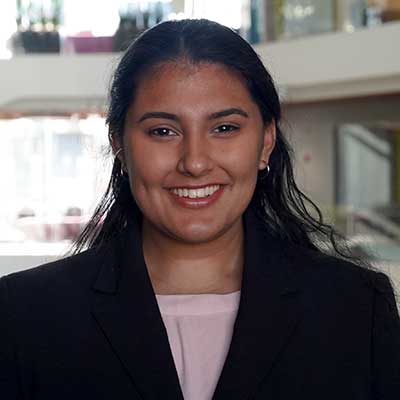
When Anusha Arora began her CS and business administration degree, she found that peer mentorship was available to her — if only she went searching for it. Receiving casual advice from older students on everything from the co-op process to how to use Github helped Arora a lot, so she decided to use the marketing half of her degree to ensure her classmates knew about the resources available to them.
Arora started as the mentorship chair at the student-run Computer Science Mentoring Organization (CoSMO), developing and marketing the program’s mentorship opportunities. She forged collaborations with NU Women in Technology and Northeastern’s Multi-diverse Unified Leaders in the Technology Industry to more efficiently to utilize their mentors, and even served as a mentor to several students herself. She eventually worked her way up to president of CoSMO in 2021, and also co-led Northeastern Women in Business.
“The most fulfilling part was just watching CoSMO grow as an organization. When I joined, it was still fairly new and was in a stage of trying to grow its programming,” Arora said, noting that the club’s membership now tops 300. “It’s been such a fulfilling journey, and looking back and seeing how I contributed to that journey is really wonderful.”
READ: CoSMO connects and creates safe space for new computer science students
After graduating in May with a BS in CS and business administration with a concentration in marketing and a minor in psychology, Arora will return to Northeastern through the PlusOne program to obtain her MS in CS. She’s excited to remain a part of the Khoury community and plans to keep an eye out for further mentorship opportunities to lift up others the way she has been lifted up.
“When I came into Northeastern, I had zero computer science experience. For me, it was a really intimidating field,” Arora said. “Being able to provide a comforting, unintimidating, non-competitive environment for people to learn and ask questions to older students was really great.”
Michael Delmonaco, Undergraduate Research Award
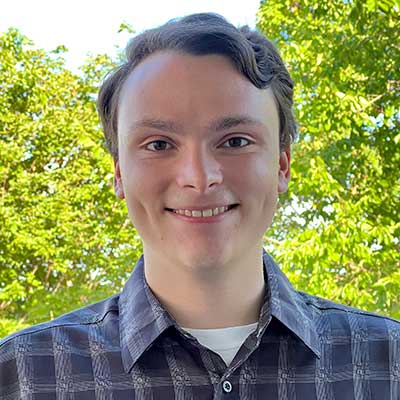
Michael Delmonaco loves to fall down rabbit holes, and coding offers him endless rabbit holes to stumble into. With a little help from Professor Ben Lerner, Delmonaco discovered an interest in programming languages, which led him to his deepest rabbit hole yet.
Domain-specific programming languages allow coders to perform specific functions (like writing tests or rendering web content) that would be unwieldy using a general-purpose language like Java or Python. Working with Professor Matthias Felleisen and his PhD student Michael Ballantyne, Delmonaco helped develop syntax-spec, a tool that makes it much easier to write and implement tiny languages inside of the programming language Racket. The tool is now available for other programmers to use, and Delmonaco is proud to have made a tangible contribution to the field.
“Coding is one of my main hobbies, so this was basically a hobby project on steroids. I was doing something that I wouldn’t be capable of doing on my own, but I had top experts in the field — like Matthias, the guy who made Racket, and Michael, a global expert on macros — advising me and guiding me through this really interesting project,” Delmonaco enthused. “I’m very excited to see what people do with syntax-spec, because I think it’s going to be very useful for making domain-specific languages.”
After graduating in December with a BS in CS and a concentration in AI, Delmonaco is now working as a web developer at AWS. He’s happy to be working in industry for the moment, but he plans to keep an eye peeled for ways to stay involved with the programming languages research community, a small but enthusiastic group in which he’s come to feel at home.
“I didn’t have a single bad Khoury professor, but any professor that was involved in programming languages was just amazing,” Delmonaco said. “They’re all so enthusiastic and they’re all such amazing teachers. They love what they do, and they want you to love it too.”
Amanda Bell, Undergraduate Teaching Award
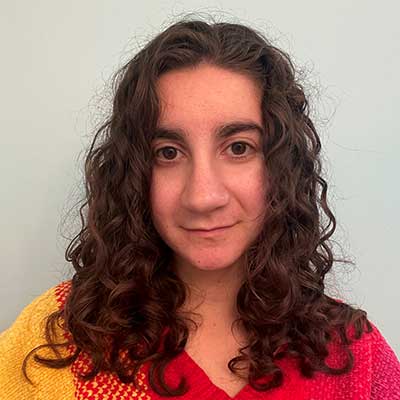
One might not expect it of an award-winning TA and peer tutor with a combined major in behavioral neuroscience and data science (and a minor in German), but Amanda Bell wasn’t always the greatest student during her time at Northeastern. But to Bell, that’s the point. Her own TAs were crucial to her success, and she wanted to help others in the same way. Plus, knowing what it feels like to struggle in a class gave her a lot of empathy for her students.
Bell served as a TA for “Large-Scale Information Storage and Retrieval” for two semesters in her third year, helping students master document-based data storage systems like Mongo and message-based storage systems like Redis. She has also spent the last year peer tutoring — first tackling biochemistry and neurobiology, then shifting to biostatistics to help address a lack of tutors in the highly specialized subject.
“What’s been the most rewarding is that students in this biostatistics class are learning from what we and their professors are telling them, but also they come up with things that we hadn’t even thought about before,” Bell said. “That’s the idea of teaching, at least as I see it. You’re not trying to make someone as good as yourself, you’re trying to help them to be better than you.”
After graduating in May, Bell plans to join biologics research and early-stage clinical development company Vistera, where she will be a research associate. She’ll work on the programming side of a cell-sequencing team, and while she expressed interest in returning to teaching eventually, she’s happy to be working in industry for the moment. Wherever Bell goes, she will continue to push herself and her fellow learners, as she’s never been one to shy away from a challenge.
“It may be a controversial answer, but honestly my favorite part of my time at Khoury was the very first series of programming courses,” Bell said. “I would not say I enjoyed them in the moment, but looking back, the whole Fundies 1, Fundies 2, and “Object-Oriented Design” sequence has been the most beneficial part of programming that I’ve experienced in college. It teaches you how to persist and work through problems even though you’re doubting yourself.”
Floris Dobber, Undergraduate Co-op Award
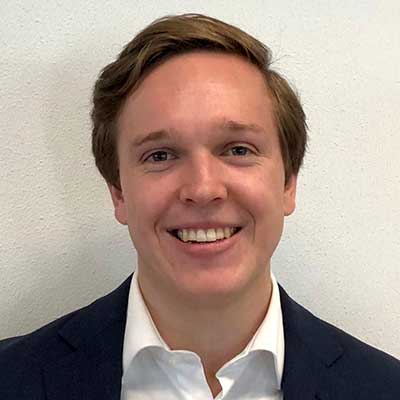
Data science has taken Floris Dobber all over the world, from a car-leasing company in Munich to environmental tech incubator Greentown Labs in Somerville to the world of finance with Eaton Vance. He’s taught himself natural language processing and built algorithms to sort and classify daily news articles. Not a bad résumé for someone whose interest in data science began with nothing more than curiosity about soccer statistics.
“The Northeastern data science program is super broad, but also in-depth enough that you get some real skills that you can apply to your job, like I did at my co-op and hopefully will in my future career,” Dobber said.
For Dobber, the diversity of his co-op experiences was the most valuable piece of Northeastern’s experiential-learning program. Working with Greentown Labs showed him how much he loves a startup environment, while his time at Eaton Vance taught him that he loved the competitive world of global finance. He plans to move to London to pursue graduate studies in finance, adding specialized economics skills to his general-purpose data science know-how.
His favorite part, though, has always been looking back at the end of each co-op to see just how far he’d come.
“As you’re wrapping up and working to hand over to the next person, you look back and see what you’ve worked on, what you came in with, and all the skills you learned,” Dobber said. “And you’re like, ‘Wow, when I started I didn’t even know what this meant, and now I’m teaching the next person to understand all the work I’ve done here. It’s a really nice moment.’”
Sumukh Vasisht Shankar, Graduate Research Award
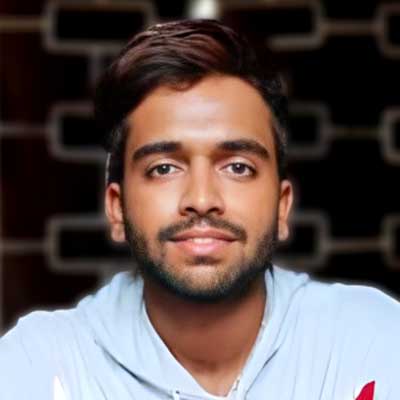
After completing a bachelor’s degree in information science and engineering in India, Sumukh Vasisht Shankar came to Khoury College with a clear goal: to get himself involved in research.
After spending a semester volunteering on Professor David Choffnes and Alexander Gamero-Garrido’s data localization project, Sumukh was accepted into the Khoury Research Apprenticeship program, in which master’s students participate in research relevant to their degree while being mentored and supported by faculty advisors. He spent the following year working with Khoury Professor Robin Walters and Rutgers Professor Jon Singer to build deep learning models exploring the relationship between the heat profile of a dynamic spatial light modulator and the pattern of reflected light it produces.
READ: The researcher’s apprentice: master’s students showcase innovative projects
Dynamic spatial light modulators are devices that change the amplitude and phase of a beam of light. They are used for data storage, holographic projection, and optical computing — a high-bandwidth type of computing that uses light waves to process data. However, because they are extremely expensive and difficult to use, deep learning models that can simulate dynamic spatial light modulator processes using very little training data are critical to the field’s continued development.
“There’s a scarcity of this information over the internet or in textbooks, so I’m learning about it right from the foundations and generating new knowledge. I find that fascinating,” Sumukh said. “The opportunities available here at Northeastern — and especially at Khoury College — opened up doors to a plethora of opportunities for me, and I’m unfathomably grateful for it.”
Sumukh will be pursuing one of those opportunities — researching deep learning models for cardiovascular research at a Yale laboratory — after he graduates this May. He’s considering a PhD after that, eager to remain in the world of research.
“The Khoury Research Apprenticeship program is also dubbed as a ‘pathway to a PhD’ program, so it’s a wonderful opportunity,” he said. “I would definitely encourage other students to go for it. It’s a wonderful opportunity to work on cutting-edge research; Khoury College is doing amazing research across all fronts, from cybersecurity to biomedicine.”
Kristine Nnemka Umeh, Graduate Community Service Award
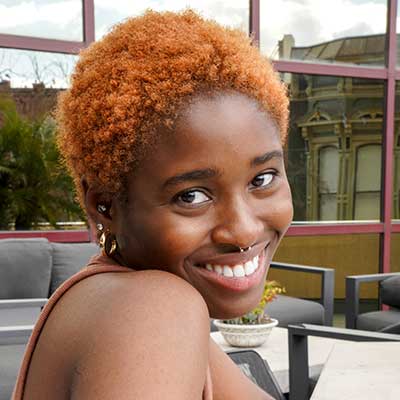
Few are more qualified to talk about what it’s like to be a Northeastern student than Kristine Nnemka Umeh. After doing her undergraduate studies in chemical engineering and Mandarin at the Boston campus, Umeh joined Khoury College’s Align program — a graduate program intended for students without computing backgrounds — and pursued an MS in CS at Northeastern’s San Francisco campus. So when she was presented with the opportunity to be a student ambassador and share her insights with other prospective Northeastern students, Umeh jumped at the chance.
As a student ambassador, Umeh has attended conferences, mentored younger students, and sat down to chat with dozens of prospective Aligners. She helps them to gauge the weight of the workload they are expected to handle, the benefits of choosing one campus over another, and how best to prepare for Align, among other questions. She’s still in contact with several people who ended up enrolling in Align in San Francisco, just as she did.
“My advice is always to rest before the program. People are making preparations, but you can’t really prepare because you don’t really know how it’s going to go,” Umeh said. “Don’t bend over backwards trying to watch all the YouTube videos and be proficient because that’s just not gonna happen, and that’s what the program is for. Don’t try to rush yourself.”
Umeh is glad that she waited until her graduate studies to pursue computer science. Having a background in a different field of study helps her to think deeply not just about whether the tools she’s building actually function, but whether they’re working towards worthwhile ends to begin with. She loved that the Align program put her in contact with other students who brought similarly diverse backgrounds and unique experiences to computer science, and she’s excited to put her new skills to work in industry.
“Diversity of thought is so important for the future. People who have a background in philosophy, sociology, literature and linguistics — we need those people getting their hands on code because they can offer feedback on how these models should behave,” Umeh said. “I’m really excited for the future, and I feel like Northeastern really helped prepare me.”
Haotian Shen, Graduate Teaching Award
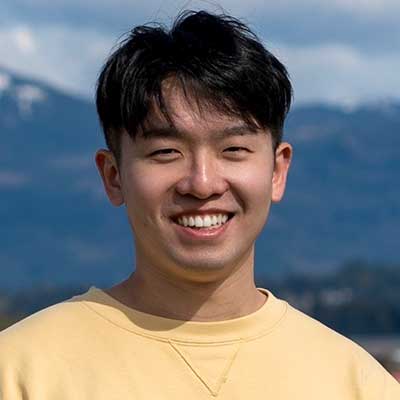
As an Align student with a background in chemical engineering and biology, Haotian Shen is no stranger to the frustration of getting stuck on a problem and lacking the resources or technical knowledge to get yourself unstuck. That’s why he doesn’t limit his assistance to his office hours. Shen encourages his students to contact him over social media for assistance, jump into a breakout room with him during a larger Zoom session to ask questions they might be embarrassed to pose in group settings, and ask for tips about everything from databases to internships.
“We need to acknowledge that different students have different learning perspectives, and they want to learn in different ways. Sometimes when I try to explain materials in a way that I think may be clear, they may not understand immediately,” Shen said. “Growing together with the other students is one of the most satisfying experiences I’ve had.”
Shen appreciates getting immediate feedback as much as he appreciates giving it. He transitioned to computer science because he loved that he didn’t have to wait weeks or months for tests to finish the way he did as a chemical engineer; he could run his code and immediately see what worked. He also appreciated that his Khoury professors were extremely up-to-date on the tech industry and could give him lots of relevant feedback. Their preparation and guidance helped him to land an internship as a software engineer at AWS last summer, a position he’ll return to after he graduates in May.
For students interested in making the transition to tech, Shen advises trying an introductory programming course online, just to see whether they like the subject in practice as well as in theory. And if they do?
“Northeastern’s Align program is such an awesome program that really breaks you into the tech industry. The co-op policies are really flexible, so they allow students to find internships in a more competitive way compared to other schools,” Shen said. “I think if they’re really determined to enter the tech industry, just come to Align.”
The Khoury Network: Be in the know
Subscribe now to our monthly newsletter for the latest stories and achievements of our students and faculty
Author: Milton Posner
Date: 05.01.23
Maya R. Said, Sc.D. put together a lengthy and varied career in the two decades after earning her doctorate from MIT. There was biology and computing research, then health care R&D and consulting, and most recently an executive role at pharmaceutical company Novartis leading Global Market Access for oncology.
But in 2017, she left the pharmaceutical industry after her own personal health scare, and amid growing frustration that treatment innovations weren’t reaching patients.
“After working for 20 years in the health care industry and being focused on patients, I became a patient,” Said recalls. “That experience was overwhelming in ways I never anticipated.”
Across six months navigating her own care, Said realized just how disorienting the experience could be for patients. During this time, she reached out to Sami Shalabi, her former MIT classmate who had led the Google News team. Shalabi had helped his own family members navigate cancer care and access to doctors in Boston. As the two compared notes and expertise, they kept returning to a key question: could tech help people navigate difficult diagnoses, starting with cancer?
Nearly six years later, their answer is a resounding yes. The company they founded, Outcomes4Me, offers a free platform and app that leverages data, clinical guidelines, and AI to help cancer patients navigate their care. Patients can track their medications, view their medical records, and browse treatment options, among other features. By delivering relevant, understandable, and personalized information, Outcomes4Me aims to help patients make informed decisions with their providers and improve their health outcomes.
“We are on a mission to democratize health care by empowering patients,” enthuses Said, Outcomes4Me’s CEO. “It means providing the tools and the means for every one of us diagnosed with a disease to take a proactive approach to our care, to participate in treatment decisions, to manage our care, to access the latest treatments.”
To fuel that mission, the company has turned to Khoury College talent early and often, converting co-ops into post-graduation full-timers with striking regularity.
“The demand for software engineers is exploding, and supply cannot keep up with demand,” notes Shalabi, the company’s COO. “It’s important to build relationships with colleges that produce high-quality talent, and Khoury College has been a great feeder to our organization.”
Turn the whole thing upside down
“If a person is diagnosed with cancer, beyond the shock, they ultimately have two questions: what are my options, and how can I best manage my life,” Said explains. “They are not emotionally ready to consume all of the information being shared when they meet with their provider.”
And once they are?
“A typical consultation with a physician is 30 minutes, and that time is only shrinking,” Shalabi says. “It’s not enough to understand a complicated, life-altering disease.”
“It ends up being like a Google search where patients have to know what they’re looking for, and they have no clue what’s meaningful,” Said adds. “So personalized, evidence-based navigation with AI and machine learning — that’s what makes our platform special.”
When a patient signs up for Outcomes4Me, they answer questions about their diagnosis. Then the app presents relevant information about treatment options, clinical trials, and symptom management, which patients can discuss with their providers.
“We’re not here to replace providers; we’re here to augment that relationship so that it becomes more effective,” Said clarifies. “We as patients can improve things only by taking a more proactive role in our care.”
Because cancer patients deal with sky-high stakes, the platform has a similarly high bar for user experience, says Bill Desmarais, vice president of engineering. Outcomes4Me sources personalized treatment guidance from the National Comprehensive Cancer Network, and the company’s clinical team answers questions in a streamlined way that hospitals and their portals often don’t.
“Medical data stored in hospital back-ends is very cluttered. A lot of relevant information in a cancer patient’s chart will be in unstructured fields in the doctor’s notes, handwritten or hand typed,” Desmarais explains. “Using AI and natural language processing, we can help to cover those gaps that are keeping people from understanding their treatment and what comes next.”
The company’s ultimate goal is to promote health equity in a country where access to new cancer drugs and treatments, medical records, and health care in general is far from equal. For Said, equity means meeting people where they are — geographically, psychologically, and emotionally — and getting the best health outcome possible for them.
“As an entrepreneur, you’re always looking for problems that touch you, that you can actually do something about,” Shalabi adds. “Computing is a powerful medium. With a small team and the right level of vision and ambition, you can do amazing things.”
When it came time to build that team, Said, familiar with Northeastern’s co-op program, began to tap it.
“The Khoury curriculum is clearly building the right foundations,” Shalabi says. “There is also a tremendous amount of diversity coming out of Khoury College, which is one of our core principles. A diverse team always results in better products and experiences.”
After hiring a few co-ops shortly after its 2017 founding, the company doubled and tripled down to the point that many full-time Outcomes4Me employees started as co-ops. The company likes that co-ops can accomplish in six months what would be nearly impossible in shorter internships; likewise, they can be folded into a team as full members, working on meaningful projects and expanding the team’s scope.
“If I hire a former co-op for full-time work post-college, it’s because I know they’re a cultural and technological fit. They’ve worked wonderfully with us for six months, so it’s always a slam dunk,” Desmarais explains, pointing out that an afternoon-long job interview doesn’t provide that same certainty. “Stepping in here and seeing that we already had a Northeastern program in place was wonderful. It meant I didn’t have to invent one.”
Mission control
When Desmarais interviews prospective co-ops, he tries to get a feel for whether they value the company’s mission. It’s no surprise, then, that Outcomes4Me has attracted students who have taken Khoury College’s “CS for Everyone” mission to heart.
READ: Dean Mynatt balances opportunity and obligation in welcoming Khoury College incoming class
“In the software industry, we’re fortunate that it’s pretty easy for us to find jobs right now, but it’s a lot harder to find meaningful work,” says Samuel Wu-Ochs, who completed a co-op at Outcomes4Me in 2021, then worked on the web app for eight months as a full-timer after graduation. “What made me pursue this company was the fact that it was working on a product I could feel invested in … You’ll always have times when you struggle a bit at your job, so when that struggle comes, I want to know it’s for something I believe in.”
Most Outcomes4Me co-ops are, like Wu-Ochs, drawn in by their connection to the mission. For 2021 Northeastern grad and senior software engineer Marvin Sagastume, it was losing his grandfather to cancer. For Tyler Hallada, a 2016 grad and the tech lead for the web team, it was a desire to improve the broken health care system.
“I’ve struggled to find jobs that have a mission, like Outcomes4Me does. You usually have to find a nonprofit,” Hallada says. “I really like the mission, coming into work and helping people with real problems. I like being in the health care space, where there’s a big need for improvement. I can’t imagine myself at an ad tech company that makes people’s internet experiences worse just to make money for a few people.”
It’s not just the company’s mission that enlivens the day-to-day work; it’s that the engineers feel connected to the platform’s users, who the company often invites to share their stories with the team in person. For instance, in high school, Victoria Bowen — now a fourth-year computer science student — participated in a program that identified community needs and designed apps to help, a program that sparked her love for computer science. When she found Outcomes4Me, she also found the ingredient that had been missing in her first forays into the workplace.
“We’re such a small company, so we get to see firsthand where our changes go. Even if I’m working on a back-end feature, I can see how that impacts our users,” she says. “All you need is your computer and brain power.”
Christina Rong feels the same. Outcomes4Me was her third and final co-op at Khoury College; she joined full-time after graduation and now works as a software engineer on the mobile team.
“There’s a lot of emphasis on understanding why we create new features. Having that direct focus on actual people gave me a clear vision of what kind of software I was creating,” she explains. “And I’m not only working with software engineers. We have great medical experts on our team, so getting their perspective on how users will use the app and what kinks to solve gives me an underlying idea about how all of this ties together.”
Rong also notes that although many of Outcomes4Me’s engineers are men, the fact that the company is woman-led means she doesn’t feel as alienated as she might at a different workplace.
“I’ve noticed the minority of women in my CS classes and in the workplace,” Bowen adds. “It excites me to be in a place where I can advocate for girls to learn computer science, broaden their exposure to it, and see it as a possible career path.”
This supportive ethos also manifests in the company’s workflows and culture, which Khoury alumni say have remained supportive and collaborative as the company has grown.
“Every time we bring someone in, they join a culture that they can immediately feel supporting them,” says Wu-Ochs, who has worked with Sagastume to hire co-ops. “They won’t be blamed for making a mistake or feel stupid for asking questions. It encourages them to further that culture.”
Company meetings, morning standups, collaborative coding and problem-solving sessions — it all creates a culture conducive to contributions from new employees. Desmarais notes that while some recent grads have a gap between classroom and workplace software knowledge, the Khoury alumni have had exposure to real company teams, and have an easier time putting computation knowledge into practice.
“We constantly have new directions we’d like to go in, and that usually ends up growing the team,” Desmarais says. “So augmenting Outcomes4Me with active co-ops and having a pipeline of former co-ops in your network makes that piece much easier to manage.”
And as the company pushes beyond its initial focus on breast cancer to include other cancer types, those co-ops will keep coming, inspired — as Sagastume was — by a larger mission.
“I always wanted to make an impact in people’s lives,” Sagastume says. “I come from a family that’s less fortunate, that suffered a lot when I was growing up. I think a lot of people forget how blessed we are with where we live and everything we have. I love that every day when I come to work, I’m proud of what I’m doing. It touches my heart when we get reviews for the app saying, ‘Hey, you’re giving me hope.’”
The Khoury Network: Be in the know
Subscribe now to our monthly newsletter for the latest stories and achievements of our students and faculty