Author: Matty Wasserman
Date: 05.23.23
Ask Northeastern’s student baseball managers, and they can immediately rattle off which of their opponents are using advanced analytics and which are not — simply by looking at their starting lineups.
To the managers, utilizing data to maximize efficiency is a clear benefit. But while the sabermetrics revolution has transformed strategy and player evaluation in Major League Baseball over the past 20 years, the analytics movement is still relatively new in college baseball. The gap is particularly pronounced at the mid-major level at which Northeastern competes, where there are fewer cutting-edge resources.
But thanks to Khoury College students Justin Chen, Reece Calvin, and Tim Clay, Northeastern baseball is utilizing analytics to stay ahead of the competition — and reaping the rewards on the field. The Huskies have shattered their program record for wins this season, and while much of the success is due to their fresh hitting talent and elite starting pitching, the Khoury trio is also providing a competitive edge.
“A lot of teams are still behind the curve in college baseball, and there are a lot of challenges with getting analytics off the ground,” said Calvin, a second-year data science and economics major. “But as teams embrace it — and here at Northeastern, the staff has really been willing to listen to us — you’ll start to see it pay big dividends.”
Building a mini analytics department
The team’s six student managers spend their days feeding pitching machines, shagging balls during practice, scouting opponents, and tracking pitches with a radar gun during practices and games. But the three Khoury-based managers also spend time compiling pitching and hitting data using a new professional-grade system, Yakkertech, that the team installed at Friedman Diamond back in March. They search for trends in everything from pitch selection to hitters’ decision-making to bunt attempts, and share the findings with Head Coach Mike Glavine and his staff.
Developing the student-led operation has been a years-long undertaking, both to improve technical effectiveness and build trust with the coaching staff. When Chen joined as a freshman in 2020, student manager Jake Sauberman — now the Los Angeles Angels’ coordinator of baseball analytics — had begun using data and building smaller-scale models for the team, albeit with sparse resources.
As Sauberman got the operation off the ground, Chen built his technical skill through his classes and outside work. His first baseball-centric project came in his “Data Science Foundations” course, where he built a predictive model to grade batted-ball contact based on underlying metrics such as exit velocity and launch angle.
“My early stuff wasn’t all effective, but it established a base of knowledge, and I knew what I needed to learn in the coming semesters to build these tools,’” Chen said. “By the spring of last year, once I took machine learning classes, I started getting much better at predictive modeling.”
In addition, Chen co-oped with the Baltimore Orioles’ analytics department in 2021, where he got a crash course in everything from data scraping and cleaning to model building to visualizations and presentation skills. The experience allowed him to bring back knowledge of how an MLB analytics department functioned and apply it to Northeastern’s operation.
Calvin joined the analytics team last fall without much experience in statistical modeling, but with a lifelong passion for baseball and an eagerness to learn. He peppered Chen with questions and observed Chen’s work while simultaneously improving his technical foundation through Khoury data classes.
“I learned how to separate data, find trends, and more technical stuff. It really unlocked everything else for me,” Calvin said. “I could analyze what people had already done at the major-league level and in publicly available projects, and learned how to apply it to the college level.”
Tim Clay chose to attend Northeastern largely to work as a student manager for a Division I team after reading about the opportunity online. He joined the analytics team after arriving on campus this past fall and has since leaned on Chen and Calvin for advice for everything from managing tips to class projects, and has eagerly contributed to the cause. For example, when given a simple data-entry task, he took initiative to streamline the larger tagging system.
“I saw where the sheet could be improved, how we could make the flow of the chart a little bit better,” Clay said. “Over time, I just kept doing that and they wound up trusting me more and more.”
Putting the data to use
Data analytics skill is still only half the battle. Without buy-in from the coaching staff to actually value the managers’ insights, their work would be irrelevant.
“I’m not the guy who played baseball my whole life,” Calvin said. “It’s difficult to convince a coach to listen to you when they’ve been doing this longer than you’ve been alive. But I think you just have to prove your value and show that you can help the team win.”
The team’s commitment to analytics is evident in the recently purchased Yakkertech system. Before it, the managers’ only data-gathering tool was a portable machine that could only be set up for practices — meaning they couldn’t access in-game data. Now, their state-of-the-art setup includes four permanent cameras and gives the managers access to detailed pitching data during practices and games.
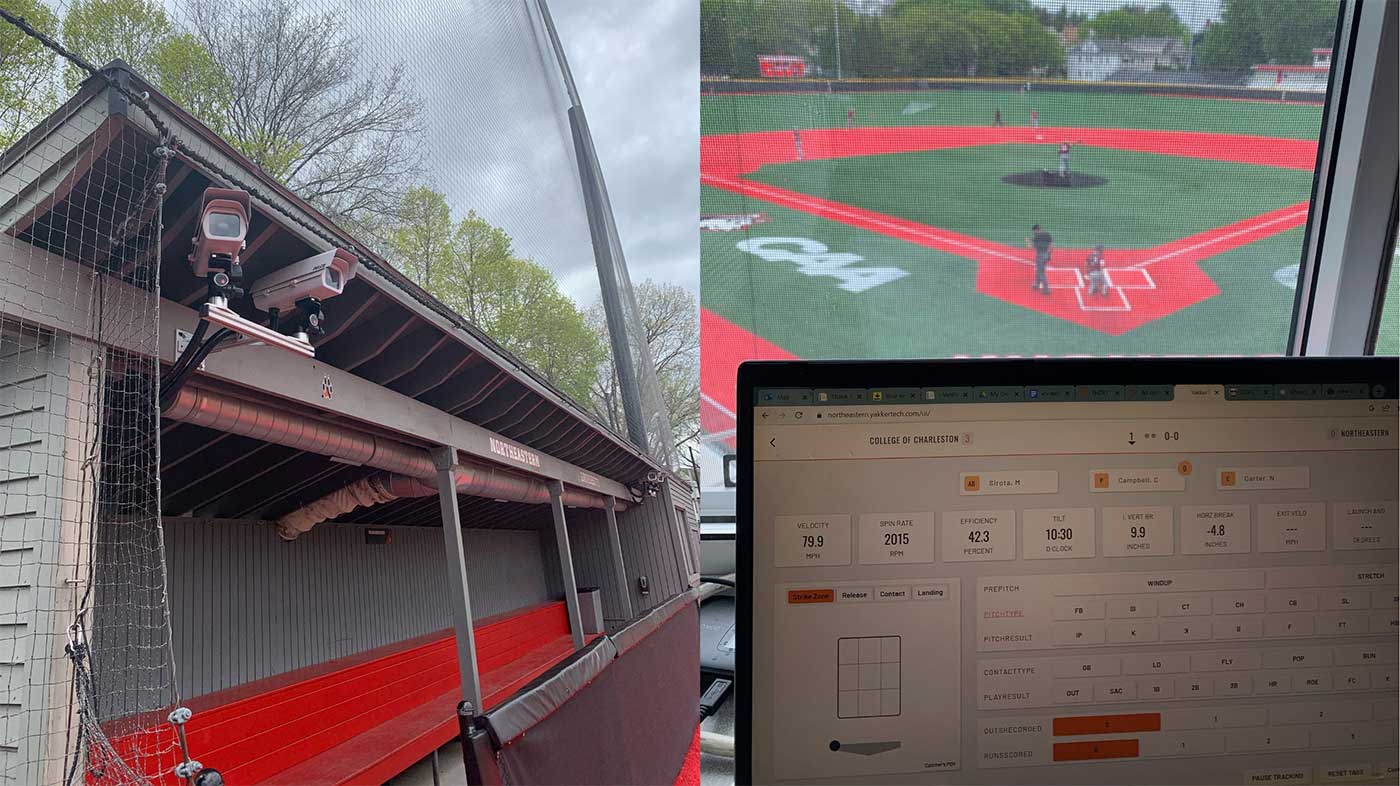
While the system was a necessary step in Chen’s long-term vision, plenty of competing teams have installed similar setups, or could soon. The onus now falls on the managers to create an edge.
“Teams are now investing in it, and coaches are now using it as a selling point to recruit players,” Chen said. “Everyone gets a ton of data, but if you don’t have anyone actually going through and aggregating it, looking for trends and using it properly, it’s pretty useless.”
After compiling the Yakkertech data and tagging the pitches with attributes such as speed, location, pitch type, and spin rate, the trio insert the findings into their trained models and tailor the observations to individual players.
“We can assess which guys are commanding their pitches the best, and which guys are getting value out of their pitches based on how they move compared to other pitches thrown in those locations,” Chen said. “So aggregating those two, you make sure that everyone is throwing the right pitches. Then if not, we’ll give suggestions, like, ‘Hey, we should have this guy throw a slider more instead of his fastball.”
Likewise, the managers have worked to refine a “run value metric” tailored to college baseball, which averages historical scoring trends by isolating hitting results from situational context such as runners on base and the number of outs. But while run value and other advanced metrics can improve on-field strategy, the data-driven concepts can be complex and difficult to explain. Therefore, the managers often translate their findings into more common metrics such as on-base and slugging percentage, as well as highlight specific in-game scenarios.
“When you explain a project in a data science class, you’re talking to people who already know exactly what you’re talking about,” Calvin said. “So trying to switch over to someone who isn’t taking the same classes as me and is very baseball focused, it’s harder to get your points across. You have to be creative.”
All those lessons are translating to success for Northeastern, which won 41 of 53 regular-season games this year — by far the most in the program’s century-old history. But the managers are breaking new ground for themselves as well. Chen will intern this summer as a quantitative analysis assistant for the Philadelphia Phillies, and he’s hoping to land a full-time role in an MLB analytics department after graduating in December. Additionally, Calvin will start a co-op in July for the Hiroshima Toyo Carp, a team in Japan’s top league.
“They don’t really have an analytics department right now, so they are starting one from scratch,” Calvin said. “Because of all the stuff we’re building here at Northeastern, I can just plug in the new data and hit the ground running.”
Clay will intern this summer at Sports Reference, the premier website and database for current and archived statistics in every major professional sport. He hopes to translate his growth into a larger role with the Huskies next season, and to lead the next generation of Northeastern’s baseball analytics department to continued success.
“Having this year under my belt to learn from Justin and Reece has been huge,” Clay said. “The foundation is all there, and we’re definitely building towards big things.”
The Khoury Network: Be in the know
Subscribe now to our monthly newsletter for the latest stories and achievements of our students and faculty
Author: Milton Posner
Date: 05.19.23
This piece is the last in a series on Khoury College’s 40th anniversary celebrations, a series that also covers events in Boston, London, Vancouver, Portland, Seattle, and California.
Tally up the travel involved for the Boston-based coordinators of Khoury College’s 40th anniversary celebration, and you’ll get 22,000 miles — nearly enough to circle the globe.
Then again, that’s appropriate.
“It was an amazing opportunity for us to connect across our global network and rediscover post-pandemic the values that bring us together,” Dean Elizabeth Mynatt said at the anniversary’s culminating celebration, held on Tuesday at Northeastern’s Interdisciplinary Science and Engineering Complex in Boston. “This 40th journey recognized the individual spark and focus of our campuses. They’re not Boston copies.”
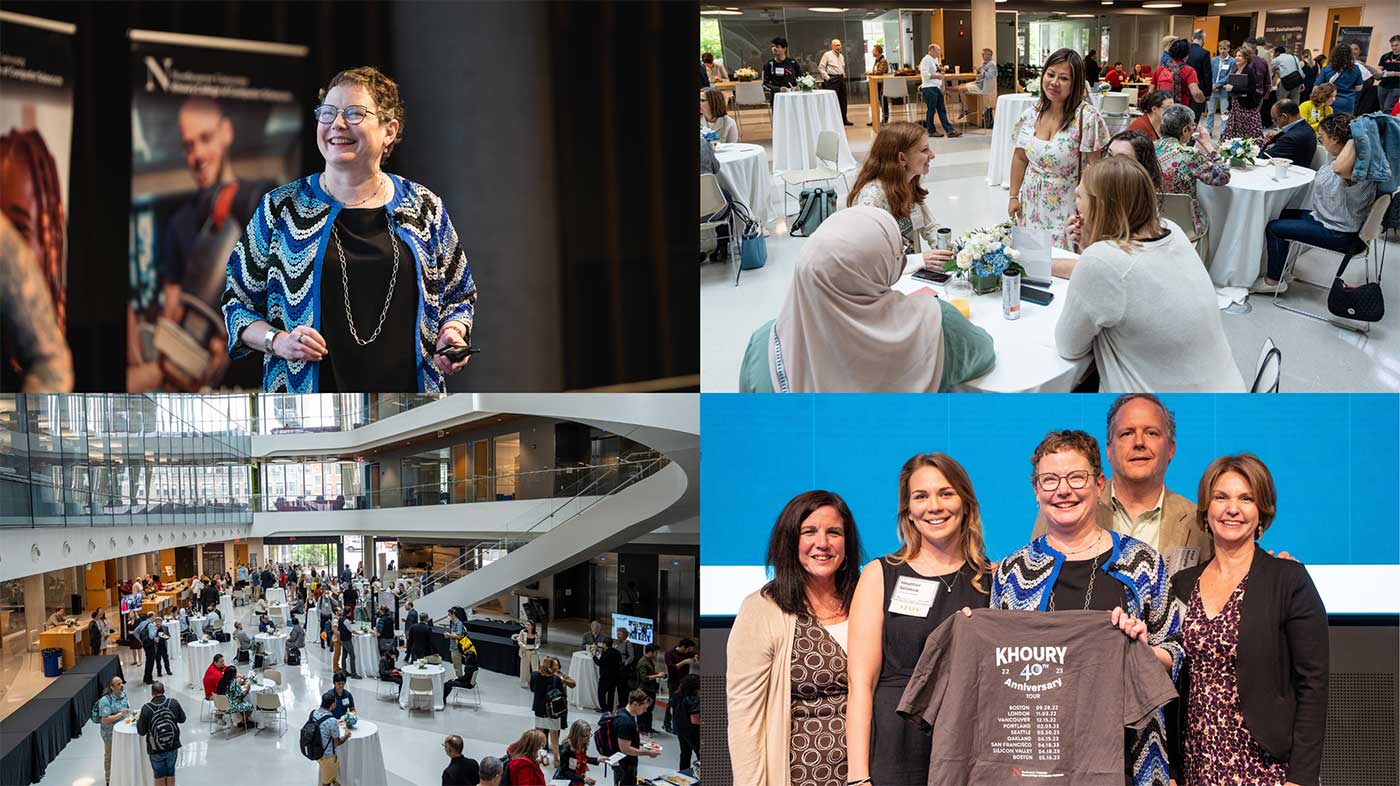
So on Tuesday, with members of those campuses among the 200 students, faculty, staff, and industry partners attending in person, as well as an additional 200 via live stream, the event marked a pivot from a storied past to an exciting future. And as the attendees moved through panels, presentations and breakout sessions, through speeches and honors and munching and networking, it all pointed to the key idea that underpinned the yearlong celebration.
“All of our stops have reinforced our mission of computer science for everyone,” Mynatt noted. “Impact, innovation, partnership — it all comes back to this mission and what our next 40 years will look like.”
In the morning
“This is a golden age — and a very interesting moment — for computer science, and Khoury College stands at the forefront of the discipline,” said David Madigan, a Khoury College professor best known for his role as Northeastern’s provost and senior vice president for academic affairs. “For decades, the college has exemplified commitment to research and the dissemination of knowledge to learners all over the globe.
“Computer science has never been more important,” Madigan continued. “It can elevate mankind to great new heights, or it can destroy us all.”
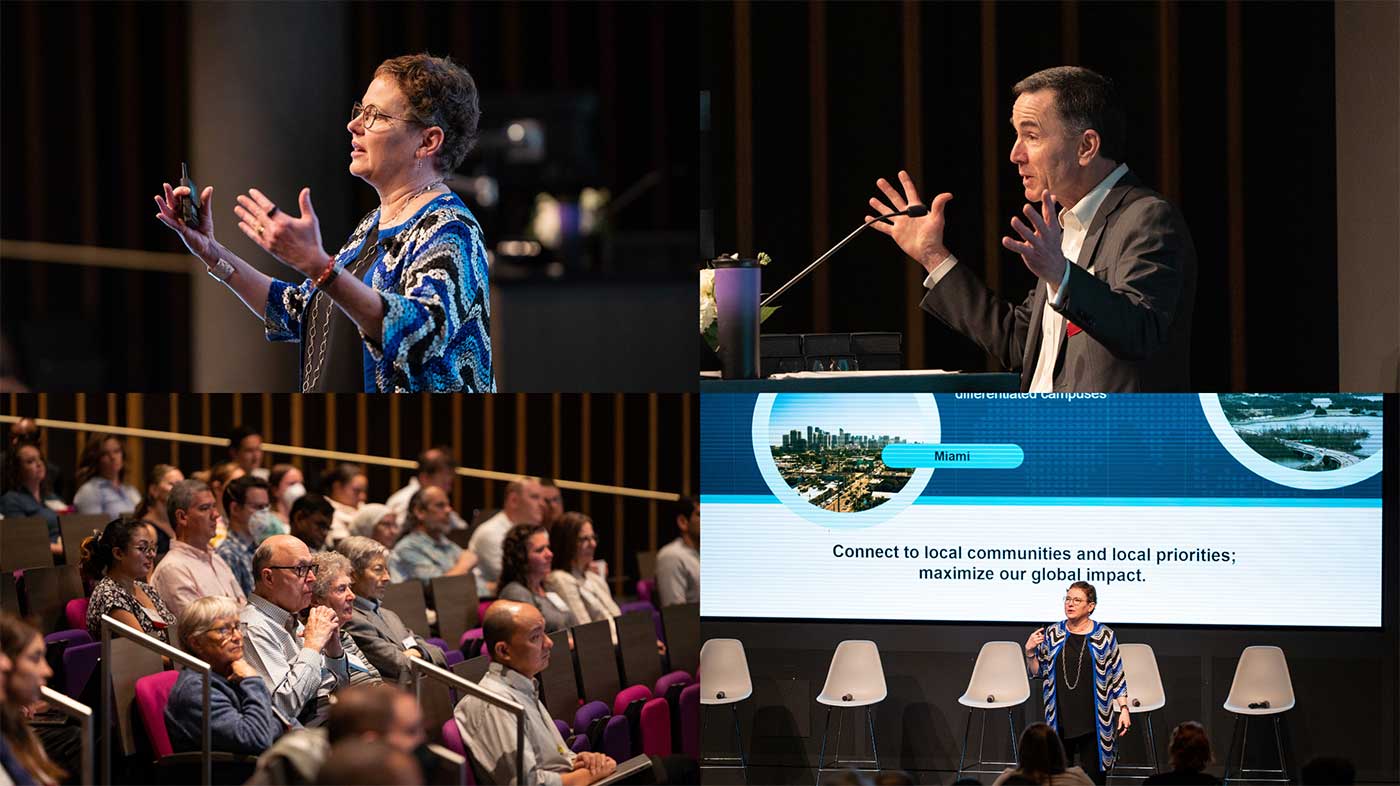
Those stakes underlined the day’s first panel, in which David Choffnes, Khoury professor and executive director of Northeastern’s Cybersecurity and Privacy Institute, queried fellow Khoury professor Abhi Shelat, Khoury research scientist Daniel Dubois, investigative tech journalist Julia Angwin, and Stephanie Nguyen, chief technology officer for the Federal Trade Commission (FTC). The central question: how can research and information produce positive change in the cybersecurity and privacy realm?
“Most of the journalists I talk to will say how depressing it is to write something and have no impact, especially when you clearly show that something is wrong,” Angwin said. “I always counsel them that it’s a long game. You don’t always get impact right away, but putting information out to the public is a service. It does change the discourse and lead to change.”
Angwin cited her investigation into risk assessment algorithms, which are often used to gauge the likelihood of criminal activity from people eligible for parole and pretrial release. Demonstrating the racial biases in many of these algorithms, Angwin said, “led to replication and validation,” making conversations on the topic more widespread, concrete, and informed.
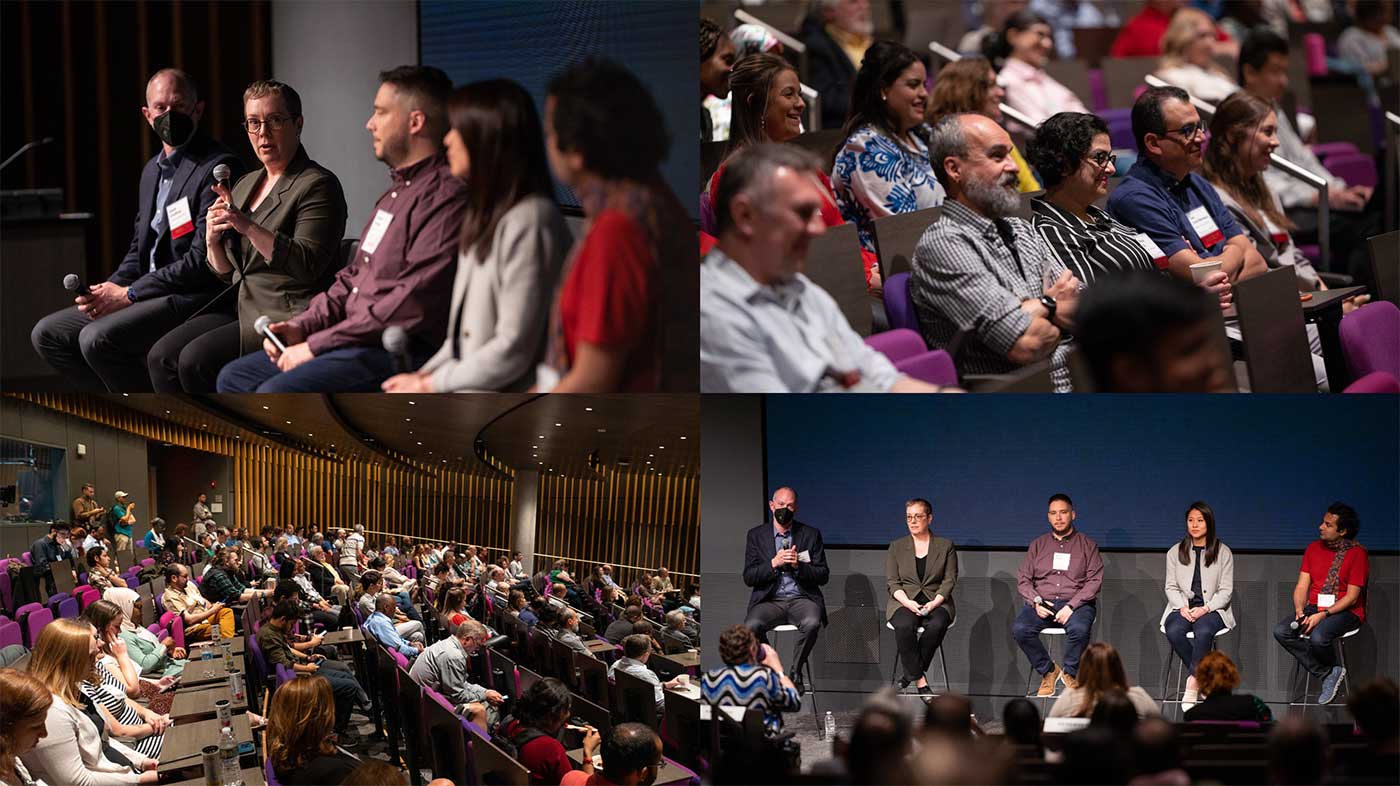
For her part, Nguyen advised researchers on how they could help the FTC protect consumers: explain who is being harmed, by whom, and at what scale.
“We want to have conversations with you and know what you’re doing before everything is fully baked,” she explained. “If you get your information out in ways that ask questions and get at the themes you’re seeing, it helps us to understand what to look at.”
On the heels of that panel came a second group helmed by Benjamin Hescott, senior associate dean of academic programs and student experience. Joining him were Khoury professor Christo Wilson, Khoury student James Chang-Davidson, May Olatoye of Amazon Web Services, UKG diversity professional Angela Harper, and Vance Ricks, a professor jointly appointed between Khoury College and the College of Social Sciences and Humanities. Their topic: how education can cultivate computing leadership.
“Khoury College is making students philosophically literate in computing and social issues … It helps you understand the challenges that exist and apply computing to social issues,” Chang-Davidson said, adding that the college had room to extend and expand that work through its curriculum, hands-on projects, and student organizations. “The places where I learned the most were the ones where I was most uncomfortable and most challenged … Challenges are inevitable in human interactions, so we need to prepare our students with the right resources to handle those situations.”
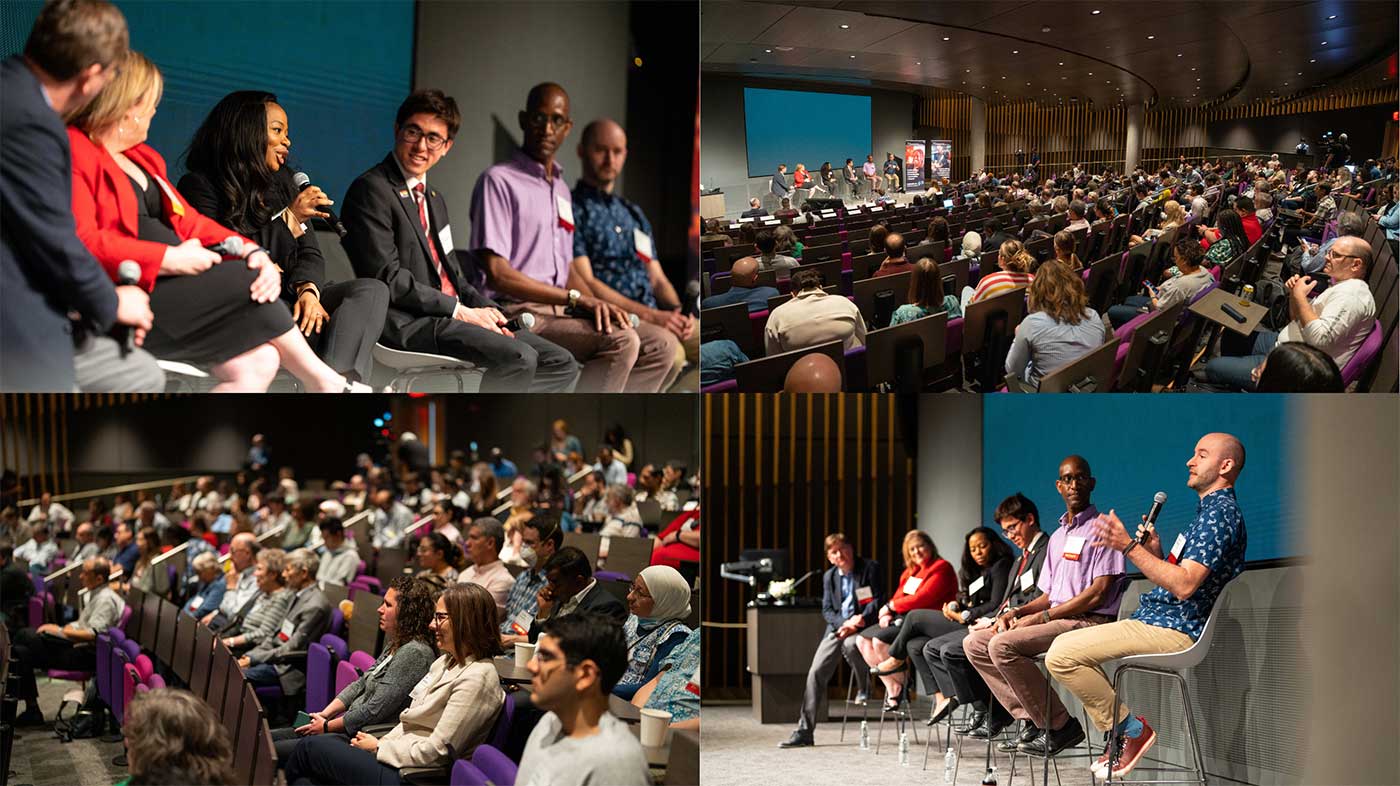
Wilson and Ricks, the two Khoury professors on the panel, also emphasized the role of education in strengthening students’ soft skills for countless technology-related careers — including ones that are brand new or don’t yet exist.
“One thing we have to do better on is not necessarily steering everyone to industry,” Wilson said. “There are whole ranges in the economy that we didn’t think of as ‘tech’ ten years ago, but they’re tech now. Those opportunities are there to cause change in the world.”
In the afternoon
For previous 40th anniversary events, Dean Mynatt and a core Boston team flew to each spoke in the network. This time, with the college funding travel, the network came to them.
And as the afternoon began with a showcase of student organizations and master’s projects, that network was well represented. LeAnn Mendoza, an Align student in Silicon Valley, represented the campus’s new ACM-W chapter, which aims to engage and advance women in computing. Joining her and a handful of other non-Boston students in the ISEC lobby were a variety of groups, from software-driven engineering outfits like Northeastern Electric Racing and the Northeastern University Mars Rover Team, to community-forward coding groups like Sandbox and, well, Code4Community.
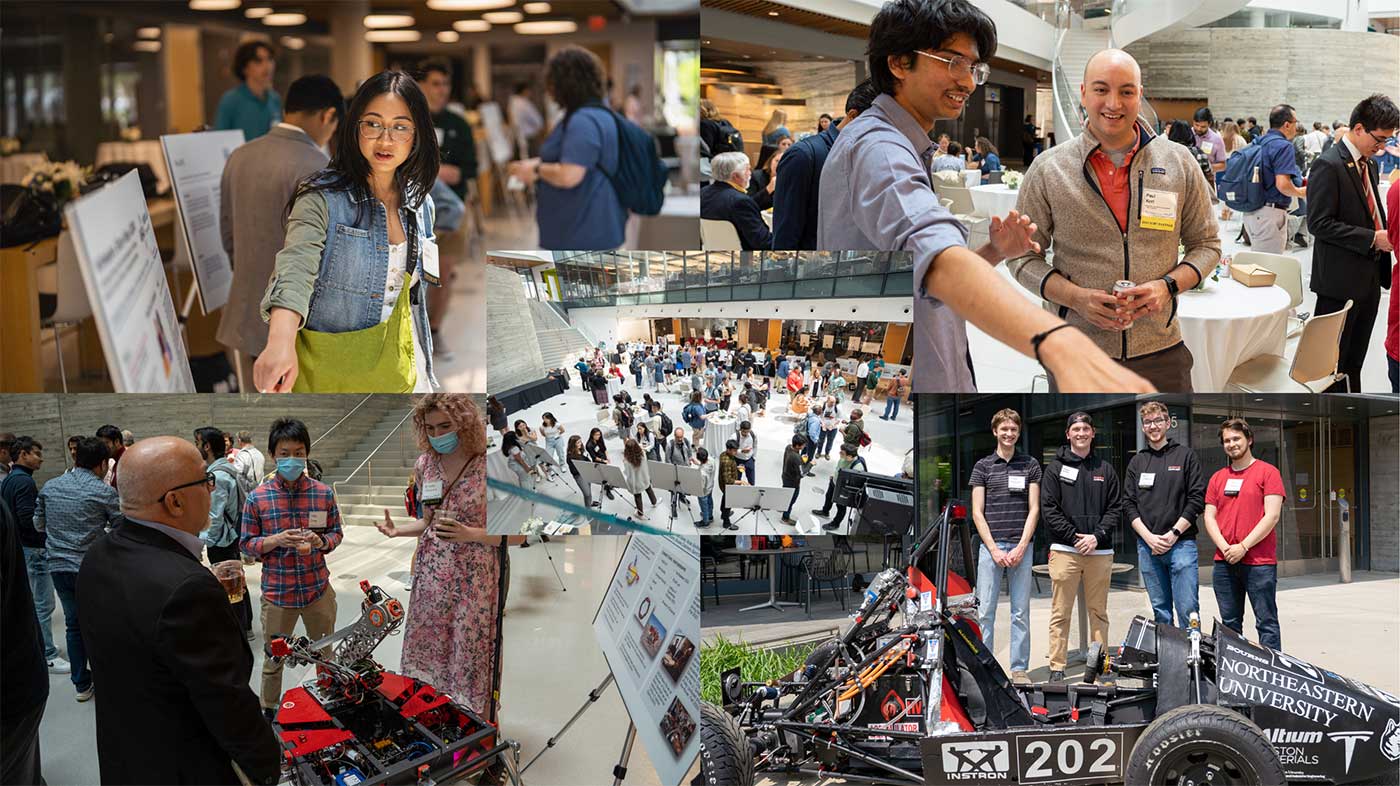
Immediately afterward, the event split into five breakout sessions for attendees to deliberate on the college’s future and the computing issues of the day, then present their findings to everyone.
“The group that comes closest to their allotted time gets to be first in line at the bar,” Mynatt joked.
From the first session on new experiential learning journeys came a quartet of ideas: an intro course that would act as a menu for new students to pinpoint their learning goals and opportunities; a service learning option where students could gain teaching and internship experience, mentor and be mentored, and reflect on their learning; students teaching students to facilitate solo and group projects; and a collaborative effort to solve key global problems.
The second session, on creating community-centric human-in-the-loop AI systems, offered a range of approaches to combat a key societal ill — loneliness — including a workplace task streamliner that aims to free up time and combat workplace isolation. The third session, on AI-assisted programming, was of particular relevance given the topical and transformative nature of generative AI in the computing community.
“We want to break this trend of universities just reacting to generative AI,” Professor Arjun Guha remarked. “In the last year or so, it’s beginning to change. The industry has started to become more democratized, there are more open and academic models, and I would like our university to get more involved in this democratization.”

The fourth group delved into the role of computing research in boosting underserved populations.
“A great portion of the technologies that have been designed have focused on populations that come from privilege,” noted Saiph Savage, professor and director of Khoury College’s Civic AI Lab, who noted the session’s inclusion of both industry professionals and staff from the office of Boston Mayor Michelle Wu. “The mayor’s office spoke about the need to help people coming out of incarceration, to help them develop digital skills and get back into the workforce. That’s something we’d be interested in exploring with them since they have access to that population and are willing to facilitate that collaboration.”
The fifth and final session explored the future of the college’s partnerships, and as the presentations wrapped, Mynatt noted just how much the presenters cross-referenced each other.
“The fact that these were interwoven is part of Khoury College’s DNA, and something that we should continue to embrace,” she said, before noting that the groups would report back on their ideas in the fall.
The day’s formal programming concluded with a smattering of honors. First came Kristine Nnemka Umeh, an Align student in San Francisco who won Khoury College’s Graduate Community Service Award and spoke at Northeastern’s graduate commencement ceremony. On Tuesday, with her mother beside her, Umeh received a pair of gifts, including the poster of her that had greeted guests at each anniversary event.
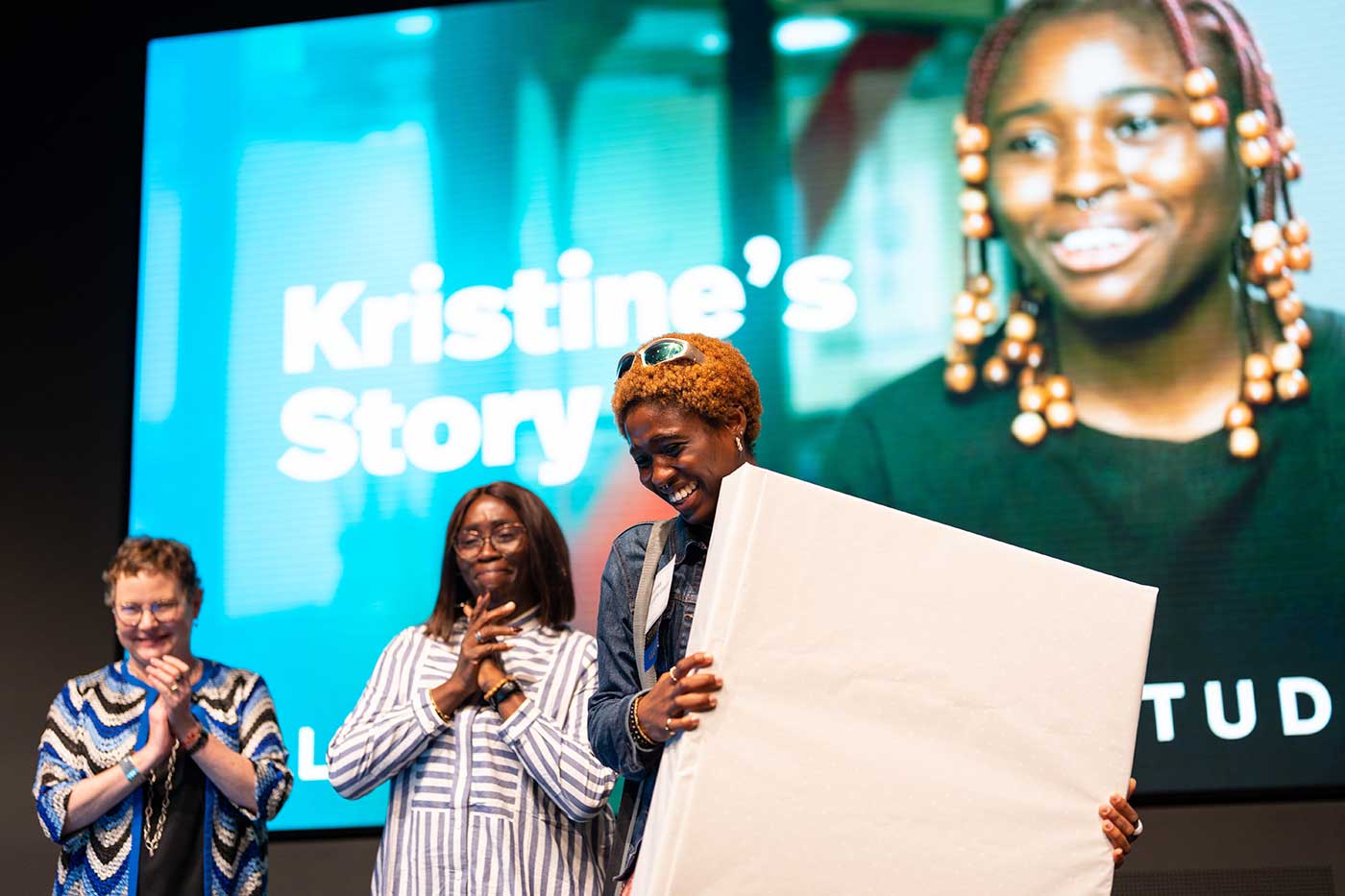
The event closed with recognizing the final 40 for 40 honorees:
- Mani Sundaram, a master’s alumnus, executive VP at software company (and co-op employer) Akamai, and keynote speaker at Khoury College’s graduate commencement
- Doreen Hodgkin, a former associate dean who worked 35 years at Khoury College, beloved by students for supporting them through emergencies and keeping them on track with their studies
- Melvin Simms, who launched the college’s co-op program in 1982, shepherded it for 30 years, and developed its infrastructure to benefit students and employers
- Cathy Bilotta, one of the college’s first grads who has spent her recent years giving back to her “happy place,” paving the way for other women in technology; also the mother of a Khoury College graduate
- Brecka Fetzer and Wayne Duso, who helped build a program to elevate the number of Align students working at Amazon Web Services
- Rehka Kamat, a master’s alumna and a global marketing director for a multinational software firm; champion for women in technology
- Bela Labovitch, a master’s alumna, engineering VP at athenahealth, and fierce advocate for attracting and retaining women in tech
- Melinda Kramer, an alumna who built her career at the intersection of finance and tech, and who is focusing on advocacy and philanthropy in retirement
- Harriet Fell, Northeastern math professor who jumped to CS instruction when the college was founded; a pioneer in creating technologies for people with disabilities
- Brian Wenzinger, alumnus who benefitted from scholarships and has given generously to fund education — including out-of-the-classroom opportunities — for those who came after him
- Glen Coppersmith, whose CS and psychology degree paved the way for his career in data-driven mental health care, and who received Khoury College’s Outstanding Alumni Award in 2019
And with that, a year’s worth of reflection came to an end. After 40 years of education, research, and innovation, of professional partnerships, of bringing computing to populations the field all too often leaves behind, all that’s left is to look to the future.
“As we close out this anniversary, the question before us is ‘How will Khoury College rise to the challenges on the horizon, and to the challenge of ensuring that breakthroughs are used for good and not for evil?’” Madigan said. “Congratulations on all you have accomplished together and all you will accomplish in the years to come.”
The Khoury Network: Be in the know
Subscribe now to our monthly newsletter for the latest stories and achievements of our students and faculty