Date: 06.30.23
During the course of its 40th Anniversary year, Khoury College honored 40 individuals who were instrumental in the college’s launch and success to date. From the college’s generous namesake, Amin J. Khoury, to key industry partners such as Amazon’s Wayne Duso and Becka Fetzer, to recent alumna and activist Molly White, the college highlighted an individual a week who exemplified the college’s spirit of innovation, vision, and capacity to use computing to improve the daily lives of thousands.
As the college wraps up its 40th anniversary, below is a recap of the 40 individuals given the “40 for 40” honor. “The college would not be where it is today without the forward-thinking tenacity of these individuals,” said Dean Beth Mynatt. “They and others have set the stage for what we have achieved and all that is to come as Khoury College continues to grow and innovate. Their collective impact is astounding.”
Khoury Leaders: Carla Brodley, Agnes Chan, Harriet Fell, Larry Finkelstein, Catherine Gill, Ian Gorton, Doreen Hodgkin, Amin J. Khoury, Brian Lackaye, Richard Rasala, Betty Salzberg, Melvin Simms, Mitch Wand, and Ron Williams.
Khoury Alumni: Cathy Bilotta, Glen Coppersmith, Chris Jelly, Rekha Kamat, Melinda Kramer, Bela Labovitch, Chris Lambert, Christa Lopes, Praful Mathur, Fiona McCrae, Marina Moskowitz, Natasha Noy, Andrea Grimes Parker, Mani Sundaram, Greg Waters, Brian Wenzinger, Molly White, and Martin Zoltick.
Khoury Partners: Brenda Bailey, Melody Biringer, Wayne Duso, Becka Fetzer, Daron Green, Bill Lakeland, Chris Paul, Padmaja Vrudhula, and Laurel Yamaguchi.
Complete profiles of all 40 individuals can be found on our 40 for 40 honoree site.
Author: Madelaine Millar
Date: 06.21.23
For Cam Perry, working on the game ValiDate is a labor of love — garnished with a little spite.
ValiDate is a visual novel dating simulation that follows 13 queer, BIPOC characters dating, making friends, falling in love, and navigating their lives in the fictional Jercy City. Each of the game’s three installments explores a handful of the characters in depth, with the first installment launching last year. But unlike many dating sims, ValiDate is not a self-insert where the lead character is meant to be a stand-in for the player themselves. By playing through the carefully crafted storylines of characters like Isabella, a Latina theater nerd, and Emhari, a Black and Middle Eastern bigender trans woman, players get a peek into the lives of people whose stories rarely make it onto the screen.
Not that everyone has reacted well to these characters.
“Anytime you went to ValiDate’s Twitter replies, it was just awful,” said Perry, a ValiDate programming lead and 2021 Khoury College graduate. “That just makes me want to support this game more. It’s very important to me for people to see different kinds of people — queer, BIPOC, etc. — in games … The more of those types of games exist, the better.”
Perry has contributed work to ValiDate for almost two years, as has their old Khoury classmate and friend Jamie Camera, who also graduated in 2021. As computer science and game development students, the two found a supportive, inclusive game dev scene on campus, and now they hope their work on ValiDate can help the wider game dev world to look more like the community they found in extracurricular spaces at school.
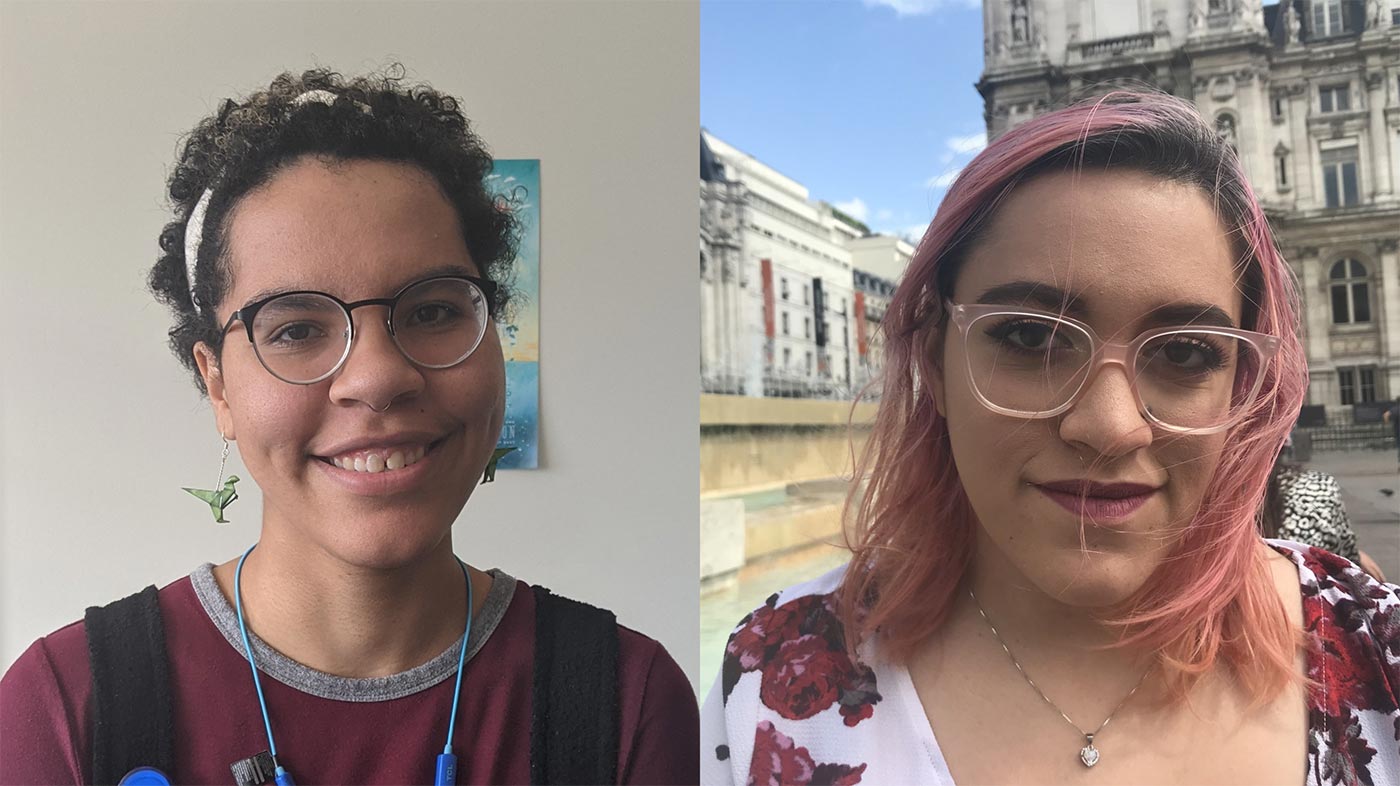
Camera was inspired to join the ValiDate team after reading Isabella’s story and seeing facets of their experience in Isabella that they hadn’t seen reflected on-screen before, like a love for musicals that their Puerto Rican and Cuban family didn’t quite understand.
“It’s about going through the positives and negatives of the relationships with other characters and the world these characters are living in,” Camera explained. “We wanted to make characters that relate to someone you know, not this idealized version of a hero or something. It’s just everyday people.”
Camera and Perry met in a game dev course their freshman year and quickly bonded over being the only ones in the class who didn’t present as cisgender men. The two joined the Northeastern Game Development Club together, eventually rising to leadership positions (treasurer and vice president for Camera, president for Perry) and discovering a creative, eclectic, hardworking group of young programmers with whom they truly felt at home. Everyone wanted to have fun, and everyone had an eye turned to the future.
“Especially compared to other game devs I know who go to college, I think Khoury students are some of the better prepared ones for the industry,” Camera said. “I knew what to expect, and I didn’t have an idealized version of what that industry was.”
But as prepared as Camera, Perry, and their peers were for the game dev industry, the game development industry wasn’t totally prepared for them.
“The Boston area actually has a really amazing game scene, probably the best on the East Coast. But it lacked the focus on queer people and ethnic diversity,” Camera continued. “We wanted to make a space for us and people like us.”
Perry had met some of ValiDate’s developers through their co-op at Code Coven, a games industry accelerator for people of marginalized genders. They began following the game when it was still in its kickstarter stage, excited to see characters on screen in which they could see parts of themself, and joined the team as a freelancer around the time they graduated. They now spend about 15 hours a week building the game in Unity, delegating and monitoring programming tasks, fixing bugs, and meetings with the other team leads; they just finished working on an update to add minigames to ValiDate.
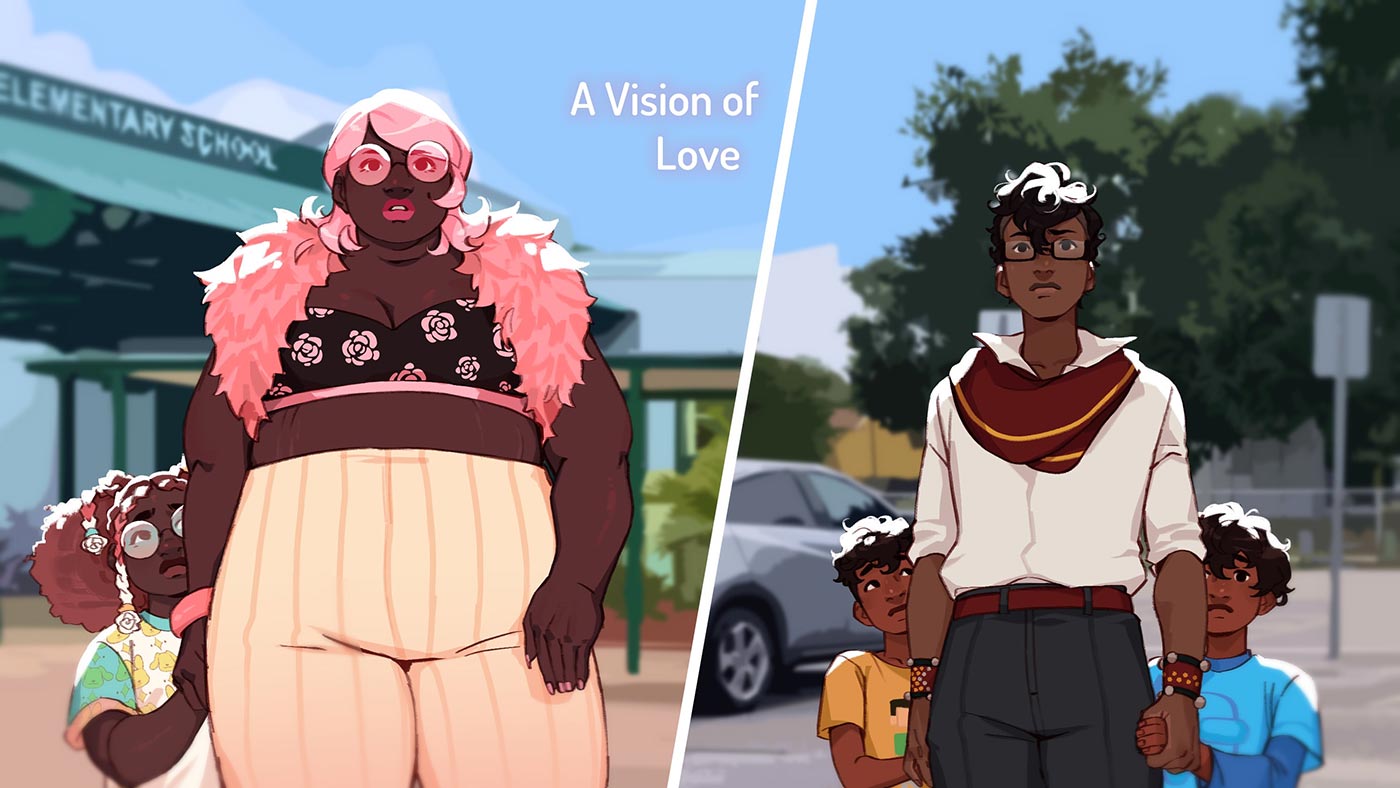
“There’s a fishing minigame and a rhythm minigame; getting those to play nicely with the plugin and Unity, and creating the transition from a visual novel to this cute little minigame was really great to see,” Perry said. “So much more work goes into those little minigames than a lot of people expect.”
Camera joined ValiDate in mid-2021, around the same time as Perry. They hope that their work can prompt others in the games industry to take a chance on characters that don’t fit established molds.
“We are a very small team; this isn’t anyone’s full-time job, so of course we’re not gonna have the resources to fully animate something or make this a 60-hour experience, which is what a lot of AAA studios do,” Camera said. “We wanted to inspire people, like ‘Hey, this game is getting good attention, maybe that means we should start adding these types of characters into our games.’”
Because Perry and Camera both have marginalized identities — Perry is Black and nonbinary, while Camera is a nonbinary Latinx person — the vitriolic online comments can sting a little extra.
“It hurts a lot to see people discredit you because they don’t agree with your quote unquote ‘politics,’” Camera said. “But I don’t even feel that this is particularly political, because all I’m doing is existing, you know?”
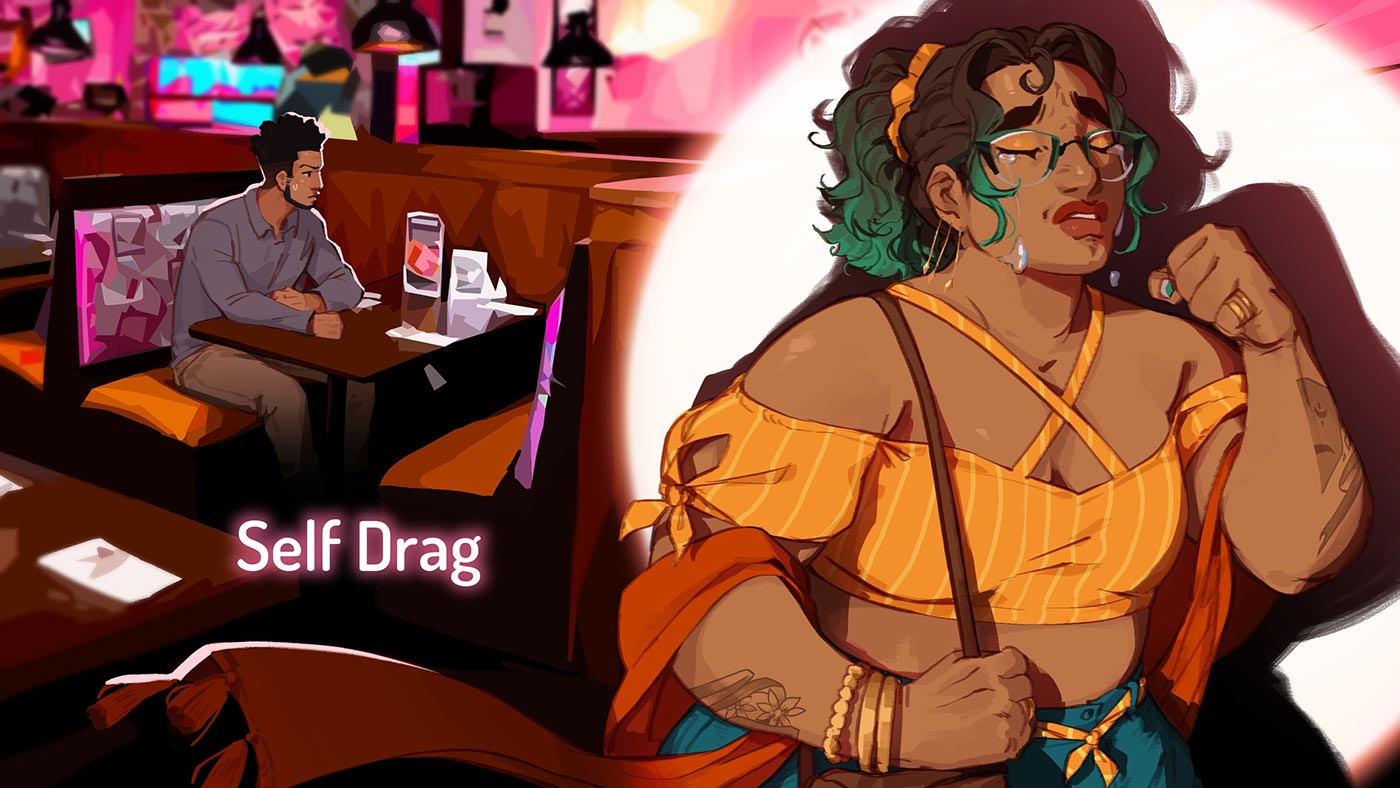
On the flip side, the reception from those who have seen themselves reflected in a game, often for the first time, has been beyond rewarding.
“We get a lot of people saying, ‘Oh, thank you so much for adding in this rep,’” Perry said. “Inaya is a Pakistani nonbinary character, and we get a lot of people from the fan server saying ‘I just read Inaya’s story arc and cried’ … It’s really important to see stories that aren’t the norm.”
The Khoury Network: Be in the know
Subscribe now to our monthly newsletter for the latest stories and achievements of our students and faculty
Author: Madelaine Millar
Date: 06.16.23
Want to land a co-op you love? Jake Ombach and Anika Das have some advice: take your class projects seriously.
Das, a newly graduated data science and behavioral neuroscience combined major, and Ombach, who just completed his data science master’s degree, landed their co-ops at Cambridge-based biotech startup Montai Health by utilizing the CS chops they’d developed building tools for books and basketball in their coursework.
“At the time of my Montai Health interview, in one of my classes, I was building an interactive visualization tool and book recommendation engine using JavaScript and the D3 library; Montai Health was really interested in that,” Das said. “During my first week on the job, they kept referring to me like ‘oh yeah, she knows all about D3’ and it gave me a lot of confidence. It was exciting to know that I had a skill they appreciated and wanted me to expand on.”
Ombach had demonstrated his supervised machine learning skills by creating a program to optimize basketball betting as a class project.
“Not every co-op has a biomedical or science background; they like having different perspectives,” said Ombach. “Regardless of your background, they want to know, ‘How are your critical thinking skills? How motivated are you?’”
Montai Health, a Cambridge-based biotech startup, regularly employs a number of Khoury co-ops on their data research team. The co-ops clean, analyze, and visualize data, and integrate new types of software to support the company’s mission to improve health outcomes and reduce the burden of chronic disease. They process both internally generated experimental data and externally generated data from biological and chemical databases, which helps Montai decide which molecules to further explore.
Montai is working to build what they call “the world’s first Anthromolecule Bioactivity Atlas,” a digital compound library of potentially therapeutic molecules found in food, supplements, and herbal medicines. Their tool is intended to speed drug discovery and development for diseases ranging from inflammatory to metabolic.
That mission was a big part of what attracted Das. Her background in behavioral neuroscience spurred curiosity with Montai’s research arm, even though she herself wasn’t conducting research. Instead, she spent a lot of her days creating data visualizations.
“As a data scientist or a computer scientist, you might initially feel removed from the science and research that’s going on in the lab, which is literally 10 feet away from you. But be curious about it,” Das recommended. “That kind of thinking trickles down to all parts of the company, and being curious and interested makes the job so much easier and more fun.”
As computer scientists, both Das and Ombach worked on Montai’s data innovation team, which is broken up into two sub-teams: platform engineering and data research. The platform engineering team primarily works to create the CS tools the company uses to sort and store data about different molecules and compounds, while the data research team works to extract information about those molecules from the data. The data innovation team works in concert with biology researchers performing lab science to create more data on the molecules Montai studies.
For Ombach, Montai’s culture was a big draw. From early in his co-op, he felt like he could talk to everyone from his manager up to the CEO, and everyone cared to hear what he had to say.
“Montai Health really values their employees and focuses on their mission to advance human health,” Ombach said. “There are always opportunities to pick people’s brains and to learn. They don’t want you doing work just to do work; they want you to grasp the why, the how.”
Das’s last co-op had been at a much larger company, and she didn’t feel her work had as much impact there as it did at a smaller, more interconnected enterprise like Montai. Armed with that knowledge, Das resolved to seek work at other small startups after graduating.
“(At Montai), I could see how the work I was doing was directly affecting other people in a positive way,” Das said. “I definitely felt more valued and important.”
Ombach continued to work part-time for Montai after his co-op ended last summer, moving from to the data research team and collaborating with new teams to extract meaning from Montai’s data. He’s now there full time.
“The best part of Montai is the flexibility and the ability to work on different projects,” Ombach said. “There are a lot of different areas of work that we do, and they’re very open to allowing you to explore different concepts and different types of work that can really expand your skill set.”
The Khoury Network: Be in the know
Subscribe now to our monthly newsletter for the latest stories and achievements of our students and faculty
Author: Zorain Nizamani
Date: 06.12.23
As the executive director of the Maine Brewer’s Guild, Sean Sullivan led an industry that has helped to change the state’s economy. But after nearly ten years of promoting craft beer, he’s taking on an entirely new challenge this year at the Roux Institute in Portland, Maine. There, he’s studying computer science through Align, Khoury College’s master’s program for students who studied something other than CS as undergrads.
“I love bringing people together who share a common interest and learning from the community to expand my horizons,” Sullivan says.
That ethos underpinned his time as the first director of the Guild, a nonprofit trade association which grew out of a monthly networking meetup for environmentally focused young professionals.
“I joined the Guild at a time when the industry was poised for big growth. There were misconceptions about our industry in the state, outdated laws which were restricting growth, and a lack of a central gravity point for the startups who were opening breweries,” Sullivan explains. “Working across industries and around the state, I found a lot of value in serving as a translator between our professional brewing community and legislators, tourists, and the public.”
During Sullivan’s time as executive director, the craft brewing industry in Maine grew exponentially, from 40 breweries when he started in 2013 to more than 175 today.
“Today, all of Maine’s sixteen counties have at least a couple of breweries, and I am proud that we’ve fostered that entrepreneurial energy around the state,” Sullivan says.
Transitioning from an executive director of a trade association to a master’s student of computer sciences requires motivation and embracing dramatic change, and Sullivan is ready for all of it. His interest in computer science kicked off early in his career, as he was building a fintech startup with a business partner. After attending a startup event in Portland in 2012, Sullivan and his partner founded a gift card company which capitalized on the ‘Buy Local’ movement while helping independently owned businesses in the city.
“We started creating and providing our customers with these basic data visualizations,” Sullivan remembers. “It helped me realize that if you understood the technology, you could create a lot of value.”
Sullivan has always pushed himself out of his comfort zone toward new things, and his new educational path in technology is no different.
“This is not a subtle career move; this is a radical shift. When I envision my future career, I see opportunities to build something even bigger, but the foundation of that vision is rooted in technological knowledge,” Sullivan says. “The communities that most inspire me today aren’t bound by geography, defined industries, or legal structures, but they are driven by technology.”
And when it came time to choose an institution for that radical shift, Sullivan, who relished the chance to contribute to communities with bold visions, saw the same quality in the Roux Institute.
“When I look at the vision for Roux, there’s nothing small about it, and Northeastern’s co-op model really appealed to me because when you’re making a career switch like I am, it’s hard to write that résumé,” Sullivan said.
Sullivan hopes he can contribute to the Roux’s effort to build a new narrative for Maine, one where the state is known for leadership in computer science, data science, and artificial intelligence.
“I expect to be part of this effort and to get a ground-floor view into how a big institution with a bold vision navigates through the challenges inherent to any pioneering effort,” Sullivan says. “I expect to be part of this first wave of students who begin to realize this potential, and as part of that, connect to a whole new community of people who are more technically inclined and focused.”
“I am proud of my career to date, but I am no longer willing to simply wonder what is below the surface,” he adds. “I need a new set of tools to fulfill my professional potential, and I know the master’s program at Roux will teach me how to use these tools so I can build the future I see for myself.”
The Khoury Network: Be in the know
Subscribe now to our monthly newsletter for the latest stories and achievements of our students and faculty