Author: Zorain Nizamani
Date: 08.17.23
Android users to the front! Regardless of which mobile browser you use, it may be collecting your personal data and compromising your security. But to what extent is it doing so, and what can you do about it?
That is what Khoury College doctoral student Amogh Pradeep has set out to find. Through his recent study “Not Your Average App: A Large-scale Privacy Analysis of Android Browsers,” Pradeep and his multinational research team set out to study the personal data collected by browsers, and how such collection can be prevented. After examining the largest dataset of these browsers ever assembled, the researchers found that numerous android browsers were indulging in privacy-harming behaviors.
For Pradeep, a study of this size was years in the making. His work in mobile security and privacy began during his undergraduate studies at the International Institute of Information Technology in Hyderabad, India. There, he worked on the TOR Project, an anonymous communication tool commonly used by journalists and activists for secure messaging.
“It is essentially a research tool used to maintain anonymity while exposing others, such as by leaking important documents. If you are a whistleblower, you have to use it because everything else is heavily surveilled,” Pradeep says. “When I worked on it, I got to travel a lot and met various people at security conferences.”
As he gained exposure, Pradeep started to work on his own projects and the topics that most interested him, leading him to mobile browsers.
“I did not know at first that there were so many browsers being used by people all around the world. So, it was fascinating to see if one of these browsers was doing something suspicious,” explains Pradeep, who is now a member of Northeastern’s Cybersecurity and Privacy Institute. “The idea first came from Chinese browsers. In China, the way they limit the internet is by limiting the network itself … I was just wondering if they were monitoring users through the browsers too … It’s a new avenue where it could possibly be done, but I was not quite sure.”
Pradeep knew that user data was regularly monitored by websites but didn’t see any data about whether Android mobile browsers were also compromised. The solution was an in-depth study where Pradeep and his team could analyze the browsers and determine whether they were collecting data on their users.
“The first step was getting our hands on these browsers from different app stores. After this, we looked at the code of these browsers to understand their functionality. This is referred to as static analysis,” Pradeep says. “You don’t run the browser; you only look at its code to see what kind of data is being collected.”
Aside from Khoury College, the team executing this analysis consisted of researchers from the IMDEA Networks Institute and Universidad Carlos III de Madrid in Spain, the Vienna University of Technology in Austria, and the University of Helsinki in Finland.
“We have a lot of collaborators who are like-minded and who want to explore these things. It just happens that Dave Choffnes, my advisor, is in collaboration with the other institutes. This was an idea they had at one of their conferences, and that’s how this academic collaboration happened.”
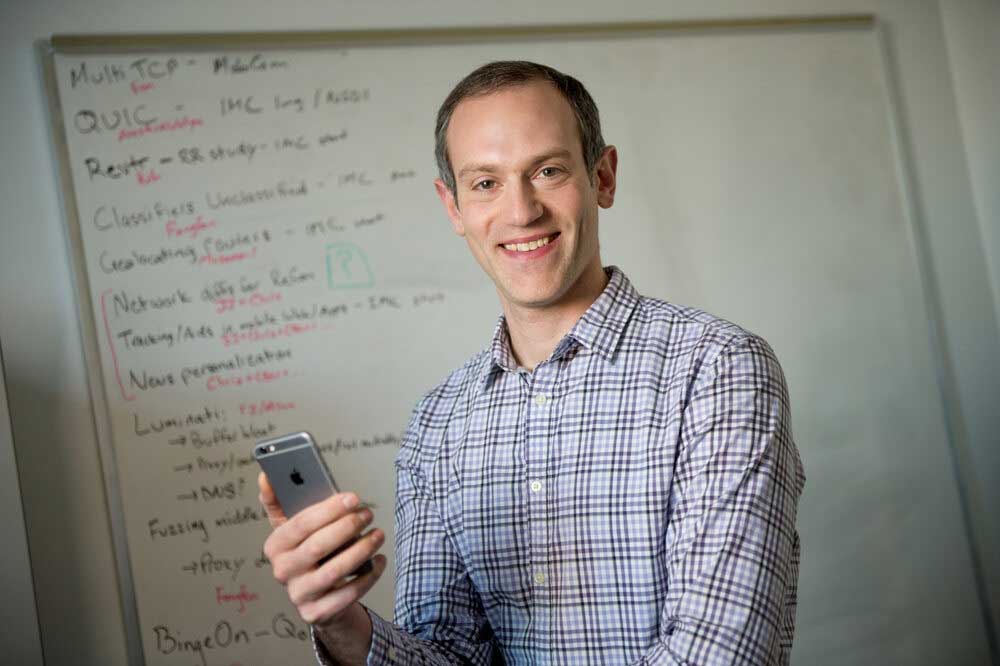
Pradeep and his team analyzed a whopping 424 browsers, including Google Chrome, UC Browser, Mozilla Firefox, and Opera. They ran each browser through a series of tests and hypothesized that the browsers were replacing or modifying content in ways that jeopardized user privacy.
“We found that data collection was happening, and a lot of these browsers were collecting web history that you browse with,” Pradeep says, acknowledging that users often click ‘agree’ to one-sided, consumer-unfriendly terms and conditions without understanding the fine print. “They say, ‘Oh, but it was in the policy’ but that’s a bit of an issue when you think of how that’s affecting user privacy. These browsers will say that they are anonymous and private, but then they will still collect your data. And how that data is being used is something we cannot say at this point; that’s a different ball game.”
In today’s technology-infused world, user data is among the biggest assets companies can own, as it helps predict trends and user behavior. But for the users, it is imperative that personal data is protected, and Pradeep is on a mission to make that happen.
The Khoury Network: Be in the know
Subscribe now to our monthly newsletter for the latest stories and achievements of our students and faculty
Author: Attrayee Chakraborty
Date: 08.14.23
For more than 10 years, Verisk Analytics has enabled Northeastern co-ops to gain hands-on experience and apply data science through quality assurance (QA), software, cybersecurity, UX, and other positions.
Verisk is a global data analysis and risk management firm with more than 9,000 employees and a wide range of clients ranging from insurance groups to financial services companies to government agencies. By working across the company’s breadth of functions and sectors, the co-ops touch on projects related to data analytics, artificial intelligence, machine learning, and software development. Aside from innovative projects and cutting-edge technologies, Verisk also provides students with mentorship and guidance from experienced industry professionals.
Nitsa Kanungo and Ryan Costa, two of Verisk’s most recent co-ops, shared their experiences with Khoury News.
Nitsa Kanungo
Nitsa Kanungo’s two major choices reflected the inspiration she brought to Northeastern — computer science after a software role on her high school robotics team, business after recognizing the immense value of communication and interpersonal skills. So when Verisk representatives presented to the members of Northeastern University Women in Technology, Kanungo was hooked.
”Verisk gave me an opportunity to learn and grow in a very open and welcoming environment,” Kanungo said. “I knew that I would be pushed to tackle difficult challenges and go beyond trivial tasks.”
Kanungo picked up several new technical skills in her role as a QA analyst. As part of her day-to-day tasks, she ran risk calculations, such as detailed loss analyses on different builds of insurance software. She also gained exposure to other projects across the company, such as working on an application programming interface as a part of the core QA financial team.
“Verisk gave me the opportunity to learn as much as possible,” Kanungo said. “Through my work on comparative model testing, I gained valuable project management skills.”
In addition to her technical growth, Verisk’s open and collaborative work culture was one of Kanungo’s favorite parts of her co-op.
“I had a mentor assigned to me who helped me with my daily tasks, apart from my manager whom I reported to,” Kanungo said. “We were also encouraged to meet the other co-ops at monthly sessions and bounce ideas off each other. This has really changed my outlook towards major corporations and has broadened my horizons on where I see myself in the future!”
Ryan Costa
Like Kanungo, Ryan Costa gravitated towards computer science in high school, finding that “manipulating computers seemed like magic.” Now, as he majors in data science with a minor in psychology, Costa believes his understanding of consumers’ thought processes provides him with an edge in finding business solutions, coding to visually represent data, building pages to highlight products, and designing inputs to satisfy clients.
“Knowing the basis of client wants, such as what actions the user will take while approaching the product, helps me design programs accordingly,” Costa said. “You may be surprised by what a client notices in your product; it may have been something you never imagined.”
Costa translated those lessons from his courses into his core QA co-op with AIR Worldwide — recently acquired by Verisk and renamed Extreme Event Solutions — which he concluded in December. EES provides a suite of risk management and analytic services to help businesses and government organizations prepare for, respond to, and recover from natural and man-made disasters.
“Verisk’s mission of tackling the challenges posed by natural disasters fits with my passion for data modeling,” Costa said. “Coming from Florida where hurricanes are no stranger, I know the impact of accurate insurance rates on residents’ lives. I wanted to contribute to a cause that helps people prepare for natural calamities.”
At Verisk, Costa and his team developed catastrophe prediction models to estimate the costs of natural disasters. The technology is especially useful to insurance companies, which use models to determine the likelihood and severity of catastrophes, giving them a head start on calculating financial damages. Specifically, Costa developed testing suites for the Touchstone software to test its resilience.
“I had taken a course called ‘Database Design’ just before my co-op. Interestingly, I found myself using SQL and Python — which I had learned in class — in my core QA role,” Costa said. “This co-op made me delve deeper and figure out how to use my academic skills. I had to explore different testing suites using a combination of programming languages like Python and R to check whether the outcome we found matched our expectations.”
Apart from leveling up as a data scientist, Costa cherished the workplace culture — and not just because of the team’s memorable trip to Georges Island.
“With a supportive manager, I learned that asking for help is always welcome,” he mentioned. “I loved the work culture at Verisk, and it would be one of my first choices for work in the future.”
The Khoury Network: Be in the know
Subscribe now to our monthly newsletter for the latest stories and achievements of our students and faculty
Author: Milton Posner
Date: 08.07.23
On Saturday, Matthew Goodwin found himself in Washington, DC, one of a handful of keynote speakers at the American Psychological Association’s annual convention. It was a prominent talk at a prominent event put on by a prominent scientific organization.
The topic Goodwin was presenting on, though, has historically been anything but prominent.
Goodwin, who holds a joint appointment between the Khoury College of Computer Sciences and the Bouvé College of Health Sciences, has spent his professional life researching and developing technology for people with autism. In particular, he’s focused on the 27 percent of that population classified as “profoundly autistic,” who are often prone to aggressive or self-injurious behavior such as hitting, kicking, biting, skin peeling, or banging their heads. With little to no ability to speak, they can’t name the source of their agitation and distress. And with no way to predict meltdowns, their families struggle to find schools and activities where they can safely participate.
But the spotlight hasn’t always found their struggle, says Alison Singer, co-founder and president of the Autism Science Foundation, which supports research into risk factors and interventions. In recent years, the ASF has focused on profound autism, which Singer says is seldom represented in media, in policymaking, and in research studies that often establish a 70-IQ minimum for participants.
But in his Saturday keynote, Goodwin showcased research that bucks that trend. By combining biosensors and machine learning to predict aggressive behavior, he’s aiming to give the families of profoundly autistic people something they’ve never had: the ability to predict, preempt, and mitigate meltdowns.
“I’m grateful for the opportunity to disseminate the work we’re doing,” Goodwin said of the APA address. “To talk about these issues so that there’s more compassion, more partnership to help people achieve their potential rather than us being afraid of them and sequestering them away — that’s what will help us provide better services. It’s an example of how technology can catalyze public health for all.”
That belief in technology was the reason that Goodwin, an experimental psychologist and behavioral scientist by training, found his way to computing in the first place. When he began researching autism in the 1990s, he knew that the scientific literature didn’t offer families much counsel on day-to-day issues outside of school, and caregivers specifically lacked support in areas such as sleep, diet, exercise, stress management, and nonverbal communication. So he resolved to support the profoundly autistic population — one often understudied in academia and underserved everywhere else.
“I wanted to record behavior and biology in the primarily nonverbal population,” Goodwin recalls. “There are more people who require support than there are people trained to provide it. Connecting people with technology is a way to offset that economy of scale problem.”
About 15 years ago, that technology started making significant strides to help the mission. Commercially available biosensors could measure heart rate, sweating, skin surface temperature, and motion — all potential precursors of aggression that are difficult or impossible to monitor with the human eye. And critically, they could do all of this in environments that participants were already familiar and comfortable with. So Goodwin and his team began measuring study participants’ physiological changes before, during, and after naturally occurring aggression.
“The exploratory and pioneering work resides in our machine learning models, and in us having enough data to train and test on, that we can pinpoint the physiological changes and predict the behavior before it happens,” Goodwin explains.
After years of study in psychiatric inpatient settings, Goodwin and his team have demonstrated that aggression can be predicted three minutes in advance with 80 to 90 percent accuracy. Now the team is replicating their methods in clinical outpatient settings before moving to the home, school, and work settings.
“Parents often have no warning before these incidents take place,” Singer notes, remembering one particularly dangerous outburst that her then-five-year-old daughter Jodie had in a moving car. “If there were a warning that aggressive or self-injurious outbursts were coming, that’s the Holy Grail. We don’t understand the biological cause, but if we can understand the precursors, we can stop it from happening and prevent injury. We could remove them from the agitating situation so it wouldn’t escalate.”
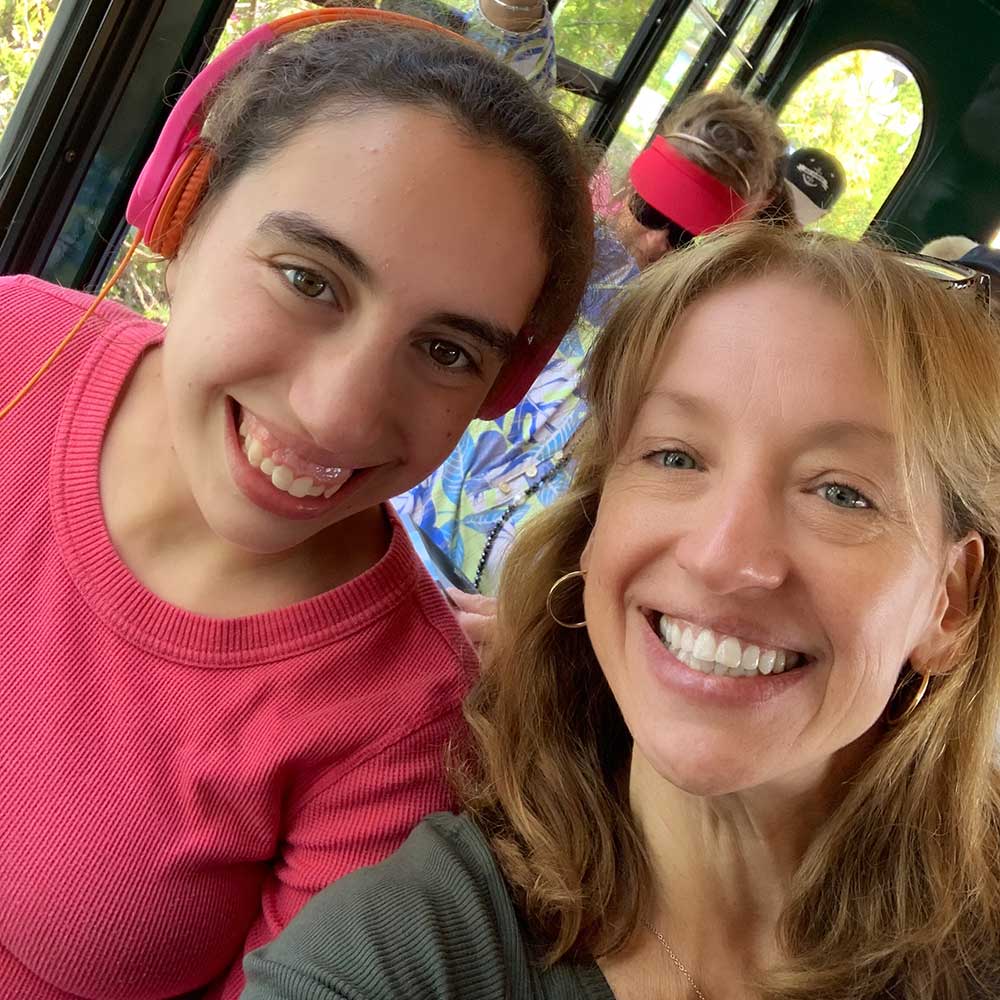
Once that’s possible, Singer adds, other doors open.
“It’s impossible to go out and participate in community activities when you’re worried that something will agitate your child, so many of our families will stay at home and become socially isolated,” she says. “But with a biosensor and predictive analytics … I think many families would be more confident participating in activities and sending their children to school. Teachers would feel more confident having those children in their classroom.”
And once they’re there?
“The data from the biosensor and machine learning allows an adult to intervene compassionately,” Singer adds. “The great thing about the biosensor is that we all wear them. So when our kids with profound autism wear them, they’re not standing out. They’re not marked as a child who is likely to be aggressive … it almost makes them more a part of the community.”
And fitting enough for technology that fills a need long overlooked by academia, the development process took a uniquely multidisciplinary effort. Khoury College, Bouvé College, and the College of Engineering. Undergraduates, master’s students, doctoral students, postdocs, research scientists, and faculty. Experts in programming languages, data visualization, signal processing, machine learning, human–computer interaction, psychology, neurology, and developmental science. Project partners including autism advocates, clinicians, teachers, caregivers, families, device manufacturers, and the Marcus Autism Center. And Goodwin’s joint appointment, which draws computing and health science students into his classes and into the Computational Behavioral Science Lab that he directs.
“Northeastern and Khoury College attract students who aren’t developing technology just for the sake of developing it. They’re attracted to applying computing to do good for society,” Goodwin says. “The kinds of tools and knowledge that we’re generating may well change public health practice, so we’ll need a workforce that’s as comfortable in clinical health sciences as they are in computer and engineering sciences.”
And as he does his part to build that workforce, Goodwin will continue to showcase the research in front of new audiences, as he did on Saturday.
“I am so appreciative that the APA is shining its bright spotlight on our children because they have been left in the dark for so many years,” Singer says. “My daughter and all of the individuals with profound autism deserve to be in the community. They are loving and lovely people. They just need some support to participate more broadly. And we need more research and compassion so that they can reach their potential and be full participants in our communities.”
The Khoury Network: Be in the know
Subscribe now to our monthly newsletter for the latest stories and achievements of our students and faculty
Author: Matty Wasserman
Date: 08.01.23
While Lace Padilla’s data visualization forecasts are intended to appear simple, the research and psychology behind their designs are anything but.
Through a rigorous, methodical process, Padilla boils down sophisticated scientific concepts and projections into easily interpretable diagrams and graphics, helping the public understand the extent of natural disasters and health crises before or as they emerge.
Her greatest challenge is accurately portraying natural events that are inherently unpredictable — such as hurricanes, wildfires, or epidemics — to an audience that seeks immediate, definitive answers. People, especially those without scientific backgrounds, generally struggle with the concept of uncertainty in predictive measurements, even though most scientific models consist of far more “gray area” and changing variables than clear-cut answers.
For her research examining this struggle to comprehend uncertainty in forecast visualizations, as well as how to better represent uncertainty in future models, Padilla won the prestigious CAREER Award from the National Science Foundation (NSF) in June. The award recognizes early-career faculty for their innovative research and commitment to equity in STEM, as well as their potential to make an impact in academia. And as she joins Northeastern this fall with a joint appointment between Khoury College and the College of Science, Padilla plans to further her data visualization research and teach courses on the Oakland and Boston campuses.
“People have a very hard time understanding the uncertainty of projections. It is one of the hardest concepts for the average person to grasp,” Padilla said. “Luckily, visualizations can make it easier for people if they are done well. Or they can cause serious misunderstandings, so it’s a double-edged sword. You have to be very careful when designing them.”
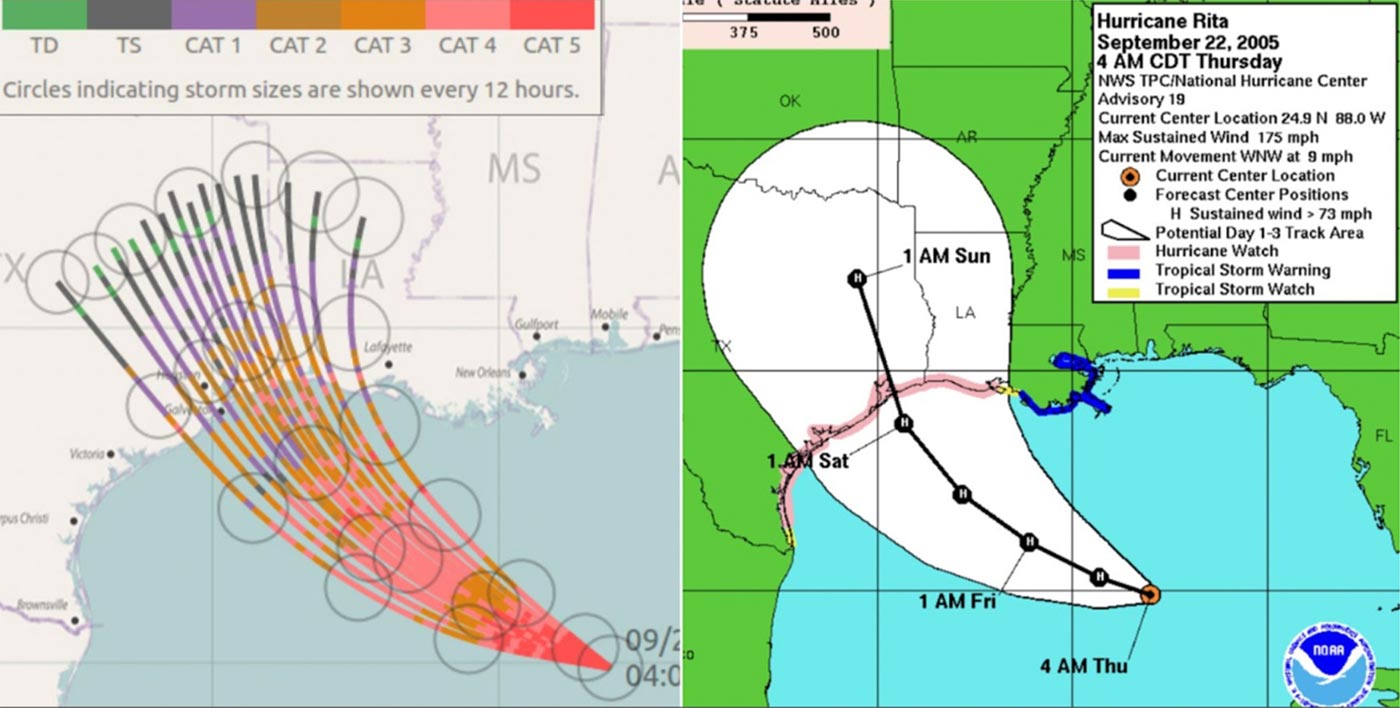
One example Padilla cites is the “cone of uncertainty,” which models the potential impact of an oncoming hurricane for different geographic areas. Often, these visualizations can be too simplistic and misleading, and cause people to not evacuate or properly prepare for impact due to a false sense of security.
“People think ‘I’m in the danger zone, I should evacuate,’ and if they’re just outside the edge of the cone, they are safe. But of course, there is no boundary to a hurricane path. The hurricane doesn’t care where we’ve marked it,” Padilla said. “So we had to come up with better techniques to convey this distribution and the gradient of risk. And what we find is that most effective visualizations show a range or distribution of outcomes rather than a binary answer.”
And while projection visualizations must prioritize accuracy and reflect nuance, the work is irrelevant unless it’s digestible within seconds. The blending of those seemingly paradoxical concepts is where Padilla’s diverse educational background becomes crucial. Her artistic expertise comes from her bachelor’s and master’s degrees in design, her behavioral expertise from a PhD in cognitive neuroscience, and her scientific expertise from her role as a NSF STEM Ambassador and other research initiatives.
“Data visualization is the perfect way for me to use these intuitions that I developed in art and the basic science I learned about how the mind processes visual information. Then I use that to create visualizations that can help improve the health and safety of people around the world,” Padilla said.
Another critical trait is Padilla’s ability not to be married to her own ways of processing information. When designing a graphic, she weighs the interpretations that people may make based on their own perspectives. In the hurricane example, Padilla must weigh how those in the line of the storm will interpret her model, while also considering if those living 30 miles inland will be accurately informed.
“Through making and critiquing art over a lifetime, you develop an intuition for what the ‘normal’ person is going to think,” Padilla said. “Oftentimes, someone who’s making a visualization with all this excellent math underpinning it will say ‘Well, people should interpret it this way.’ But I don’t make a lot of assumptions about what people should do or how they should think.”
Likewise, it’s critical to assess accessibility not only geographically, but also demographically. In many cases, Padilla tailors her work to those who she feels most need the concept of uncertainty reinforced through visuals.
“The people who are most affected by uncertainties — specifically by climate change, COVID, and hurricanes — are those who are in underrepresented populations,” Padilla said. “Those groups tend to have lower levels of education and lower socioeconomic status, so I try to make visualizations for them and I assume nothing about what they know.”
The process of getting visualizations finalized and widely adopted is often slow, particularly when working with government agencies that are hesitant to make sweeping changes. But still, Padilla has made progress. For instance, she has researched wildfire visualizations alongside one of the county’s premier wildfire experts, and while the work is still in progress, she expects their final product to be adopted officially in California. And despite the grueling development process, she hopes to continue her campaign to make the general public more comfortable processing uncertainty in this new phase of her career.
“One aspect of my CAREER award is training young people to understand uncertainty in visualizations,” Padilla said. “Especially with climate change, uncertainty will become increasingly more important, and we need to make people more resilient to these uncertainties. It’s only going to impact more of our decisions in this changing world.”
The Khoury Network: Be in the know
Subscribe now to our monthly newsletter for the latest stories and achievements of our students and faculty