Author: Milton Posner
Date: 12.08.23
Student clubs are an indispensable part of the Northeastern experience. Eager learners coalesce around shared passions, create and collaborate with like-minded friends, and supplement their required coursework with projects and activities of their choosing. At Khoury College alone, the results of this inspiration range from Mars rovers and electric racecars to computing mentorship for new students.
Enter Kaleidoscope, a newly formed, student-led consortium that aims to build community among Khoury College’s clubs, streamline their access to resources, and grow them throughout Northeastern’s global network. And with two dozen clubs and counting under their banner, the group’s leaders feel they’re well on their way.
“Clubs can often be overlooked or taken for granted at such a large university,” says James Chang-Davidson, a fifth-year computer science student who founded Kaleidoscope and serves as its president. “Whereas I feel that clubs are a tremendous part of the university, and a pivotal part of students’ social and professional experiences.”
More than 500 such groups make up Northeastern’s student life tapestry. But according to a recent survey, Chang-Davidson says, fewer than five percent of those clubs self-identify with Khoury College, the lowest of Northeastern’s nine colleges. By better supporting these clubs — plus a handful that identify primarily with other colleges, thanks to Khoury College’s many combined majors — he hopes that Kaleidoscope can pave the way for more of them.
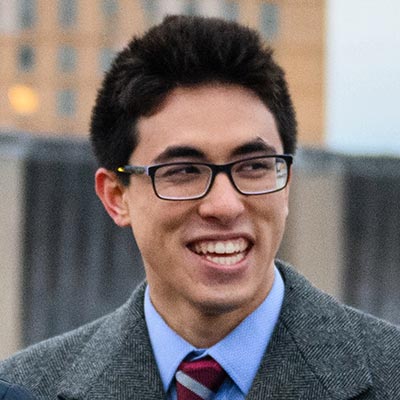
James Chang-Davidson
“We serve as the middleman between Khoury College and the clubs,” explains Ivy Jordan, Kaleidoscope’s community director and a second-year computer science and design student. “It’s hard for clubs to ask their college or Northeastern for help and resources; we’re a big school and there are lots of people to deal with for different things … We empower the clubs with the resources they need to grow.”
Kaleidoscope does this by advocating for increased and tailored club resources. This can mean money, but also project tools; for instance, the group is moving to supply student organizations with industry-standard computing resources as those organizations build software products for the Northeastern community.
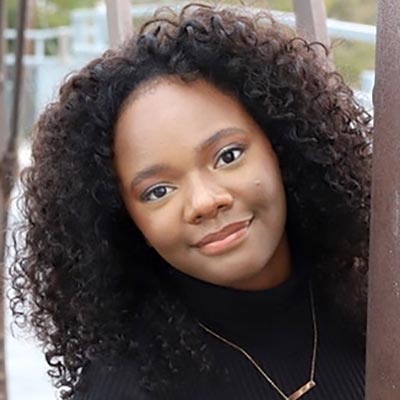
Ivy Jordan
Kaleidoscope is advised by teaching professor and assistant dean of student experience Mark Fontenot, ensuring close collaboration with the dean’s office. Fontenot helps Kaleidoscope in their efforts to centralize funding appeals and distribute money through its events fund and grants. By doing so, the group ensures all clubs have access to support and spares each club from needing to navigate complex funding processes alone.
“The fund aims to enhance club events and boost attendance by providing financial support for clubs to use [on] food, merchandise, or other means of making their events more engaging. The goal is to encourage a sense of Khoury community and shared experiences,” says Sara Takhim, a fourth-year cybersecurity student and Kaleidoscope’s co-head of operations. “Collaboration among clubs enables the sharing of diverse perspectives and ideas. This cross-pollination can help to develop unique, innovative projects and initiatives.”
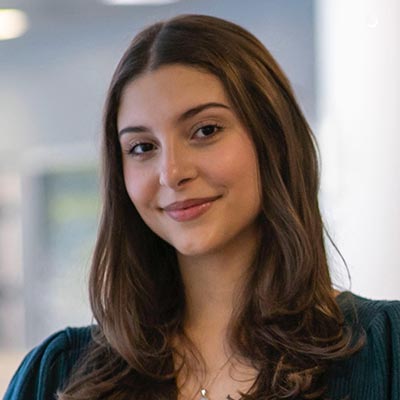
Sara Takhim
READ: From cybersecurity co-ops to women in tech, Sara Takhim makes her mark
And that’s not the only way Kaleidoscope aims to unite the college’s student organizations.
“It can be easy to compete with other clubs or compare yourself to them, and sometimes clubs do the same things under different names,” Jordan says. “Instead, we want these clubs to grow together. So we’re promoting workshops and events to help these clubs network and collaborate” on projects, events, and sponsorships for mutual benefit.
“It’s not that the clubs don’t get to be individual clubs,” adds Anika Sharma, Kaleidoscope’s global experience coordinator and a second-year computer science and environmental science student. “But we don’t want them to be off on their own with no sense of community. If they’re struggling, we can provide resources, network for them, and help them figure things out.”
The same goes for campuses outside of Boston. To date, only a small handful of clubs have sprouted at these newer, growing locations — a gap Kaleidoscope is working to bridge.
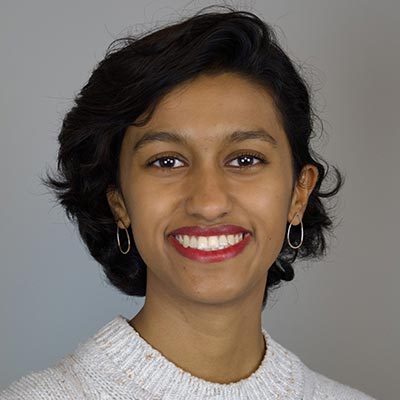
Anika Sharma
“It’s hard for students in some of these locations to start clubs, especially for students who know they’re going to transfer campuses,” Jordan notes, adding that Kaleidoscope can provide initial logistical support and aid the clubs’ continuity. “Once they’re established, we want to advocate for these clubs to help them grow and have longevity, to support them the same way we support Boston clubs. We don’t want clubs to die within the first two years because they’re on their own.”
In particular, Kaleidoscope is focusing on Northeastern’s Oakland and London campuses. In London, the group is trying to identify a group of students to support in creating either a new computing club or a chapter of an existing Boston club. In Oakland, where there is already a computing club, Kaleidoscope is looking to expand other Boston clubs out west, and to build a sustained and supportive connection with Oakland students as they build the organizations they want.
“We’re trying to help Boston clubs take the knowledge they’ve built up over the years and pass that on to other campuses,” says Sharma, who spent last year at Oakland as an NU Bound student before jumping to Boston this year, and who now focuses on Kaleidoscope’s inter-campus efforts. “I didn’t have the opportunity to join a club in Oakland, but in Boston I’ve joined quite a few, so extending that opportunity to other campuses is really exciting.”
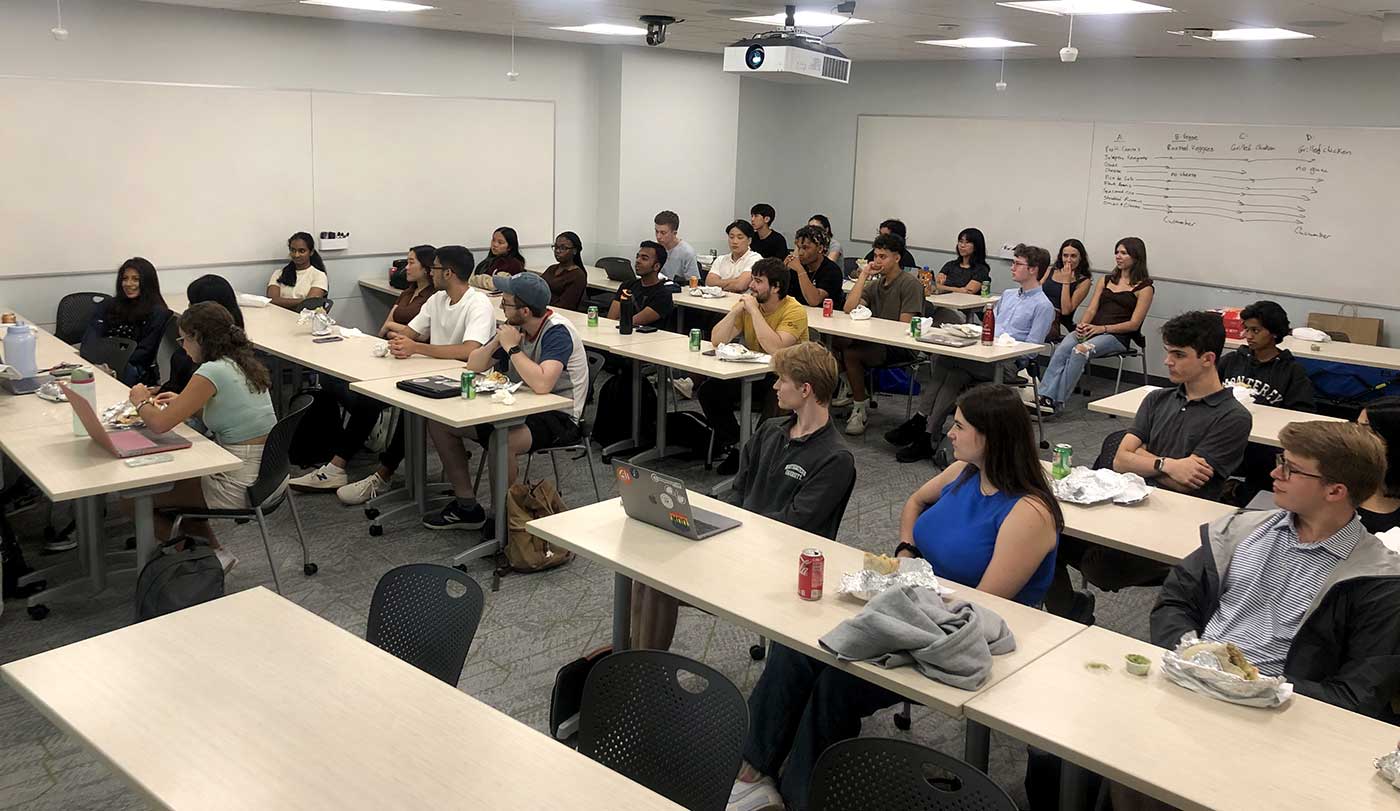
Kaleidoscope members at their first fall 2023 meeting.
In the short term, Kaleidoscope is providing funding for clubs’ educational computing programming, extending the university’s LinkedIn badging program to clubs, developing and assisting Khoury club leaders through its “How to Club” initiative, and collaborating with Makerspace at EXP on a maker fair.
“We want to have clubs present their work to employers … employers can then connect with clubs and invite students to work on projects,” Jordan says of the fair, noting the group’s discussions with co-op employers and its work with co-op coordinator Priyanka Bishnoi on career-related initiatives. “Given how fast-paced Northeastern is, students are always looking for their next project, their next leadership opportunity, their next co-op.”
In the longer term, Chang-Davidson wants to achieve the right balance between institutional support and student leadership, a balance he says was missing in previous attempts at Northeastern club councils.
“In founding Kaleidoscope, Khoury College takes the lead in student-led club councils … I really want to build a robust and lasting structure that would support unequivocal student leadership,” he says. “That means building a close relationship with Khoury College so the group is student-run, but funded and supported by Khoury College. We’re fortunate to have a dean’s office that is so supportive of what we do and that gives us the room to experiment and build Kaleidoscope.”
The Khoury Network: Be in the know
Subscribe now to our monthly newsletter for the latest stories and achievements of our students and faculty
Author: Zorain Nizamani
Date: 12.05.23
In a world where the relentless pursuit of knowledge meets the unwavering call of duty, Justin Raynor has balanced the rigor of academia with the discipline of military service. An Air Force major and a Khoury College doctoral student who recently defended his thesis on cybersecurity and data visualization, Raynor is a steadfast officer who proves that the skies are not the limit when it comes to scholarship and service.
“I have been in the Air Force for almost 14 years now and I have held various positions, starting with the Air Force Research Laboratory where I worked with satellites and unmanned aerial vehicles,” Raynor says. “Then I did satellite command and control for the National Reconnaissance Office for four years.”
This service runs deep in Raynor’s blood, to the point that it seems more like a genetic trait — one he is proud to carry.
“Both of my parents served in the Air Force, and both got out around the time I was born,” Raynor remembers. “Both my grandfathers served in the military too. It was never pushed on me, but it was always something I wanted to do.”
Raynor has put similar dedication into his academics, first earning multiple undergraduate degrees in computer engineering and computer science.
“I always wanted to be a military engineer because I wanted not only to be a part of projects that civilians could not, but also to contribute to something greater than myself,” he explains. “My undergraduate education helped me achieve that.”
These projects included designing experiments to improve the optical detection capabilities of drone and satellite imaging systems, as well as designing user interfaces for mission crews onboard the Airborne Warning and Control Systems aircraft.
Raynor went on to earn his master’s degree from Northeastern University in electrical and computer engineering with a focus on electromagnetics, plasma, and optics — all while serving as a full-time officer. He then decided to pursue a doctorate from Khoury College in cybersecurity visualization design approaches under advisor Cody Dunne and within the Data Visualization Lab, focusing on improving visualization designs and research methodologies to accommodate challenges and risks in the cybersecurity realm. By improving the visual techniques used to present data, Raynor aims to bridge the gap between academia and industry, and to propose visualization solutions across the two domains. The common ground between his military background and doctorate, he says, makes the entire experience more rewarding.
“My work with operations, managing teams and seeing how things work in the Air Force has really driven how I have approached my PhD,” he says. “In visualization, we have the tendency to build really fancy tools with great graphics. But a lot of times, those tools don’t end up getting adopted or their adoption rates are very low … Many times, people can get too theoretical with their research, so practicality is something I have really taken to heart. My research is focused on what we can learn from military practitioners rather than pushing technology down on them.”
Raynor is firmly of the view that researchers need to work closely with military practitioners to understand how to design the tech. Design spaces is one such area of Raynor’s research, where the aim is to improve the design of processes and workflows, then efficaciously incorporate them within military organizations.
And he’s just as excited about his next assignment.
“I will be at Fort Meade in Maryland with the United States Cyber Command,” Raynor says. “As a senior major, I will be the focal point for the operations floor there, with my tasks revolving around managing people and operations.”
US Cyber Command is the nation’s unified combatant command for the cyberspace domain. Its mission is to direct, synchronize, and coordinate cyberspace planning and operations, and to defend and advance national interests in collaboration with domestic and international partners.
But beyond his busy professional and academic life, Raynor’s experiences have taught him how to balance a fast-paced, technology-laden career with his family life. He also believes it is equally important to give back to community — addressing pressing social issues and fostering a sense of purpose, belonging and personal growth. Raynor believes that his family strengthens him every day, which allows him to continue doing what he does best.
“My wife is a board member for a community theatre organization in Massachusetts while I’ve been busy earning a PhD, and I had the opportunity to be on the board for a conservation organization out of Colorado,” he said. “We have four kids too, so family life is equally important. We go to national parks and camp out. Balance in life is imperative.”
It’s that balance that has led Raynor through his journey as a scholar–officer, and it’s that balance that will drive him forward — newly earned doctorate in hand.
The Khoury Network: Be in the know
Subscribe now to our monthly newsletter for the latest stories and achievements of our students and faculty
Author: Zorain Nizamani
Date: 11.22.23
In our busy lives, the mantra “out of sight, out of mind” is all too familiar. But Shivanjali Singh had an idea: What if she could launch a business that would allow people to dictate their end-of-life plans on their own terms?
“I have been an entrepreneur ever since I was a kid. I was always making up ideas, making jewelry and selling it, buying candy and selling it,” she said. “I was always able to give people something that they didn’t realize they wanted.”
Now, six years after completing her computer science and business studies at Khoury College and the D’Amore McKim School of Business, Singh is pursuing her newest venture: Legacy. The in-development app will allow users to effectively sort and execute their end-of-life planning — all under one umbrella, and in just four simple steps. It will do this by allowing users to efficaciously sort their assets and liabilities, as well as appoint trustees or guardians.
“The app begins with an onboarding quiz which tries to understand the psychology of the user and how far they are in their own end-of-life journey; the app then formulates a custom plan. The next step involves a task engine which breaks down that plan,” Singh explained. “The third part is a vault for documentation. The vault houses both documents that are auto generated through data collection from the task engine and those manually uploaded by the user. The last part is a marketplace which connects users to lawyers, counselors, and insurance agents — people who are in or adjacent to the field.”
Singh believes that her approach toward end-of-life planning could attract users because Legacy is being introduced during increasingly digitized times, and because of a mindset shift in the younger users the app will target.
“The novelty with Legacy is that its target market includes the most death-positive generations to date, and because of that, they have a different relationship with death,” Singh noted. “We are having you look back at life with reflection, not as a direction toward death, but toward the kind of experience you have had with your life.”
Those same generations are also especially conscious of data privacy in an age when the collection and storage of personal data continues to loom large, explains Singh.
“Being in tech, I know data has to be highly secure,” she said, adding that for Legacy’s future users, “All your data belongs to you; Legacy will not own your data. If you end up going through the marketplace, then you’re falling into the data constraints of working with a lawyer, which of course is also confidential.”
Singh also plans for the app to be subscription based, with users paying only a few dollars every month to take advantage. The app should be fully developed and available within the next few months.
But after providing all that information, what happens if a user no longer wants to use the app?
“We give you your data back as is and you no longer have anything remaining on the app,” Singh said. “Anything you upload is housed in your own secure part of the cloud and we don’t read it. We don’t scrub through your documents to see what you’ve done. We’re essentially opting in for you to tell us, ‘Hey, I uploaded my will,’ and that’s it.”
And when a user dies?
“You set up a granular permission to your vault, and the people you give this granular permission to are the only ones who have access to your documents,” Singh explained. “If you do pass away and Legacy has your data, there is always someone who has secondary ownership of your account.”
Singh believes Legacy is commercially viable, thanks in part to the computer science and business skills she honed at Northeastern.
“At this point in my career,” she said, “I believe I have gotten enough skills under my belt, and I feel the timing is just right for a tool like Legacy to be brought into the world for creating this ease and for democratizing end-of-life planning.”
The Khoury Network: Be in the know
Subscribe now to our monthly newsletter for the latest stories and achievements of our students and faculty