Author: Matty Wasserman
Date: 01.17.24
Machine knitting, the automated manufacturing process of making textiles and garments out of yarn, is an integral component of industrial manufacturing. But the programming behind these knitting machines — in essence, how they are coded to knit sweaters, shirts, socks, or blankets to specific measurements — is extremely complex.
Altering knitting commands and designing new ones is a laborious, inefficient, and error-prone process — one that Megan Hofmann, an assistant professor at Khoury College, has become all too familiar with after years of research in the space. Hoping to ease these hurdles, Hofmann took it upon herself to create a new baseline framework, and to make it free and available to everyone.
Over the past year, Hofmann has led a group of researchers in developing KnitScript, a domain-specific machine knitting scripting language based on Python. In October, the group — which includes Carnegie Mellon University’s Lea Albaugh and Scott Hudson, as well as the University of Washington’s Tongyan Wang and and Jennifer Mankoff — presented their research paper, KnitScript: A Domain-Specific Scripting Language for Advanced Machine Knitting, at the ACM Symposium on User Interface Software and Technology.
While KnitScript is primarily being used by Hofmann’s research collaborators, students, and local partners for now, her vision for it is far wider.
“Much in the same way that programming languages are the bottom-layer infrastructure for all of the software we use, I imagine that this will be used for just about everything in machine knitting,” Hofmann said. “This is not the endpoint or the design tool itself; this is what lets us build tools on top of it. Everything from fashion to the medical industry would be building their own design tools on top of this language.”
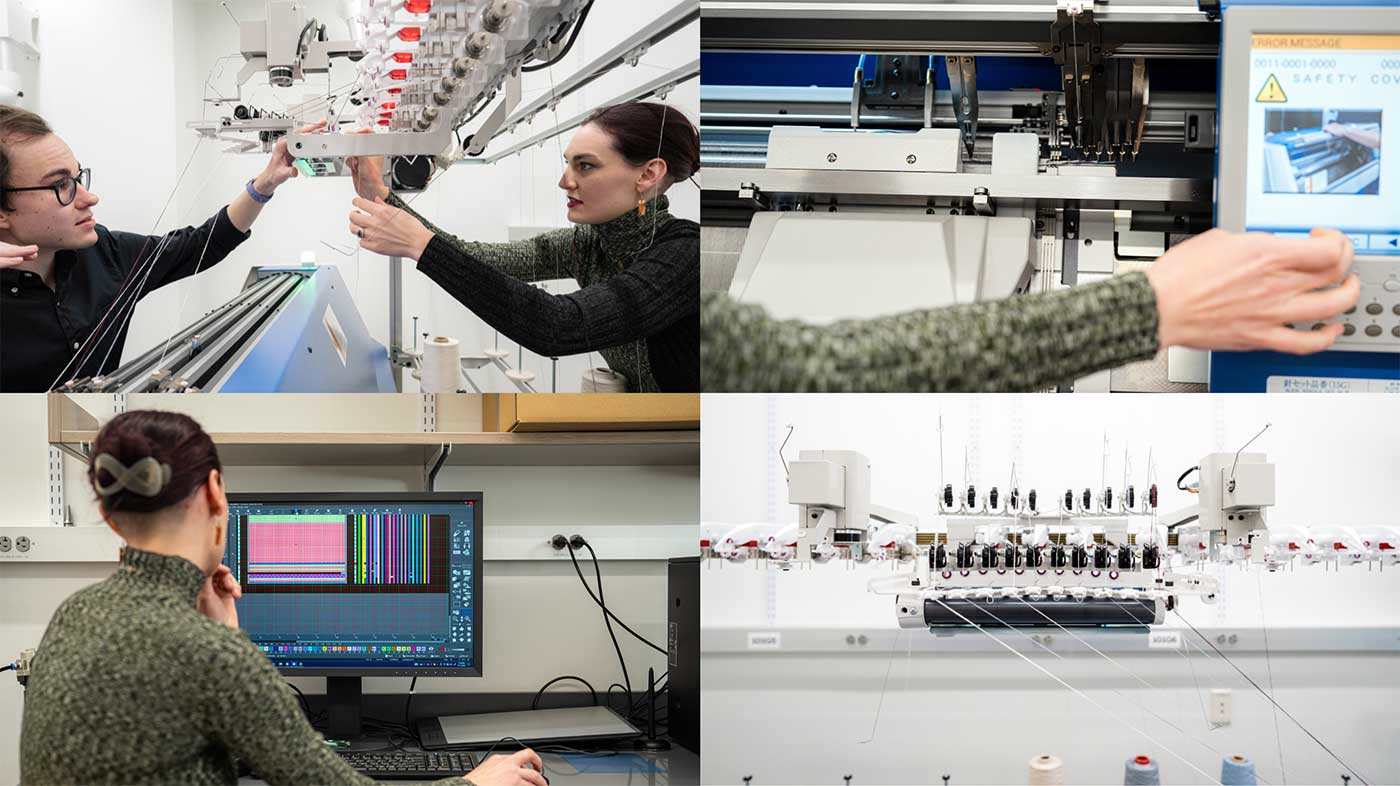
Previously, programmers had two workaround solutions to tailor knitting machines to their desired patterns and algorithms. They could use template-based design tools that came integrated with the machine, which limited the originality of designs, or they could use low-level assembly programming tools, which were complicated to build and difficult to scale. Now KnitScript provides a foundational, industry-standard language, lays the groundwork for further advanced knitting techniques, and simplifies the training and adoption process for programmers.
“The existing framework for these machines was so locked into what individual companies produced with their tools, and there wasn’t an easy way to bring in someone who had a computational background. If someone wanted to program with machine knitting, they needed to dedicate six months to learning how to use the equipment,” Hofmann said. “Now, they just need a few practice coding problems.”
Hofmann first pinpointed this need as a doctoral student at Carnegie Mellon University, where she blended machine knitting and medical making to create customized assistive devices for people with disabilities, earning a SIGCHI Outstanding Dissertation Award in the process. Through that project and others, Hofmann found herself tweaking and adapting the machines’ underlying programming over and over again. Eventually, it clicked that her work from these projects could be developed into a broader programming language, eliminating the treacherous process altogether.
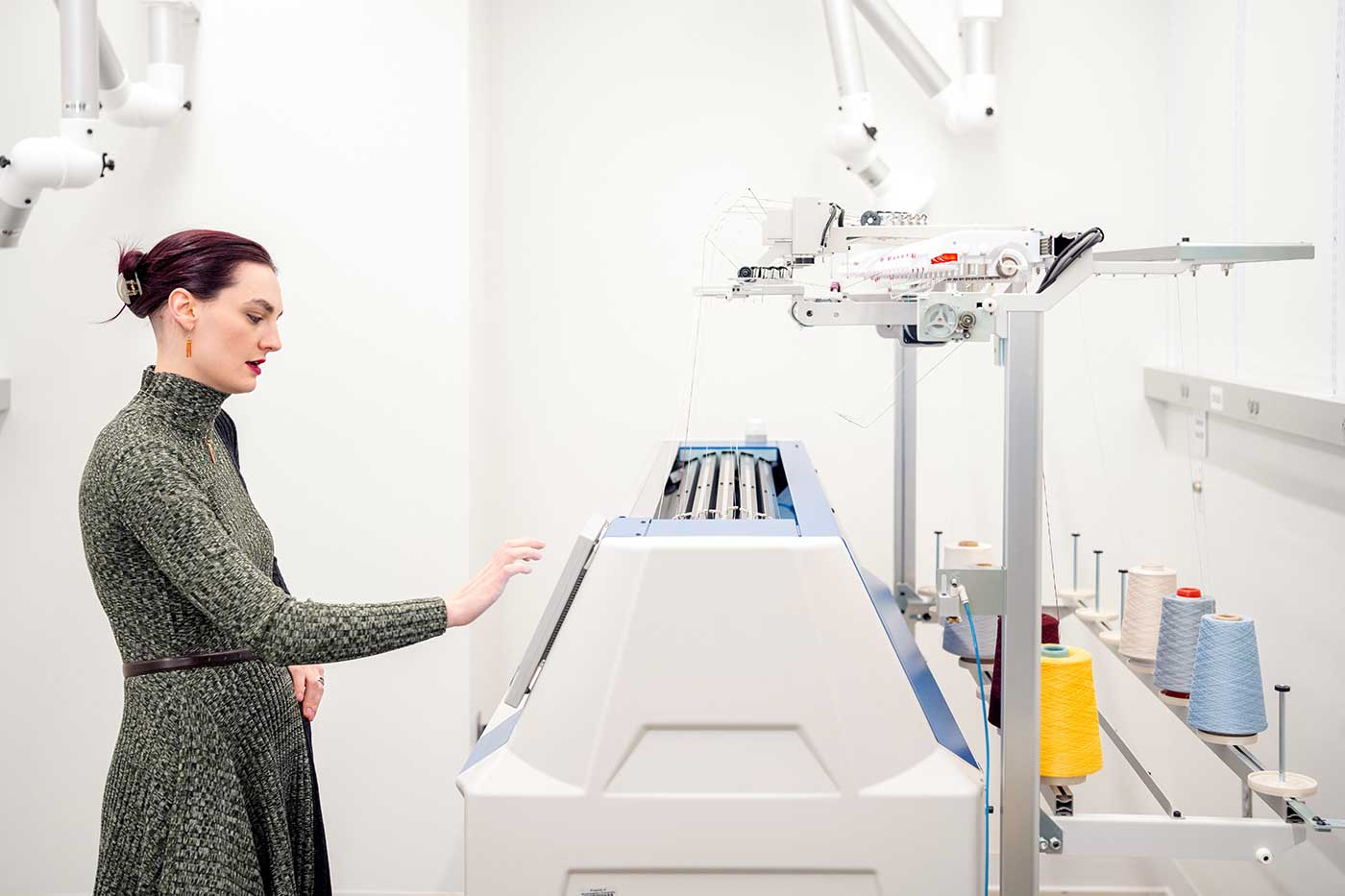
“It took me a number of years to get to that point of familiarity,” Hofmann said. “I essentially rebuilt the toolset that underlies this language three or four times in the process of building other tools for other research projects, until I felt like I had settled down on a consistent structure.”
But while the idea of a domain-specific programming language felt obvious to Hofmann, it wasn’t being widely pursued. So in the spring of 2022, she conducted a user study to introduce the concept to other researchers, and received extremely positive feedback.
“It was not intended to be a research project initially,” Hofmann said. “But as soon as we had a working tool that our team was using, and the other collaborators I had were using it, we thought, ‘Oh, there’s really something meaningful and important here.’ We wanted to get it out into the community.”
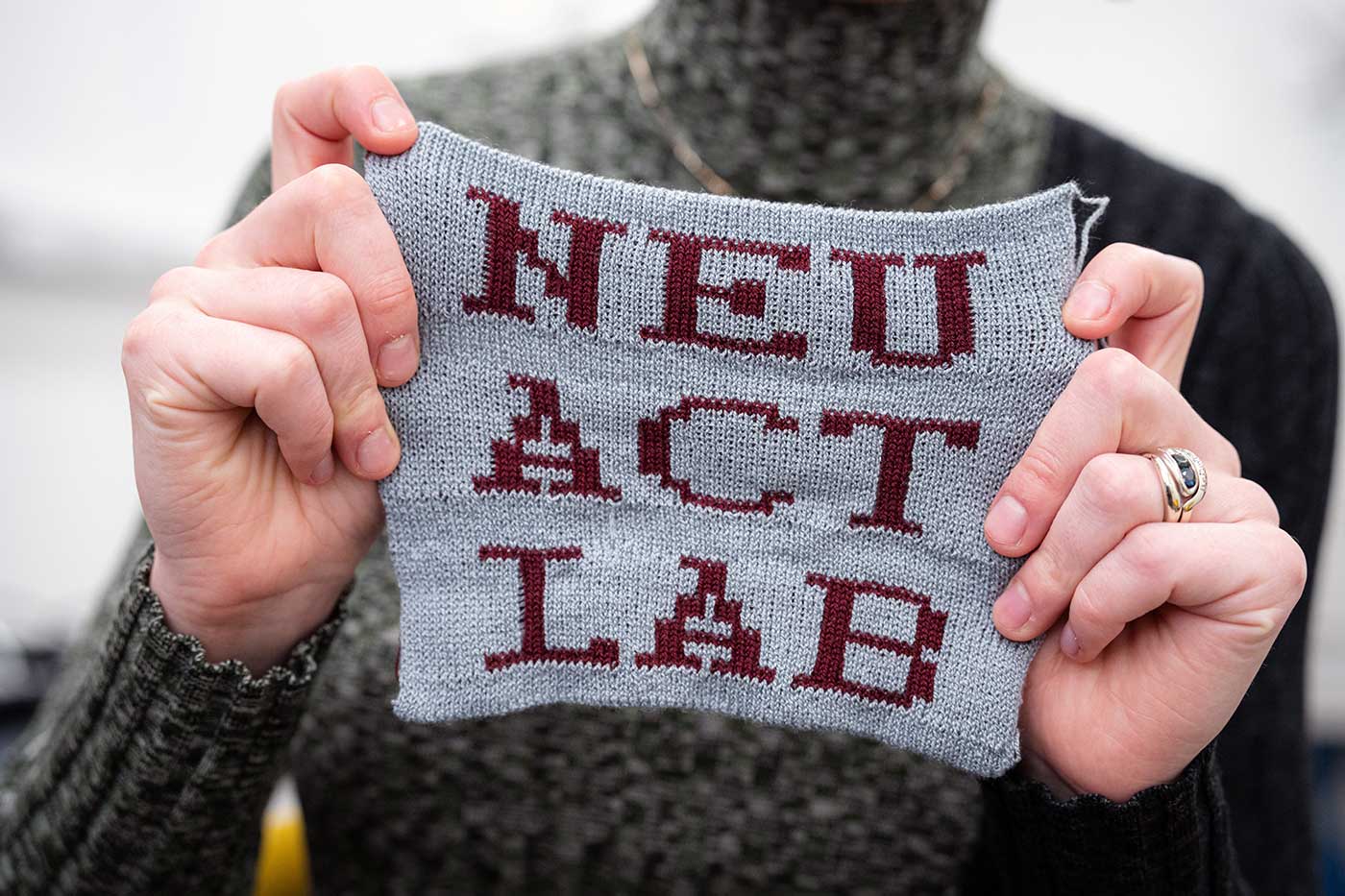
Aside from Hofmann’s students and the ACT (Accessible Creative Technologies) Lab she heads at Khoury College, Hofmann’s collaborators at the University of Washington, Carnegie Mellon University, and the Massachusetts Institute of Technology have also adapted the software. She hopes more researchers and students nationwide will adopt the technology, and to spur this, KnitScript’s full documentation and library is publicly available and easy to install on PyPi, a Python software repository.
“We wanted to make this really, really easy to get started with, and get it into the hands of as many people as we can,” Hofmann said.
But for KnitScript to jump from academia to ubiquitous industry use, it must also be integrated with industrial manufacturers, including makers of clothing, customized medical devices, and advanced textiles. Hofmann is already partnering with organizations in the Boston area to use KnitScript in their design processes, which she hopes will build industry awareness of KnitScript’s value and malleability.
“There’s a huge variety of companies interested in manufacturing advanced textiles, and all of them need this kind of toolset. Many of them have been doing this in-house, and they’ve been struggling with it because it’s really hard to find anyone with this expertise,” Hofmann said. “Being able to work with them and get them into KnitScript means they’re going to be building their software and their advances on top of it.”
As the demand for customization and design sophistication continues to grow in the advanced textile space, Hofmann sees KnitScript’s benefits increasing as she and her collaborators continue to evolve it.
“We’re still adding new data structures, different presentations, and new ways of detecting common errors. But it’s really a pluggable and scalable project; we can expand on it just like with any other programming language,” Hofmann said. “And as we have more of a community understanding of the machine knitting space and what this community needs, we’ll continue advancing KnitScript in the direction it needs to go.”
The Khoury Network: Be in the know
Subscribe now to our monthly newsletter for the latest stories and achievements of our students and faculty
Author: Sarah Olender
Date: 01.16.24
When Northeastern University merged with Mills College in Oakland, California in 2022, there were a lot of mixed emotions from Mills students like Yasmeen Dao. While it was bittersweet to say goodbye to the Mills community as it was, Dao saw the merger as a unique opportunity to explore all that Khoury College has to offer.
“At first, I had never experienced anything like a merger before, so I didn’t know what to expect or how to react. But I always wanted to go to school on the East Coast and explore there,” Dao said. “I saw that Northeastern had great opportunities [for] growing professionally and personally … so I wanted to go and see what Northeastern had to offer.”
So after commuting to Mills from her nearby hometown of Orinda for two years, Dao chose to embrace change. She came to Boston in the fall of 2022 and has been based there ever since.
Dao’s journey didn’t stop, or even falter, with a change of campus. Upon coming to Boston, she joined Northeastern’s women’s club soccer team, which was a natural transition from her previous role as a Division III player at Mills. Dao played on a developmental academy competitive soccer team growing up, and knew she wanted to continue playing at a competitive level in college.
Dao had also entered Mills College intent on studying computer science. But early on in her academic career, Professor Susan Wang gave a talk to one of Dao’s computer science classes, and it opened Dao’s eyes to the world of data science. Enamored with the field’s many interdisciplinary applications, Dao decided to pursue a career in data science, diving into its intersections with climate change, poverty, health care disparities, and other societal challenges.
While Boston was a major shift from Mills’ Oakland campus, Dao has embraced the differences, welcomed the change in scenery, and enjoyed her time on the East Coast.
“It’s so different being in a big city compared to Mills, which is in a smaller, more tranquil setting with intimate class sizes, but I’ve met so many people and so it’s been really nice,” Dao said.
One of the things that Dao enjoys most about the Boston campus is being on a large campus in the middle of a large city, and the opportunities that result. For instance, she recently completed a software engineering co-op with Manhattan-based Parametric, an asset management division of Morgan Stanley. While in New York, she was part of Parametric’s fixed income investment team, where she configured authorization security to help process requests necessary for portfolio construction; she also helped to develop an application that delivers offers and aggregates deals on municipal bonds.
Dao arrived in New York aiming to further explore the East Coast and to take advantage of the opportunities Northeastern had to offer. While there, she also made friends with the other co-ops.
“It’s so different from what I’ve kind of been doing in classes because my classes are more data science related,” Dao said about her co-op. “On co-op, I’ve learned so much about computer science and the finance world as well.”
Between her transition to Boston, finding her place on campus and on the soccer team, and exploring new locations and internships, Dao has experienced plenty of personal and professional growth.
“I felt discomfort in the transition at first and I was really scared because I didn’t know what to expect. But it proved to be really important to forge adaptability and challenge myself to do those tough things,” Dao said. “It led me to New York, and if I hadn’t gone to Boston to begin with, I don’t think I would have been there. Even outside of academics, I’ve learned so much about myself and life in general, which is so important and a testament to gaining confidence and pushing myself out of my comfort zone.”
The Khoury Network: Be in the know
Subscribe now to our monthly newsletter for the latest stories and achievements of our students and faculty
Author: Sarah Olender
Date: 01.15.24
Dakuo Wang has worn many hats and called many places home in his career.
His educational journey took him from computer science to electrical and computer engineering, then to information systems and informatics. He’s gone from Beijing to Paris to California. He has sought to understand how AI interacts with humans and design, and how it can do so more effectively. And he’s found himself increasingly intrigued by human–computer interaction, and how technology and human behavior intertwine in the rapidly evolving digital landscape.
“My research is all about harmonizing AI and human needs … to create a productive partnership between humans and machines,” Wang said.
Now jointly appointed with Northeastern’s Khoury College and the College of Arts, Media and Design, Wang is applying his research in AI and human interaction to the up-and-coming industry of livestream shopping — how it works, how it affects online shopping behavior, and how it might impact shopping experiences.
Consumer livestream shopping is when a company contracts with an influencer — such as a movie star or athlete — to bring products directly to consumers’ screens through live video. To many, this intersection of shopping, ease, and entertainment is beneficial, as it can show people how products work or how clothing looks on people, among other things. This immediacy and interactivity, along with the vast range of products these platforms can accommodate, makes them enticing to numerous sellers.
But behind the ease and effectiveness of this shopping revolution, danger and malice may be lurking, Wang said. He recently co-authored a paper with Qunfang Wu, Yisi Sang, and Zhicong Lu, where they dove into the world of livestream shopping to see how it was done and who benefited most. The quartet of researchers recorded over 40 livestream shopping sessions on TikTok and Taobao, two massively popular platforms for livestream selling, then analyzed the often deceptive, malicious, coercive, and tactical patterns of livestream sellers on each platform. The researchers then interviewed livestream viewers to get their perspectives.
The team found that many sellers use unsavory tactics to lure in and take advantage of consumers. Many sellers lie about the quantity of their stock to create a sense of urgency among customers. Others lie about having the lowest price or highest-quality product.
“These tactics range from spreading false urgency to orchestrating attacks against those who voice negative opinions,” Wang said, noting that many sellers respond to negative product feedback from customers by calling those consumers liars.
These issues are especially timely as livestream shopping continues to rise on platforms such as TikTok, which counts 19% of Americans as members and sees them spend an average of 23 hours per month on the app. The social media platform launched its e-commerce business in August in an effort to heighten competition with rival platforms Temu and Shein.
Unlike with infomercials, which are recorded programs, users can seek out livestreams or stumble upon a seller unintentionally while scrolling through the app. Livestream shopping is also attractive because it allows consumers to ask questions through the comment section and receive answers in real time, whether from the seller, the company conducting the livestream, or other consumers in the comments.
“Humans, by nature, are more attracted to videos in comparison to images and text,” Wang explained. “When you have a huge population of users watching, or if you have a very good recommendation algorithm powering an endless feed of one livestream after another, there’s a huge incentive for advertisers, service providers, and all kinds of brands and shops to utilize that big user population.”
This allure of higher sales can often overshadow the need for ethical selling practices, leading to decreased user trust. As more people flock to these platforms seeking the thrill of interactive shopping, Wang places the responsibility for crafting a trustworthy and secure environment on the shoulders of designers, engineers, and policymakers.
In particular, the team’s research showed him that the livestream shopping platforms were being designed to benefit the sellers, not the buyers. After hearing the consumers’ discontent with this, Wang says he wants livestream platforms to adopt a user-centric approach, embrace their responsibility to their users, and ensure that the allure of livestream shopping doesn’t eclipse the users’ rights and interests.
“Platforms often provide features that favor sellers, resulting in an environment where buyer opinions are silenced,” he said. “The race for revenue should never come at the cost of users’ trust.”
The Khoury Network: Be in the know
Subscribe now to our monthly newsletter for the latest stories and achievements of our students and faculty