Author: Madelaine Millar
Date: 02.23.24
If you went to a library at the turn of the 19th century to learn about proteins, good luck. The Dewey Decimal System did not exist yet, so books were shelved using an organizational scheme unique to each library. You could use an encyclopedia, but to dig deeper, you’d need to know how that specific library classified books about proteins. Not to mention, when a librarian departed, their institutional knowledge moved on with them.
Today, if you parse the roughly 35 million indexed biomedicine publications for information about a specific protein, you’ll run into a similar problem. While existing ontologies and databases compile and organize knowledge on specific topics, biomedicine has long lacked an equivalent to the Dewey Decimal System — a unified, open-data-compliant way to identify, organize, and network together information about billions of researched entities, from chemicals and proteins to phenotypes and diseases. That difficulty in locating what we already know slows down research and drug discovery, and it means that existing data goes underused.
But Ben Gyori and Charlie Hoyt of Northeastern University’s Gyori Lab for Computational Biomedicine are working on a solution. The Bioregistry is a comprehensive resource that labels every biological entity — from proteins and molecules to diseases and pathogens — with unique, standardized identifiers that are linked together. Identifiers are crucial for data integration, but their use in the biomedical community is still limited and highly inconsistent.
The Bioregistry irons out these inconsistencies and allows researchers to more easily locate information in their areas of interest. And with two years of new funding from the Chan Zuckerberg Initiative, Gyori and Hoyt aim to expand the tool’s scope and integrate it more deeply into the scientific community.
“We need technologies that allow for different pieces of existing research to be put together in a consistent way,” explained Gyori, an associate professor jointly appointed between Khoury College and the College of Engineering. “This will accelerate the scientific discovery cycle by making it easier for researchers to leverage the body of knowledge that is out there.”
The Bioregistry had a humble beginning. While working on systems biology and network science projects, Hoyt kept encountering a persistent problem; the literature and the data were filled with entities referred to by identifiers that he couldn’t recognize.
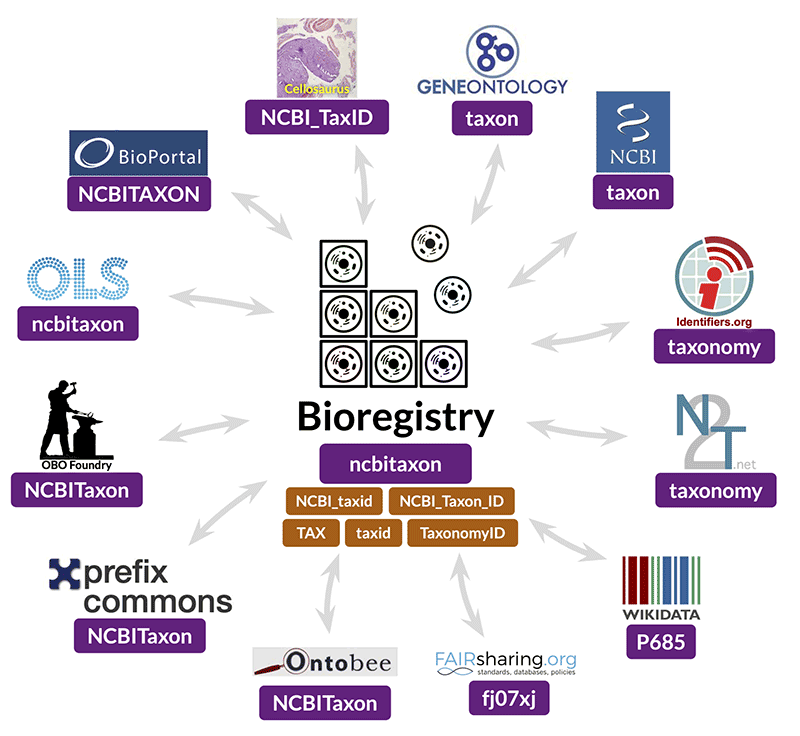
“Many widely used databases we were integrating with our tools were using different synonyms and capitalizations and styles for providing identifiers, and it was often impossible to tell what they were; on occasion I even had to ask people by email,” said Hoyt, a senior scientist within Gyori’s lab. “Every time I got an answer, feeling like I was a digital Indiana Jones, I wrote it down. I wrote enough of these down that I realized this could be its own resource, and that it would be helpful for other people.”
At the time, Gyori, a recipient of DARPA’s Young Faculty Award for his work on accelerating biomedical discovery, was already working with Hoyt. He saw the potential of Hoyt’s idea to further not just the lab’s goals of large-scale integration of biological knowledge, but to improve biological research in general.
“If you’re on a mission to solve a specific problem, you often run into limitations you didn’t anticipate. If you then find a general solution to that problem, that will also help other people in the community,” Gyori said. “The Bioregistry is one example of that. We needed it to achieve our own ambitious goals, but we’re making sure that we not only solve this problem for ourselves, but create a resource that’s broadly useful for the community.”
Since then, Hoyt and Gyori have made significant progress. They have cataloged almost two thousand resources that provide identifiers for biological entities, making it easier to locate information about billions of individual biological entities. They have also built a semi-automated curation workflow to support community contribution to the Bioregistry, where researchers can add entries based on their own work.
The whole resource is compliant with the Findable, Accessible, Interoperable, and Reusable (FAIR) data principles and open science standards, which Gyori believes is critical to making the project widely available and sustainable.
Now, after three years of building the Bioregistry from an idea into a functional piece of technology, it’s time for a different flavor of work. While other projects have sought to solve a similar problem before, they have been limited by their institutional ownership and noncompliance with open data practices. With the Chan Zuckerberg Initiative’s support, Gyori and Hoyt will spend the next two years working to ensure long-term sustainability for the Bioregistry — building out a community-oriented governance model, expanding its scope, and pursuing integration with a broad set of other projects. It’s important to the duo that the Bioregistry’s usefulness outlasts their research tenures, and to do that, they need a community that will continue to use and update the resource independently.
“For externally funded research, it is our responsibility to make our work available openly and broadly. But beyond that, we are developing a blueprint for creating resources in a way that ensures sustainability if funding for the original developers runs out, if people change careers, or if anything happens,” Gyori said. ”With the Bioregistry, we not only made a larger and more comprehensive resource, but we came up with a framework that allows for further growth initiated by the community.”
While organizing scientific data integration might sound obscure, its potential influence is difficult to overstate.
“It has a big impact, even though it’s something people might not be aware that they’re relying on — the same way that roads are fundamental to a functioning society,” Hoyt said. ”Personally, I’m a neat freak. I see the world of fragmented biological data as a puzzle that needs to be solved. I think the Bioregistry is a key part of the solution.”
The Khoury Network: Be in the know
Subscribe now to our monthly newsletter for the latest stories and achievements of our students and faculty
Author: Milton Posner
Date: 02.15.24
Long before 2023 ended, it had already been crowned as the year of generative AI. Spurred by the advent of models like ChatGPT that produced detailed, jarringly human replies to user prompts, experts and novices alike began musing on the technology’s potential impacts on work, education, and creativity.
But while today’s large language models (LLMs) are stunningly capable, they’re also shockingly vulnerable, says Khoury professor Alina Oprea. She’s been studying AI in a cybersecurity context for more than a decade, and recently co-authored a report that delves into these attacks on AI — how they work, how they’re classified, and how they can (and can’t) be mitigated.
“It’s really difficult to keep generative AI secure,” Oprea says. “The scale of these models and their training data will grow over time, which only makes these attacks easier. And once you start talking about generative AI that goes beyond text to images and speech, security becomes a very open question.”
The report, published by the Department of Commerce’s National Institute of Standards and Technology (NIST), is an update of the report Oprea co-authored last year with NIST’s Apostol Vassilev. That initial report dealt with more traditional predictive AI, but with generative AI exploding in popularity since then, Opera and Vassilev welcomed generative AI experts Alie Fordyce and Hyrum Anderson from Robust Intelligence to expand the project’s remit.
“Now we have academics, government, and industry working together,” Oprea noted, “which is the intended audience for the report.”
According to the report, generative AI models owe their vulnerability to a variety of factors. For one, Oprea notes, most attacks are “fairly easy to mount and require minimal knowledge of the AI system.” For another, the models’ enormous training data sets are too large for humans to monitor and validate. And the code underpinning the models isn’t automated; it relies on human moderation and is exposed to malicious human meddling.
The upshot, say the quartet of researchers, is four major types of attacks that confuse AI systems and cause them to malfunction: evasion attacks that alter the model’s inputs to change its responses, poisoning attacks that corrupt the model’s underlying algorithms or training data, privacy attacks that coax the model into revealing sensitive training data such as medical information, and abuse attacks that feed incorrect information into legitimate sources that the model learns from. By manipulating the model’s inputs, attackers can choose its outputs in advance.
“This can be used for commercial purposes, for advertisement, for generating malware spam or hate speech — things the model wouldn’t usually generate,” Oprea explains.
Without overtaxing themselves, malicious actors can control the web data an AI model trains on, introduce a backdoor, and then stealthily steer the model’s behavior from there. Given the exploding popularity of these models, such backdoors would be concerning enough on their own. But the damage doesn’t stop there.
“We now have these integrated applications that use LLMs. For example, a company builds an email agent that integrates with an LLM in the background, and it can now read your emails and send emails on your behalf,” Oprea says. “But attackers could use the same tool to send malware and spam to thousands of people. The attack surface has increased because we’re integrating LLMs into these applications.”
As destructive and dangerous as hate speech and mass spam are, there are even bigger security concerns on the horizon.
“Some applications are safety-critical, like self-driving cars,” Oprea says. “If those models make incorrect predictions, they can’t be used.”
So what can be done? The team prepared the report, which they plan to update annually, for a few audiences — policymakers, AI developers, and academics who can use the report’s taxonomy as a foundation or context for their own work. All of these groups, Oprea says, have work to do to ensure that AI models align to human values, preserve privacy, and operate in the best interest of users. But she acknowledges that addressing every issue raised in the report is challenging, and that anyone hawking solutions rather than mitigations is sorely mistaken.
“There are many more attacks than mitigations, and for every mitigation we mention, there is a tradeoff or a performance overhead, including degradation of model accuracy,” Oprea cautions. “The mitigations don’t come for free and securing AI is a really challenging endeavor, but we hope that the report provides a useful starting point for understanding the attacks.”
The Khoury Network: Be in the know
Subscribe now to our monthly newsletter for the latest stories and achievements of our students and faculty