Author: Madelaine Millar
Date: 03.11.24
The Neural Information Processing Systems (NeurIPS) Conference is one of the most selective and respected machine learning conferences in the world. As such, undergraduate acceptances to December’s New Orleans-based gathering — which covered topics ranging from machine learning and neuroscience to computer vision, statistical linguistics, and information theory — were uncommon, and a high honor.
So imagine their pride and surprise when Khoury College undergraduates Federico Cassano, Noah Shinn, and Neel Sortur learned they’d be among this top conference’s attendees.
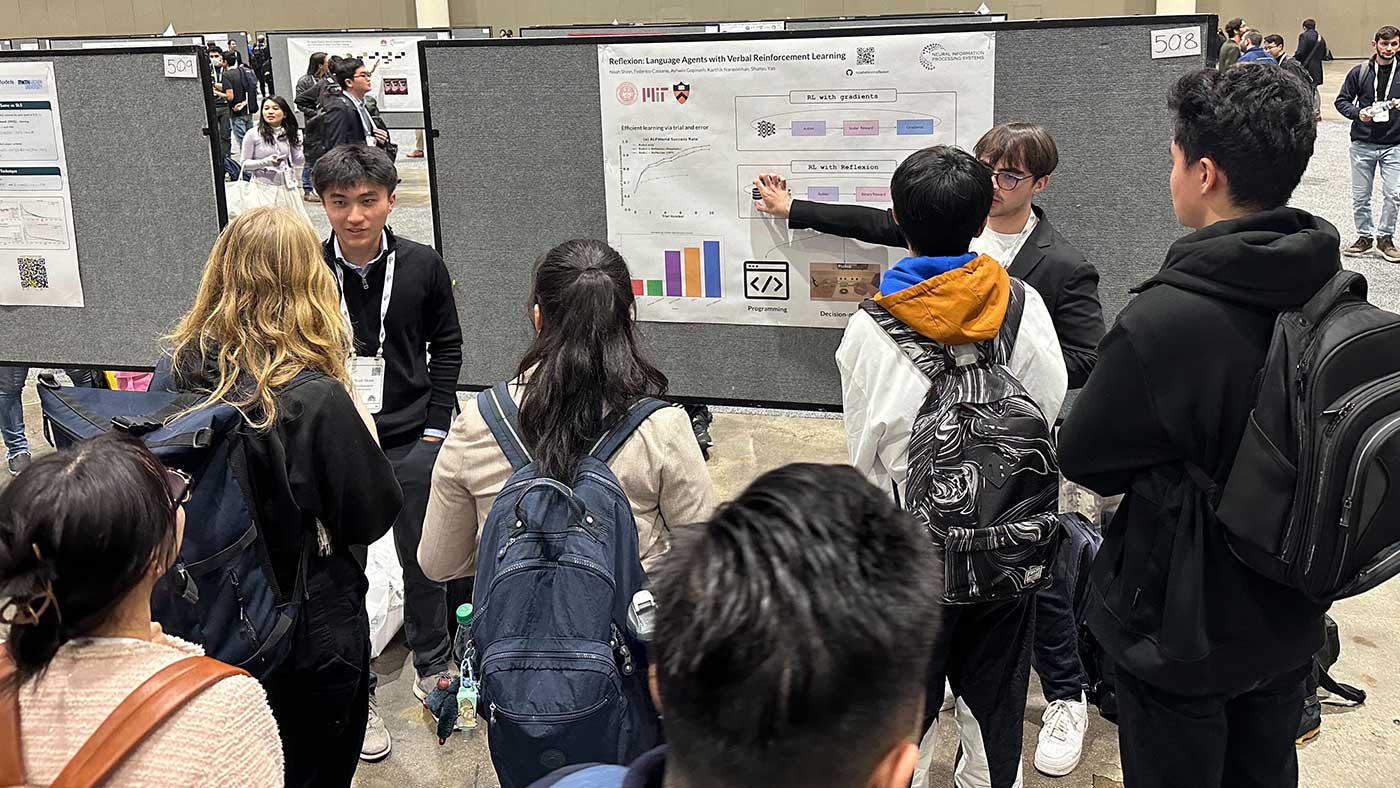
In the main conference, Shinn and Cassano presented a poster about their large language model verification technique, which improves on the accuracy of the previous state-of-the-art technique by 11 percent. Sortur participated in a workshop on symmetry and geometry, one that aligned with his own paper in which he used neural networks to model satellite drag. Both students expressed gratitude for Khoury College’s assistance in helping them to attend the conference, which Cassano described as an exciting opportunity to share his art.
“Khoury College is happy to provide funding support to help defray conference attendance costs,” said Jessica Biron, senior director of undergraduate programs at Khoury College. “Undergraduate students presenting at such a prestigious conference is a huge personal achievement, and we are very proud of our students!”
Training large language models to correct their own mistakes
As large language models (LLMs) develop, it’s becoming clear that there are things they are really good at — such as generating a block of text or code, or spotting and correcting errors in an existing block — and things they aren’t so good at, like generating a truthful and accurate block the first time around. But is it possible to use the tech’s strengths to address its shortcomings?
That’s the idea behind Reflexion, a framework developed by Khoury undergraduates Noah Shinn and Federico Cassano, with support from MIT professor Ashwin Gopinath, Princeton University professor Karthik Narasimhan, and Princeton doctoral student Shunyu Yao.
When an LLM spits out a solution, Reflexion automatically feeds that solution into an evaluator tool and reflects on its outputs to correct any mistakes. By simply asking the model to automatically verify its work one time, Shinn and Cassano achieved 91% accuracy on the HumanEval coding benchmark, an 11% increase over the previously state-of-the-art GPT-4 model. In addition to code generation, the process can be applied to reasoning and decision-making tasks too. The team’s paper has already been cited around 200 times, and their verification technique has been used by large AI labs like Google’s DeepMind.
”It turns out that using the model to generate a verification step is much more accurate than using the model to generate the data,” said Cassano, second author on the paper and a third-year combined cybersecurity and economics major.
Cassano enjoyed that the NeurIPS poster session let him face questions and pushback about Reflexion from experts in the field, which helped him to brainstorm ways to further develop the framework. Up next: making the process faster and cheaper by building the self-correcting step into the LLM architecture itself, instead of treating it as an add-on process.
Beyond the college’s financial support for the conference trip, Cassano credited his classes with inspiring him to pursue this line of research in the first place. Specifically, his “Artificial Intelligence” class with professor Steven Holtzen had a huge impact.
“Initially, I didn’t realize my interest in AI; I was always fascinated by symbolic reasoning,” Cassano said. “In the class, I discovered that AI could integrate with symbolic reasoning, blending two areas I am passionate about. That truly captivated my interest in AI.”
How to stop satellites from crashing into each other
There are more than 8,000 satellites orbiting earth, each one whipping around the planet at thousands of miles per hour. To avoid collisions, it’s important to know where they’re all going, and fourth-year computer science major Neel Sortur has found a way to use deep learning to help.
With support from Khoury doctoral student Linfeng Zhao, professor Robin Walters, and the Geometric Learning Lab, Sortur developed neural network models to predict the drag force that acts on symmetrical satellites orbiting the earth. While it’s possible to compute the satellites’ future trajectories and prevent disasters using more traditional methods, doing so is prohibitively expensive, and fairly uncertain when making long-term predictions. Sortur’s machine learning methods help put safety within reach.
Avoiding such collisions is vital because of a phenomenon called the Kessler Syndrome. If even a couple of satellites collide, the debris could cause a cascade that damages a huge number of satellites. If enough damage occurs, it could create a debris field around Earth that would make it difficult or impossible to launch new orbiters into space.
“GPS would stop working; radar for a lot of Earth imaging, for detecting climate change, would stop working,” Sortur said. “If you can accurately model the drag coefficient and track where satellites will be, you can stop this at the source.”
This was Sortur’s maiden first-author paper, and he made use of many Northeastern resources to take his project from ideation to presentation. Reflecting back, he suggests that other students interested in research make use of the Office of Undergraduate Research and Fellowships, and that they reach out to doctoral students already researching in their areas of interest. He also specifically thanked Walters, his supervisor and the paper’s third author.
“He’s super supportive; I think it’s great that he was willing to chat so much during the project,” Sortur said. “We met every week.”
Although Sortur was nervous going into the NeurIPS Workshop on Symmetry and Geometry in Neural Representations, he found the conference incredibly rewarding.
“Everyone is thinking at such a high level. There’s a certain bar that everyone is at, so you could have really, really intellectual conversations,” Sortur said. “The professors I looked up to and many influential researchers were willing to talk to everyone … I didn’t feel like an undergrad student for a bit. People just wanted to know about your research and your methods, and they didn’t care what your background was. It felt really good to be in that environment.”
The Khoury Network: Be in the know
Subscribe now to our monthly newsletter for the latest stories and achievements of our students and faculty
Author: Milton Posner
Date: 03.05.24
Ronald J. Williams, a professor emeritus of computer science at Khoury College and a pioneer in the field of neural networks, passed away last month. He was 79 years old.
Among Williams’ contributions to computing over his 22 years at Khoury College, it was his paper “Learning representations by back-propagating errors,” co-authored with David Rumelhart and Geoffrey Hinton, that rang the loudest and longest. In proposing a novel method for building and training neural networks, the trio laid the groundwork for the eventual development of neural-network-based platforms such as ChatGPT.
“For much of the history of computer science, neural-network-based machine learning was just an idea that could not be realized. Then in 1986, Rumelhart, Hinton, and Williams proposed the algorithm that made training a neural network truly possible,” Khoury professor Jay Aslam said in 2023. “Ron’s paper launched the field.”
At the time, the tech world lacked the data and computational resources to scale the paper’s findings and realize its vision. But over time, as the paper sparked interest in neural networks, other computer scientists followed in the trio’s footsteps, and the resources grew to match the ideas.
“Now, deep-learning-based neural networks are at the forefront of AI, and this one paper has 30,000 citations,” Aslam said. “It’s that influential.”
Williams continued to research neural networks and reinforcement learning, as well as partial order optimum likelihood, a machine learning method used to predict active amino acids in protein structures. His publishing output, while small by today’s standards, packed an influential punch.
“We overlapped at Northeastern for five years, and we shared the machine learning lab,” Aslam remembered. “When I joined, there were only a handful of people doing machine learning research, much of it done by him. He was pretty quiet, and for someone who wrote papers that were that influential, he was very humble and down to earth.”
Before joining Northeastern in 1986, Williams worked for a defense contractor, where he developed algorithms to aid the US military in finding Soviet submarines. Outside of work, Williams was an avid musician. During his undergraduate and doctoral studies in his native Southern California, he, his guitar, his keyboard, and his band could be found gracing numerous local bars at night. He found additional years-long passions in trivia, bridge, and skiing, and grew to love the sports teams of his adopted home of Boston.
He is survived by his wife Pam, his three children, and his five grandchildren.
The Khoury Network: Be in the know
Subscribe now to our monthly newsletter for the latest stories and achievements of our students and faculty
Author: Matty Wasserman
Date: 03.05.24
In a keynote address to hundreds of young female computer scientists, Khoury College Dean Beth Mynatt summarized her decades-long computer science journey with one word: courage.
The audience had gathered for WeCode, the world’s largest student-run women in tech conference. Organized annually by Harvard University students, the conference drew more than 1,000 students from 300 different colleges, hosted over 50 guest speakers, and featured 30 workshops at Harvard’s Science and Engineering Complex on February 17 and 18.
In addition to Mynatt’s hour-long keynote, Khoury professor Tina Eliassi-Rad hosted a workshop on machine learning, and Mynatt also took part in a panel which explored the intersection of technology and social good. Afterwards, both spent time chatting with students in small groups at Khoury College’s open meet-and-greet lunch.
In her address, Mynatt spoke of courage as her “North Star” — the term she’s come to embrace as she’s navigated the complex, ever-changing computer science field.
“It’s funny, because I never would have described myself as a courageous human being. Maybe a little bit opinionated, maybe energetic and passionate,” Mynatt said. “But somehow, those characteristics have distilled in me that courage — and it’s a very directed form of courage — of what we can accomplish as the future of computer science.”
Mynatt spoke at length about her own journey in the field, one that showed her that technology is only as important as the people who build and use it.
“When I look back on my career, those 30-plus years, my world has always centered on the relationship between people and technology,” Mynatt said. “Because when you think about that relationship, technology doesn’t evolve on its own; it’s how people adopt technologies, how they reject them, put them onto new users. It’s like it’s a dance between the two.”
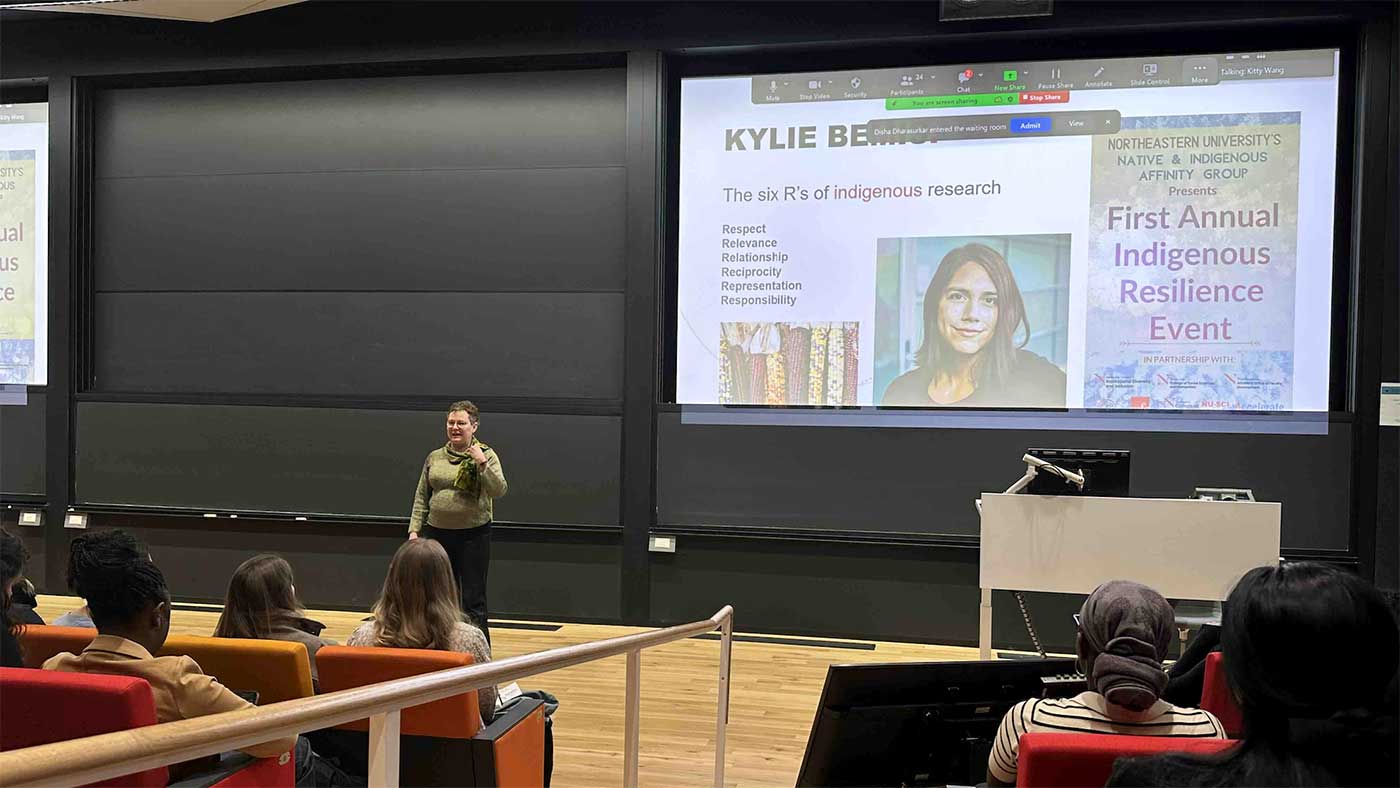
Mynatt also stressed that technology’s seismic impact — the same impact that makes the field so exciting — also means that those who practice it bear great responsibility. The next generation of computer scientists have endless opportunities to push barriers and shape the field’s future, but it takes courage to find those opportunities and to use that power to make a positive impact.
“When you’re creating new technologies, it’s not just the technical capabilities that you need to understand,” Mynatt said. “You need to understand the whole framing — the who and the why, who’s going to pay, who’s going to be impacted, who is going to be uplifted, and who is going to be hurt … technology amplifies the very best and, as we’ve discovered, the very worst of human behavior.”
Mynatt’s message of courage resonated with many of the attendees, including Niyati Khandelwal, a master’s student on Northeastern’s Seattle campus and an ambassador for Rewriting the Code (RTC), an organization which supports young women in the tech industry and which made Khoury College its first collegiate partner last year. To Khandelwal, courage means both the ability to use technology as a positive force and to have confidence in her own abilities — particularly as a woman in a field traditionally dominated by men.
READ: Northeastern’s Rewriting the Code ambassadors share their stories
“Especially as women, I think there’s an unconscious mindset where we are fearful or we are always second guessing our decisions,” Khandelwal said. “But like Dean Beth said, if you take courage as your North Star, I think that will help you move ahead and blaze a path without being intimidated by whatever else is around you. Courage is about knowing that it’s okay if something goes wrong or there’s a struggle, because you are trying and you are going to get there eventually.”
That sentiment was reinforced by RTC founder Sue Harnett, who introduced Mynatt at the conference. Harnett spoke of the value of WeCode being student-run and welcoming to aspiring computer scientists of all backgrounds, and she encouraged students to take full advantage of both the conference’s resources and the community of women it attracted.
“This is the way a conference for women in tech should be,” Harnett said. “You have the opportunity to hear from cutting-edge tech companies, from unbelievable people in their field on the academic side, and from young engineers from all different kinds of tech companies who are here to support you … you have an opportunity to interact with a lot of women who are just ahead of you, and you can feel more comfortable asking them questions about what it’s like to be a woman in tech.”
Later in the morning, Eliassi-Rad held a smaller workshop with roughly 50 students where she discussed the biases of machine learning systems, the complex processes that generate the systems’ training data, and the forces behind misleading information and false claims. In so doing, Eliassi-Rad touched on many of the same themes as Mynatt, chiefly the responsibility of those who design algorithms and complex systems.
“The one thing that I want you to take from this is that no matter where you come from, [machine learning] will affect you. So please get rid of this veil of ignorance of ‘us’ versus ‘them,’” Eliassi-Rad said. “You are part of this society you’ve built. And now your own algorithms will be used on you. Good luck, because you know all the problems right? So you need to work on how the problems will be solved.”
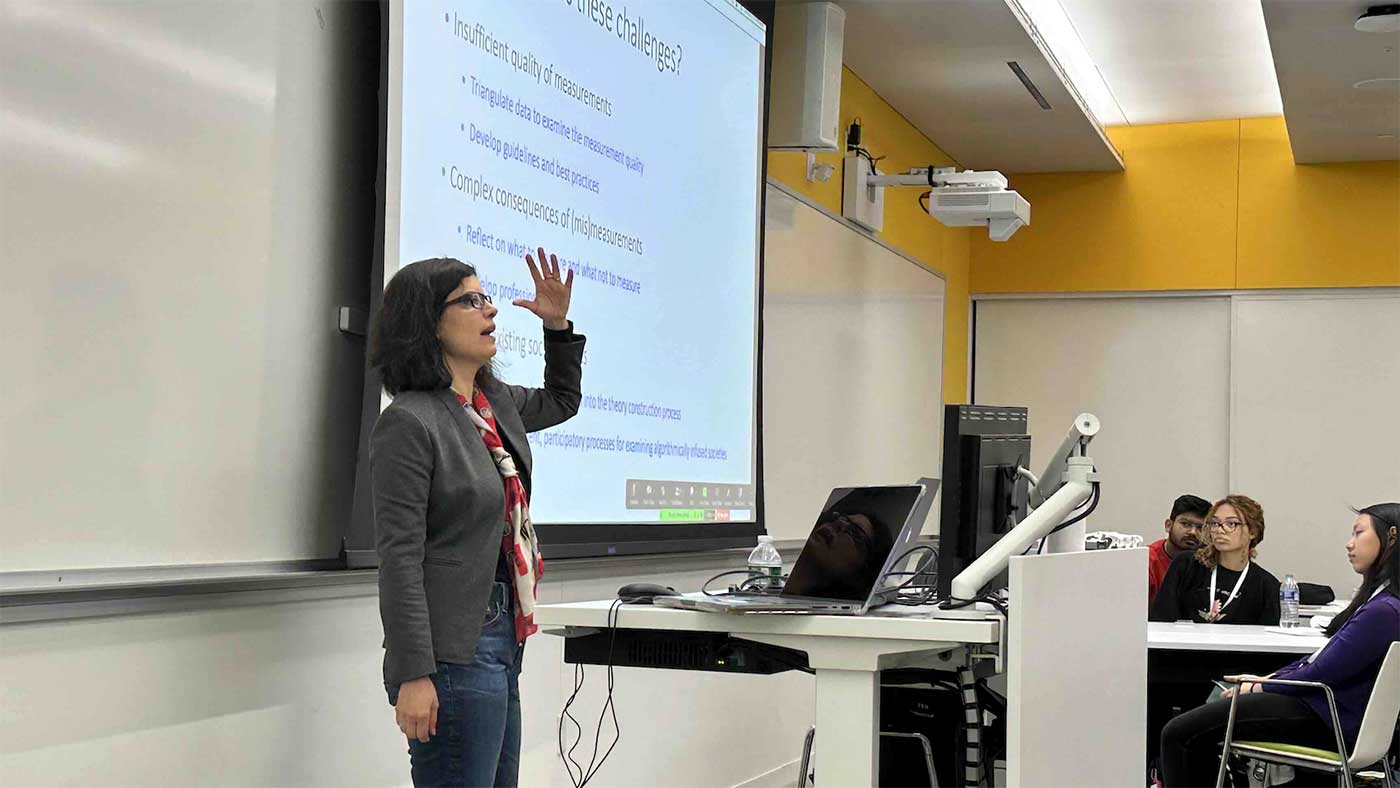
In addition, Eliassi-Rad dove into another potential problem caused by the commercialization of machine learning — ambitiously overstating how broad of a population an algorithm works on, often with an eye toward receiving investor funds or a quicker rollout. To ensure machine learning is integrated fairly and ethically for consumers, Elassi-Rad said, both the developers and marketers must ensure their sales pitch aligns with the technology’s capabilities.
“Unfortunately, everything in America now has become marketing and advertising. So when companies put out a new grammar assistant, they say, ‘It will work on anybody, anywhere,’ which is completely wrong,” Eliassi-Rad said. “At least be honest. Say, ‘Look, ‘my algorithm works on white males between 35 and 60 who live in the Northeast.’ But often, people do not say that because they want to make more money.”
While the workshops throughout the weekend were insightful for any aspiring computer scientist, to Khandelwal, the visual of hundreds of other female attendees with similar goals and experiences as her was most reassuring.
“In a classroom, or in my previous internships, I used to look around me and I’d see mostly men,” Khandelwal said. “But coming to a place like this, you feel much safer. You feel much more confident about yourself, you feel that you can open up and you can be vulnerable and you can talk about things… you know that the people around you are facing the same difficulties and challenges that you are facing.”
The Khoury Network: Be in the know
Subscribe now to our monthly newsletter for the latest stories and achievements of our students and faculty