Author: Jarriah Cockhren
Date: 03.25.24
On January 31, Kylie Bemis, assistant teaching professor at Khoury College, was awarded the 2023 Outstanding Teaching Award from the Boston chapter of American Statistical Association, the “world’s largest community of statisticians.” The award ceremony, held in West Village E, began with touching remarks from the president of the ASA’s Boston chapter, Wenting Cheng, followed by Khoury College Dean Beth Mynatt.
“Kylie has taught over 1,000 students. Her mentorship, care, and concern for the student body is so deeply valued by our community, her fellow faculty members, and the students,” Mynatt said. “As a Native American, transgender woman on our faculty, she has taught me about intersectionality, the experience of our faculty and our campus, and the importance of acknowledging the Native American experience within Northeastern.”
Bemis dedicated her presentation, titled “Outliers, Life in the Tails, and the Statistics We Don’t Plot,” to members of her family who recently passed away — specifically her father, Kerry Bemis, a fellow statistician and the catalyst for her own career in statistics. She went on to talk about her undergraduate experience at Purdue University and her choice to major in statistics.
“I was interested in physics as well as mathematics, but I really ended up liking statistics, because I could apply it to any of the sciences or any kind of field that I wanted to,” Bemis said. “And so that was the thing that really drew me into statistics specifically in the first place.”
Notwithstanding the identity struggles she faced as a student at Purdue University, Bemis weathered the challenges and found a welcoming community. She eventually graduated from Purdue’s master’s program, landed a job at a statistical consulting service, embarked on a statistics Ph.D. program, and became involved with the school’s Native American Educational and Cultural Center (NAECC).
“I was offered a Sloan Indigenous Graduate Partnership, which is something that the Sloan Foundation has in a few different universities, including Purdue … for Indigenous graduate students,” said Bemis, “And they became my family away from home.”
The partnership seeks to include more Indigenous people in STEM by providing resources and funding to native students pursuing masters and doctoral degrees. In Bemis’ case, her journey took her from conducting research in California to mentoring Indigenous high school students in rural Alaska. And as it did, Bemis came to the conclusion that to complete her doctorate, she needed to make one of the most important decisions of her life, and be fully herself.
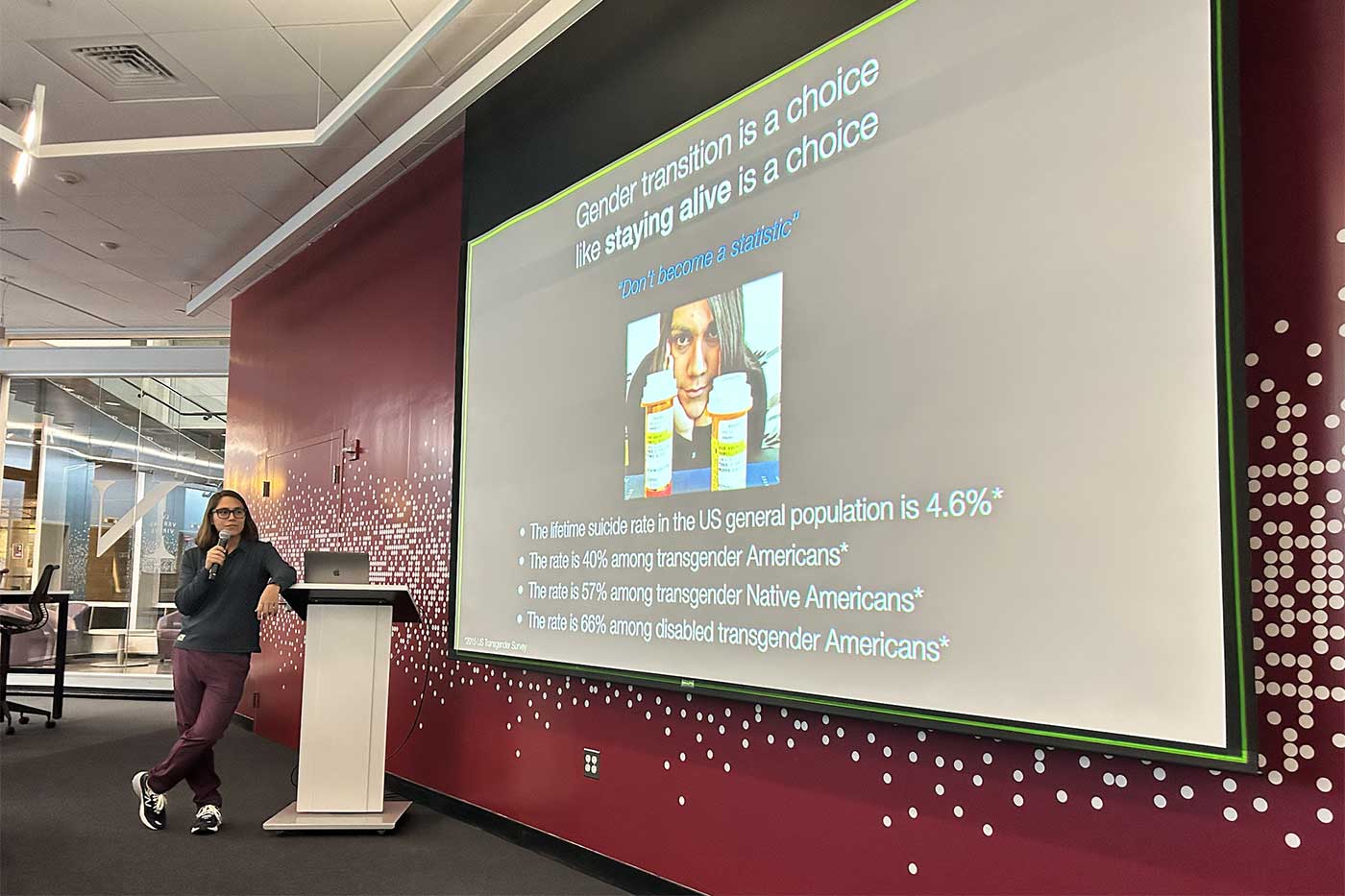
“Getting a PhD is still hard,” she said. “But unfortunately, gender is even harder. So in the last year of my PhD program, I finally figured out that I really needed to transition if I wanted to finish that PhD and continue into that world.”
Bemis’s current research focuses on machine learning and statistical computing for bioinformatics, along with the development of the Cardinal R packages. In her teaching, which primarily covers data management and processing, Bemis extends the lessons she has learned in her journey of self-discovery and statistics to her students. She also incorporates the six Rs of Indigenous research: responsibility, relevance, relationship, reciprocity, representation, and responsibility. The framework was developed by Indigenous scholars to encourage researchers to maintain meaningful intracommunal and intercommunal relationships; it not only improves teacher–student relationships, but also enhances connections with the community and the world.
Bemis concluded the talk with acknowledgements to her parents, members and staff of the NAECC, and her doctoral advisor, Olga Vitek, for their support and encouragement. In light of the barriers for Bemis and those like her, the ASA award — as well as every stone on the path she paved to it — are worthy of celebration.
The Khoury Network: Be in the know
Subscribe now to our monthly newsletter for the latest stories and achievements of our students and faculty
Author: Matty Wasserman
Date: 03.18.24
When Huaizu Jiang thinks of where he might apply his marriage of slow-motion AI with sports videography, his daughter’s golf training comes to mind. What if Jiang could film her swing from his phone, set the video in super-slow motion, and her golf coach could analyze every detail without the video ever becoming grainy or choppy, as super-slow videos usually do?
With his new research, Jiang is striving to make that future possible. The Khoury College assistant professor recently co-authored a paper with UC San Diego master’s student Jiaben Chen titled “SportsSloMo: A New Benchmark and Baselines for Human-centric Video Frame Interpolation.” Their work builds on the growing field of slow-motion AI models, which can recreate super-slow video content by “filling in the blanks” of choppy or low-resolution videos, all with full clarity and smoothness. To apply the technology to sports videos, the AI must accurately synthesize and reflect human motions common to physical activity — a uniquely difficult, but promising use case.
“In sports, the main content will be humans. And those fast-moving athletes in the videos pose significant challenges for existing slow-motion AI models,” Jiang said. “The athletes move a lot with their hands, their feet, and their entire body. And there’s heavy interference between different athletes in the same frame.”
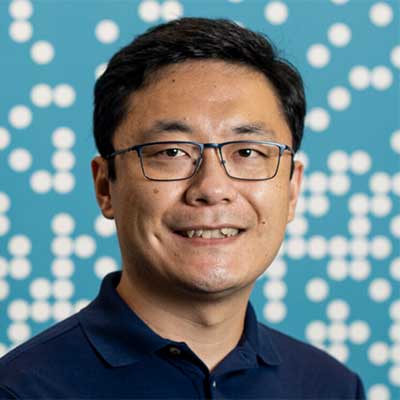
These slow-motion AI models have been in development for years, but Jiang’s desire to extend them into the sports sphere dates back to his time as a graduate research assistant at UMass Amherst, where he completed his doctorate in 2020. Shortly after arriving at Northeastern in 2021, he began to focus on the niche area.
“As a professor, you have more freedom to work on what you’re interested in,” Jiang explained. “And this is what I’ve been set on … Understanding human movements in this way is a new challenge for the research community, but it will unlock a lot of applications.”
The technology is still in its early stages, and requires honing before those applications can be made available and usable for everyday consumers. But Jiang sees endless applications — everything from TV broadcasts of live sports to high school recruiting tapes or even just transforming normal action videos.
“Let’s say your friend is doing a cool skateboard trick and you want to check all those stunning details that you can clearly see in slow-motion video,” Jiang said. “But typically, you would just record it in plain view. Later, AI models can help you to recreate those slow motion contents at a professional level.”
Jiang’s study highlighted two key insights to help AI capture the human body during athletic activity. The first is segmentation, where the technology picks out each person and object from the rest of the frame, then tracks their movements. This enables the AI to locate the precise boundaries of each athlete and prevent them from overlapping one another in the slow-motion recreation of the event. Secondly, Jiang incorporated AI technology that can “recover” movements of the human body, even without those movements being visible in the frame. For example, it can estimate the trajectories of human joints, or how a person’s hands or feet would move in a sequence.
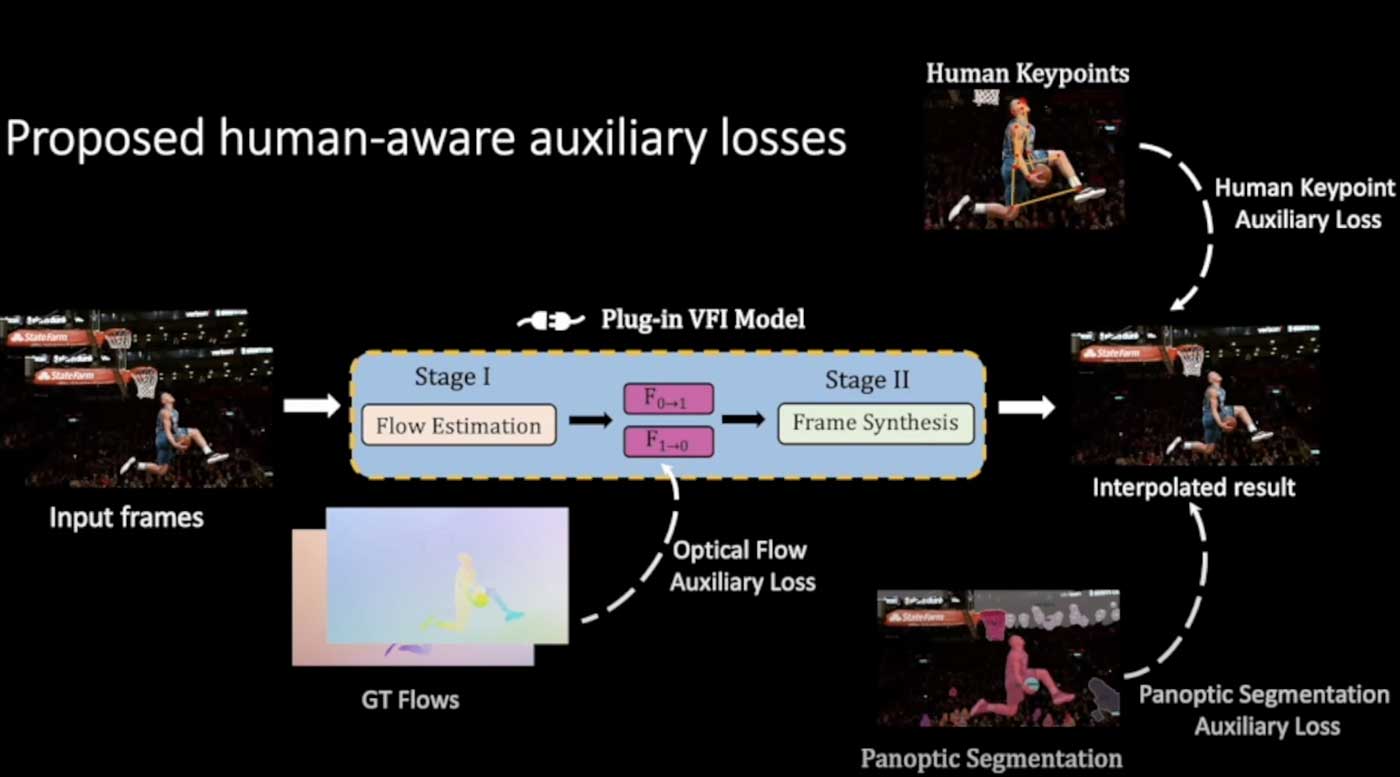
“The idea is that based on those trajectories and understanding each individual person and movement, you can insert human joints in between frames,” Jiang said, “so that the generated videos and slow-motion content will be more authentic.”
While small-scale videos are the simplest application, Jiang envisions a future where the technology is used in large-scale settings. For example, if a sporting event were filmed with just one or two cameras, the AI could create slow-motion replays from angles that the cameras never saw, simply by understanding the dynamics of human movement. Likewise, viewers of live sports could have instant access to multiple slow-motion replay angles, even those that the broadcast did not provide on the air.
Jiang’s new research is just the beginning of his exploration into the topic. His data set is open to other researchers, and he hopes they will also continue to innovate in the exciting new space alongside him.
“Even if you have just one camera or just a couple of cameras scattered around a large field, with this kind of data, we can develop another type of AI technology allowing you to freely watch the game from angles that are not even captured by real devices,” Jiang said. “It’s just synthesis. And that’s really exciting.”
The Khoury Network: Be in the know
Subscribe now to our monthly newsletter for the latest stories and achievements of our students and faculty