Author: Milton Posner
Date: 05.06.24
If speeches be the guide, Khoury College’s commencement celebrations were defined by, in order, a computer scientist’s responsibility to society, the confluence of superpowers and elevators, and the immense value of dreams.
The crowds hearing those messages on Thursday at Matthews Arena — roughly 500 undergraduate students in the morning and 400 graduate students in the evening — represented a majority of Khoury College’s largest graduating class to date. By month’s end, nearly 1,200 Khoury students will have walked the stage in Boston, Vancouver, Seattle, Silicon Valley, Oakland, and Portland, Maine, collectively boasting a degree and gender diversity that markedly outstrips national averages. And as Dean Elizabeth Mynatt noted in her address, the students hailed from dozens of countries and US states, and earned more than 50 different types of combined computing degrees.
READ: Congratulations to the Khoury College Class of 2024
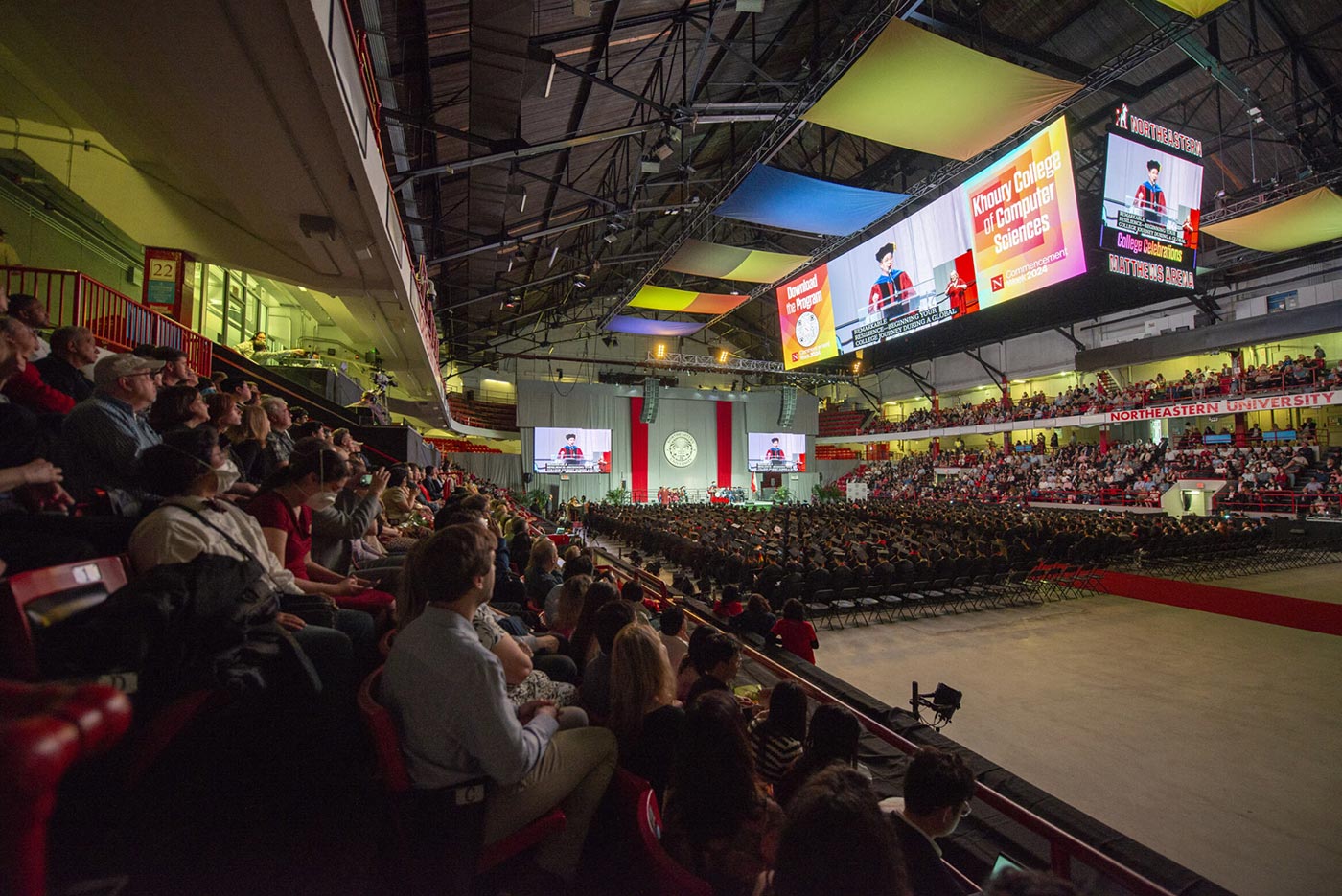
But the stats were merely a precursor to Mynatt’s main message.
“You are entering the field of computer science at an exciting time, as well as a time of great upheaval … a time when computer scientists grapple with difficult and consequential questions regarding the technologies under our charge,” she said, citing ethical issues around AI systems, privacy, and algorithmic bias. “I am confident that you are ready to help fulfill Khoury College’s mission in the world, to use the power of computing to improve all aspects of life for all communities, and ensuring equitable access to innovation that empowers and safeguards all people.”
As has become tradition, Mynatt led the graduates in reciting the computer scientist’s oath she has spearheaded — one she hopes will become standard at CS graduations globally, and which affirms a “special obligation to safety, security, privacy, and equitable opportunity.”
“Every day, no matter where you are in the stack, your profession strives to augment human action — through networking that connects us; through the acquisition, storage and analysis of data; through the design of systems that promote creativity, problem solving, and collaboration; and through the equitable care and treatment of all people,” Mynatt added. “You have a powerful role in bootstrapping human activity to address the most pressing problems facing our society.”
For undergraduate speaker Sara Takhim, who established herself at the fore of tech-based community life and service before and during her time at Khoury College, the observations were similar.
READ: From cybersecurity co-ops to women in tech, Sara Takhim makes her mark
“[In] the essay that opened the doors to Northeastern for me, I equated understanding computer science to a modern-day superpower. These feelings stemmed from curiosity and the belief that within the realms of technology, there is potential to change the world for the better,” she said. “Khoury College has been the hallmark of this transformation for us, providing the very experiences that will turn that potential into a reality.”
Takhim also cited her father’s words on the value of calm and focus amid adversity, which came to her several years ago when she was stuck alone in an elevator.
“His advice is what got me through two painful hours of a rescue operation, and it still resonates with me today as we face the uncertainties of adulthood,” she reflected. “Today, let us step forward with adaptability, perseverance, and confidence, armed with the very superpowers Khoury College has helped us to develop, alongside the wisdom of those who have inspired us.”
Master’s ceremony speaker LeAnn Mendoza also reflected on childhood lessons as she addressed the 400 graduates and invited guests.
READ: Impostor to Aligner: How LeAnn Mendoza found her way to Align
“If you asked me as a kid what I wanted to be when I grew up, I would’ve said a philanthropist AND an actress AND something to do with computers — with stars in my eyes and a child-like wonder, not really understanding the nuances that any of those roles carried,” she recalled. “But childlike wonder is an amazing thing. We had the audacity to believe in our dreams.”
The first two didn’t magically come together, but Mendoza fought for the third — enrolling in the inaugural Align program data science cohort in Silicon Valley, involving herself extensively in the campus community, and battling feelings of impostor syndrome along the way.
“Friction subsides when students give themselves permission to believe in their journey, and when they give themselves permission, anything is possible,” said Mendoza. “This is the culmination of our countless dreams, aspirations, and relentless efforts over the past few years … This is the moment you’ve dared to dream of, and now it’s your reality.”
The Khoury Network: Be in the know
Subscribe now to our monthly newsletter for the latest stories and achievements of our students and faculty
Author: Benjamin Hosking
Date: 04.30.24
With commencement season in full swing, Khoury News sat down with computing graduates from across Northeastern’s global network to hear about their journeys, their experiences, and their plans.
READ: Congratulations to the Khoury College Class of 2024
Nicholas Selvitelli, Boston

During the COVID-19 pandemic, student leader and computer science major Nicholas Selvitelli joined coding project club Oasis from his dorm room. In the years since, he has participated in its continued growth into an expansive community of like-minded students, providing them with many of the skills necessary to succeed on co-op through collaborative coding projects. He mentions Mark Fontenot, Khoury College assistant dean of student experience, as a mentor for him and collaborator with Oasis.
On Selvitelli’s eight-month co-op at software technology and digital forensics company Basis Technology in 2022, he worked on an engineering team that, he says, accepted him as “one of their own.” As he progressed through his tenure, they allowed him to take on key responsibilities on their projects, including building artificial intelligence software that reads documents and unstructured data in multiple languages. Meanwhile, a study abroad in Iceland gave Selvitelli the opportunity to discover another country, exploring the outdoors and environmental science while still making progress on his computer science education.
“Being near the end of my time at Northeastern, I wouldn’t change my experience for the world,” Selvitelli says. “It has been the perfect fit for me.”
He is planning a post-graduation backpacking trip to nineteen locations around Europe with some friends from Northeastern.
Jie Zhang, Silicon Valley

Before becoming the first in her family to immigrate to the United States, Align computer science graduate Jie Zhang worked as a high school teacher in China for many years. After moving to the Bay Area, she decided to shift her career path from education to technology, and became aware of Khoury College at an open house in Silicon Valley.
Attracted by Khoury College’s motto of “computer science for everyone,” Zhang excelled in the Align program, balancing family and learning while interning as a research assistant at Khoury College and working on three research papers. She also found peers who came from similar situations and professors who shared her life experiences.
“[The balancing act] can be very challenging for middle-aged women,” she says, “but I feel that America encourages women to explore more and not just focus on a traditional life.”
After graduating, Zhang will become an R&D engineer at a company in the Bay Area.
“Every effort was rewarded,” Zhang says of her journey. “I think CS is a good fit.”
Tianyi Zhang, Vancouver

Prior to Northeastern, Tianyi Zhang studied bioinformatics at the University of California San Diego. The material overlapped with computer science, so when he learned about Khoury College’s master’s program in Vancouver, he decided to give it a try. He loved the Vancouver campus, situated downtown but still close to nature and hiking spots.
Zhang mentions Aanchan Mohan as a particularly influential faculty mentor. Mohan was looking for a student who wanted to work on machine learning with his company, Happy Prime, which builds inclusive and accessible speech and natural language processing solutions. For more than a year, they and other collaborators worked to create an app which used machine learning to recognize the voices of people with speech disorders. Zhang helped develop the back end with a state-of-the-art automatic speech recognition model called WhisperX.
“I learned how to do research,” Zhang says. “[Mohan] taught me machine learning, he encouraged me, and mentored me on career and academic paths.”
Through Mohan, Zhang found an internship at Cerence, a company that builds a voice assistant for cars using natural language processing. His work focused on out-of-domain detection, which helps the car learn what it’s not capable of doing.
Zhang is now a doctoral student at the University of Victoria under Yvonne Coady, a visiting Khoury College professor. There, Zhang will work with faculty from both schools, and he looks forward to continuing his research while looking for employment opportunities and industry internships.
Niyati Khandelwal, Seattle

Master’s student Niyati Khandelwal deeply appreciates the industry experience of the faculty at Khoury College’s Seattle campus. With previous experience as a full stack software engineer, she knew that she wanted to learn AI and machine learning concepts to expand her professional options. Meanwhile, faculty mentors like Tamara Bonaci helped Khandelwal through other challenging courses like “Programming Design Paradigm,” which she cites as a rigorous Java-based class that helped her learn design principles.
“They teach you about industry standards, practices, and how to be an excellent engineer,” she says. “The way [Bonaci] taught was very effective.”
Khandelwal mentions her internships at Lumen Technology and Tesla as formative, as was her time at a Tesla Gigafactory, where she glimpsed the end-to-end process of automobile manufacturing. She also participated in a product development hackathon hosted at the Boston campus as part of a Khoury-sponsored, Seattle-based team that finished in the top ten.
In addition, Khandelwal became a Seattle campus ambassador for Rewriting the Code, an organization which helps women in computer science to network with each other and employers, and also provides students and early-career tech professionals with mentorship and networking opportunities. She was grateful to see people like her climbing the tech ladder and hopes to give back even after graduating.
Khandelwal is receiving Northeastern’s Lux. Veritas. Virtus. Award for 2024, which honors exceptional graduate students across the Northeastern network. Soon, she will begin working as a full-time software engineer for Tesla’s internal applications team in California.
Philip Mathieu, Portland

READ: Roux Institute Alfond Scholar uses data to make environmental policy impacts in Maine
Philip Mathieu came to the Roux Institute in Portland, Maine, to tackle the problems of today with the tools of tomorrow. With a childhood set nearby in New Hampshire and Maine, he was drawn by the Roux Institute as a place where he could build on his education while also putting down roots.
While on co-op with ocean engineering company Kelson Marine Co., Mathieu helped design offshore structures like seaweed farms and wind power projects. He also completed a capstone project with Portland-based MedRhythms, a medical therapeutic company that specializes in helping patients recover from neurological events such as strokes.
Outside of the classroom, Mathieu is the volunteer co-chair of conservation for Maine’s chapter of the Sierra Club. In that capacity, he served on a subgroup of the Maine Climate Council, where he helped draft new goals around equity in conservation and climate change policy using Maine census data. Following graduation, he will be joining Maine-based IDEXX’s Data and AI Center of Excellence where he will apply his data science skills to develop novel applications for machine learning in veterinary medicine and diagnostics.
“It’s very funny to try to imagine an alternative world where the Roux doesn’t exist and what I would have done,” he told Northeastern Global News in December. “Being able to make the choices that are right for my career and having Northeastern fit right into that was really cool.”
The Khoury Network: Be in the know
Subscribe now to our monthly newsletter for the latest stories and achievements of our students and faculty