Author: Jarriah Cockhren
Date: 07.26.24
To the everyday web surfer, the sheer power of the internet can be easily taken for granted. You search for your desired site, and just like that, you’re transported to your destination. Though it may feel like magic or teleportation, this smooth experience belies a more fascinating and intricate process of front-end development and inner mechanics.
When the web surfer enters a URL, the browser examines all the elements of the web page, as expressed through HTML, CSS, and JavaScript. It reads the webpage’s code to understand how it should look, then begins assembling and displaying the page’s text, images, videos, and other elements as requested.
Lazy loading streamlines this sequence. Instead of loading all the webpage’s information simultaneously, lazy loading prioritizes and selectively loads the essential elements visible to the user, resulting in a faster and cleaner loading experience.
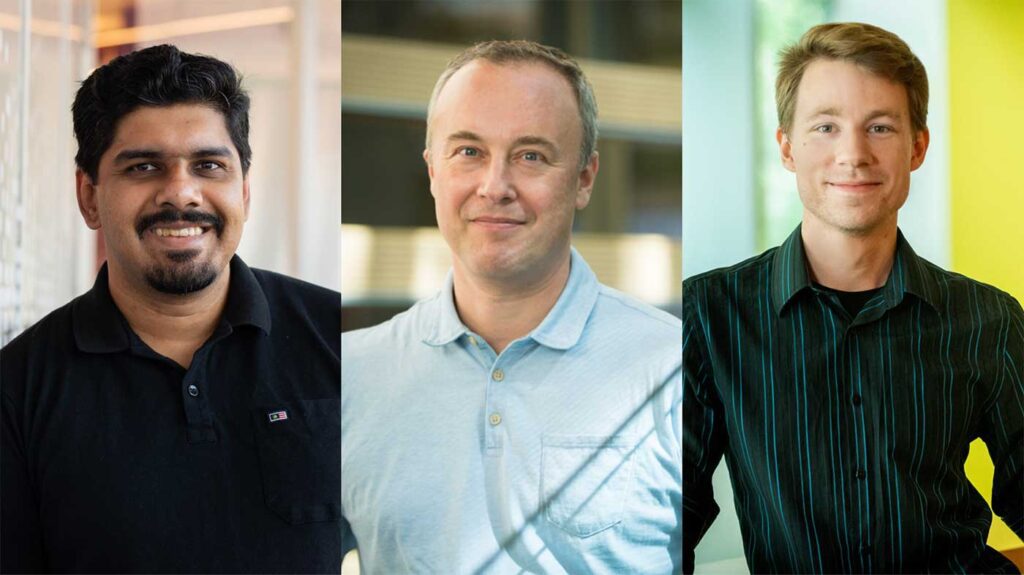
In a recent paper, Khoury professor Frank Tip, alongside recently graduated doctoral student Alexi Turcotte and current doctoral student Satyajit Gokhale, have designed a new tool called “Lazifier,” which aims to streamline and improve lazy loading and the user experience. By using static analysis to analyze webpage code without running it, Lazifier can automatically suggest changes in code to lazily load external packages in JavaScript applications, allowing front-end developers to easily integrate the suggestions and speed up webpage load times.
“We do a lot of static-analysis-based performance optimization for JavaScript in the lab,” Gokhale said. “And just prior to this we had papers published on two other tools: one called Stubbifier, which did the exact same thing of removing unused or dead code from server-side applications, and another called Desynchronizer, which introduced asynchrony into previously synchronous Node.js applications.”
With this combination of Desynchronizer and Stubbifier, the team could achieve asynchronous lazy loading in client-side applications, which run on the user’s device.
Now, with the goal of developing a “technique that would improve performance on the client side by reducing the initial load time of applications,” the team examined numerous client-side JavaScript applications to determine if the Lazifier technique would apply. As they did, they categorized the applications according to various criteria, including the presence of tests that could ensure the Lazifier-related code changes weren’t undermining the applications’ core functionality. An additional approach involved using call graphs to document the roles of an application’s functions and libraries, as well as how they interact with each other.
“If a certain set of predicates are satisfied during our analysis, we can determine that a certain function or method can potentially be loaded lazily,” Gokhale explains.
The final step was manually running the applications to validate the results. This left the team with 10 projects to test on for the next stage, in which they modified and rebuilt the code to implement lazy loading. Lazifier reduced the size of these applications by an average of 36%, sped up loading by 30%, and did it all without harming the functionality of the applications.
So, what does this mean for web surfers?
“Anytime you visit a website which has less code, it automatically loads faster, and you get a much more responsive page,” Gokhale said.
The tool could also prove useful to developers by recommending changes to the code; developers would simply need to accept those changes to enable faster loading.
Gokhale hopes to one day perform an evaluation larger than 10 projects to accommodate for extensive distribution.
“Before widespread adoption, there might be a couple of other steps that we need to take, but the technique definitely works,” he said. “Maybe with a little more effort it can be turned into a widely used tool.”
The Khoury Network: Be in the know
Subscribe now to our monthly newsletter for the latest stories and achievements of our students and faculty
Author: Attrayee Chakraborty
Date: 07.22.24

Recorded Future, a threat intelligence cloud platform, enables organizations to identify and mitigate threats across cyber, supply-chain, physical, and fraud domains. The company uses machine learning and natural language processing to collect, process, and analyze threat data from open, deep, and dark web sources, and offers a cloud-based threat intelligence platform that provides real-time visibility into cyber threats, adversaries, and infrastructure. The company also integrates its intelligence with security products from companies like Cisco, Splunk, and Palo Alto Networks.
Khoury student Maya Prasad and alumnus Felix Yang have both completed co-ops with Recorded Future, and they shared their experiences with Khoury News.
Maya Prasad
Prasad, a rising third-year data science and math major, has had a passion for coding since high school, and especially enjoys deductions based on provided information. Data science aligned well with these passions, as did her data engineering position with Recorded Future’s Structured Data and Signals team.
“Recorded Future is incredibly focused on building threat intelligence to share with customers,” Prasad says. “Data science is a really key part of building that, because in large part, we’re the backbone.”
Prasad’s team receives data from many different clients using many different platforms, whether through Recorded Future’s APIs or structured data provided by vendors. The team packages the data to give clients a more open view of the threats they face.
“Problems can vary from tickets for addressing software bugs to full-on products to solution designs for a new product,” Prasad says. “One of the first problems that I worked on was using dynamic attributes to understand where malicious data was coming from on a scanner IP, which was difficult as we received around 20 million records in a day on our platform.”
Dynamic attributes are properties of an object that can be added, changed, or defined during a program’s runtime rather than being fixed when the program is written. For instance, you might add a “current speed” attribute to a car object only when the car starts moving.
Prasad notes the challenge of figuring out the source of malicious content, including whether it was the scanner IP or whether there was any malicious data attached to it. It was a great introduction to the realm of applied data science and different ways of storing data.
Prasad feels that her Northeastern courses, especially “Advanced Programming with Data,” helped her to improve the efficiency and runtime of algorithms.
“Now I have a way to apply that knowledge in a real-world setting,” Prasad says. “I was able to increase the code run, which allowed us to process more data and in turn give more information to the clients.”
Prasad even ended up working on a crypto mining tracker project during a company-wide hackathon.
“We created fake crypto miners and used machine learning to detect data compromise,” Prasad says. “We ended up being 95% accurate and won the hackathon. It was great to know my team better and how to code better in a fun setting!
“There’s so much potential for growth and understanding in cybersecurity,” Prasad adds. “I could definitely see myself doing a career in this!”
Felix Yang
Felix Yang, who graduated Northeastern in May with a math and data science degree, works as a business intelligence engineer at Chewy, an online retailer specializing in pet products and services. Yang did his co-op at Recorded Future as a data analyst for the Product Insights team.
READ: Furry, four-legged coworkers? A co-op experience at Chewy
“I loved the ease in interaction at Recorded Future,” Yang says. “I felt like I had a sense of agency to pick my projects and help out in ways I wanted to.”
Those projects included building applications and dashboards, plus providing reports to product managers. One such dashboard allowed salespeople to interact with clients and notify them of outstanding alerts and notifications.
“My primary question was ‘How we can automate alerts for a specific client instead of having to generate it over and over again?’” Yang says. “I built an interactive Slackbot service in response.”
Yang worked with API access to understand the data coming out of servers, then create a streamlined service that provided alerts to salespeople from client companies — alerts they could use without much technical knowledge.
Yang also feels that his classes at Northeastern, specifically “Foundations of Data Science” and “Advanced Programming with Data,” helped a great deal.
“I learned how to work with Python code and websites in class,” Yang says. “This gave me the foundational basis for working with JSON and CSV files that I needed to make the Slackbot.”
Yang’s biggest challenge was getting used to the business-to-business approach at Recorded Future, and thereby understanding business needs. But the more he worked, the more he gained the sort of interpersonal experience and savvy needed to retain customers.
“Talking with the managers in a professional setting, along with working with project managers and coworkers, has been really helpful,” Yang says. “Discussing work, especially being introverted, helped me highlight my successes.
“I got to wear many hats — engineering and business — in one role,” Yang adds. “Being a data scientist and also helping to set business goals has been extremely enriching.”
The Khoury Network: Be in the know
Subscribe now to our monthly newsletter for the latest stories and achievements of our students and faculty