Author: Madelaine Millar
Date: 05.07.26
Open source offers a compelling vision. In an era where more and more proprietary software is offered as a monthly service with ever-increasing fees, software with freely available source code — which users can copy, run, learn from, or build on as they see fit — is a fairly utopian pitch. So why don’t more people use open-source alternatives?
Because without a platform to host the app and an interface to interact with it, implementing open-source alternatives can range from annoying to impossible, says Khoury alumnus Ben Senescu. That’s why he’s building EveryApp, a platform to develop and self-host open-source applications and ensure open source is a genuinely viable alternative.
Right after Senescu started working on EveryApp in the fall of 2025, he encountered an ideal use case. He wanted EveryApp to be shown by Google to potential users, so he needed a tool to help him understand what people were searching for and boost his website’s search engine optimization (SEO).
“Every tool was $120, $150 a month,” he said. “If you’re someone like me who’s just starting out, you aren’t going to get $150 of value a month out of those tools.”
Instead, Senescu wanted to use a free open-source alternative. He found a provider that had the SEO data he needed, charged a usage-based fee to access the data, and even offered an open-source API. But he still needed a way to host and interface with the data before he could use it to search-optimize his website.
So Senescu turned to the platform he was building to solve his problem. Through EveryApp, he used coding agents to quickly draft his user interface then self-hosted it on Cloudflare. Within days, he’d built the initial version of OpenSEO to help him start to improve EveryApp’s ranking for search engines.

Senescu is currently a one-man team, so in theory, he could have hosted his UI on his own device. But the benefit of EveryApp becomes even clearer when many members of a team on different devices are trying to work with the same piece of open-source software. EveryApp handles hosting, deployment, authentication, user management, database setup — all the parts of multi-device deployment that are, in Senescu’s words, “scary for non-technical people, and annoying for technical people.”
“People in the SEO community seem very excited,” said Senescu. “I want to make it the best SEO tool so people can see what the ceiling is on open source.”
Businesspeople who want to avoid renting proprietary software-as-a-service apps are one of Senescu’s target audiences; the other is everyday consumers. EveryApp’s deployable examples — a workout tracker, to-do application, and cooking assistant — are designed to reach this second group.
“Lots of open-source apps already exist. The code is open source but they aren’t easy to actually host yourself. The assumption is that you’re going to pay the company to host it for you,” he said. “The vision is to have an app store where you can have open-source free versions of every software … It’ll be a magical website, where you click a button and you can use all these services for free.”
Senescu has long been interested in what he can build outside of the established tech ecosystem and is grateful for the support he received to explore that passion at Northeastern. He took part in the Husky Startup Challenge during his second year and worked with Northeastern’s venture accelerator, IDEA. The product that began at IDEA — a platform to connect musicians directly to their fans — eventually became his self-developed second co-op, in partnership with two other students.
READ: Undergrad Ben Senescu and co-founders launch new app for musical artists
“Northeastern has a great startup mentality and ecosystem,” said Senescu. “I really learned how to figure things out.”
After graduating with his degree in computer science in 2021, he spent a few years at Boston-based startups like Klaviyo and Patrol, getting a handle on how an idea goes from prototype to product. But he never lost his passion to see what he could build, and in November 2025, he turned his attention to EveryApp full-time.
As EveryApp continues to develop, Senescu’s dream is that the new platform will not just be a technology, but also a community. He hosts a Discord server for developers using EveryApp and notes that the project is still in an early enough stage that if community members ask technical questions there, the answers will come from Senescu himself. He is particularly hopeful that students will get involved.

“A lot of students — or at least, me — struggled with the question, ‘What should I build for a project?’ I think EveryApp is a really cool way to make something that’s different,” he said. “There are lots of workout tracking apps, but with EveryApp you can make something people can easily install and use. And it’s within this ecosystem. You can learn to use Cloudflare; you can learn new modern tooling. If you get stuck, you have access to the whole community for help.”
The Khoury Network: Be in the know
Subscribe now to our monthly newsletter for the latest stories and achievements of our students and faculty
Author: Jenny Tran
Date: 05.04.26
Khoury students looking to connect with alumni will no longer need to rely on sending cold emails or going through third parties to network, thanks to a new website developed to foster mentorship and connection.
During the summer of 2025, Kelly Hsu, a second-year, Vancouver-based computer science master’s student in the Align program, came up with the idea of creating a website to connect current students with alumni working in the students’ desired career field.
In the same year, Hsu collaborated with fellow second-year Align CS student Lucy Guo and a recent Align graduate, Jialu Bi, on a project for Project Forge Lab to start building the networking website outside of the classroom.
“The idea was inspired by another student project — a career pathways website that helped students choose courses based on their career interests,” said Neda Changizi, a clinical instructor and Project Forge Lab’s advisor. “That project sparked a broader question: Once students know where they want to go, how do they find the right people and opportunities to get there?”
Within the Northeastern community, some mentorship platforms require lengthy questionnaires and complicated email set-ups that prevent users from easily and actively customizing the tool to meet their needs. So, the trio built off the existing ideas, then made some improvements.
The result, which they call Khoury Alumni Community, was built to bring together Khoury scholars and professionals, “addressing the disconnect that often exists between alumni and current students — the absence of a structured, community-driven space to seek collaborators, share job referrals, or tap into the broader NU network,” Changizi said.
The website is currently offline for maintenance. But when live, its homepage, titled “Huskies,” will display name cards of Khoury students and alumni, along with their company, job title, technology field, mentorship status, and country, among other information. These categories will also be customizable in the search bar, allowing users to search more precisely.
Like other networking platforms, Khoury Alumni Community is compact — anyone visiting a profile can see not only basic information, but also a resume and activities.
Guo oversees the front-end development, the user interface, and the user experience elements of the website, including layout and interactivity. Bi designed the database of users’ information and built the functions that interact with the database; he is also in charge of developing a collection of users’ information, including names, years in college, industry, and employer. And for functions like matching similarities between users, the team relies on a back-end service called Firebase.
“Basically, it provides all of the functions that we need to interact with the database, which saves us so much time compared to building everything from scratch,” Bi explained.
Working with a dense network, Hsu then integrated OpenAI API into the website to facilitate matching of mentors and mentees.
“The most challenging decision was to design the algorithm to match the mentors and mentees,” Hsu said. “At first, we didn’t think of using a large language model, but we figured out that design from scratch is kind of difficult, so we started using the large language model to send information and instructions to get the outputs.”
The team will continue to run the website and is looking for more users to join, hoping it will become a widely used platform within Khoury College as well as the wider Northeastern community. Hsu, Guo, and Bi hope to add more features like a recruiting page and geographical map for users to visualize their network, as well as enhanced website security.
“The project has strong potential to grow into a go-to hub for the NU community. The AI-driven matching system could become increasingly powerful as the user base scales,” Changizi said. “With further development, it could expand beyond mentorship to support project collaboration, startup incubation, job referrals, and recruitment pipelines — making it a meaningful long-term asset for the university.”
The Khoury Network: Be in the know
Subscribe now to our monthly newsletter for the latest stories and achievements of our students and faculty
Author: Milton Posner
Date: 04.29.26
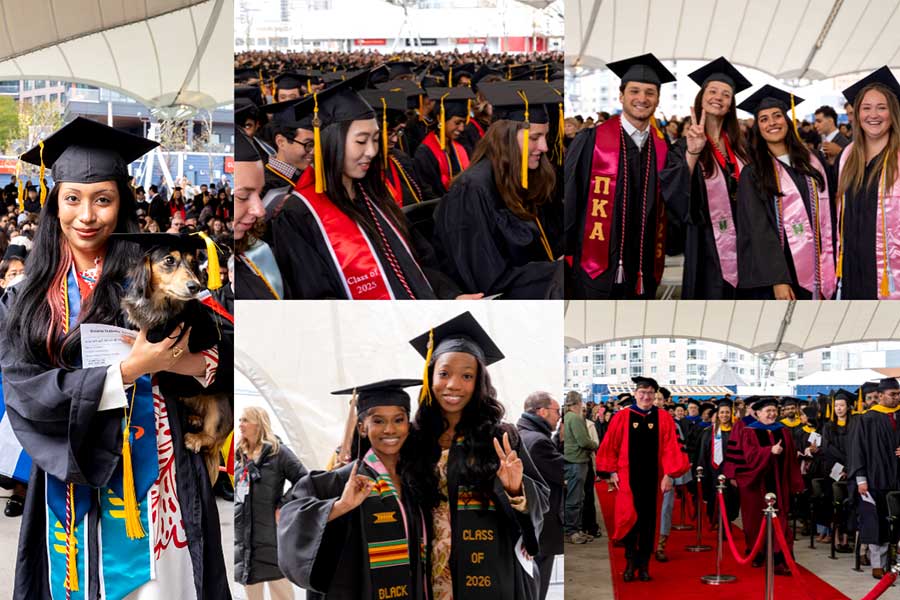
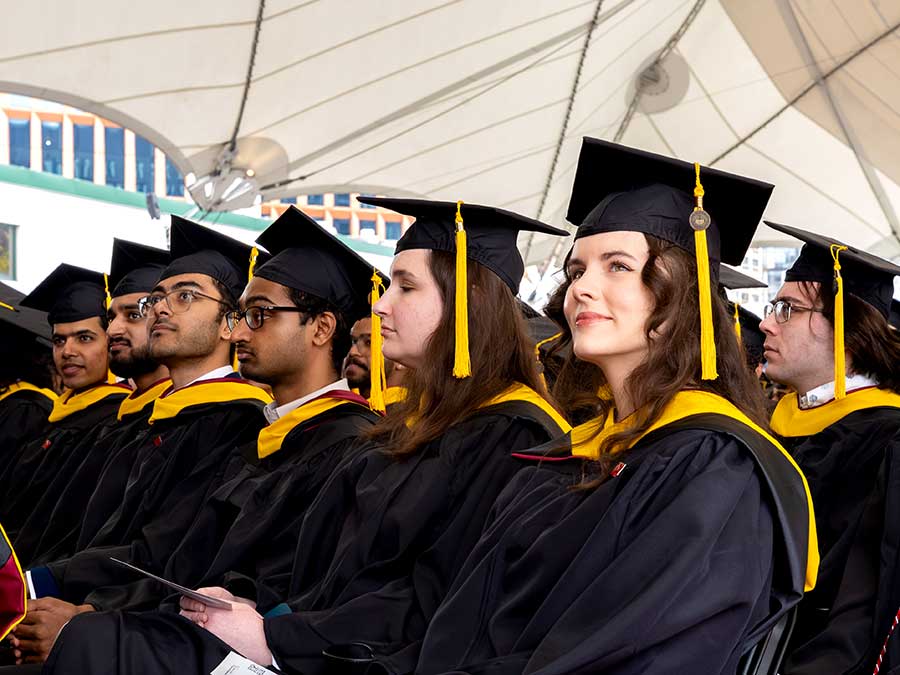
Khoury College’s Boston-based commencement celebrations were about embracing the new.
This was evident in the choice of setting. With Matthews Arena having been demolished weeks prior after more than a century of service to Boston’s sports ecosystem and cultural life, the graduates and their families gathered at Leader Bank Pavilion, a tented amphitheater overlooking Boston Harbor.
But it was also evident in the charge to the graduates, which exhorted them to remain versatile, vocal, and optimistic in their work as AI upends past ways of work and learning.
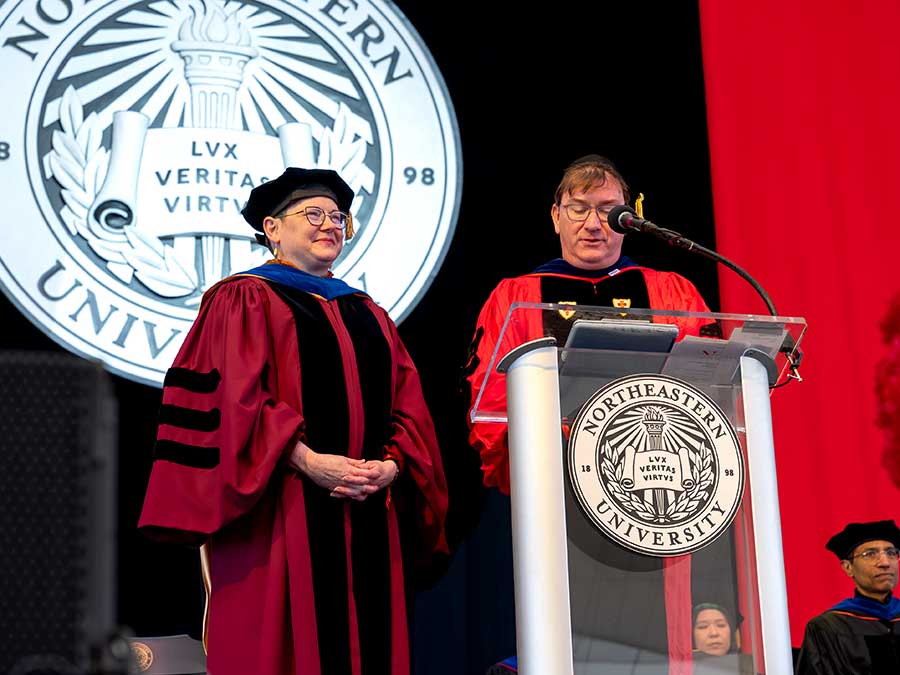
With a beaming Dean Elizabeth Mynatt looking on since she had lost her voice, Senior Associate Dean Ben Hescott served as her vocal stunt double, urging the students — 844 undergraduates in the morning and 680 graduate students in the afternoon — to turn the AI upheaval to their benefit.
“You are entering the field on the ground floor of this next wave of technology expansion,” Hescott said. “Workers and companies will respond by doing more, moving faster, and creating software and services that we can barely imagine. The world needs versatile, capable programmers who can harness AI in a growing number of industries.”
As young professionals, Hescott continued, the graduates will guide workplaces as they absorb AI tools into their workflows and will help set guardrails for when and how AI is used, as well as which data it collects.
“You will need to reach beyond your technical skills to higher levels of critical thinking … It will require the courage to stand up and find your voice, at a time when maintaining your voice and holding on to your purpose has never been more important,” he reminded them. “I ask you to remain resolute in the mission of Khoury College — that computer science is for everyone, and that everyone should benefit from computer science.”
It was a sentiment echoed by data science and economics student Misha Ankudovych, who delivered the undergraduate student address. His message centered around Khoury College’s Oath for Computing Professionals, which calls on new graduates to protect the well-being of all those affected by computing systems. Many of the graduating students, including Ankudovych, were in the audience when the oath was first introduced to incoming students in September 2022.
“Some of us were still figuring out how to log into Canvas … and now, we were also promising to protect the dignity of our society and of our future profession,” he remembered. “At first, the oath felt symbolic, memorable, maybe even a little strange. But as I’ve come to appreciate, Khoury College played the long game.”
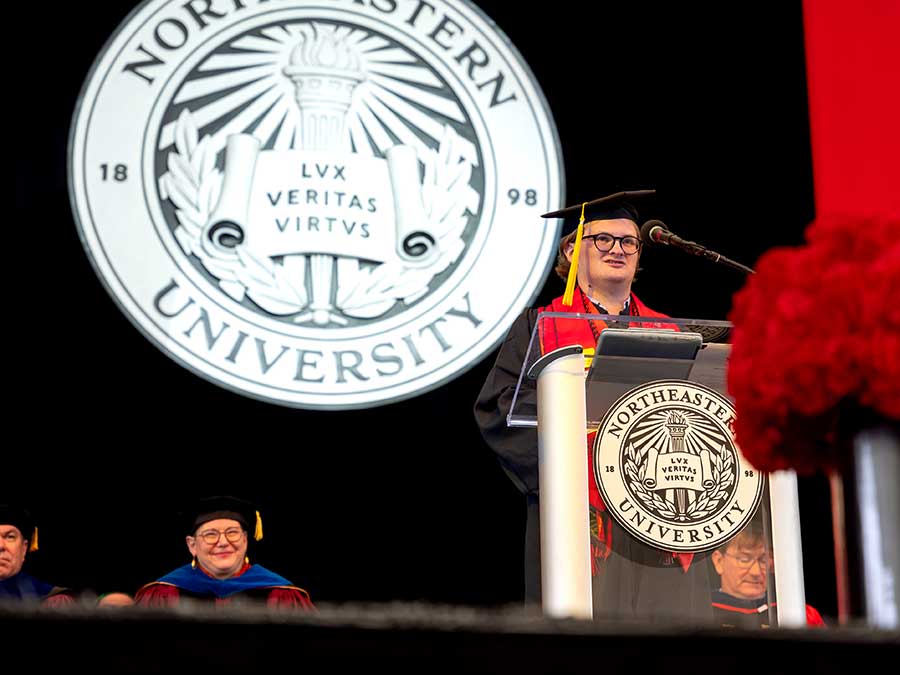
For Ankudovych, Northeastern’s core concept of “experiential learning” became about more than just doing consequential work. It also included double-checking intuition with documentation, understanding how assumptions shape outcomes, and reckoning with how his output affected real people.
“Somewhere along the way,” he noted, “the oath started to make sense and responsibility stopped feeling abstract … It wasn’t asking us to be perfect. It was asking us to be intentional, to remember that the systems we build may shape the world, and more importantly, that we are accountable for the choices we make.”
Master’s student speaker Daniela Alejandra González, who adds an MS in Data Science to a biopharmaceutical research career that already encompasses a doctorate and a Fulbright Scholarship, also took a wider view, albeit in a different fashion. With a nod to the higher purposes of science and the personal journeys of the graduates, she broke down Northeastern’s motto of lux, veritas, virtus (light, truth, courage).
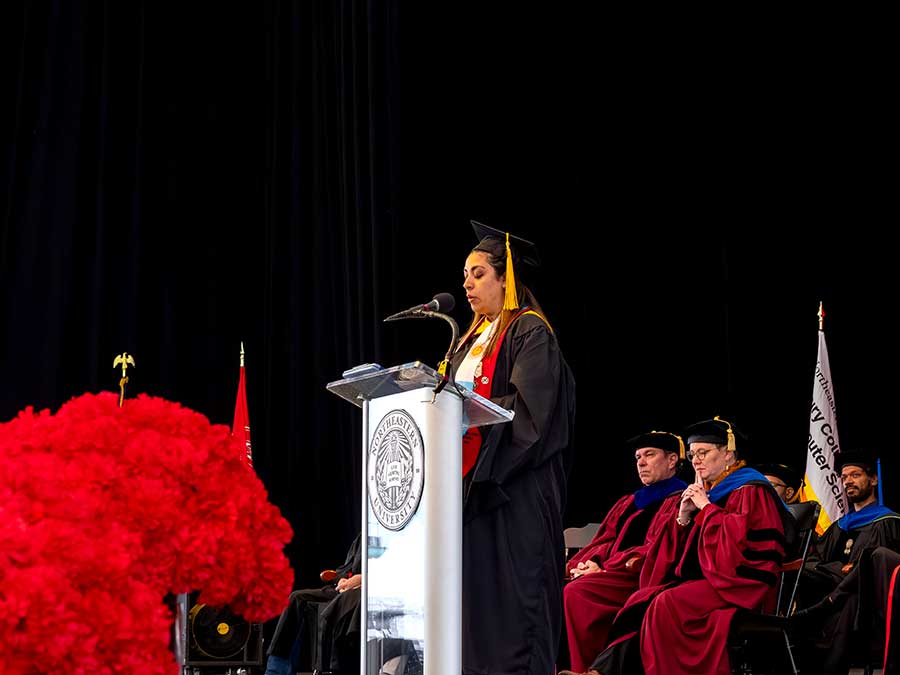
“Science taught me that truth does not come because you want it to. It comes because you refused to stop looking. That persistence is what I brought with me here,” González said. “And Khoury College gave me something powerful in return: the tools to look at old problems in entirely new ways.”
And as for light and courage?
“This class is full of people who found the light on their own — people who studied between jobs, who learned across time zones, who translated not just words but entire ways of thinking,” she said. “Every person here had a moment when it would have been easier to stop. And you didn’t. That is what brought us here today.”
González concluded her speech by balancing Northeastern’s motto with that of her alma mater, the National University of Tucumán in Argentina — pedes in terra, ad sidera visus (feet on the ground, eyes toward the stars).
“Keep your feet on the ground, in the data, in the evidence, in the rigor this education has given us. And never stop looking up,” she said. “Carry the light into rooms that need it. Hold on to the truth. And have the courage, always, to cross whatever border stands between where you are and where the world needs you to be.”
The Khoury Network: Be in the know
Subscribe now to our monthly newsletter for the latest stories and achievements of our students and faculty