Author: Emily Spatz
Date: 1.7.25
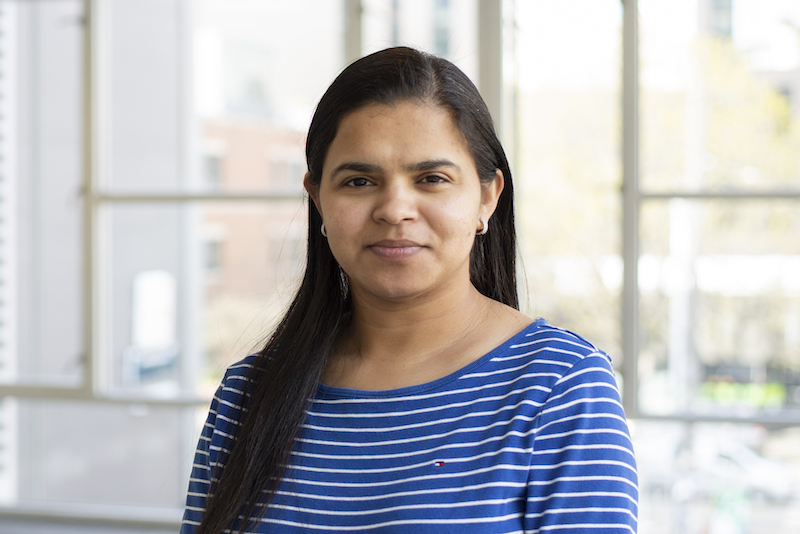
Divya Chaudhary, an assistant teaching professor at Khoury College in Seattle, has developed an advanced and more accurate method for detecting melanoma. This innovative approach enhances segmentation accuracy and classification efficiency, aiding medical practitioners in diagnosing and treating skin cancer while preserving surrounding healthy tissue.
Along with Peng Zhang, a master’s student in computer science at Northeastern’s Seattle campus, Chaudhary published her findings at BIOKDD 2024 — held in conjunction with SIGKDD 2024 — in Barcelona, Spain. Together, they leveraged existing deep learning models to create a hybrid technique for detecting and identifying melanoma, a form of skin cancer.
“The hybrid technique could allow medical practitioners to more accurately classify cancerous and noncancerous cells in the body,” Chaudhary said. The technique can help damage fewer cells and localize the target of radiation so healthy cells are not impacted. Its performance highlights the potential of deep learning models to enhance early detection, providing a promising pathway to improve patient outcomes and shrink mortality rates associated with skin cancer.
While Chaudhary spends most of her time teaching, she has always been motivated to pursue research. Her main goal is to inspire both herself and her students to enact positive change in society, so she has worked on transphobia, depression, suicidal tendencies before and after COVID-19, hidradenitis suppurativa, and Alzheimer’s disease.
“I have always been fascinated by artificial intelligence and its potential to benefit society,” she said. “My goal was to pursue innovative and impactful research that not only supports students but also contributes to society. This work inspires both my students and me, fostering a research-driven mindset on the Seattle campus and across Northeastern, encouraging students to consider research as a career path.”
In the melanoma study, Chaudhary and Zhang utilized two existing convolutional neural network architectures, U-Net and EfficientNet. U-Net was employed for image segmentation, dividing the image into pixel groups, while EfficientNet was used to classify whether the abnormal cells were cancerous.
“We used the power of both models to generate a hybrid model, and fine-tuned it,” Chaudhary said.
The hybrid technique boasts 99% accuracy with both models for melanoma detection. Individually, EfficientNet and U-Net have addressed various classification and segmentation problems like pneumonia, tuberculosis, and lung cancer, but together, they had never achieved such an accurate binary melanoma classification.
“If doctors know the cancer’s exact location, they can target that specific region and … minimize damage to the body,” Chaudhary said. “So, our goal was to have a more accurate diagnosis that will effectively help doctors and practitioners target which regions are cancerous.”
To expand the accessibility of the model, Chaudhary plans to build an application and submit it to Northeastern’s Center for Research Innovation, which supports researchers in securing intellectual property protection and building corporate relationships. She is also organizing a workshop on generative AI and large language models for health at the 2025 AAAI Conference on Artificial AI, to be held this coming February and March.
The Khoury Network: Be in the know
Subscribe now to our monthly newsletter for the latest stories and achievements of our students and faculty
Author: Meghan Hirsch
Date: 1.2.25
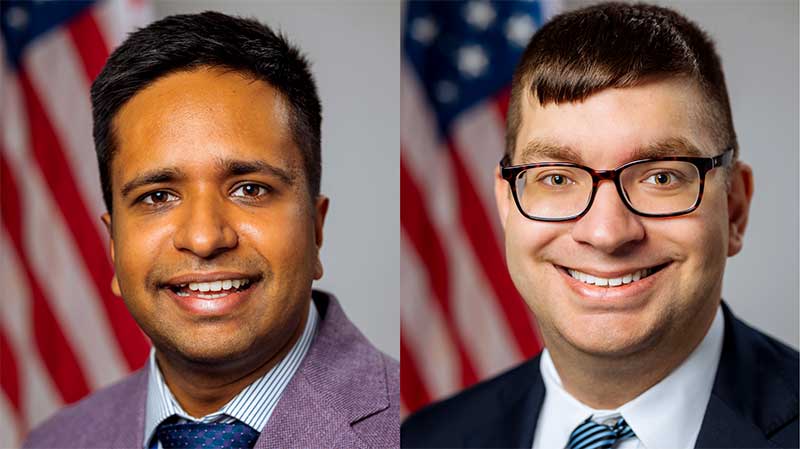
Not long after graduating, two Khoury alumni are leveraging their technical skills in a new government-run fellowship program.
The US Digital Corps (USDC) offers a two-year fellowship for early-career technologists to work in areas such as customer experience, public health, cybersecurity, and artificial intelligence. The program, a collaboration between independent federal agencies and White House offices, is highly competitive; in 2024, just 70 fellows were selected from a pool of more than 2,000 applicants, an acceptance rate of 3.5%.
Monideep Chakraborti, who graduated from Khoury College in 2022 with a master’s in computer science and a specialization in AI and data science, is working at the National Institutes of Health (NIH), focusing on product management. Griffin Milas, who graduated from Khoury College in 2023 with a bachelor’s in data science, works at the Cybersecurity and Infrastructure Security Agency (CISA) on the data science and analytics track.
While the classroom studies provided a foundation in machine learning and algorithms, Milas said, it was Northeastern’s co-op program that taught him “what it looks like to apply theoretical concepts to real-world applications.” His co-ops at Johnson & Johnson, Dassault Systèmes, and Liberty Mutual Insurance provided him with a range of experience, including the opportunity to work on data visualizations, analysis, webpage recommendations, and designing data structures, as well as frequent collaborations with stakeholders. Milas is now applying that experience to his fellowship, where he works on a customer experience team.
Chakraborti also attributed much of his existing skill set to his time at Khoury College, specifically the “team-based learning pedagogy, where you do the pre-readings and then have a great discussion with your teammates.” This interactive learning model helped him prepare for his time in the Corps, as well as for the application phase. Chakraborti had kept up with the USDC for a while before graduating, and given his additional background in biomedical sciences, it seemed like a natural progression to apply.
“It offered a unique platform to use my AI and biomedical skills to work on impactful projects that affect health and well-being across the country,” Chakraborti said. “My background in biomedical sciences and AI was going to be directed toward things that I really wanted to work on.”
Milas remembers feeling extremely excited, too, and impressed by the tailored application process. Chakraborti concurred, noting that interviewers were clearly interested in matching applicants with the projects they most wanted, using extensive interviewing, matching questionnaires, and surveys to do so.
Milas participates in the Corps remotely; Chakraborti relocated to Bethesda, Maryland, where the NIH is located.
Milas, who is part of a customer experience team, said he primarily works with cybersecurity and security-oriented experts and groups. This work mainly includes “trying to understand the needs of stakeholders and making sure that people doing these projects are listening to their customer base,” which involves visualizing data received from different subsets of customers, as well as gathering data into a centralized location.
This means that understanding “boots on the ground (people) is the most important function of our team,” Milas continued, adding that listening to feedback and finding ways to make sure stakeholders understand their customers’ security needs has been one of the most rewarding aspects of the job.
Chakraborti is also working with large amounts of data. His main project focuses on improving search techniques within National Center for Biotechnology Information databases to create “scalable, user-friendly systems that cater to diverse users.” Because the project will likely take three to five years, Chakraborti has spent much of his time so far learning what work has already been done and how the database has been used. In doing so, he said, he applies his skill set from his “background in biomedical sciences to understand the needs and challenges of a community.” His experience working on speech recognition software for his Khoury capstone project also honed his product management skills, which have helped significantly in his NIH role.
Chakraborti and Milas are scheduled to complete their fellowships in 2026, at which point they both hope to stay on in their respective departments as full-time employees. They also hope to take advantage of the “huge network of past, present, and future Digital Corps members,” Milas said.
The Corps represents a broader shift within the US government toward a more digital future, and for these two Khoury alumni, it represents a unique opportunity to apply technical expertise and varying academic backgrounds to careers in the public sector.
“[When I applied for private-sector jobs], I was missing the impact that I wanted to have on my community, and on other people.” Milas said. “But in the Corps, I’m helping my community, I’m helping my country, and that’s really important to me.”
The Khoury Network: Be in the know
Subscribe now to our monthly newsletter for the latest stories and achievements of our students and faculty