Author: Paul Murphy
Date: 03.27.25
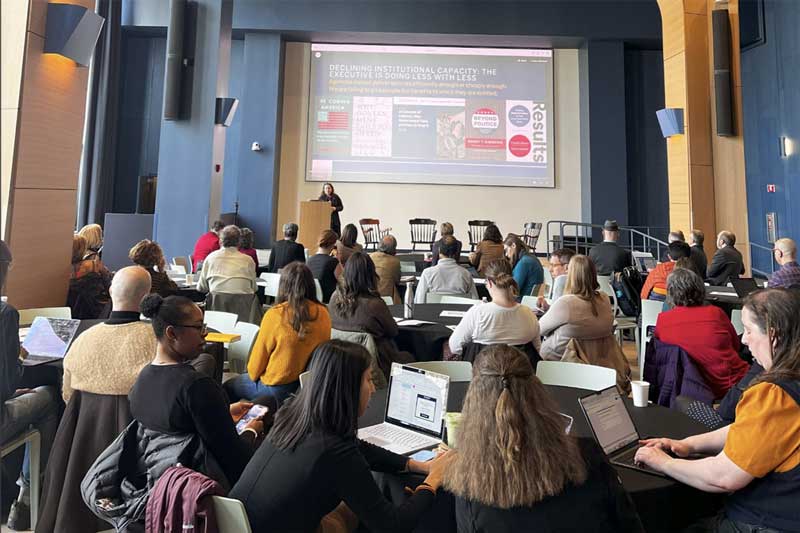
On March 18, senior leaders and researchers from Khoury College, along with leaders from across Northeastern and outside organizations, gathered to explore ways to advance the college’s research and fulfill its mission of using computer science for the betterment of all. The policy roundtable, conceived last fall to more effectively amplify and extend Khoury research toward translational policy impact, was held on the Boston campus and broadcast across the Northeastern network.
“This event is about laying the groundwork for a long-term discussion and strategy to increase the impact of our work through broader collaborations and by building improved awareness of policy,” explained Khoury Dean Elizabeth Mynatt. “We hope this will be the first of many such events.”
The role of AI
The afternoon event contained three panel discussions and two plenary talks, with questions from in-person and virtual attendees sprinkled throughout. The opening plenary from Beth Simone Noveck, director of the Burnes Center for Social Change, discussed the changing political landscape and the evolution of AI.
“There is a tremendous amount we can do to ensure that technology is being used responsibly,” Noveck said, acknowledging that the US is not alone in wrestling with these complicated issues. “We can do more with AI to fix the problems of democracy than ever before.”
Noveck emphasized that AI can be used to study and enhance governance, deepen democracy, and improve daily lives; in particular, she noted its potential to support political candidates of all income levels, generate responsive ads, and identify misinformation more quickly.
Advancing policy in DC
Four Khoury faculty members — Alan Mislove, Laura Edelson, Malihe Alikhani, and Rajmohan Rajaraman — shared their experiences working and advising in Washington, DC. The group stressed that lawmakers are eager to engage with computer scientists to better understand how technology can be used to solve constituency problems.
Edelson noted that a life as a scientist requires commitment, so it’s important to pursue directions that align with your personal goals.
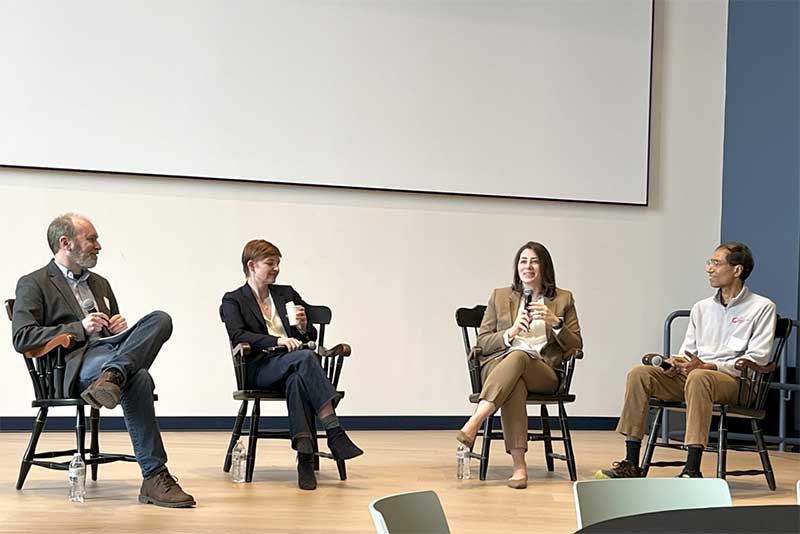
“We all have relevant expertise, and we all have to protect the institution that is science,” she said. “And we are called to do that.”
Alikhani pointed out that while the political environment is greatly contested, a lot of research, specifically AI, is nonpartisan. The group also cited policy underpinnings as foundational to research success, with Rajamaran stressing that policy-driven research involves foundational computing knowledge and an understanding of how research impacts people. Mislove recognized that while federal funding priorities are currently uncertain, researchers can look to state, local, and foundation funding to support policy-oriented research activities.
The importance of storytelling
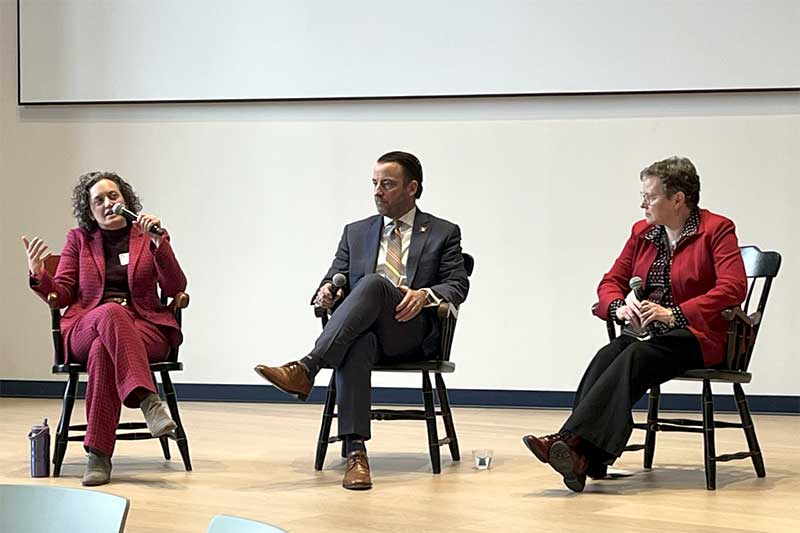
Throughout the afternoon, participants pointed to the importance of sharing the stories behind the research, including who benefits, how they benefit, and what more is possible. Jack Cline, vice president for federal relations at Northeastern, shared that sometimes he has only five minutes to explain his case to an aide, who then has to relay it quickly to a legislator. A powerful story can go a long way in conveying the substance of complex scientific impacts.
Along these lines, Miriam Quintal, a lobbyist and managing principal at Lewis-Burke Associates, asked the scientists in attendance to share the stories of their research impacts. She noted that sharing research impacts make the work more personal and more local.
Christo Wilson, Khoury professor and associate dean of undergraduate programs, has created several videos online as a way to communicate his work and quickly synthesize information.
“We have the expertise to help, and we need to be able to boil information down to the basics,” he said.
Building and maintaining relationships
David Choffnes, associate professor at Khoury College, explained that it can be challenging to establish a foothold in the policy space. But, he said, these relationships are foundational to the long-term impact of research. Predrag Radivojac, associate dean for research, agreed, and emphasized that not all efforts that influence policy are government related. For instance, his computational biology work has influenced guidelines for the use of algorithms in diagnosing genetic diseases.
Northeastern’s interdisciplinary approach is also key to building relationships, sharing ideas, and enhancing communication, said Sina Fazelpour, assistant professor at Khoury College and the College of Social Sciences and Humanities.
Changing political landscape
Quintal provided a briefing on the current state of science funding and programs. She acknowledged that this is a challenging time for academia, with many unknowns and ongoing legal challenges. But she also highlighted several research priorities on the horizon, including national security, AI, quantum computing, advanced computing, advanced communications, and biotechnology.
“Government needs science,” she said, emphasizing the need to be strategic and to “focus on the outcome, not the how.”
Takeaways and next steps
Throughout the afternoon, several next steps were discussed, including inviting policy makers and PhD students to future events, asking policymakers to share their big concerns, and tapping business leaders for their expertise.
“Any policy requires public engagement,” stressed keynote speaker Maria Ivanova, director of the School of Public Policy and Urban Affairs “What footprint or what handprint will we each have?”
“Today’s discussion was amazing,” Mynatt added. “So many great ideas about policy engagement were shared, and I look forward to where we go from here.”
The Khoury Network: Be in the know
Subscribe now to our monthly newsletter for the latest stories and achievements of our students and faculty
Author: Juliana George
Date: 03.24.25
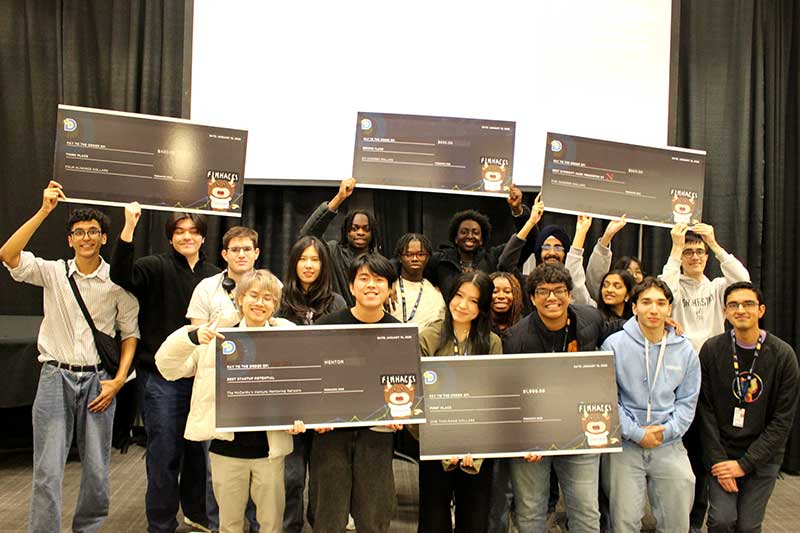
Rich Zou came up with the idea for a financial technology hackathon over spring break last year on Northeastern’s Miami campus, where he was participating in the Miami Fintech Entrepreneurship Trek. The first hackathon he hosted, PawHacks, was a little over a week away at the time, and he was already thinking about his next venture.
Zou, a second-year business administration major at Northeastern’s Oakland campus and the co-director of FinHacks, is passionate about hosting hackathons because of what he sees as a lack of opportunities for coding beginners. At FinHacks, which took place in January on the Boston campus, 71% of the 137 participants were first-time hackers.
I wanted to take on something I’d never done before … It felt a little unreal to win when I went in with a mindset of learning more so than winning
Bart Lojanarungsiri
“I saw a lot of my friends who were applying to CS clubs getting rejected over the summer because they didn’t have anything on their résumé,” Zou explained. “These clubs are supposed to help them build up their projects so they can prepare for co-op. But since they don’t have any projects ready, they can’t even get in. That’s what motivated me to do another hackathon.”
Zou and his five-person team spent more than six months reaching out to sponsors through Northeastern’s alumni network, vetting potential judges, and organizing event logistics. Zou was overjoyed at the turnout and excited to learn that 10 of the 33 submitted projects are being pursued as long-term ventures.
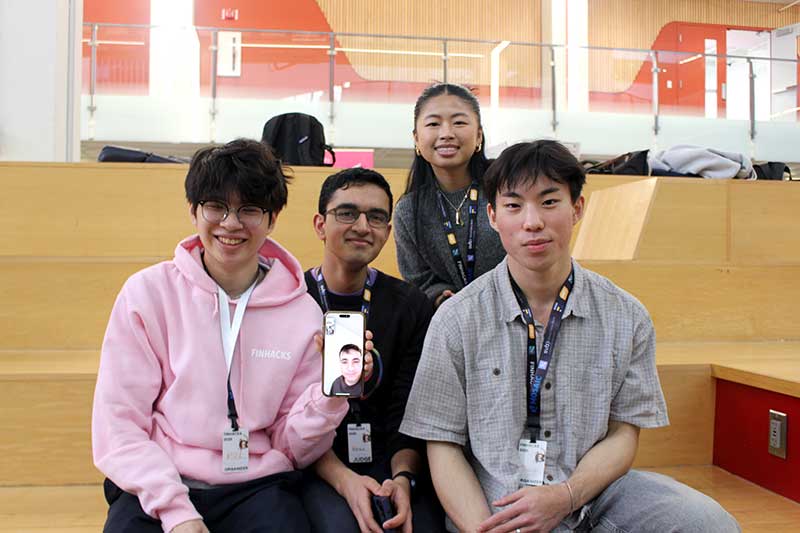
“I wanted to make sure that the projects that these students make in 24 hours can be taken outside the hackathon and continued as potential startups,” he said.
With the success of his first two hackathons, Zou hopes to host a hackathon across all Northeastern’s global campuses this fall.
The winners: Shared experiences, mentorship, and career growth
Shresht Bhowmick and Sophia Fu met through a mutual friend and bonded over their shared hatred of price gouging. From there, they developed the idea for ProsperouSSS, a digital twin software designed to help marketers, small businesses, and banks tailor product price points to specific demographics.
“The market data that exists about demographics is very in-depth, but … there isn’t a lot of focus on underserved markets, even though they have a lot of purchasing power,” said Bhowmick, a first-year computer science and linguistics major. “It makes sense for marketers, banks, etc. to target these kinds of markets, but they don’t do it because there isn’t enough data.”
To address this gap, Bhowmick and Fu, a second-year computer science major, created an easy-to-use interface that combined demographic data from the Bureau of Labor Statistics with machine learning. First, the ProsperouSSS interface prompts the user to type in demographic information about their target market, such as “35-year-old software engineer living in Seattle.” The program then generates information on the demographic’s consumption habits and uses machine learning to extrapolate additional information, allowing users to test prices against the income and spending preferences of the target.
The duo’s efforts won them the competition’s $1,000 top prize, and Bhowmick plans to develop the software into a marketable business this summer.
The second-place team took a more personal approach, drawing from their shared experiences growing up in West African families.
“There aren’t that many applications catered to people of the African diaspora, and a lot of things that go on with banking aren’t accessible for a lot of Muslim West Africans since interest is haram within Islam,” said Malik Diallo, a second-year computer science and business administration major.
Wanting to provide a culturally sensitive alternative, Diallo and his collaborators team — second-year computer science and math major Netochi Ibe, second-year computer science and business administration major Adesola Odubiyi, and second-year computer science and economics major Rachel des Bordes — built Susu, a communal saving platform named for the West African and Caribbean practice of informally pooling money within a small group of community members through a system of rotating contributions.
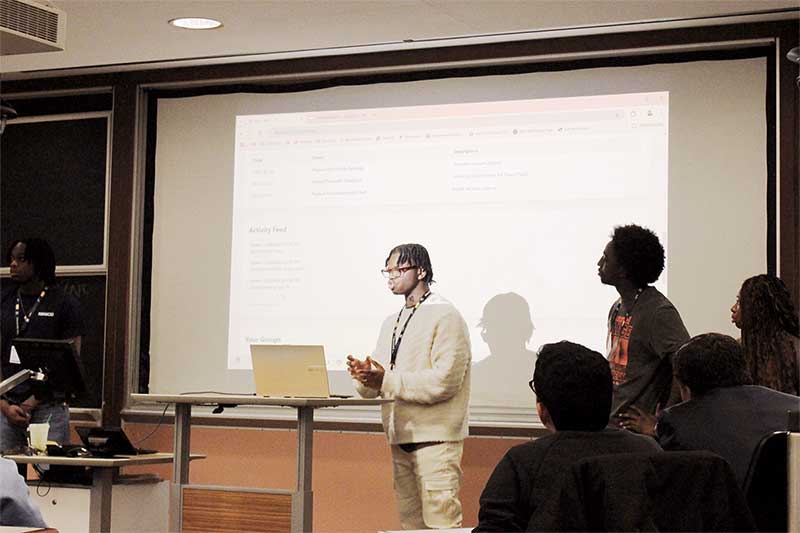
“I grew up with my parents having to drive around to meet the people who they did susu with, depositing money and doing manual accounting. And I just thought, there’s a better way to do
this,” Diallo said. “We found a great way to streamline this process and put it in one place where it’s accessible.”
On the Susu interface, users can add members into a group, send messages, and track recurring and past payments. The team didn’t expect to win against what they saw as more complicated projects, but simplicity worked in their favor, earning them a $600 cash prize and a project that they can continue to develop.
For second-year computer science major Christopher Yeo, his team’s third-place project Portal Card was inspired by his enthusiasm for public transportation.
“The past few years, I’ve gone to Asia a bunch,” Yeo said. “Whenever I go, I have to take public transportation because that’s the only way to get around. But when I come back to America, it’s more of a car-based society. Public transportation exists in America, so why isn’t it more widely used?”
And so, the idea for Portal Card, a transportation-specific credit card with a reward system, was born. The team’s biggest roadblock was learning how to add the card to Google Wallet, an application programming interface that no one on the team was familiar with. When he heard the team’s name called for third place, first-time hacker Yeo could hardly believe it, and while he was glad for the $400 cash prize, he and his teammates — second-year computer science major Joseph Siracusa, second-year computer science and chemical engineering major Lily Lane, and second-year business administration major Alex Mohammed — are even more grateful for the mentorship resources they gained after the hackathon.
“We were offered by Northeastern’s IDEA venture accelerator to move forward with the project, which is a big factor in us wanting to continue to work on it,” said Siracusa. “Having that support from the university helps us want to make this business a reality.”
The hackathon also offered a dedicated Best Startup Potential award, sponsored by Northeastern’s McCarthy Venture Mentoring Network. Recipients get the opportunity to complete an exclusive mentorship program.
After realizing that their initial idea didn’t suit the hackathon’s theme, scrapping 12 hours of work, and starting from scratch on an entirely new idea, second-year computer science majors William Pan and Bart Lojanarungsiri weren’t sure they would place at all, let alone win Best Startup Potential. But they boldly pivoted to a project motivated, naturally, by a love of free money.
“I really like to get free money when I spend by using credit cards, like getting free cash back or points that you can convert into money,” explained Pan, who previously coded the website for PawHacks but did not compete.
With High Card, users can maximize their rewards by matching their purchases to their credit card. After considering their user’s credit cards and desired purchase, the tool recommends which card will generate the highest rewards.
The pair’s unexpected time crunch meant that their project wasn’t as thought-out as they had hoped, but Pan said he was looking forward to taking advantage of the mentorship program and reworking the project into a marketable product.
Lojanarungsiri was happy with his team’s win, but said the hackathon was more of an opportunity to take on new coding challenges.
“I wanted to take on something I’d never done before. That’s why we decided on a tech stack that we’d never properly experimented with. And I took on a front-end role, even though I’m more of a back-end engineer,” he said. “It felt a little unreal to win when I went in with a mindset of learning more so than winning.”
The Khoury Network: Be in the know
Subscribe now to our monthly newsletter for the latest stories and achievements of our students and faculty