Author: Meghan Hirsch
Date: 04.07.25
Data is increasingly plentiful and accessible, not to mention vital to most scientific discoveries. But the traditional techniques and systems we use to manage it are often outdated or inadequate.
That’s where Prashant Pandey comes in. The Khoury assistant professor recently received the prestigious NSF CAREER Award for his work on data systems, which is helping to improve genomics, climate research, artificial intelligence, and many other fields where large amounts of data come into play.
“Are these old methods still efficient when we are dealing with humongous amounts of data?” Pandey asked. “We need to go back to the drawing board and understand the theoretical guarantees of these techniques and whether they scale at this level. If they don’t, we need to come up with new algorithmic paradigms so we can design better tools.”
One key element of Pandey’s work is ensuring that theoretical models translate into practical, scalable solutions. He explained that the goal “is to build scalable systems with strong theoretical guarantees by examining problems at the intersection of theory and practice.”
This guiding principle pervades the research associated with the NSF award. This research reimagines Bloom filters, a type of data structure that checks if an element is part of a set. These filters, Pandey explained, are “one of the most common data structures in all of computer science. They were introduced in 1970, so it’s been more than five and a half decades since they were built.”
Pandey’s research aims to make the filters more scalable, less error-prone, and better at correcting their mistakes. One key area focuses on transitioning away from traditional data analysis methods like BLAST. The tool, which stands for basic local alignment search tool, is widely used to search through genomic data.
“This is a technique that was introduced a couple of decades back and it’s very efficient,” Pandey explained. “But it can search only 1% or 2% of all the raw sequencing data that we have available, so we need to build new techniques to search the unassembled data directly and answer the big questions in biology.”
Another cornerstone of Pandey’s work is democratizing access to advanced data systems. Recently, he and his team wrote a proposal outlining a plan for a common data analysis infrastructure that would be available even to smaller labs with relatively little funding.
“There are lots of smaller labs that still want to answer those biological questions, but they cannot afford to invest money into building such heavy infrastructure,” Pandey noted. “We do not want science to suffer because of the infrastructure challenges. We want everyone to be able to answer deep biological questions and not be bottlenecked by the amount of money it takes to build this infrastructure.”
Pandey has also been researching energy efficiency in algorithms, leading to exciting advancements in how supercomputers operate.
“Given the demands of supercomputers, which are power hungry in terms of how much energy they consume to run computations, we are rethinking data structures and algorithms in terms of their energy efficiency and some of the inherent trade-offs,” Pandey said.
This means weighing the pros and cons of a task taking a few more seconds but requiring less energy, and vice versa.
The increased funding from the NSF Career Award is not the only boost for Pandey’s work. He stressed that his “students, mentors, advisors, and collaborators all make up this ecosystem around me that is enabling me to continue doing this work.”
And given the countless applications for the work, Pandey hopes that the upshot will be the advancement not just of one field or industry, but of many.
“There’s a ton of genomics data that has been produced in the last few years. The same thing applies to data generated by LLMs and new AI technologies. The same is true for other fields of science, like quantum physics or quantum chemistry,” Pandey explained. “Science should not suffer due to the lack of technical tools to handle the data. We want to enable science; that’s the high-level goal in my lab.”
The Khoury Network: Be in the know
Subscribe now to our monthly newsletter for the latest stories and achievements of our students and faculty
Author: Juliana George
Date: 03.31.25
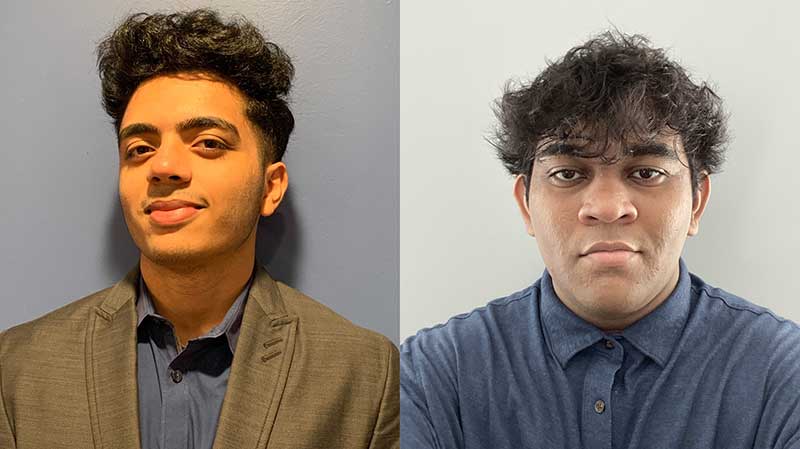
Last fall, five Khoury students got the unusual opportunity to co-op at Snowflake, a cloud-based data storage company on the cutting edge of AI and machine learning.
This co-op cycle marked the first time Snowflake had ever partnered with Northeastern, and the co-op listing didn’t appear on Northeastern’s job board, NUWorks, until early September, according to fourth-year computer science student Aayush Turakhia. Coming off a summer internship at Lowell-based software company UKG, Turakhia had all but given up on finding a four-month co-op and was enrolled in fall classes before Snowflake reached out for an interview. By the end of September, he had the job.
Fourth-year computer science student Vinit Patel felt similarly lucky to have found the co-op late into the application process. Both Turakhia and Patel noted that Snowflake stood out from their previous work experiences in the amount of independence and responsibility they were given.
Snowflake was a huge step for me. It’s probably one of the more valuable companies to get your hands on as a Northeastern student
Vinit Patel
“At some co-ops and internships, you don’t really get the chance to work on a project of your own, but we basically had full ownership over the product we were developing,” Turakhia said. “You don’t often see that at this stage in your career, so it was really exciting.”
All five co-ops were hired to the Solution Innovation team at Snowflake’s Boston office, a division of the company focused on using Snowflake’s cloud architecture to create AI and machine learning solutions for clients. Four of the five, which also included third-year computer science and math student Daniel Yu and third-year computer science student Nidhi Jadhav, were given one major solution each to work on, ranging in sectors from financial services to video game development. The fifth, data science student Emily Liu, served as a technical program manager, overseeing the projects of the other four.
Turakhia worked with data from Boston-based financial data and software company FactSet to build an AI-assisted analysis tool for the financial services industry. The dataset divided companies by sector, revenue, and a host of other factors, and Turakhia created an interface that made the data digestible and easy to navigate with support from AI.
“I created a set of dashboards that visualized all that data, a set of AI assistants that extracted insights from it, and a chatbot that you could use to help you extract additional insights and visualizations,” he explained.
This was the first time Turakhia had built a dashboard from scratch, and although he’s a firm believer in self-teaching and learning through experience, he recalled that his Khoury coursework in algorithmic thinking and programming methodology came in handy on the job.
Patel’s solution focused on the retail sector. To help manufacturers and retailers make smart decisions about product pricing and supply chain management, he constructed a competitive intelligence tool that compared product data across retailers. Unlike Turakhia, Patel used a mix of internal data from Snowflake Marketplace and synthetic data generated to protect customer privacy.
“In the retail space, it’s hard to match products across locations because product codes are not uniform across all these different retailers,” he said. “My solution focused on taking sales data and customer review data and creating aggregated data we could give to companies, like how a product performs across retailers or, for a retailer, how a product performs competitively in other markets.”
Although Patel had previously worked with data, he had never done so at this scale; he guessed that the dataset for this project was around 15 million rows. He felt pleasantly challenged at Snowflake and complimented the straightforward onboarding process and “friendly” work environment.
Yu produced “Player 360,” a machine learning solution that allowed gaming companies to build a data analytics platform that personalized player experiences and increased player retention. Jadhav developed an AI assistant for sales calls that aggregated and analyzed call transcript data for improved sales strategy.
All of these solutions live permanently on the Snowflake website in the Solutions Center, cementing the students in the history of a rapidly growing cloud company decisively investing in AI.
Turakhia is set to graduate in May, and he’s grateful for his experiences at Snowflake as he moves into the job market.
“It was such a cool experience and a fun, interesting space to be in. There’s a lot of novelty and a lot of exciting innovation taking place, so it would be awesome to stay in that space,” he said.
For Patel, who was approved for back-to-back co-ops and is currently working as a software engineering intern at Amazon Robotics, his graduation date is less certain — he’s thinking of taking on his third co-op in a row for the fall semester. But he is sure about one thing: His experience at Snowflake reaffirmed his passion for working in software.
“Snowflake was a huge step for me. It’s probably one of the more valuable companies to get your hands on as a Northeastern student,” he said.
Mary Trimarco, Khoury College’s director of strategic initiatives, set Northeastern’s partnership with Snowflake into motion through a contact at Snowflake and was thrilled by the outcome. Although the co-op is off the market for spring semester, she hopes the partnership will resume in the future.
“This co-op made for a really unique experience where students got to work with customer data and put together a project from a problem all the way to a solution,” she said. “They all did really impressively.”
The Khoury Network: Be in the know
Subscribe now to our monthly newsletter for the latest stories and achievements of our students and faculty
Author: Meghan Hirsch
Date: 03.26.25
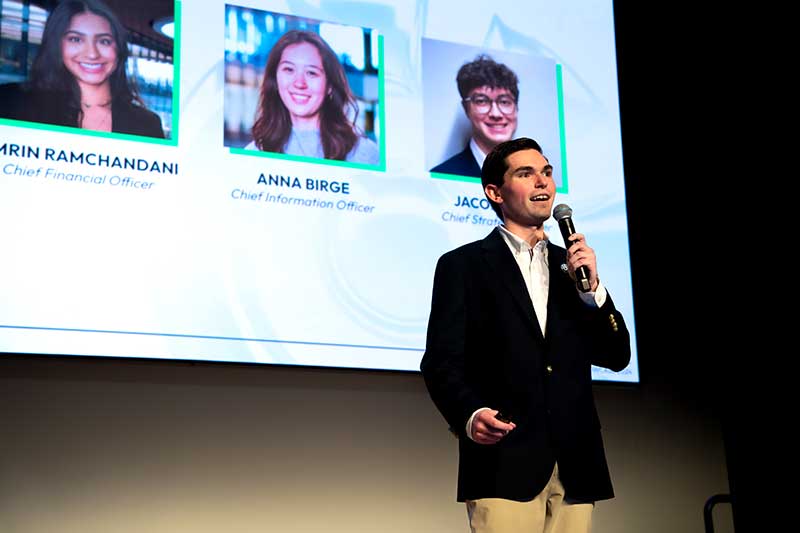
Some students have truly championed Khoury College’s “CS for everyone” mission.
Jay Sella, a fourth-year computer science and business administration major, has been heavily involved in the success of other students, whether through mentoring, curriculum design, or club leadership.
“I really enjoy doing what I can to help others by giving back and teaching based on my own learnings and experiences,” Sella said. “A big part of that is seeing how different individuals approach problems and try to solve them.”
Sella’s role as a leader began when he worked as a teaching assistant for “Fundamentals of Computer Science 1.” He then followed that cohort of students to “Fundamentals of Computer Science 2.”
After that, Sella continued in “Object-Oriented Design” (OOD) as one of eight head TAs. There, alongside Mark Fontenot and his fellow TAs, he helped create “course materials, lab guides, programming assignments, exam questions, grading rubrics, and feedback templates for students,” he said.
During that semester, Fontenot and Claire Wassinger, Khoury College’s associate director of program development and undergraduate student engagement, were trying to reimagine the college’s first-year seminar.
“Many students’ had disparate exposure to, knowledge of, and comfort with tools that were not directly part of any one course’s curriculum,” Sella explained. “Some classes and professors expected students to know things without explicitly teaching them. Also, students had expressed interest in learning more industry tools and technology prior to their first co-op.”
Sella was invited to serve as a curriculum innovation developer. In that role, he “ideated ways to restructure the course, engage students, incorporate ‘missing semester’ curriculum, and expose first-years to a wide range of disciplines before honing in on a specific focus area,” he said. He and his fellow designers asked questions and drew from their own experiences: “How can we better expose students to real-world tools and technologies? What was valuable in our own professional journeys? What do we wish we had learned sooner?”
One goal was allowing students to explore different areas of computer science as first-years and to accommodate students’ fluctuating levels of understanding entering the course. So, Sella and others redesigned the course — now fully asynchronous and self-paced — to include guest speakers, Khoury professors discussing their research, more hands-on projects, videos of former students detailing their experiences, and short quizzes and guided projects that let students try out things they had learned.
The rewrite, Sella explained, had three main components: “Personal, which included time management, transitioning to college, and goal setting; professional, which focuses on giving and receiving feedback, personal branding, and mastering behavioral interviews; and technical, which is the theory and application of computer science topics.”
Sella also played a role in adapting some of the projects in OOD to engage students more. One of these projects was a DIY digital bullet journal, a personal organization tool that students could use to keep track of to-dos while adding features to allow them to track, search, and tag entries.
Sella explained that the project included “new requirements and feature requests every few days, mimicking a real-world development project. Students had the opportunity to choose a subset of each feature set to implement. They were able to incorporate their own unique flair and build tools that they might use themselves, with the flexibility to focus on aspects of personal interest.”
Sella has also helped design Odyssey, a Coursera-like on-demand learning platform for the Khoury community. For undergraduate and graduate students seeking information on computing topics, Odyssey is a curated place to start.
And Sella’s commitment to his peers’ learning — and to turning his own knowledge into resources and guidance for others — isn’t confined to the classroom. With Oasis, a student group that helps students learn to build their first website or app through workshops, mentorship, and an eight-week bootcamp, Sella served as a mentor and project series director.
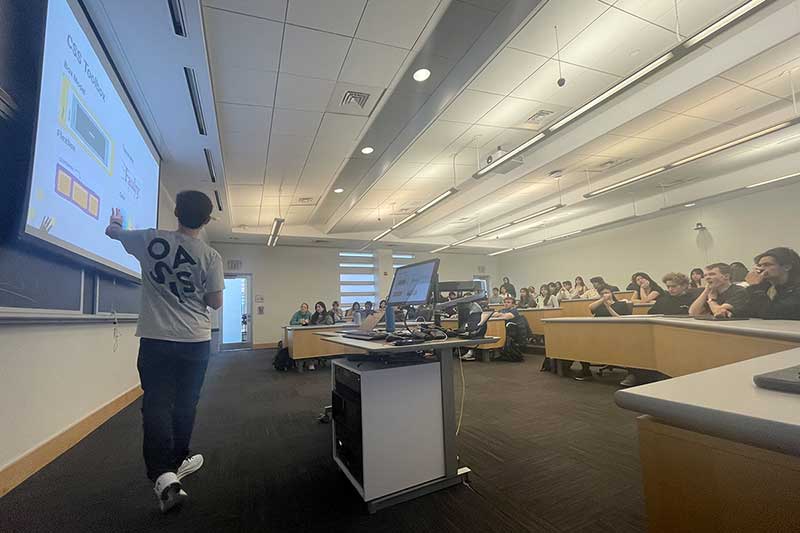
In those roles, Sella oversaw weekly workshops and a wiki, a public, on-demand library of guides and resources for those just getting started with web and app development.
Sella is also involved with Generate, a 160-student product development studio that works with venture clients from the Northeastern community to develop hardware, software, and data solutions. He is the operations director, overseeing the group’s finances, member data, relations with industry partners, and professional development for members.
“Generate is a rapidly growing community and we’re coming up on our 10-year mark,” Sella said. “We’re figuring out how to leverage that network as members and alumni become more involved in industry, and we also launched an alumni mentorship program to connect members with alumni.”
In his own professional life, Sella has carried the same spirit of entrepreneurship. His first professional experience as a Khoury student came from a startup called Tadpole, which he learned about when the founder pitched the idea to his OOD class. Tadpole is software that helps educators manage schedules and pay, communicate with students, and more.
“While I started as a summer software engineer, I became increasingly involved as the team and scope expanded,” Sella explained. “My role grew over time, and eventually I took over as lead software engineer and technical product owner.”
With this experience, Sella had the confidence to initiate his first co-op at Chick-fil-A.
“I hadn’t heard of someone doing a co-op there before, and I doubted they had a co-op program. I knew about their mobile app, but I didn’t think of them as a ‘tech company,’” he said. “One day, I checked their job postings in case they offered a summer internship and found that they offered a rotational co-op program.”
After completing two consecutive co-ops with Chick-fil-A, Sella plans to return as a full-time digital fellow in July.
Although he did not necessarily set out to find influential mentors or become a prominent figure in the Khoury community, Sella explained that by “being involved in organizations on campus and teaching assistant roles, you have the opportunity to forge those connections.”
“I’m passionate about educating others and taking my own learnings to give back,” he added. “I love the intersection of technology and finding ways to take my background and improve processes for others.”
The Khoury Network: Be in the know
Subscribe now to our monthly newsletter for the latest stories and achievements of our students and faculty