Author: Laila Griffin
Date: 05.18.26
Each year, Khoury College honors exceptional students for achievement in research, teaching, community service, and co-ops. To learn more about this year’s winners, find their stories below or simply scroll to read more.
- Undergraduate Co-op: Sabine Laurence
- Undergraduate Teaching: Misha Ankudovych
- Undergraduate Research: Zack Eisbach
- Undergraduate Service: Katherine Aristizabal
- Master’s Teaching: Mansi Modi
- Master’s Research: Nihar Sanda
- Master’s Service: Ritika Kumar
- PhD Teaching: Hye Sun Yun
- PhD Research: Harsh Chaudhari
- PhD Service: Andisheh Ghasemi
Sabine Laurence, Undergraduate Co-op
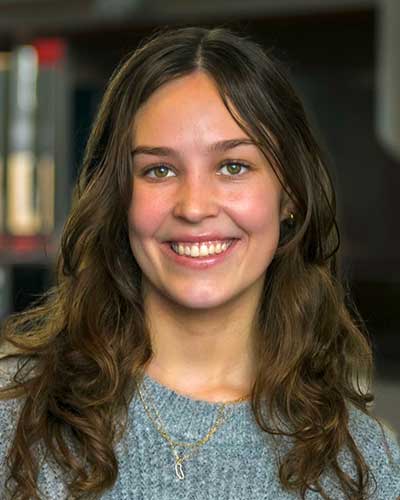
Sabine Laurence had no plans of pursuing computer science. Originally from San Jose, she spent much of her time focused on the humanities. But after taking one CS course at Northeastern, she was hooked — and the new CS and economics graduate has no intention of turning back.
During her first co-op, she worked as a full-stack software engineer for Cisco, a technology company based back home in California. She was tasked with creating a new project management tool to replace Cisco’s outdated one.
“I was the only one working on this project,” she said. “I got a lot of freedom.”
With her co-workers as customers and a three-month deadline before the company stopped funding their old tool, Laurence built a customized internal app that featured more than 200 columns of data, enabling Cisco teams to track more than 500 projects. Using her app, teams could filter, group, and view only the information relevant to them, all from a single database.
“I definitely learned a ton,” she said. “By the end of my co-op, a couple of other teams had onboarded to the app. That was just a really cool feeling. I’d never done something like that before.”
Returning home to San Jose for her second co-op, Laurence worked as a back-end software engineer at Intuit, building on her skills from the previous co-op but with a larger team.
“It was a very different experience,” Laurence said. “This one was a lot more technical.”
She worked with application programming interface management tools that connected data across teams, building systems to route and unify information like customer phone numbers and bank data. She also helped develop a metrics dashboard to measure and improve developer efficiency and contributed to a company-wide GraphQL layer by organizing and parsing through duplicate data.
“As a whole, my team worked on making other engineers’ lives easier,” Laurence said.
Her co-op work deepened her involvement in Northeastern Women in Technology. Alongside her second co-op, she became website manager and later president, virtually running the site while applying her new skills and bringing herself closer to the community she had joined as a first-year.
“I feel like I’ve met some really incredible people at Northeastern,” Laurence said. “And I’m proud to be part of that network.”
Misha Ankudovych, Undergraduate Teaching
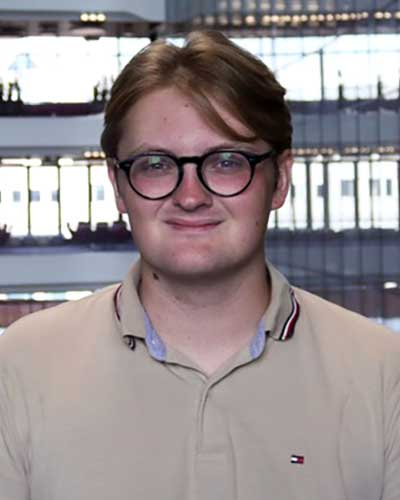
As a tour guide, parliamentarian of student government, chair of the Senior Year Experience Board, and leader of the hockey student section, Misha Ankudovych contributed to nearly every phase of student life. But it’s his role as a teaching assistant where he had the most direct impact on students.
Originally a psychology major, Ankudovych became a regular at office hours for “Discrete Structures.” The support he found there helped him earn an A and inspired him to apply to become a TA himself. A combined data science and economics major who graduated this spring, Ankudovych says his parents, one of whom is a high school teacher, instilled in him an early appreciation for education and mentorship.
“I don’t think I ever imagined that I would be a teacher or a teaching assistant,” Ankudovych said. “The value and the privilege it is to teach — I definitely got from an early age with my mom.”
Ankudovych spent the last three semesters as a TA for “Introduction to Databases” with Teaching Professor Mark Fontenot, including the last two as lead TA. Alongside eight other TAs, he tested homework, hosted office hours, proctored, graded, and made rubrics for a class of approximately 200 students.
“The community you build between the TAs and the professor, I’ll definitely keep in contact with everyone long after I’m gone from Northeastern,” he said. “That’s such a unique thing to be a part of.”
His connection to the course extended beyond colleagues to the students he supported.
“There were people I would talk to almost every week in office hours and then I’d see them doing better over time,” Ankudovych said. “It’s extra special if you saw them along that journey and saw the connections happen.”
Ankudovych never stopped learning himself. With three internships and one co-op under his belt, he remained driven to take on new challenges. In August, he’ll move to Washington, DC, to work as a forward-deployed software engineer for data management systems.
“If you have the privilege of being able to be uncomfortable, take advantage of it. Northeastern’s a great place to do that,” he said. “You never know what you’ll love to do, and you never know where it’ll lead.”
Zack Eisbach, Undergraduate Research
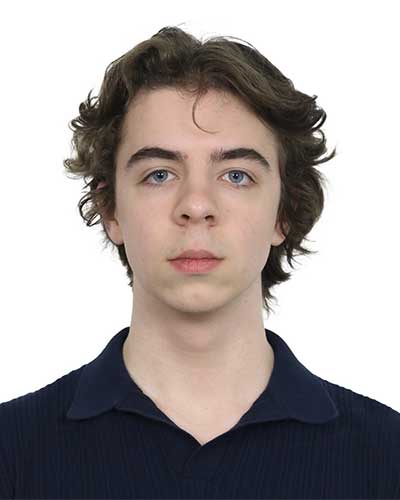
Zack Eisbach, a recent computer science and mathematics graduate, has dedicated himself to studying language interoperability, the ability of programs written in different programming languages to communicate safely.
At the heart of Eisbach’s research are application binary interfaces, or ABIs. Eisbach has focused on transforming these ABIs, which have lots of room for ambiguity and security risks, into precise, machine-checkable mathematical models, enabling formal verification of whether software components correctly adhere to them.
Under the supervision of Khoury PhD student Andrew Wagner and Professor Amal Ahmed, Eisbach co-authored a paper presented at OOPSLA 2024 that introduced a novel framework for formally specifying ABIs.
“There are all of these nice programming languages with new systems that rule out bugs by construction. But in practice, we have to interact with these unsafe languages,” he said. “Some of my research is partially concerned about how we can make unsafe languages safer for the purposes of interoperability.”
This approach models how high-level language types correspond to low-level machine behavior, demonstrated through a Swift-like language with reference counting. The work led to an ongoing collaboration with Apple’s Swift language team, where Eisbach’s contributions include developing a formal specification of Swift and its ABI on the LLVM platform.
Beyond research, Eisbach served as president of Northeastern’s Math Club. After graduation, he returned to Jane Street Capital, his former co-op employer, as a full-time compiler engineer.
Katherine Aristizabal, Undergraduate Service
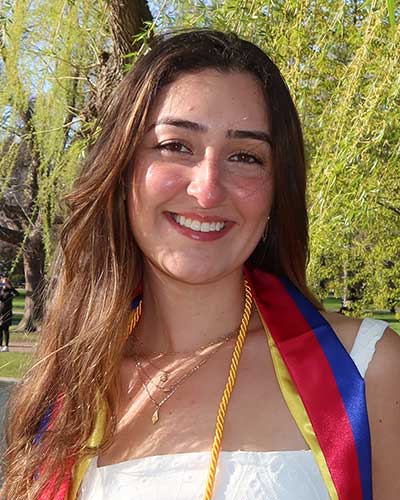
As a native of Lowell with roots from Medellín, Colombia, Katherine Aristizabal began her time at Northeastern through PODER, a student mentorship program for incoming first-generation first-years run through the Latinx Student Cultural Center. She studied computer science with a concentration in human-centered computing and a minor in psychology — and ended up going full circle as a program manager with PODER, where she served as a mentor to first-year students.
“Through PODER I made a really good support network of upperclassmen who had been through similar things. That really helped when it came to applying to co-ops,” she said. “I’m so thankful for all the people who helped me along the way. I wanted to be that for other people.”
Drawing upon skills learned from her co-ops at Johnson & Johnson, Notability, and Apple, Aristizabal also spearheaded the construction of the program’s first website, coordinating with program managers to create a centralized place for resources and photos.
“They didn’t have a website before. At first it was just bare-bones WordPress we were working on,” Aristizabal said. “Since then, the program has grown so much, which is so great.”
At Northeastern’s student chapter of the Society for Hispanic Professional Student Engineers, Aristizabal transferred these skills to work as a website administrator. She was also part of the first cohort of Khoury F1rst — the college’s group for first-generation college students — and similarly returned to help lead workshops on themes such as fine-tuning resumes and overcoming impostor syndrome.
“It is so important, especially in computer science,” she said. “It’s a predominantly male field and I wanted to be that resource even more within CS.”
After graduation, Aristizabal will return to Apple in San Francisco as a full-time software engineer, where she hopes she can continue mentoring future interns.
“Those moments where you see pieces of yourself, you’re like, ‘It’s crazy how far you’ve come,’” she said. “I’m very proud to be in a role where I can help other students and see that.”
Mansi Modi, Master’s Teaching
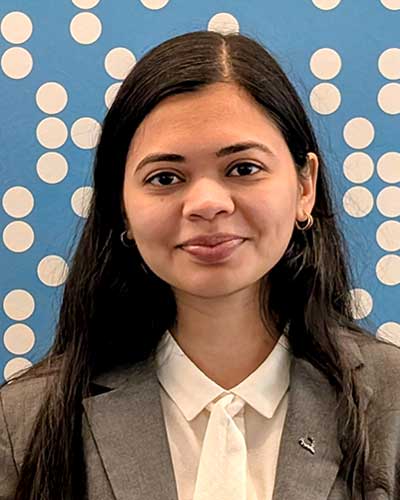
Before ever stepping foot in a college classroom, Mansi Modi was already teaching herself to code. She started with the C programming language, built herself a working calculator, and eventually moved on to web and mobile applications.
Now, four semesters into her studies at Northeastern’s Vancouver campus, she’s on the other side of the classroom, having helped teach four courses to a wide range of students: some with prior programming experience and others encountering the field for the first time.
“I wasn’t introduced to computers early in school,” Modi said. “My first time writing an actual program was my first year of the bachelor’s program.”
Her first course as a teaching assistant, “Programming Design Paradigms” with Jack Thomas, was straightforward for her. Having worked with Java for five years, Modi was familiar with the material and could focus on helping explain the content to her students.
The following summer, she continued with Thomas, pivoting to teaching “Object Oriented Design.” Then, as she returned to campus in the fall, she helped teach “Foundations of AI” with Richard Hoshino, a course for Align master’s students that, for many, served as their first introduction to computer science.
“I helped them set up the environment; I even helped them with the labs and explained how a Java program is run,” Modi said. “It was a good moment that I was able to explain to the non-technical folks how something works in very simple terms.”
In her final term, Modi took on a TA role for “Building Scalable Distributable Systems” with Yvonne Coady, helping guide the course through a significant overhaul. The syllabus was reworked to incorporate AI, giving students access to Claude Code and extensive server logs.
As part of the shift, students were tasked with using AI. Modi supported their work through weekly interviews, spending about nine hours each week tracking their progress, examining their AI-assisted assignments, and probing their code and decision-making to better understand how they arrived at their solutions.
As she finishes her final research capstone, Modi is researching how to empower students with AI, designing assignments and analyzing how students interact with the tools.
“Most of the students I talk to have so much to share, so much to inspire,” Modi said. “I’m going to miss all these conversations and meeting these new people and getting to know about their experiences.”
Nihar Sanda, Master’s Research
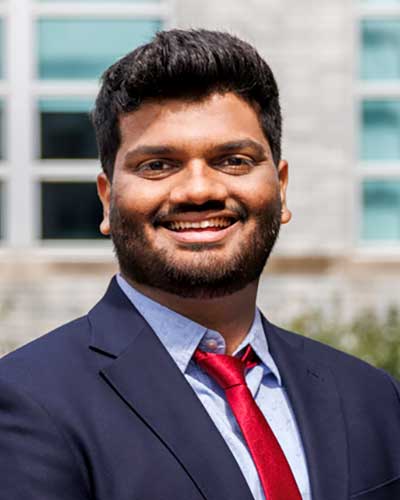
Nihar Sanda completed his undergraduate computer science degree amid the upheaval of the COVID-19 pandemic. This ignited an interest in health care and biomedicine, which has shaped his research ever since.
“I really like the idea of computers trying to understand human language,” Sanda said. “My common thread of applying all of these NLP tasks was always related to life sciences or health care. This interesting interaction was very surprising to me.”
Having wrapped up his master’s in computer science at Khoury College last December, Sanda now works as a machine learning engineer at Northeastern’s Institute for Experiential AI.
Throughout his time at Khoury College, Sanda was involved in a multitude of research projects, publishing six peer-reviewed papers in leading venues such as ACL, CHI, ISMB, and AIED. For his master’s thesis, Sanda, who was advised by Ayan Paul, Benjamin Gyori, and Auroop Ganguly, worked with three Northeastern labs to build a cross-domain knowledge aggregation system to understand the effects of climate on health.
He also completed a co-op at Vanderbilt University; joined Assistant Professor Maitraye Das’s Technology, Equity, and Accessibility Lab; served as a graduate research assistant; and collaborated with NASA on AI safety in geospatial science. In recognition of his work, Sanda received the Best Poster Award for Impact and Novelty at the Khoury Poster Day in 2025 and was named to Northeastern’s Laurel and Scroll 100.
“In research, especially when you are collaborating, having multiple ideas is interesting because there are so many professors who’ve worked in their specific domain for so many years,” he said. “As a student, you get a plethora of ideas that I think you wouldn’t get if you weren’t collaborating.”
Ritika Kumar, Master’s Service
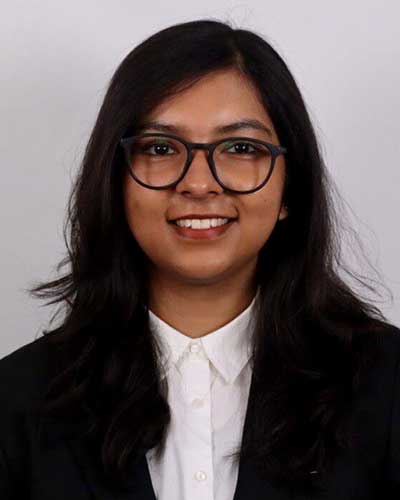
Ritika Kumar is no stranger to building projects from the ground up.
As a self-developed data science co-op at Bevi, a company that designs smart water dispensers, Kumar designed a real-time AI summarization pipeline for customer service calls. Beyond the technical work, she collaborated closely with the customer service team and consistently engaged with colleagues.
She credits these communication skills to her work with Khoury SHEROs of Color, an affinity group that supports female faculty and graduate students of color in Khoury College, of which she’s a founding member and director of events.
“Starting a club is scary,” Kumar said. “That experience itself taught me a lot about leadership, soft skills, and communicating with people.”
Having just completed her master’s in data science, Kumar is most proud of her time at SHEROs.
“This is such a male-dominated field, and I feel that women need the space to feel like they belong — a space to talk about their achievements, what they’re doing, where they’re struggling, how they can do better,” Kumar said. “In a room, you’re the only girl sometimes. In labs, you’re the only girl on the team. It was just nice sharing experiences, connecting with people, and feeling like you’re not the only one feeling this way and that there are others who can support you.”
Kumar is working on her thesis under Assistant Teaching Professor Deahan Yu, who specializes in health care and natural language processing. Her job involves predicting International Classification of Diseases codes. These codes are used for billing within health-related services and research into the patterns and causes of diseases. She is also working to further automate this process using large language models and synthetic data augmentation.
As she wraps up her last semester, she’s excited about the possibility of returning to SHEROs as an alumna to inspire future students.
“I came to Khoury College with one singular goal of computer science and becoming this technical person who’s really good at her job, but I gained so much more,” Kumar said.
Hye Sun Yun, PhD Teaching
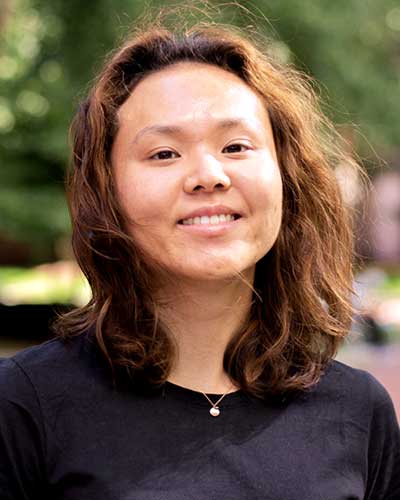
Hye Sun Yun’s path to teaching began long before her PhD studies.
Yun attended Wellesley College for undergrad, where she studied computer science and had very approachable, supportive professors — sparking her interest in academia.
“That environment allowed me to have the confidence to pursue computer science as a career,” Yun said. “I’m highly influenced by how my [Wellesley] professors taught my courses.”
After working as a full-stack engineer, Yun came to Northeastern with the goal of taking on more teaching in addition to her research in natural language processing, human–computer interaction, and health communications. She designed and taught her own course, “Research in Human-Centered Natural Language Processing,” working closely with a small group of 10 undergraduate and graduate students.
Last fall, she stepped into a much larger teaching role, co-teaching an undergraduate data science course. There, she coordinated with instructors, managed a team of 14 TAs, and helped guide a section of 11 students through the material.
The two experiences helped Yun to clarify her teaching style, and to realize that she thrives in more intimate classroom settings.
“There is instant gratification in some sense when students get it,” Yun said. “You see students progress, you see students actually learn something.”
Throughout her time teaching, Yun has watched — and adapted to — evolving educational needs.
“AI has infiltrated pretty much every aspect of the research process, whether for good or bad,” Yun said. “There’s been a lot of changes with teaching computer science to students.”
Still, she’s excited for the challenge. After defending her thesis in June, Yun will join Lafayette College to teach an introductory programming course and an intermediate course on the principles of data science.
Harsh Chaudhari, PhD Research
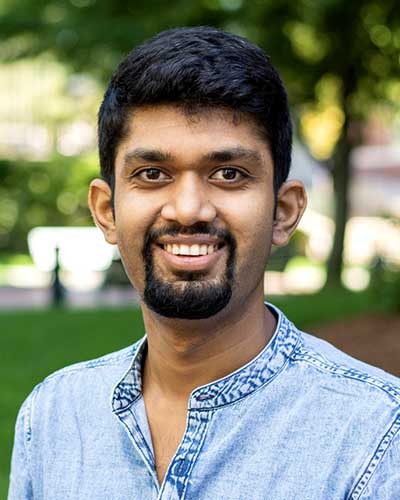
As a fifth-year PhD student, Harsh Chaudhari has been a witness to what he calls the “LLM boom.”
Chaudhari’s path to machine learning grew out of an early interest in applying cryptography to real-world problems. While completing his master’s degree, he began exploring machine learning as a practical use case. Over time, his focus shifted toward understanding machine learning itself, particularly the security vulnerabilities that arise when training these models.
“You have to adapt,” he said. “Whatever the new technology is, you have to be proactive to learn new technologies that are needed to become a better researcher.”
Under his advisor Alina Oprea, Chaudhari began investigating how model behavior would change when the data LLMs scrape is manipulated.
“When learning, LLMs don’t really learn what is good from bad,” Chaudhari said. “We show that it’s easy for the model to learn bad behavior.”
With the right kind of prompting or slight manipulation of training data, models can revert to earlier patterns or be nudged into producing outputs they were designed to avoid, Chaudhari explained, essentially learning harmful behavior without recognizing it as such. The implications raise broader concerns about how easily AI systems can be influenced. Because models can absorb and reproduce biased or misleading patterns from even small examples, they can potentially be leveraged for malicious purposes.
“This capability of the LLM to learn, to try to solve things that it has not seen before — you can use it to your advantage while spreading bad behavior,” Chaudhari said. “You can imagine it spreading stuff like propaganda. You can easily change the narrative.”
As he wraps up his PhD, Chaudhari has grown more comfortable with ambiguity, recognizing that perfect safeguards are unrealistic. Instead, he sees the work as a constant balancing act, a cat-and-mouse game between those building protections and those trying to break them.
“When joining, I thought that by the end of my PhD I would probably be more of an expert on things,” he said. “I’ve learned to navigate better not knowing is fine and that you need to keep learning.”
Andisheh Ghasemi, PhD Service
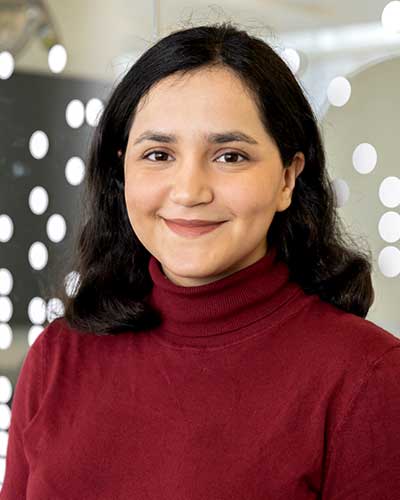
Computer science always felt like a natural fit for Andisheh Ghasemi. Building professional connections, however, was less intuitive. Now in the third year of her PhD, she has made an effort to turn that challenge into an opportunity for growth.
“Networking didn’t come naturally to me, but I knew how important it was,” Ghasemi said. “I decided I had to actively work on it rather than avoid it.”
Throughout her academic journey — from her undergraduate studies at Sharif University of Technology to her master’s at the University of Paris — Ghasemi regularly attended theory seminars. So, when she arrived at Northeastern, getting involved in the Theory Seminar was an intentional first step toward building community.
“One of the first things I did was join the seminar, meet people, and start forming connections with students and faculty,” she said.
The seminar brings together students and visiting researchers for weekly talks and discussions. Since 2024, Ghasemi has taken on a leadership role as an organizer, coordinating speakers, managing logistics, and leading outreach efforts to encourage broader participation.
“I especially wanted to motivate junior PhD students to attend,” she said. “Creating a supportive environment helps everyone feel more comfortable engaging.”
Encouraging attendance can be challenging, as many PhD students are deeply focused on their own research. Still, Ghasemi sees the seminar as a valuable space for connection and mutual support. Under her involvement, participation has steadily grown, with 10 to 15 attendees at each session.
“It’s important to show up for each other,” she said. “If your lab mate is presenting, go listen, ask questions, be part of that moment. It’s good for our sense of community — and even for our mental well-being.”
As she continues her PhD, Ghasemi plans to pursue a career in research. She credits her experience with the Theory Seminar not only for expanding her professional network, but also for helping her become more confident and engaged within the academic community.
“I’ve learned how much of a difference it makes to support others,” she said. “That shift has helped me grow, both professionally and personally.”
The Khoury Network: Be in the know
Subscribe now to our monthly newsletter for the latest stories and achievements of our students and faculty
Author: Yashavi Upasani
Date: 05.14.2026
Many Khoury undergraduates are doing important, hard-hitting research. But five undergraduates — Arinjay Singh, Elaine Zhu, Luisa Li, Misha Ankudovych, and Zack Eisbach — have displayed an especially high level of ingenuity and dedication to solving some of the biggest challenges in modern technology. All were nominated by their professors or research advisors for the Computing Research Association’s Outstanding Undergraduate Researcher Award, with Singh and Li being awarded honorable mention and Eisbach placing as a finalist. All five graduated from Khoury College this spring.
From proposing AI regulation to evaluating whether delivery apps are profiling users, these students used the resources around them to tackle leading questions in their fields.
Arinjay Singh: Testing the emotional intelligence of AI
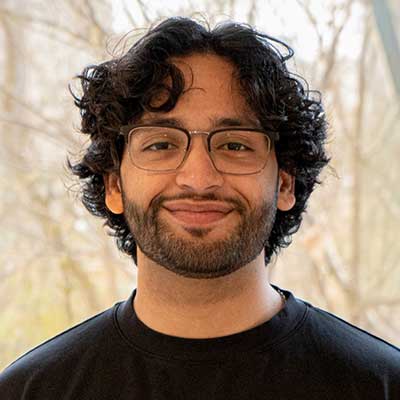
Arinjay Singh, a computer science and economics combined major, was writing about AI before ChatGPT became the phenomenon it is now. Singh’s inherent interest in understanding AI has been a driving force of his work at Northeastern, core to several of his research projects and leading him to add a minor in information ethics.
“Both projects are related in that they have to do with the ethics of AI. All of my research is centered in the field of natural language processing, which is a subsection of AI that I’m particularly interested in,” Singh said.
The first project evaluated patterns of data bias in cross-linguistic AI settings, ultimately creating a comprehensive framework on how to approach bias assessment and equitable data construction. Looking at natural language processes involving English and Arabic spoken languages, Singh evaluated AI training data to create a framework that would identify biases in the data before the model used it.
“The project wasn’t necessarily creating a new system. It was more so creating a framework to evaluate existing systems,” Singh said. “Going forward, when someone writes a paper, they can at least reflect on how what they’re putting out in the world is going to perpetuate in an AI model. Because if there are biases, oftentimes they’re not enforced by the people who are affected, so they wouldn’t naturally recognize it.”
Singh’s second project, which he’s currently working on, explores the interpretable emotional intelligence in language learning models. Singh studied how AI models represented human emotions, how the models designate each emotion, and how the models could be improved at these tasks. The idea was inspired by his observations on the way language learning models are being used in high-stakes situations despite having little to no understanding of human emotional processes.
“A more recent push for me [is understanding] how ingrained technology has become with all of our lives, and AI being involved in quite sensitive domains,” Singh said. “People use it for therapy or in mental health spaces; it’s just in a very vulnerable place in society. So, we should at least understand how AI understands emotion, how to make it better, and whether it’s beneficial to the people who use it.”
Singh is not sure what he wants to do after he graduates, whether in industry or academia. However, his interest in the ethical implications of widespread GenAI adoption and discovering more about the technology’s internal process will continue to fuel his work.
Elaine Zhu: Profiling users through data collection
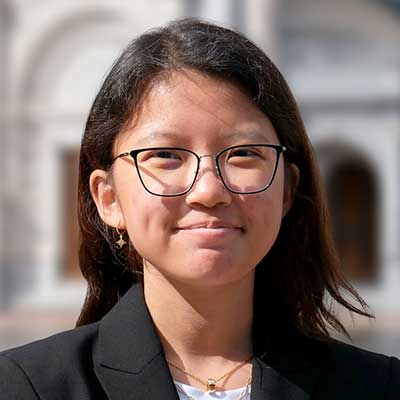
Elaine Zhu, a cybersecurity and criminal justice combined major, couldn’t help but notice the large, digital ecosystems of the people around her, worlds that included numerous phones, tablets, laptops, and watches they owned and interacted with frequently.
Zhu’s published paper, which she presented at PETS 2025 in Washington, DC, explored how voice assistants like Alexa, Siri, and Google Assistant profile users based on their voice interactions. She discovered the different methods these assistants use — whether that be tracking searches linked to demographics or purchase history — and how they tag users with categories like income, marital status and employment.
“If I have a human as a personal assistant, I don’t want that person to be tracking what I do and creating a profile on me,” Zhu said. “These kinds of research allow for a greater discourse on the implications of using all of these devices that are connected to the internet.”
This project began with Tina Khezresmaeilzadeh, a PhD student at the University of Southern California, before Zhu brought it to Northeastern and continued to work on it.
Her current research focuses on a “surveillance pricing” project that started about 10 years ago under Northeastern professors Christo Wilson and Alan Mislove, who studied changes in airline pricing based on personal data gathered by the airline. Zhu is taking this idea and applying it to delivery apps like DoorDash and GrubHub, with the goal of measuring whether these apps change their prices based on collected data.
A major source of inspiration for Zhu’s work is a rallying cry for greater transparency from companies on how they use customers’ data, including sharing these practices with customers.
“These specific data collection uses weren’t disclosed in Google’s terms of service,” Zhu said, citing the example of Google Assistant. “With this research … it’s about informing the public that these things are happening. We want more companies to be more transparent about their practices.”
Luisa Li: Turning an idea into a solution
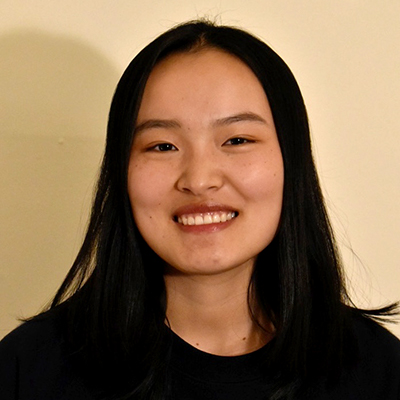
When Luisa Li, a computer science and mathematics combined major, began working more with scientists, she noticed the detailed methods they were forced to use for questioning AI models, inspiring her to create more transparent, interpretable models.
“Say you’re talking to ChatGPT via some prompting. There’s not much you can do to understand what is happening under the hood; there are no restrictions on what the model can be after you train it,” Li said. “My main line of work is understanding what sort of rules or restrictions you can place on the model to make it a little bit better. And it turns out, there’s some very nice math that you can do to get these sort of restrictions on models.”
One ongoing line of work is studying dynamics over a surface — for example, what does heat diffusion look like over a bunny-shaped surface? Li studies the behavior of models when simulating all kinds of dynamics, from processes like heat diffusion, which are considered “smooth,” and processes like the separation of oil and water, which are considered “wrinkly.” Li and her co-author worked out math that, in the heat diffusion case, allowed them to more precisely control the model to simulate the same rate of diffusion as the actual physical process.
“Diffusive processes happen at different speeds, and the question that we want people to think about is, ‘To what extent is the model that you’re using accurately reflecting this behavior?’” Li said.
Li’s paper is undergoing peer review, and she hopes that after it publishes, she can continue to make AI models more transparent and reliable through PhD work.
Misha Ankudovych: The road toward AI regulation
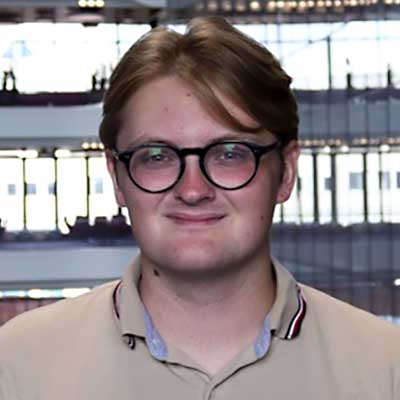
After researching with more traditional STEM methods — building software and analyzing data — Misha Ankudovych, a data science and economics combined major, chose a different approach for his work on AI regulation. After taking “Regulation in the Digital Platform Economy” with Khoury–School of Law Assistant Professor Elettra Bietti, Ankudovych began to view AI through a new lens: working legislation.
“When it came time to do one culminating piece for that class, I realized a lot of what we talked about, like privacy, applied to AI,” Ankudovych said. “I’m a data science student, so in my other classes, I have built AI; I’ve built a large language model. I thought it would be interesting to engage with this in a very different way.”
This different way manifested as an almost-50-page piece of AI legislation, one which adopted ideas from other works and added Ankudovych’s own touches. He also highlighted the potential downsides and weaknesses of the previously proposed legislation and adapted the work to a United States context, expanding on potential US stakeholders that might oppose his proposed methods.
Ankudovych is optimistic about the future of AI but acknowledges that this positive scenario only occurs if there’s strong research done on regulation.
“AI is not only rapidly advancing, but it’s gotten to the point where people don’t even know what AI is. What is an AI? In some senses, it has become a scapegoat,” Ankudovych said. “But I think people are rightfully scared. There’s a very fine balance of the idea of regulation and the idea of also wanting to advance.”
Ankudovych’s proposals include assigning clear-cut responsibility between developers and deployers, transparency requirements for AI platforms, and penalties for violations. Most importantly, he advocates for funds dedicated to teaching the general public how AI works instead of simply how to use it.
Post-graduation, Ankudovych is moving to Washington, DC, to work as a forward-deployed software engineer, helping government officials and their partners create AI and data-driven software while keeping in mind his central message on regulating models well.
“I think we want to make sure that as a country, we are enabling and helping technologists make the best product and the best research,” Ankudovych said. “Before we lose the plot on that, it’s important to think about regulation and the ways in which we can think about these things now so we’re not looking back in five years saying, ‘We’re so far gone; we don’t know where to start.’”
Zack Eisbach: The innovation to solve decades-old problems
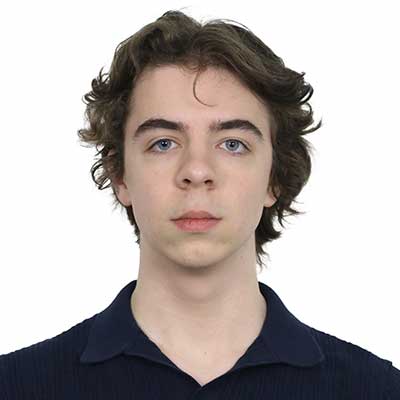
Zack Eisbach, a mathematics and computer science combined major, never expected that his research into application binary interfaces (ABI) would lead to an ongoing project with Apple’s Swift team. But that just speaks to the nature of his work.
ABIs are low-level specifications that identify how different program components are allowed to interact with each other. They are crucial for linking two programs written in different languages, a process known as language interoperability. Eisbach’s research, which he began in his second year at Northeastern, aimed to transform the hundreds of pages of prose dictating each ABI into a machine-understandable math, eliminating errors and security vulnerabilities when the languages are combined.
“A lot of the things that I’ve been focusing on in my research are ways to make language interoperability safer,” Eisbach said. “There are all of these nice programming languages with new type systems that rule out bugs by construction. But in practice, we have to interact with these unsafe languages that have been around since the 70s; we can’t just go and rewrite all those programs. So, some of my research is partially concerned about how we can make unsafe languages safer for the purposes of interoperability.”
Alongside Khoury PhD student Andrew Wagner and Professor Amal Ahmed, Eisbach wrote a paper chronicling their research and findings, using Apple’s Swift programming language as a case study. Although the Swift team has never had research interns before, they worked with Eisbach after he reached out to them, speaking with him about his work and later offering him an internship to continue developing this idea.
“Once I got to Apple, I worked directly with a lot of the language features,” Eisbach said. “There’s only so much that you can uncover yourself digging through source code and examples; being able to ask the person who implemented the feature how it worked was extremely valuable.”
After graduation, Eisbach will return to Jane Street, his former co-op employer, as a full-time compiler engineer. He credits a lot of his inspiration and dedication to research from a deep love for all things data, logic, and math.
“That’s what really got me into programming language research; it’s applicable to the real world,” Eisbach said. “It touches on computer science and programs, but there’s also a very rich history of using math to study these languages. And it touches on a lot of topics from logic as well.”
The Khoury Network: Be in the know
Subscribe now to our monthly newsletter for the latest stories and achievements of our students and faculty
Author: Caroline Baker Dimock
Date: 05.11.2026
With commencement season in full swing, Khoury News is highlighting students across Northeastern’s network of campuses to learn more about their experiences at Northeastern and goals for the future. Find their stories below or simply scroll to read more.
- Arlington: Arth Patel
- Boston: Reese Cantu
- Miami: Erdun E
- Oakland: Vinal Dalcy Dsouza
- Online: Marcela Perro
- Portland: Venkateshprasad Kulkarni
- Seattle: Sihe Chen
- Silicon Valley: Mandar Ambulkar
- Vancouver: Kalhar Pandya and Mansi Modi
Arth Patel, Arlington
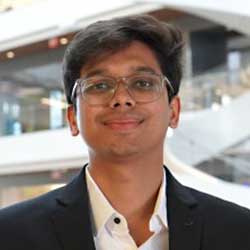
Arth Patel, a master’s student in computer science, transitioned to Northeastern directly from his undergraduate studies in India, drawn by its renowned co-op program and global campus network. He was particularly interested in gaining extended, hands-on industry experience while maintaining flexibility in his academic and professional path.
During his time at Northeastern, Patel supported both academic and career development initiatives. He served as a teaching assistant for a graduate-level algorithms course — helping students navigate complex concepts — and worked as a career peer advisor, guiding peers with resume-building, LinkedIn optimization, and job search strategies. One of his most impactful experiences was participating in a residency program at Northeastern’s Miami campus, where he connected with students across campuses and supported them in building professional networks and career direction.
Patel also completed a co-op as a UX/UI and AI intern at the Verse, a California-based gaming company, where he contributed to augmented reality applications focused on improving users’ emotional and personal well-being. This experience helped him refine his career interests and pivot toward data science and AI roles, particularly in health care. Reflecting on his journey, Patel values the diverse and close-knit community at the Arlington campus, crediting it with helping him grow both personally and professionally.
Reese Cantu, Boston
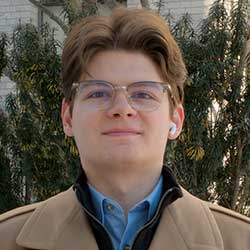
READ: With first-of-its-kind double major, Reese Cantu strives to build tech for the deaf community
Reese Cantu created a unique double major in computer science and American Sign Language (ASL)–English interpreting to combine his two long-standing passions. Inspired by early exposure to both fields, he designed his own academic path to address a major gap in technology: the lack of accessibility for the deaf and hard-of-hearing community. His experiences, including a “study domestic” at the Northeastern-partnered Gallaudet University for deaf and hard-of-hearing people, strengthened his ability to engage with technical concepts in ASL and deepened his understanding of deaf culture and community.
Cantu focuses on improving how technology supports sign language, especially by addressing limitations in current recognition systems that often miss important nuances like facial expressions. Through projects like developing user-friendly software for the Massachusetts National Guard, he has emphasized accessibility and real-world usability. After graduation, he hopes to continue building inclusive technologies in collaboration with the deaf community, ensuring their needs are central to the design process.
Erdun E, Miami
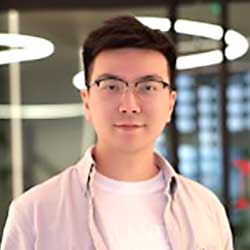
Erdun E, a master’s computer science student, has distinguished himself by blending technical expertise with strong leadership and community building. Drawing on previous industry experience, including work on large-scale distributed systems at Amazon Web Services, he has continued to apply his technical knowledge while fostering collaboration among his peers.
At Northeastern, E founded and led the Miami Tech Club, the campus’s first student-led technical organization, creating opportunities for student engagement, career development, and research exploration. He has also launched cross-campus initiatives that connect students across Northeastern’s global network to allow students to meet and bond over shared interests. In addition to his leadership roles, he serves as a Khoury Student Ambassador, represents the Miami campus on the Khoury Master’s Student Advisory Board, and contributes as a teaching assistant, mentoring students and supporting coursework in advanced computer science topics.
Professionally, E completed a software engineering internship at Superstars, where he developed a TikTok-style video creation workflow within the Flutter-based mobile application and improved team efficiency by authoring developer onboarding documentation. He was also selected for Northeastern’s competitive Entrepreneurship Trek, an immersive program focused on startup innovation and product development.
Recognized for both his technical contributions and leadership, E received the Outstanding Leadership Network Student Award and Northeastern’s Laurel and Scroll honor. Through his work, he continues to prioritize building inclusive, supportive communities that enhance student learning and collaboration.
Vinal Dalcy Dsouza, Oakland
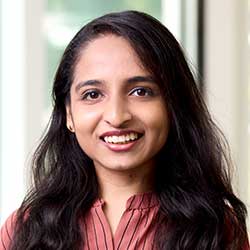
Vinal Dalcy Dsouza, a master’s student in computer science, arrived at Northeastern’s Oakland campus after nearly five years working as a data engineer for multiple multinational companies, where she quickly earned promotions. Despite her professional stability, Dsouza was motivated to step out of her comfort zone and fulfill a long-standing goal of pursuing a master’s degree, ultimately choosing Northeastern for its strong reputation and emphasis on experiential learning.
At Northeastern, Dsouza embraced a new academic environment that challenged her with a more practical, hands-on approach to learning. She became involved in research through the Khoury College Research Apprenticeship program, contributing to a project focused on AI adoption in local government. After completing the apprenticeship, she continued her work as a research assistant and presented her findings at a research showcase, gaining valuable exposure to a field she had not previously explored. She also took particular interest in distributed systems coursework, where she deepened her understanding of how infrastructure and system design shape real-world applications.
Building on her background in data engineering and her academic experiences, Dsouza aims to pursue roles at the intersection of data, AI, and distributed systems, such as applied AI or cloud-focused engineering positions. She credits supportive faculty and a collaborative academic environment for helping her stay motivated and confident as she navigated her studies and transitioned to the next stage of her career.
Marcela Perro, online
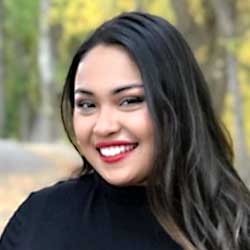
Initially hesitant to enter tech as a first-generation college student studying in a second language, Marcela Perro instead began her career in project management. But her passion for tech never faded, so after the pandemic — and with encouragement from her husband — she decided to take the leap, joining Khoury College’s Align master’s program for students without computing backgrounds. The flexibility of the program’s online option, along with its supportive community and in-person residencies, allowed the Montana-based mother of two to balance family life while building technical skills.
Despite early challenges, such as impostor syndrome and having to learn programming from scratch, Perro persevered and eventually became a teaching assistant to support others facing similar struggles. Partway through her degree, she transitioned into a cybersecurity role with the state of Montana, where she now automates processes to improve threat detection and response. By adjusting her course load and working closely with advisors, she has been able to manage her career, education, and family responsibilities. Perro’s journey highlights that transitioning into tech is possible at any stage of life, and that flexibility and determination can make even complex goals achievable.
Venkateshprasad Kulkarni, Portland
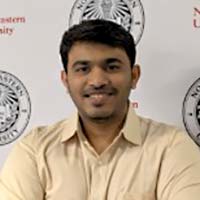
Venkateshprasad “Venky” Kulkarni is a master’s student in computer science who, before coming to the US, spent five years working at Capgemini in India, where he advanced to a team lead role. With an undergraduate background in electronics and telecommunication, Kulkarni chose to pursue computer science to broaden his knowledge and explore new technical pathways.
During his time at Northeastern, Kulkarni pursued both research and community leadership. As a research apprentice, he worked on a qualitative study examining how students from non-computing backgrounds adapt to the field. His work was accepted for a presentation at the ICER conference at the University of Virginia. In addition, he served as a lead for the Google Developer Groups chapter, where he organized Arcanum, a weeklong, multi-campus puzzle competition that engaged more than 100 students across Northeastern’s global network.
Kulkarni also gained industry experience through a co-op at Grantx, a Maine-based startup that builds AI and data tools to aid those applying for grants. There, he worked with data and machine learning systems, gaining valuable exposure to US work culture and earning a full-time job offer upon graduation. Reflecting on his journey, he credits his growth to stepping outside his comfort zone and embracing new opportunities, a mindset he encourages other students to adopt as they navigate their own paths.
Sihe Chen, Seattle
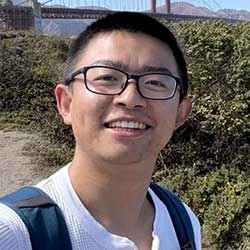
Sihe Chen began his career in the autonomous driving industry, and over three years, he discovered a strong interest in areas like machine learning, AI, and computer vision — fields he had not explored during his undergraduate studies in information security. Motivated to deepen his knowledge, he chose Northeastern’s Seattle campus to pursue a master’s in computer science and delve into research opportunities.
At Northeastern, Chen immersed himself in computer vision early, taking on one of the school’s most rigorous courses in his first semester. That decision proved pivotal, connecting him with faculty and peers who shared his interests. He went on to collaborate on research with Professor Bruce Maxwell through a master’s research apprenticeship, which led him to co-authoring and publishing a paper. In addition to research, he served as a teaching assistant for multiple semesters and as a research peer advisor, mentoring fellow students and sharing insights from his academic and industry experiences.
Chen also leveraged these experiences to return to the autonomous driving field, securing an internship, and later a return offer, with Waymo. After graduation, he will join the company’s simulation team, working on systems that use virtual environments to test and improve self-driving technology. He credits his growth to taking risks and pursuing new opportunities.
Mandar Ambulkar, Silicon Valley
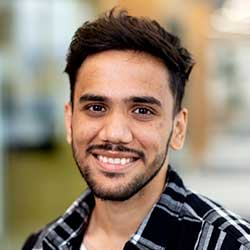
READ: In grad school, Mandar Ambulkar cranked up the pressure — and thrived
Mandar Ambulkar made the most of his CS master’s studies in Silicon Valley by taking on a wide range of academic and extracurricular responsibilities. Initially arriving from Pune, India and focusing on social life and fitness, he quickly shifted gears after discovering opportunities on campus. He simultaneously worked as a teaching assistant and as part of the campus’s audiovisual and IT team, where he supported major university events, including managing live graduation displays for hundreds of attendees. Balancing multiple roles, he developed a structured approach to productivity by breaking tasks into manageable pieces and focusing deeply on one responsibility at a time.
Ambulkar also engaged in hands-on research, collaborating with peers on projects in computer vision and AI. His work on a real-time hand gesture recognition system achieved strong accuracy and efficiency, earning recognition at a student research showcase and sparking interest in applications such as medical training tools. He later contributed to a privacy-focused AI chatbot in partnership with a startup called SurfSense, emphasizing data security and practical implementation. Through these experiences, Ambulkar built technical expertise, confidence, and adaptability.
Kalhar Pandya and Mansi Modi, Vancouver
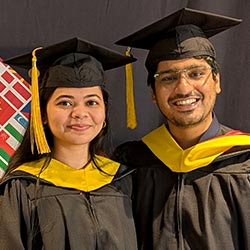
READ: “Northeastern became our second family”: Kalhar Pandya and Mansi Modi’s journey in Vancouver
Kalhar Pandya and Mansi Modi, a married couple pursuing computer science master’s degrees at Northeastern’s Vancouver campus, have built their academic journey around shared goals, collaboration, and community. The two first met as undergraduate students in India, bonding over their curiosity about technology before eventually forming a relationship. Determined to continue their education together, they chose Northeastern for its global reputation and Vancouver for its thriving tech scene. Throughout their graduate studies, they have taken many of the same courses, supported each other through challenging material, and strengthened both their academic and personal partnership.
Beyond the classroom, Pandya and Modi have worked together on hackathons, teaching assistant roles, and workshops, while also building strong connections with faculty and peers. Their experience at Northeastern has been defined not just by academic success but also by a deep sense of belonging. After moving far from home, they found a close-knit support system within their university community, even celebrating their wedding with professors and classmates. As they prepare to graduate and begin their careers, their journey reflects the power of shared ambition and the importance of community in shaping both personal and professional growth.
The Khoury Network: Be in the know
Subscribe now to our monthly newsletter for the latest stories and achievements of our students and faculty