Author: Benjamin Hosking
Date: 07.30.2025
This past April, 32 middle and high schoolers gathered at the STEM Coliseum and Learning Center of Maine to defend the structure from a hypothetical attack. The students toured the building, assessing how they could “defend the castle” both physically and digitally.
“Campers are each given this castle which they have to figure out how to defend on a whiteboard with moats, towers, weapons, gates, and only one entrance in,” says Scott Valcourt, a Khoury teaching professor at the Roux Institute in Portland, Maine. “Then we asked them to turn around and think like the adversary who will attack the castle. When you figure that out, you figure out an aspect of the castle that’s deficient.”
For the budding cybersecurity experts, it was not their first time defending a castle. They had spent a week together in July 2024 at the first GenCyber Camp in Maine, also held at the Roux Institute. GenCyber, a government-supported program sponsored by the National Security Agency, aims to inspire the next generation of cybersecurity professionals by providing experiences for students and teachers at the secondary school level.
“That principle of thinking like an adversary resonates throughout the week as one of the concepts one needs to think about when considering cybersecurity,” says Valcourt, who directed the camp. “Then translating that thinking to apply those principles to passwords, systems, websites, etc.”
Because the camp was free and residential, students from across Maine could attend, leveling the playing field by offering access to every student.
“Cyber is a growing field, and we need to provide opportunities for the youth, particularly in Maine, to explore the concept and to see it as a viable career option,” Valcourt says. “Middle school tends to be the time period when you’re looking at technology as a direction for a career; high school can be too late.”

“A program like this introduces students within the K-12 space to STEM. Our ultimate goal is to get them excited about the field and realize it can be for them,” adds Gary Cantrell, director of computing programs at the Roux.
Cantrell was the lead curriculum instructor for the camp. He collaborated with Lindsey Jamieson, a Khoury teaching professor and associate dean of teaching faculty who specializes in K-12 computer science education, to adapt the complexities of cybersecurity to an informative and fun experience for sixth through ninth graders. Each day, the camp instructors would introduce a cybersecurity concept, followed by a related game or exercise.
“I designed the course from the ground up, starting with how a computer works and then each day focusing on a different, relevant topic like cryptography, networking, or digital forensics,” Cantrell explains. “That’s what a cyber specialist is; you’re a jack of all trades and need to know how everything works.”
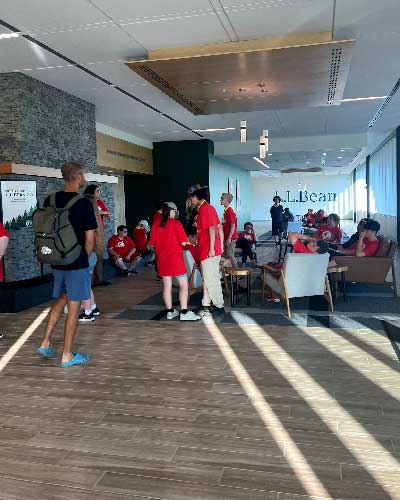
In between activities, there were field trips to the Portland Museum of Art and the Portland Observatory, both walking distance from the Roux Institute. The campers toured the L.L. Bean headquarters with one of their cybersecurity professionals to get a sense of how a large retailer handles cybersecurity. Guest lecturers from colleges and high schools across the state came to speak.
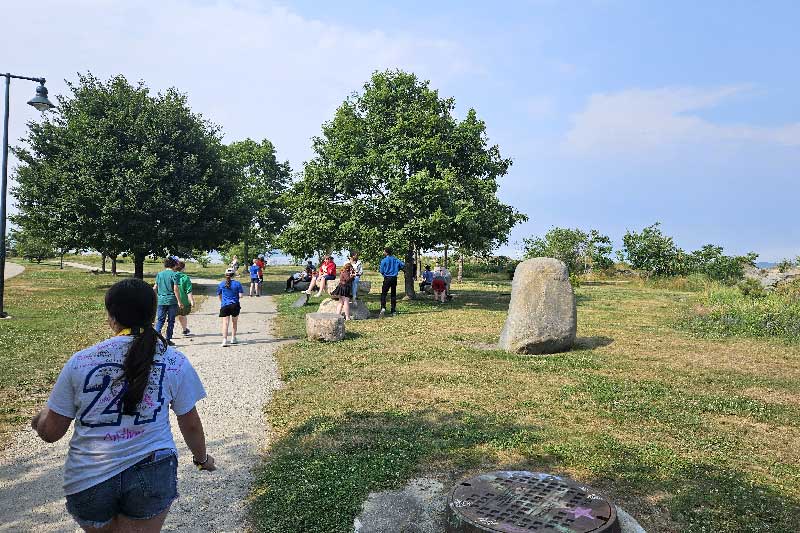
Two events brought the lessons together: a scavenger hunt on Peaks Island that involved geolocation and code breaking, and a big game of capture the flag that involved hidden messages and codes to open a box with a final prize.
Valcourt and Cantrell both expressed how refreshing and fulfilling it was to teach middle school students about cybersecurity.
“It’s always fun to see someone’s realization when they peek behind the curtain,” Cantrell says. “Every time you take a photo on your phone, it embeds the GPS data of where it was taken. That was a lot of fun, they saw behind the curtain.” The scavenger hunt functioned as an online safety lesson, showing students how easily they could be tracked.
“Coming out of the GenCyber camp, we learned a lot about running a camp for middle schoolers in their summer break season,” Valcourt adds. “Middle schoolers are a tough audience, and we’re thinking about how we might translate what we learned into programs on other concepts.”
Those future efforts just might get even more ambitious. After the students spent the latter half of their day at the STEM Coliseum learning about drone flight and the real-world cybersecurity issues it poses, Valcourt saw the potential for a Maine-based team for drone soccer, a competitive sport integrating computing, aerospace, and teamwork skills for K-12 students.
Cantrell was especially glad to see that even after many months and the big change of starting high school, the campers had retained key lessons from the previous summer.
“The number one lesson I try to get across is not technical at all, it’s about balance,” he explains. “Computer security is about balance. The more secure you make something, the less accessible and usable it is. They retained that. As an instructor, that’s your biggest hope, that they retain the big lessons.”
The Khoury Network: Be in the know
Subscribe now to our monthly newsletter for the latest stories and achievements of our students and faculty
Author: Madelaine Millar
Date: 07.10.25
Before she’d even finished her bachelor’s degree, Marcela Perro knew she didn’t want to work in communications.
While she enjoyed the handful of web design courses she’d taken, as a first-generation college student pursuing a degree in a second language, she didn’t feel like computer science was for her — even though the field tempted her.
After she graduated from Utah Valley University, she began work as a project manager, moved to Montana, and had two children. But her desire to pursue tech never faded, and after the pandemic, she decided to take the plunge and go back to school for her master’s degree in computer science.
“We moved to Montana when my second baby was two months old, and my husband said, ‘You’ve been wanting to do this degree; why don’t you try it out?’” Perro recalled. “That’s when I found the Align program. I started talking to one of the recruiters, and it was like, ‘OK, I think this is really gonna work out’ … I felt like they really valued all my life experiences.”
Align is Khoury College’s master’s program for students without undergraduate computing backgrounds. Students begin with four bridge courses on foundational computing topics, then join their direct-entry peers for more specialized coursework. In addition to being offered at several Northeastern campuses, the Align program is available online, with three first-year, in-person residencies to allow students to form community with their peers.
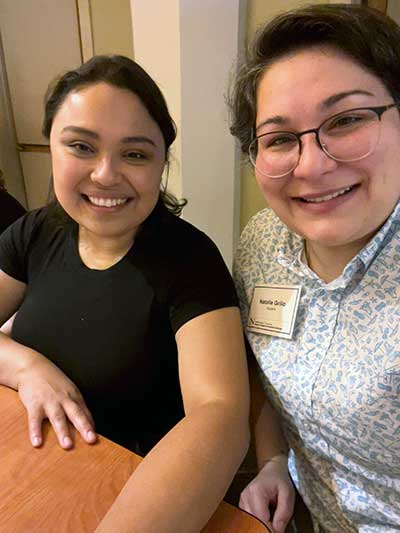
“When I went to the first Align program residency, I loved it. I loved everyone that was in the program; it was so welcoming,” Perro said. “I met a lot of fellow students, and we would plan out courses that we wanted to take together to have that extra support. We always get on random calls, and I’ve developed a lot of friendships in the program that are going to be lifelong.”
That’s not to say that her first year was easy; like many Align students, Perro dealt with impostor syndrome, and she worked hard to cover a lot of complex new material. In particular, she found herself struggling in “Intensive Foundations of Artificial Intelligence,” which was her first experience using Python.
READ: Impostor to Aligner: How LeAnn Mendoza found her way to data science
“The help that I got from the TA and Professor Albert Lionelle made a huge impression on me,” she said. “I decided to be a TA for the course once I finished my bridge year because I wanted to help students that were in my position, where they just felt that they couldn’t power through. I would tell the students that when I started, I had no idea what I was doing, and look at me — I’m a TA now!”
A year and a half into her degree, Perro landed a role in cybersecurity for the state of Montana, automating processes like phishing notifications and alerts for suspicious logins to ensure cybersecurity risks are caught quickly and handled consistently. Perro said she found the job “100%” more enjoyable and fulfilling than her previous work. To help her thrive in her new role, she even did an independent study focusing on mitigating cybersecurity risks by using automation and log management to improve threat visibility and streamline responses.
The new job left her with less time for school, though, so Perro was grateful to find that she could lighten her course load by adding a year to her degree, ensuring she didn’t have to choose between her education and the job it was preparing her for.
“Talking to my advisor, that was the best thing. I would meet with them every semester and say, ‘This is what I want to do,’ and we would draft a roadmap with the courses that I needed to complete,” Perro said. “As a woman also in a male-dominated field, it can be a little daunting to set those boundaries, but I’m not going to feel bad setting a boundary, because that’s just how life is. To make it work, I have to be transparent.”
As Perro takes stock of the job she enjoys, the family she loves, and the remaining year of her degree that she’s preparing to tackle with a cohort she cares for, she’s glad that she took the plunge and transitioned to tech. She hopes other people considering a master’s degree through Align understand that the complexity of their lives doesn’t have to stop them from making the career change they want.
“It doesn’t have to be all or nothing; your focus doesn’t have to be 100% on transitioning into tech,” Perro said. “That can be part of your roadmap, but you can also do other things that you like. There’s flexibility in being an online student; you don’t have to burn yourself out. If you’re passionate about it, then you can 100% accomplish it.”
The Khoury Network: Be in the know
Subscribe now to our monthly newsletter for the latest stories and achievements of our students and faculty