Author: Elizabeth S. Leaver
Date: 08.14.2025
Milo Margolis wants to make his mark on the Boston rental market, and he’s hoping his newly launched AI-powered leasing agent is bringing him closer to doing just that.
Margolis, a fourth-year computer science major at Khoury College, was inspired to create HouseFly following a 2024 Dialogue of Civilizations in Belgium in which he and his cohort were instructed by their professors, Mark Fontenot and Eric Gerber, to build an app — “something from scratch that has a database and a front and a back end and actually worked,” Margolis says. “And that sparked an interest in wanting to build stuff on my own.”
READ: Pastries and projects: Khoury undergrads study data and software in Belgium
Initially, he and several other Northeastern students built HouseFly as a free matchmaking app to help first-time renters find housing and roommates in Boston by interviewing tenants and weeding out real estate agents who treated their clients poorly.

But within a few months, he realized the limits of the app’s utility and profitability.
“We would be following up with hundreds of people, basically answering the same questions and trying to extract the same information from every roommate group,” he explains. “And the problem was that 95% of them did not close a lease, which is normal for real estate agents in the student rental market. They’re working with 10 other agents; they change their plans all the time.”
That inefficiency, coupled with a desire to transition to “something more focused on AI,” compelled Margolis to ask some of his agent contacts about their workday pain points. The one that stood out: Boston real estate agents spend 60–70% of their working hours answering would-be renters’ questions, qualifying their information, and following up with them — a tedious and time-consuming process of asking and answering the same questions.
“If we can replace that piece and free up another 20 or 30 hours during the agent’s week to get new leads or close deals, we’d be solving an actual problem,” Margolis says.
Margolis says the tech behind the newest iteration of HouseFly — an SMS assistant to handle that legwork — was fairly simple to implement. To start, HouseFly purchases a 10-digit phone number capable of application-to-person messaging for the real estate agent to use as their SMS assistant. Once the number is registered and legally cleared for commercial text messaging, HouseFly uses LLMs to generate natural questions and responses; a Supabase database to store users, responses, and prompts; and AWS-Lambda to deploy the software.
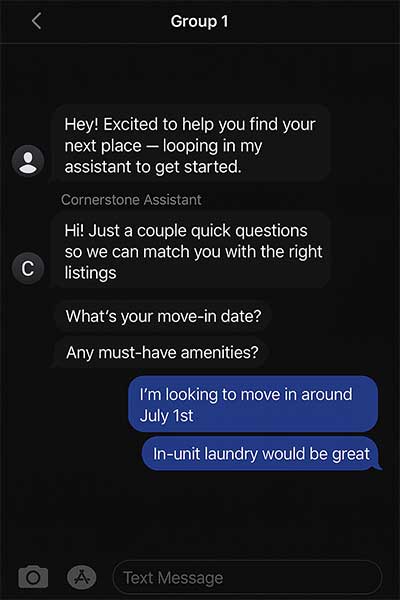
For the AI component, HouseFly uses OpenAI’s API to generate standardized screening questions for renters based on their initial inquiries about preferences and requirements.
“We just integrate with MLS, the Multi Listing Services API, to get access to what houses are available and in what areas,” Margolis explains. This integration allows the system to cross-reference renter preferences with available properties in real time, pulling listing data including price, location, amenities, and availability.
A real estate agent would start the process by creating a group chat that includes the AI assistant and the prospective renter. The assistant automatically initiates a structured interview process, asking standard qualifying questions —”How many bedrooms?” “What’s your price range?” “Preferred neighborhoods?” — that would typically require agent time. The AI parses the responses, structures them into standardized data fields, and auto-populates them into a Google Sheet.
Margolis notes that many agents might not be ready to use AI for workday solutions quite yet. But he’s hopeful that the simplicity of essentially creating a group chat — and tech doing the rest of the work — will entice more agents to get on board.
Anthony Contreras, a real estate agent at Cornerstone Real Estate, first connected with Margolis when Margolis was looking for an apartment. Contreras said he had a positive experience with the original matchmaking app and with Margolis — “he’s very outgoing, very eager, very knowledgeable and smart” — and is eager to explore the capabilities of the AI assistant during the upcoming fall lease-signing season.
“We rent about 300, 400 apartments every season, so the questions are going to accumulate,” he says. “To have a system in place … that has all the answers will free up a lot of our time and make things easier.”
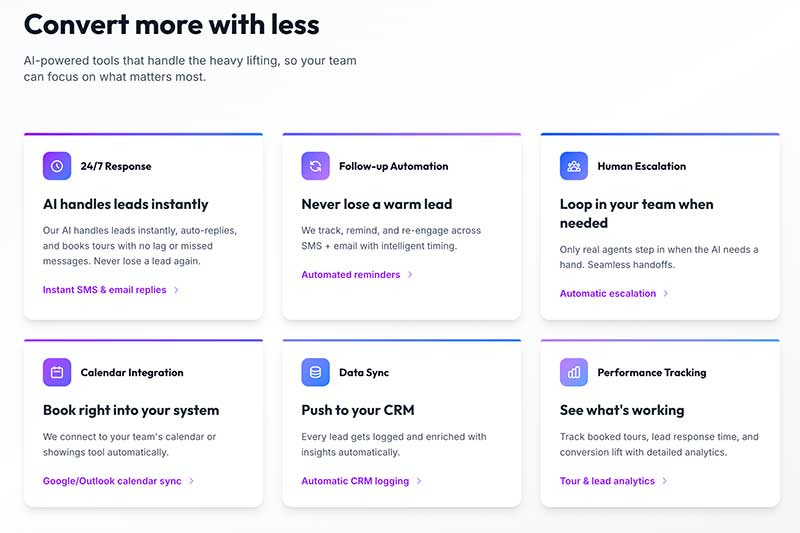
HouseFly is monetized as a subscription service for now, but Margolis stresses that his primary goal is to improve utility for a variety of brokerages.
“I’m more just trying to figure out if we can make something that’s useful for people and then we can figure out how they how much they’d be willing to pay,” he says.
Margolis credits both the structure and leaders of his Belgium Dialogue as instrumental in giving him the confidence and chops to get HouseFly to where it is.
The experience “definitely built us up not only as programmers, but just as people confident to try things and build things.”
The Khoury Network: Be in the know
Subscribe now to our monthly newsletter for the latest stories and achievements of our students and faculty
Author: Emily Spatz
Date: 08.06.25
Research a product online, and suddenly you’ll see ads for it across every website you visit. It’s a routine part of using the modern internet that most people have come to accept.
But for Seyed Ali Akhavani, a doctoral candidate at Khoury College, the experience was annoying — and slightly concerning.
“The websites that are showing ads to me know something about what I’ve been doing on the web,” Akhavani said. “That didn’t seem right to me, because there’d been some data shared with venues that I wasn’t aware of.”
With the help of joint Khoury College/College of Engineering Professor Engin Kirda and Florida International University Assistant Professor Amin Kharraz — who graduated with his doctorate from Khoury College in 2017 — Akhavani created a solution: PriveShield. The mechanism, Akhavani’s second doctoral project, strikes a balance between protecting users’ privacy and preserving website functionality.
PriveShield (pronounced PRAI-vuh-sheeld) uses existing but little-known privacy features of browsers and automates them for users, Akhavani explained. The team detailed its findings in a paper published in January.
“One focus of the work was to allow people to use existing privacy tools in browsers and to expand the capabilities of browsers to make privacy easier,” Kirda said.
Before digging into solutions, Akhavani researched exactly how websites obtain users’ data. The answer comes down to “cookies” — files containing user data that websites store in a user’s browser. Some cookies track returning users or save login information, which can be helpful to the user.
But other types of cookies — called “third-party cookies” — enable the modern online ad system and can pose privacy issues. Website administrators don’t own the advertisements they display; they collect them from third parties that set their own cookies on a browser, Akhavani said.
“That’s how they can identify you in the future,” he added, explaining that third-party cookies are the reason ads can track users across websites.
Solutions exist, but for website visitors and owners, they are far from optimal. Ad blockers limit owners’ ability to make revenue. Incognito browsing tabs don’t save any user data, which can mean no saved passwords or browsing history for the user.
“The question here is, ‘Is there a way to share less data from the user, or not share users’ personal data to everyone out there, but still show ads and make the whole revenue system work without totally blocking cookies and ads?” Akhavani said.
One way to do so would be to manually create separate browsing profiles for each category of website a user visits — shopping or news, for example. That way, data can only be shared between websites within each profile, Akhavani explained.
But most people don’t realize this is possible … or how to do it.
“It’s going to take you a ton of time, and it’s impossible to do that if you want to have a sleek user experience,” he said.
This is where PriveShield comes in. Instead of manually creating different profiles, it automates the process. When a user spends a lot of time on a website, PriveShield creates an isolated profile for that website category. Other sites can’t access data from that browsing session unless they’re in the same category.
“You don’t have to click on anything. You install the extension, surf the web, and it automatically takes the patterns that you use to visit the websites, gets the categories, and creates all those profiles for you automatically,” Akhavani said.
Another positive of the extension — which Akhavani tested on Google Chrome — is that unlike some other privacy mechanisms, websites can’t recognize it.
“Ad blockers do work, but more and more websites are blocking them. You sometimes need to disable them for the specific website you want because people don’t want to lose revenue,” Kirda said.
In testing, PriveShield was 90% effective at protecting users from unwanted tracking across websites. But to be available and effective for users, PriveShield would have to be updated often to keep up with rapidly evolving web browsers. So instead of putting the extension on the market themselves, the researchers hope that industry will take the baton.
“Rather than us maintaining it for many years, it’s better if browser vendors take the ideas and implement them,” Kirda said.
The Khoury Network: Be in the know
Subscribe now to our monthly newsletter for the latest stories and achievements of our students and faculty
Author: Emily Spatz
Date: 08.05.25
Yan-Bo Chen knew what it felt like to be unsure about which courses to take to ensure career success down the road. As a student in Khoury College’s Align program — which allows students without a computing background to earn a CS master’s degree — he wanted a quick and simple way to understand which credits would fulfill his graduation requirements.
So Chen, along with classmates Yifei Ma, Weihang Ding, Yilin Pan, Sitong Zhang, and Jiuyue Shang, built an app to help out.
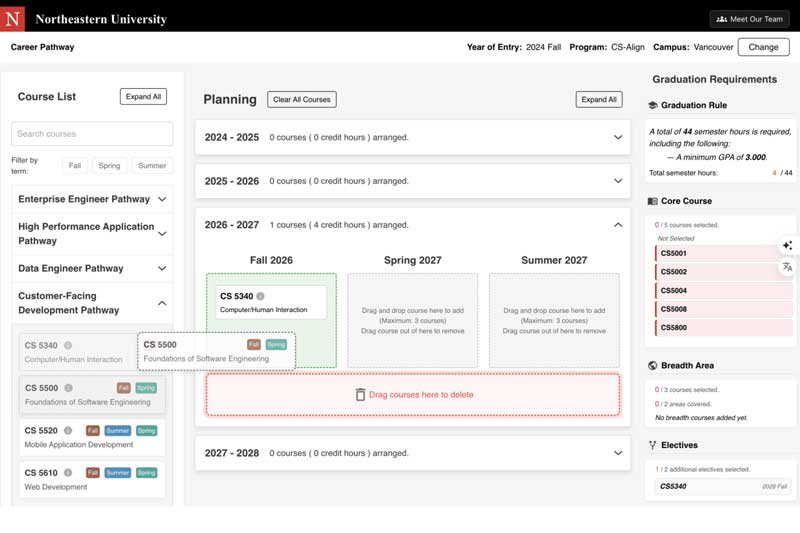
After studying computer science for only a few months — and while juggling 40 to 50 hours of coursework each week — the team created and deployed the Career Pathway Course Planning Application, a tool featuring a drag-and-drop interface that lets students map out classes and align them with potential career paths. Not only did the project help team members apply class concepts, but it also built their teamworking skills and bolstered their resumes.
“That seed of an idea grew into something much bigger, and that’s where it all began,” Chen said.
The Career Pathway tool is available to students in the Align and direct-entry CS master’s programs at the Vancouver campus and is designed to expand to the Seattle campus next.
As is typical for Align students, the teammates had vastly different experiences before they joined the program. Chen had a background in medicine and decided to study computer science because he was interested in how AI and technology could benefit health care. Shang had experience as a product manager. Ma, who holds a bachelor’s degree in chemistry, spent a few years exploring different career options and ended up taking a course in computer software engineering.
As first-year Align students, all three — and their other teammates — faced similar challenges. Course planning wasn’t easy and often required meeting with academic advisors or digging through information online.
“I remember many students were saying they felt unsure because most of us do not have a background in computer science and step into this field to figure out what kind of career path we want to choose,” Chen said.
After a conversation with Ildar Akhmetov, Khoury College’s director of computing programs in Vancouver, the students decided to tackle the problem head-on, coming up with the initial concept for the Career Pathways application in fall 2024. But as full-time students with limited computer science experience, getting started was challenging. That’s when clinical instructor Neda Changizi stepped in to advise the team.
“When they came to me, they had already started but were a little lost in terms of how to divide the work and track progress,” Changizi said.
She began meeting with the team every two weeks, helping them break down tasks and manage their time. She also guided them through the more technical aspects of the project, giving them learning resources and tips on software design.
“I’m very impressed by how dedicated and enthusiastic they were, especially because they didn’t have to do this,” Changizi said. “This was a very complex project, so it was really impressive how they wanted to make this work.”
The team began work in the spring, setting up a GitHub-based workflow. They continued meeting every two weeks to discuss goals and accomplishments and to assign tasks.
“It was definitely challenging, especially at the beginning,” Ma said, adding that the students had disagreements about workflow and how much their project sponsor Akhmetov should be involved.
“Looking back, thanks to my amazing teammates, none of the challenges seem too overwhelming now,” Chen said. “After we worked through those initial communication differences, the team dynamic became really strong.”
The students credited the support and encouragement from the university and professors like Changizi with helping them succeed.
“Having professional support saved us a lot of time because otherwise we would have to do a lot of trial and error before realizing what would be a good approach to teamwork in the context of software development,” Ma said.
Shang said one of her biggest takeaways from the project was the value of mistakes.
“You keep making mistakes and you keep learning new things during the process, and this is really rewarding,” she said.
While the software is currently independent from Northeastern, the team hopes to integrate the tool into university course planning and expand services to other campuses, all as they iron out kinks and design new concepts. After presenting the project to Ben Hescott, Khoury College’s senior associate dean of academic programs and student experience, they emerged with more ideas for integrating co-op and career development opportunities into the tool.
“We’re trying to expand to other programs, especially within Khoury College, because that’s what we know best,” Ma said.
“We believe this kind of integration could create a win-win-win scenario for the university, the students, and the administrative teams alike,” Chen said.
In the meantime, Ma and Chen created their own student interest group called the Project Forge Lab to encourage peers to pursue independent or collaborative projects outside of the classroom.
“We hope our initiative can inspire many students across different campuses so they can start something similar,” Chen said.
“We felt like our experiences really contributed to our future, and we want to provide a similar experience to our colleagues,” Ma added, noting that their self-guided project “helped fill the gap between what happens in class and what happens in industry, because very rarely are projects solo.”
Shang encouraged students to take the leap.
“Don’t be afraid if you are inexperienced,” she said. “The most important thing is to stay curious, ask for help when you need it, and keep learning.”
The Khoury Network: Be in the know
Subscribe now to our monthly newsletter for the latest stories and achievements of our students and faculty