Author: Caroline Baker Dimock
Date: 09.29.25
Hidradenitis suppurativa (HS), sometimes known as acne inversa, causes inflamed nodules, abscesses, and scarring in some of the body’s most sensitive areas. Beyond physical suffering, patients face isolation, delayed diagnosis, and limited treatment options. Stigma often prevents patients from seeking help, and when they do, many are misdiagnosed. Despite its prevalence — it affects nearly 1% of the global population — HS remains poorly understood, as researchers have lacked the structured, large-scale data necessary to identify its hidden triggers or predict its flare-ups.
A new Khoury-led study tackles the HS challenge with an AI-driven, interdisciplinary approach. By combining generative AI with advanced machine learning, a team of researchers including Divya Chaudhary, Shagun Saboo, Peng Zhang, and Rishabh Jain created the first predictive models for HS flare-ups.
“This disease not only gives patients painful nodules filled with pus, but it keeps coming back — even after surgery,” said Saboo, a recently graduated master’s student in data science. “There is no cure, and many people don’t even know they have it. That’s why we felt it was necessary to bring this disease out into the open.”
The team, which included Khoury researchers based in Boston and Seattle, titled their study “When Pain Hides in Silence: ML-Driven Flare-Up Prediction for Hidradenitis Suppurativa Using Synthetic Patient Data” and published it at IJCAI in August. It includes the results of a 65-question survey covering diagnosis history, treatment response, lifestyle habits, environmental exposure, and psychological impact. Using GPT-4o, the team generated 10,000 synthetic patient profiles to simulate diverse experiences of HS sufferers.
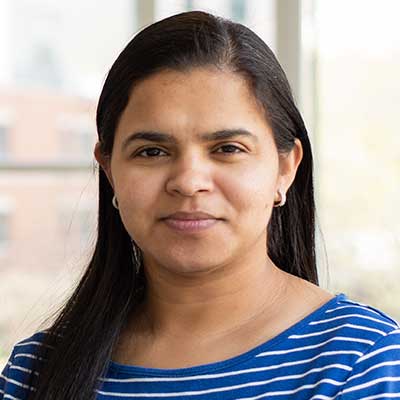
“Synthetic data is not real patient data, but it is statistically realistic,” explained Chaudhary, an assistant teaching professor at Northeastern’s Seattle campus. “This isn’t a replacement for clinical data, but a bridge. It helps us move fast while respecting patient privacy, and it gives other researchers a starting point.”
READ: Assistant teaching professor Divya Chaudhary pioneers novel melanoma detection method
The researchers tested a range of predictive methods, from decision tree, random forest, and XGBoost to advanced recommendation-based architectures.
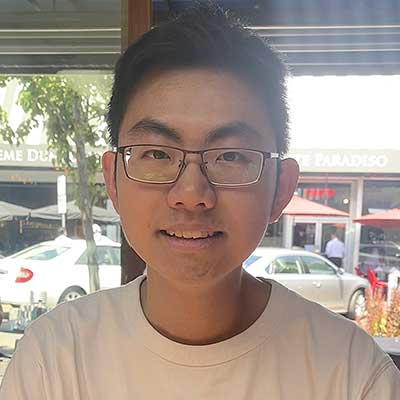
“We tested six models overall,” said Zhang, now a software engineer at Meta. “Random forest performed best among the traditional models. But among the advanced recommender systems, our customized YouTube recommendation model gave the strongest overall results.”
These models highlighted significant predictors of flare-ups, including pregnancy and postpartum changes, hair removal methods, occupational factors, and environmental exposures such as chlorinated water. The findings aligned with what patients and clinicians have long suspected but lacked evidence to quantify.
The team is already translating their findings into a mobile tool called HSBuddy, which aims to give patients actionable recommendations tailored to their routines.
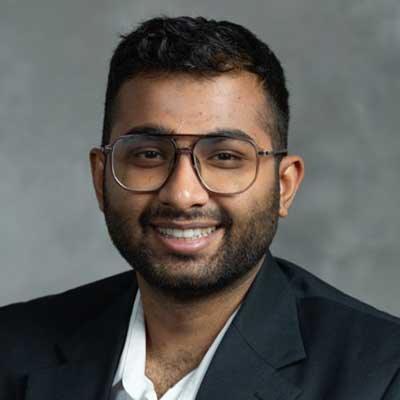
“Our app takes in daily journal-style inputs about diet, activity, or time outdoors,” explained Jain, now a software engineer at Chewy. “Based on that, it recommends what to avoid the next day to reduce flare-ups.”
For now, the dataset remains synthetic, but the researchers see it as a crucial first step toward larger, clinically validated systems.
“Right now, the data itself may not help doctors directly, but it’s invaluable for researchers trying to identify triggers or design predictive tools,” Saboo said. “There’s no dataset like this available for HS.”
“This particular paper is about finding trigger points — what foods, environments, or behaviors worsen HS,” Chaudhary added. “That information can feed into future clinical studies and eventually guide physicians.”
Looking forward, the team hopes to integrate real-world clinical records, wearable sensor data, and genetic information.
“We already have the HSBuddy app built, ready to be powered by real patient data once available,” Chaudhary said. “Right now, it’s running on synthetic data, but once clinical records and sensor data are integrated, the predictions will become even stronger.”
The Khoury Network: Be in the know
Subscribe now to our monthly newsletter for the latest stories and achievements of our students and faculty
Author: Elizabeth S. Leaver
Date: 09.23.25
According to Khoury College lecturer Steve Schmidt, the fundamentals behind his machine learning work aren’t as complex as people might imagine. Despite working for some of the world’s most recognized brands, including his recently concluded role at Nike, Schmidt says the foundational math is essentially the same as that used in everyday applications — and in all the courses he teaches.
Schmidt’s own grasp of those fundamentals involved a diverse journey that included a less-than-stellar undergraduate experience and early career roles in hotel sales and marketing. He had never taken a math course but taught himself math online and from books, ultimately earning a master’s in theoretical math.
He says it wasn’t long before he realized that “you need computers to do most of the cool math,” so Schmidt pursued a second master’s degree, in computer science. His experiences with supportive professors in both degrees compelled him to begin teaching part-time, first at the College of Charleston and then, after relocating to Boston, Khoury College.
“I had a lot of help from people who believed that I could learn this stuff, even with a poor undergraduate resume,” Schmidt says.
The combination of his willingness to do whatever it took — which included “a lot of tests” and watching YouTube videos — along with the support of people who believed in him led Schmidt to his advanced degrees, and eventually, to a career that grew to include roles with Nike, BAE Systems, Raytheon, and Wayfair.
In his role at Nike, which he began in 2022, Schmidt oversaw a team that develops and optimizes machine learning models’ data and objectives. These models customize users’ search experiences, allowing them to immediately see different and more relevant search results.
One such change was the evolution from lexical search, which relies on matching exact words or phrases, to natural language models that allow for more nuanced searches. This enables the machine learning team to provide enhanced and improved user experiences. Schmidt gave the example of a user searching for “marathon-winning shoes”; in the past, results could be more limited because the search term likely wouldn’t match the description on Nike’s website.
“More sophisticated reasoning models enable more of a natural language appeal to how a user would experience that search,” Schmidt explains. “So, you could type in ‘marathon-winning shoes’ and that model will reason over the fact that that’s how people talk about it and then present you with the styles that have been worn by marathon winners.
“From a user perspective, you’ve gone from hoping that the search keywords that you used matched exactly to now expecting results that are more natural language focused,” he adds.
Another experience Schmidt says his team “really bought to life” is when they alter a model that influences users’ individual product recommendations. Mixing what Nike knows about a user’s behavior — what they’ve browsed, clicked on, and put into their carts — with their long-term customer profile (e.g. athletic vs. lifestyle and leisure) “really is the essence of personalization,” he explains.
“The individual experiences, whether it’s for search, browsing, recommendations, what you’re getting in your emails — all of that can be tailored through machine learning to each and every person,” Schmidt says.
And the tweaking is never done.
“It’s always day zero,” Schmidt says. “There’s always the ability to improve on personalizing those results.”
While applications vary in complexity and scope, he maintains that the behind-the-scenes math fundamentals, the same ones he teaches at Khoury College, are generalizable.
“It’s the same math that’s used to train an unmanned undersea vehicle as we use to personalize your website experience at Nike,” Schmidt says. “It’s different applications, but the underpinnings that you would learn in an undergraduate or graduate course are exactly the same.”
As with his students, this fall ushers in a new chapter for Schmidt; he is starting a new role in machine learning research and development at Boston Dynamics. But his commitment to teaching remains steadfast, due in part to the influence good teachers had on his career trajectory.
“That can really make the difference in getting a job and being passionate about your career,” he says.
The Khoury Network: Be in the know
Subscribe now to our monthly newsletter for the latest stories and achievements of our students and faculty