Author: Caroline Baker Dimock
Date: 10.20.25
Each year, Northeastern University recognizes a cohort of trailblazers through the Women Who Empower Innovator Awards.
Launched in 2021, the awards celebrate bold and creative women looking to create change across the university community and the world by reshaping industries and advancing ideas. It’s more than just an award program, as it provides funding, mentorship, and a platform for innovators to scale their impact. Over five years, the organization has distributed $1.8 million to 133 recipients.
This year, three honorees emerged from the Khoury College community. Among them is Hannah Wimpy, a student entrepreneur whose ventures exemplify the marriage of technology and social impact. Her award is the latest milestone in an academic journey defined by interdisciplinarity and curiosity.
“I came into college and I couldn’t find a major that I liked. None of them fit exactly, so I thought, ‘Why don’t I make one?’” said Wimpy, a Stamps Scholar in the John Martinson Honors Program. “I used to be a pharmacy technician, so I was interested in pharmaceuticals. I also ran my own full-stack development firm in high school. Computational biophysics combines all of that — biochemistry, computer science, and physics.”
Her independent major allows her to take courses ranging from quantum physics to machine learning to biochemistry.
“Most of it is math,” she said. “Some people would hate that, but math is the foundation of everything. I never get bored.”
At Northeastern’s Center for Drug Discovery, Wimpy developed new methods to understand how molecules interact within the body. Later, while on co-op at Harvard Medical School, she created machine learning models of voltage-gated ion channels.
“Ion channels are important for anything from epilepsy to autism — they literally dictate how our bodies function,” she explained. “I became really interested in modeling them so that we could understand them better and make better drugs for diseased ion channels. My work uses continuous Bayesian networks, which help us do things we couldn’t with previous models.”
These experiences inspired her to launch Ionova, a software platform that streamlines the drug discovery pipeline.
“Ionova is an end-to-end drug discovery platform,” Wimpy said. “It’s really a bioinformatics pipeline that automates all the little things that slowed me down as a researcher. Right now, we’re focused on coding and building cloud infrastructure, but our goal is to bring preclinical workflows from weeks or months to just days.”
Ionova helps scientists move more efficiently from hypothesis to experiment by providing computational tools that model molecular behavior.
“It’s by scientists, for scientists,” Wimpy added. “Anything that drives you in business should come from real problems. We’re automating the tedious steps in between, so researchers can focus on the parts that are actually intellectually stimulating.”
This project exemplifies Wimpy’s passion for using computer science to accelerate biomedical breakthroughs. Already, Ionova has begun automating aspects of the discovery process that previously required weeks of manual work. Wimpy hopes the platform will be used by everyone from big pharma to academic labs and researchers, even those without huge budgets.
And as she works to make it happen, she’s glad to have a new community to support her.
“I was on the e-board of WISE (Women Interdisciplinary Society of Entrepreneurship), and that was really impactful for me — being part of a community of women entrepreneurs who actually want to do something interesting,” she said. “What’s amazing about Women Who Empower isn’t just the funding, it’s being part of this supportive network. When the awards were announced, everyone was congratulating each other in the group chat. Sometimes it can be really hard to be a founder alone, but this community makes it feel less lonely.”
The Khoury Network: Be in the know
Subscribe now to our monthly newsletter for the latest stories and achievements of our students and faculty
Author: Caroline Baker Dimock
Date: 10.16.25
When Kurt Marcinkiewicz, Tim Sakharov, and Logan Wells graduated from Khoury College in the late 2010s and headed into the world of tech entrepreneurship, they carried a shared vision to build technology that not only connects people digitally but also enriches the ways they connect in real life. That vision has come to life with Atmosphere, an app designed to help Bostonians discover social spots that reflect their lifestyles and tastes.
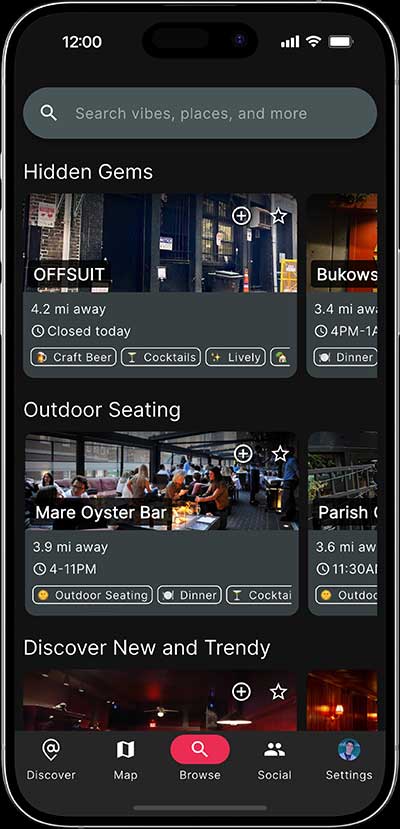
“Atmosphere is an app to help people find hidden-gem bars and restaurants based on vibe,” Marcinkiewicz said. “Like a dimly lit cocktail bar or a Chinese place downtown with a rooftop — ways that a local might describe a local place.”
The idea emerged during the COVID-19 pandemic from a blend of frustration and curiosity.
“For Tim and me in particular, our favorite restaurant going back to when we were at Northeastern closed down,” said Marcinkiewicz. “We were randomly in Brookline one day and stumbled upon this place called Publick House. We were like, ‘Wow, how do we not know about this place? It’s exactly our vibe.’ That’s when we realized that finding a place isn’t always about star ratings or what’s on the trendiest list.”
As the pandemic ravaged Boston’s dining and nightlife, many spots closed for good. Marcinkiewicz, Sakharov, and Wells decided to use the moment as a reset, venturing beyond the obvious and discovering new favorites tucked into unexpected corners of the city.
“Oftentimes you want it to be something that matches your personal vibe, maybe in general or maybe just for the day,” said Marcinkiewicz. “So being engineers, we got to work creating discrete descriptions of places and decided to make an app out of it.”
The story behind the app began during the trio’s time at Khoury College, where they met. While each had unique interests within tech, they shared a common entrepreneurial spark.
“During my time at Northeastern, I had three co-ops at startups. That was a very formative experience,” Marcinkiewicz said. “Now, starting a company, I’m really leaning on those mentors and lessons.”
“I think the best thing that prepared us for this was experiential learning as a whole,” Sakharov echoed. “I only did one co-op, but I also studied abroad and researched with a faculty member. That breadth of experience across different companies and contexts was huge.”
Wells also found the co-op program a formative experience.
“I did three co-ops in the five-year program, and that experience — actually getting time on the job — is what prepared me for working in software dev professionally,” he said. “When [Marcinkiewicz and Sakharov] told me about this idea, I immediately thought, ‘Wow, this is solving a problem I’m having in Boston as well.’ That’s the kind of mindset I built at Northeastern.”
After graduation, the three explored careers in software engineering and product development, but following the pandemic, they kept circling back to Atmosphere. Traditional review sites, influencer posts, and “best of” lists failed to capture the nuance of the spaces they loved.
“The more time we spent on it, the more we realized, hey, this is a pretty cool idea,” Sakharov said. “It was exciting to launch on the App and [Google] Play stores and have people share the same experience we had.”
Atmosphere users can search for places based on moods and atmospheres rather than just cuisine or price. They can browse collections curated by the community, from the best study spots for finals to quirky date ideas to low-key spots to take visiting family. And they can plan nights out by building custom itineraries and sharing them with friends.
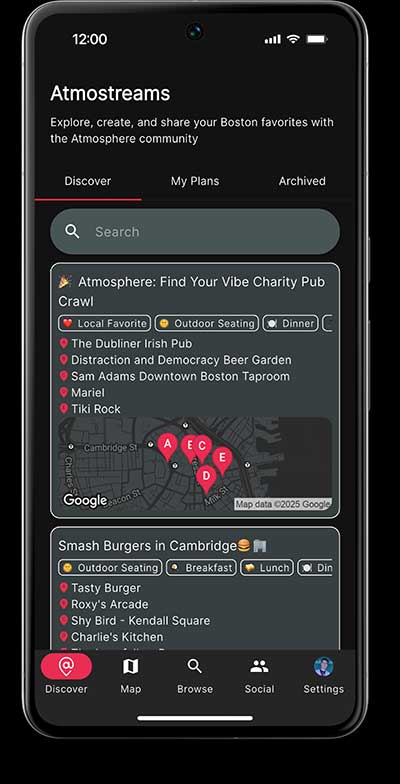
“We sort of see ourselves as the TripAdvisor for Gen Z,” said Sakharov. “We built the app for us — young professionals, college students, folks new to a city. Long term, traveling is going to be a big use case, too.”
The founders see Atmosphere evolving well beyond its Boston launch.
“Boston is a particularly difficult dining market; it is the city that always sleeps,” said Marcinkiewicz. “We felt if we could do a good job here, there’s a good chance we could do well in other cities, too. We’re looking to expand to a couple midsize cities, then New York and LA.”
“I’d love to hear someone tell me one day that they found their new favorite spot on Atmosphere,” Wells added. “I’m hoping it can be the go-to when you’re looking to go out, meet people, or find a shared space.”
And fittingly enough for a trio of college friends, they hope the app can help its users — many of them college students — meet new people. After all, it’s what led to Atmosphere in the first place.
“The people you meet and the experiences you have at Northeastern really shape your opportunities down the line,” Sakharov said. “Even if you take a non-traditional path, it’s about gathering more experiences.”
The Khoury Network: Be in the know
Subscribe now to our monthly newsletter for the latest stories and achievements of our students and faculty
Author: Emily Spatz
Date: 10.14.25
Third-year data science major Vichu Selvaraju knew he didn’t want a typical co-op.
“The biggest thing I was looking for was being able to take control of the work,” he said.
Instead, Selvaraju applied to and was hired by Northeastern’s Co-op Consultancy Program. For six months, he worked with a team of five other students to design, from start to finish, software that could help Verizon retain customers and understand reasons for customer turnover.
The co-op consultancy, which was piloted in fall 2024, is an innovative take on traditional Northeastern co-op. Instead of working directly for a company, teams of four to six students are hired by Northeastern to build business solutions for companies that partner with the university.
The first cohort of students worked for the State Street financial services corporation and in spring 2025, Northeastern added Verizon as a program partner. Students on the Verizon team said their experience was transformative, offering challenges and growth opportunities that other jobs wouldn’t.
“You have so much ownership over the project, which does present many challenges,” said Afnan Tuffaha, a third-year computer science student. “But I find that the greatest learning is done through solving these problems and overcoming these challenges.”
Students built software that aggregates publicly available data about both Verizon’s and competitors’ clients. Machine leaning draws conclusions about the data, and that information is then converted to an interactive dashboard Verizon can use to track client sentiment and turnover. It’s now up to company leadership how they implement and build upon students’ work.
Students said one of the most important skills they learned during the six months was how to interact and communicate with customers. The team met with Verizon executives every two weeks to provide project updates.
“We’ve had so much work in terms of preparation for presentations and meetings and even just ensuring professionalism that I’m very grateful for,” Tuffaha said. “I have so much new knowledge on how to communicate to different people from different backgrounds.”
The opportunity to meet and present ideas to company as well as university leadership gave the students access others rarely get.
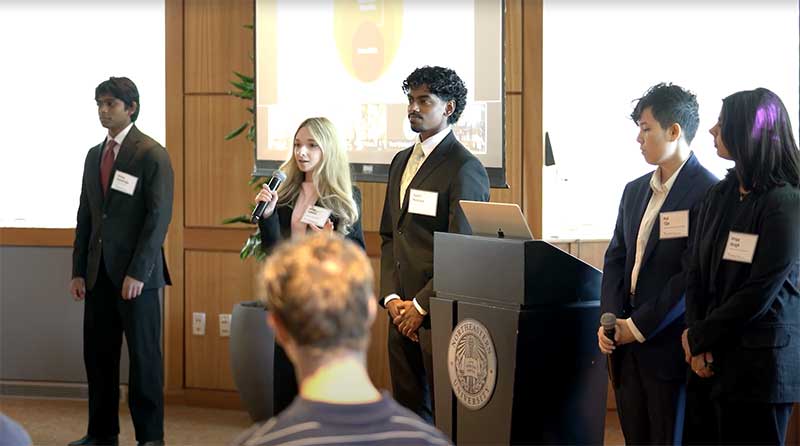
“To meet all these incredible people, communicate with them, absorb their knowledge, and add that to my daily life and work was such a great experience,” Selvaraju said.
Beyond meeting industry leaders, students also found value in working together, another experience not all co-ops offer.
“Everyone I work with is also a co-op, so it kind of gives the energy that you’re just interacting with other students, and obviously we all want to help each other learn things,” said Priya Singh, a third-year computer science and design major.
For Singh, the co-op was also a way to figure out what she enjoys about computer science and design. Because students largely directed their own work, they could choose which aspects of the project to take on. Describing herself as more design-oriented, Singh said challenging herself to help with the computer science aspects of the project strengthened her coding skills and helped her discover an interest in machine learning.
“I’ve come out of the experience knowing way more than I did when I came in,” she said. “I know what I’m good at and what I want to become good at, and I don’t know that I would’ve had that exposure had I done a more traditional co-op.”
Throughout the length of the program, which varies based on client needs, students receive extensive expertise and guidance. Teams are supervised by James Chang-Davidson, Khoury College’s director of industry-aligned student programs, who helps teams every day with technical and nontechnical issues.
“For a lot of students, this is an opportunity to do a co-op with an external partner but have the safety net of the full Northeastern community to support them,” said Liz Zulick, Northeastern’s senior vice chancellor for education innovation.
Mark Fontenot, a teaching professor and assistant dean of student experience at Khoury College, advises teams on everything from technical specs and solutions to making sure they are prepared for client presentations. But the students do most of the work themselves.
“That’s what’s great with these students; they don’t need to have their hands held,” Fontenot said. “You can give them drops of knowledge, and they can take that and run with it.”
For companies, having the insight of both students and professors is valuable, and consulting co-ops offer a new pathway for collaboration. Paul Sullivan, vice president of Verizon, said the company often looks for ways to partner with academia.
“They’re looking at it with totally different eyes,” Sullivan said. “A lot of times, from an industry standpoint, we look at data and we get tunnel vision. When you can bring other folks in and students with the faculty helping to guide them, the world’s your oyster.”
Students on the Verizon team said that as challenging as the work was, it was just as rewarding. If anything, some wanted more than six months to make their solution even better.
“I feel like everyone on the team shared the same idea. We wanted to keep working on it, really bring it to what it could be,” Selvaraju said. “But we’re limited to the six months, and I think we met everything that we had to.”
On the final day of the co-op, the Verizon team presented its final product to senior leadership from Verizon and Northeastern. Sullivan said the Verizon team’s final presentation was “amazing” and expanded on what the company initially asked it to do, looking beyond just Verizon’s customers to include competitor data.
“I saw them at the beginning to where they are now,” he said. “The growth was just humongous.”
The Khoury Network: Be in the know
Subscribe now to our monthly newsletter for the latest stories and achievements of our students and faculty