Author: Laila Griffin
Date: 11.13.25
If your car breaks down, you can call a mechanic, someone who understands how the parts fit together and function. When something goes wrong with an AI model, it’s unclear who to ask for help.
This question is at the heart of mechanistic interpretability, or “mech interp,” a growing research field that aims to open up the “black box” of AI systems and understand them internally, at a structural level.
At the second New England Mechanistic Interpretability (NEMI) workshop, a one-day event held at Northeastern University, academic and industry researchers, students, and professionals gathered to explore this very challenge and share progress in making AI systems more approachable.
“Usually, people look at AI by giving it a different input and seeing how the output changes,” said Koyena Pal, a doctoral student at Khoury College and the lead organizer of the 2024 and 2025 NEMI workshops. “But there’s a whole process inside that this field tries to decouple.”
The event was held on August 22 in Northeastern’s Curry Student Center Ballroom and included more than 200 attendees, some of whom traveled from abroad. A YouTube livestream accommodated around 50 virtual participants.
“We filled up the room,” said David Bau, an assistant professor at Khoury College, senior organizer of the NEMI Workshop, and director of Northeastern’s National Deep Inference Fabric (NDIF) project, which strives to unpack the mysteries of large AI systems. “There are a lot of people in the Boston area who are interested in not just using AI, but trying to explain how the mystery of AI works.”
To bring this vision to life, Pal and the team leaned on community input and the creative use of technology. Working alongside Pal were organizers Alex Loftus and Aruna Sankaranarayanan, logistics supporter Heather Sciacca, and senior program committee members Jacob Andreas, Himabindu Lakkaraju, and Najoung Kim.
After polling participants, Pal and her co-organizers reviewed papers and noted requests to meet other specific attendees at the workshop. They then used a large language model — an AI program trained on large quantities of text — to identify overarching topics of interest. With 24 tables available, the organizers generated 24 topics and identified three or four participants to moderate at each table.
“I kind of felt like a matchmaker,” Pal said. “I felt like I had full access to know what people were interested in and what they were doing.”
The organizers’ efforts paid off.
“At the conference itself, it was nice to know that it was very noisy,” Pal said. “That means people were actually talking! There were hallway discussions, discussions across all the tables, and in the poster rooms.”
Hands-on demo sessions of new tools and initiatives in the mech interp research community followed.
“We demoed our main software, which is called NNsight. We also demoed some new features that are coming out,” said Emma Bortz, NDIF’s technical community outreach and education manager and co-organizer of the NEMI workshop. “We host models for researchers to run these experiments on. We’re kind of an infrastructure for mechanistic interpretability, and we will soon be releasing many new models that researchers can access for free on our platform.”
Among these models is a no-code visualization and analysis tool, Logit Lens Workbench UI, which allows users to interact with machine learning models without writing a single line of code.
“Getting us speaking the same language is, I think, the first step toward this interdisciplinary work,” Bortz said. “This is why we’re developing these no-code user interfaces.”
With its emphasis on interdisciplinary research, the workshop reflected the fact that AI is no longer confined to computer science.
“You want to involve the philosophers, you want to involve the doctors, you want to involve the lawyers, because they’re the ones who really understand the concepts underneath the field,” Bau said.
Bau sees involving other subject-matter experts as crucial to ensuring the technology is applied responsibly.
“A legal expert might be able to explain to me what it is that the AI is thinking, and we could crack open its neurons together and figure out how it all works,” Bau said. “It’s really hard to do that on your own. These workshops are a chance to bring people together and share all these different perspectives.”
One example of such interdisciplinary research was “Discovering Interpretable Concepts in Large Generative Music Models,” in which Dartmouth professor Nikhil Singh and his colleagues combined machine learning and music theory to explore how generative models understand and represent musical structure.
“How do we bridge the gap between the raw statistical horsepower of these models and the structured conceptual vocabulary we humans use?” the paper asks.
Ultimately, the workshop organizers hoped to reveal not only how AI models think, but also how much we have yet to uncover.
“Science is usually a difficult, painstaking, gradual process, but in AI we’re seeing pretty rapid advances,” Bau said. “One of the takeaways that I hope everybody brings with them is what an amazing time it is to be studying this stuff.”
The Khoury Network: Be in the know
Subscribe now to our monthly newsletter for the latest stories and achievements of our students and faculty
Author: Madelaine Millar
Date: 11.10.25
This story is part two of a six-part Khoury News series called “Research that hits home,” which showcases researchers who come from — or form close partnerships with — the communities they study. The first installment covered the principles of epistemic justice and Michael Ann DeVito’s research into queer online communities.
Social media has drifted a long way from the connected community promised by websites like MySpace and Facebook in the early 2000s. For many, being online has become often unenjoyable or sometimes unsafe, and nowhere has this been truer than in the communities of trans women that doctoral student Erika Melder studies.
Which is why their optimism is a refreshing surprise.
“I’m excited to have a vision of social media where people can feel safe and welcome to participate, where I don’t have to fight against algorithms pushing me to engage in a way that I don’t want to, where it feels like the social media we were promised,” Melder said. “Quitting social media is one answer, but I think we can keep social media. It just has to change.”
Melder uses epistemically just methods — which respect a community’s knowledge about itself — to study community governance and boundaries in online transfeminine communities. In doing so, they have identified technical options that could reconceptualize online spaces around users’ needs and desires, creating a more human-friendly internet.
When they wanted to learn about building a livable internet, Melder turned to the transfem community — partly because they were already part of it, but also because marginalized people often suffer through more extreme versions of ubiquitous problems.
“When transfem people are on social media, there’s a risk of harassment, transphobia, all kinds of pushback. It’s framed in broader social media spaces as a debate, and when folks go online, they’re trying to fight a battle against an opposing side,” Melder explained. “In smaller spaces, we can create a space where users don’t have to fight just to exist. These spaces are often refuges for marginalized people.”
Those communities frequently form on social media platforms like Mastodon, Bluesky, and Discord that allow for smaller subcommunities, are often fiercely protective, and frequently share mutual aid resources among themselves. However, most social media platforms are built to value virality and lack tools to insulate a growing community. As a result, these communities often fend off harassers using ad hoc measures like block lists — massive spreadsheets that list users for community members to ignore.
But these measures also make it easy for interpersonal schisms to spiral. Melder gave the example of two large queer communities on the decentralized social media website Mastodon, which had blocklisted one another because two administrators disagreed about how to handle a moderation case.
“When we talked to people who ran these block lists, a lot of them viewed it as mutual aid; they said, ‘This is me protecting my community.’ But the people who were blocked didn’t see it as mutual aid at all,” Melder said, noting that Mastodon’s mechanics ensured lots of people saw every post, pushing the two communities together and turning differing priorities into a source of conflict. “People were using systems like blocklists to fight against Mastodon itself. Mastodon promotes reach, but that’s not what people wanted. They wanted their [community] to be local.”
In addition to interviews, Melder gathered stories like these using an Asynchronous Remote Community (ARC) study, a semi-structured online community in which researchers can post questions, provide prompts, and lightly mediate discussions.
“It allows people to do more creative exercises. We had a lot of visual elicitation, drawing, and collage-making. We had folks submit a meme, give advice to a fictional person, draw their social media space as a house party,” Melder said, describing how these nontraditional questions let them gather both explicit opinions about social media and more subtle insights into participants’ worldviews that are incredibly useful for designing a digital world. “Through those creative insights, we got very rich and useful data that helped so much more than any text interview or focus group.”
To Melder, the most interesting insight was how much people thought about social media as — and wanted to interact with it like — a physical space.
“Going on Twitter is like going to a party where everybody has a microphone hooked up to the house’s stereo system; if somebody’s talking, everybody hears it,” Melder said. “But what if Twitter had channels, like rooms within a house party? What if there was a sense of locality where they could converse with each other? What if there were hallways between channels where you could have little conversations?”
Melder also identified two technical changes that could allow users to more comfortably inhabit their digital communities. The first was to return control over a post’s reach to the user, with options like local-only posting and a broader range of privacy settings. They found users often spoke more freely when they controlled who they’re speaking to.
The second was to codify ad hoc security practices like community block lists into platforms. Building community boundary controls into the platform facilitates consistent governance, so blocked users could appeal decisions and blocklist creators could respond to new information.
The initial feedback has been positive.
“A lot of folks are mistrustful of ‘big tech’ in blanket terms, so giving users tools to protect yourself is the natural progression; it’s something that they wanted to see for a while,” Melder said.
They also believe there’s a lot in their study — which was published in CSCW earlier this year — that could benefit internet communities more broadly, including the use of ARC-style forums to hash out community rules and local-only posting to give users more control over their posts. In the meantime, Melder is excited to continue using ARC to study communities they care for and says being a member-researcher helps them have the empathy, context, and trust to conduct insightful research.
“Epistemic autonomy, to me, is making sure that all people … can experience and express knowledge,” Melder said. “I’m going to take their experiences and say, ‘This is the lived truth of my participants; how can I look at the structures we’re building to make that lived experience better?’”
The Khoury Network: Be in the know
Subscribe now to our monthly newsletter for the latest stories and achievements of our students and faculty
Author: Caroline Baker Dimock
Date: 11.05.25
Lace Padilla, an assistant professor in the Khoury College of Computer Sciences and the College of Science’s Department of Psychology, has been awarded the Institute of Electrical and Electronics Engineers’ Visualization and Graphics Technical Committee (VGTC) 2025 Significant New Research Award.
The honor recognizes Padilla’s work at the intersection of data visualization, human cognition, and graphical perception. In particular, her work tackles a deceptively simple question: How do people interpret complex data visualizations when the data behind them is uncertain?
“Uncertainty is a very complicated topic because many people don’t understand how to reason for it,” she said. “I use data visualizations to communicate uncertainty in forecasts — like hurricanes, wildfires, and COVID-19 — and apply what we know about the brain to design visualizations that are easier to understand and better support decision-making.”
Padilla’s work explores how cognitive processes such as attention, memory, and emotion shape a person’s ability to draw conclusions from uncertain displays of data. Her findings have shown that even small design decisions, such as how uncertainty is visually shown or how contextual cues are presented, can dramatically influence how people perceive risk and make choices.
“We’ve found that visualization techniques that show distributional information in an easy-to-count format can actually reduce misinterpretations of uncertain forecasts,” Padilla explained. “This helps viewers make more informed judgments without oversimplifying complex information. This approach, called frequency framing, has been studied in psychology, and we are developing new ways to apply it to data visualizations.”
Padilla and her collaborators, including those in the Khoury Vis Lab, have demonstrated that these techniques help the average person visually quantify uncertainty in forecasts.
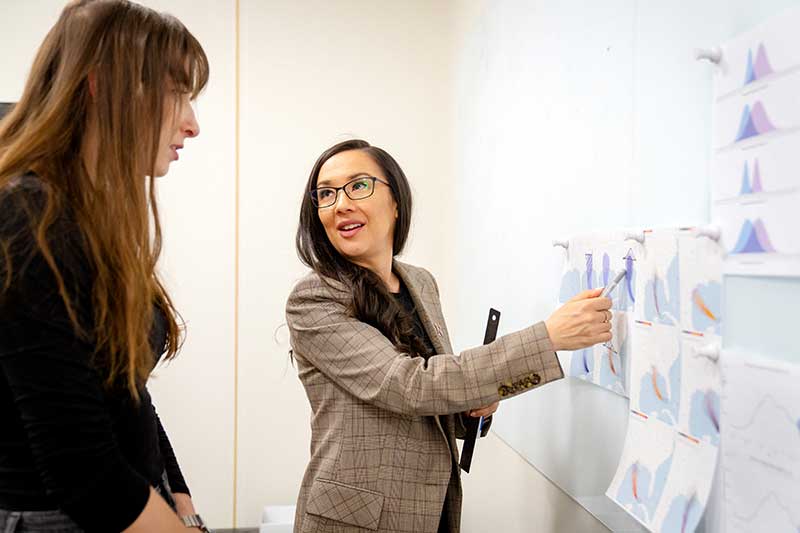
“Visualizations have the power to transcend education and language barriers,” she said. “If designed well, they can allow more people to understand critical information, but if designed poorly, they can make things more confusing. That’s why understanding how people process visual information is so essential.”
Padilla’s joint appointment in computer science and psychology places her at a unique crossroads. While many visualization researchers focus on computational methods or design innovation, Padilla’s work is rooted in understanding how the human brain processes visual information.
“It’s an amazing opportunity to be jointly appointed in two colleges that are both very supportive,” she said. “Northeastern has found a clever way to balance commitments across departments, so I get the benefits of collaborating widely without being overextended. Psychology helps with human subjects research and IRB processes, while computer science has been essential for building strong collaborations in computational modeling.”
Beyond advancing the academic understanding of visualization, Padilla’s research helps to make complex, uncertain information more accessible, equitable, and actionable — empowering non-experts to make data-based decisions in everyday life. In an age of information overload and misinformation, creating effective visualizations isn’t just a design issue; it’s a psychological and social issue, too.
Padilla’s group has collaborated with scientists, educators, and government agencies to design visualizations that help people make sense of uncertainty in contexts ranging from natural disasters to public health. By bridging lab studies and applied design, she’s helping set a foundation for evidence-based visualization, where what we know about cognition directly informs how we present data to the world.

“During COVID-19, for example, there were more than 50 pandemic models produced by teams around the world,” Padilla said. “We’re trying to understand whether people can integrate and reason with those competing forecasts, and how we might visually communicate their reliability and precision. Using this research, we developed a technique called multiple forecast visualizations that can balance trust in the forecast with a person’s ability to predict future events from it.”
Padilla also hopes to continue taking her findings beyond academia.
“I’m really excited to work with industry partners to implement what we’ve learned,” she said. “For instance, we’re collaborating with the Red Cross Climate Center, working in risk-prone regions like Bangladesh to help them interpret competing climate forecasts. That kind of applied work is where we can make a real difference.”
As a VGTC Significant New Researcher Award recipient, Padilla joins a distinguished list of visualization scholars.
“I’m deeply honored and grateful,” she said. “It’s the largest early-career award in my field, only two people receive it each year internationally, and nominations are anonymous. I’m so thankful to whomever nominated me and to the community that has supported me throughout my research career.”
The Khoury Network: Be in the know
Subscribe now to our monthly newsletter for the latest stories and achievements of our students and faculty
Author: Madelaine Millar
Date: 11.03.25
This story is part one of a six-part Khoury News series called “Research that hits home,” which showcases researchers who come from — or form close partnerships with — the communities they study. The remaining stories will be released throughout the fall.
Research starts with a problem.
Sometimes it’s a hard-to-articulate problem with an endless number of possible solutions: Social media is filled with harassment and conflict.
Sometimes it’s an interdisciplinary problem with historical roots: Low-income Black communities experience poor health outcomes.
Sometimes it’s a problem that can never be fully solved: Activists make trade-offs between safety and visibility.
Sometimes it’s a problem whose solutions can only be tested in the real world: Academia has historically treated marginalized peoples’ knowledge as unimportant.
And when a problem has all these characteristics — when it crosses disciplines, resists clear articulation, and is impossible to fully solve — it’s called a “wicked problem.” These are the society-shaping problems traditional research tends to dismiss as unsolvable. But the better answer, says Michael Ann DeVito, is to turn toward your community.
“From the outside looking in, a problem has to start from a deficit; there is something going wrong here. But to solve it from an in-community perspective, you have much more insight into what people want to preserve; that lets us start much, much closer to what we do about it,” says DeVito, an assistant professor with joint appointments at Khoury College and the College of Arts, Media and Design, and the director of the SEALab. “When you’re trying to solve a problem that affects you or people you care about, it’s a lot easier to keep going and to spot surprising things.”
DeVito’s work is built on the assumption that respecting epistemic justice — the idea that people and communities should have authority over their own life experiences — surfaces better answers to more complex questions. Her philosophy has underpinned work at Northeastern since well before her 2024 paper on epistemic autonomy received an honorable mention at CHI, the world’s top human-computer interaction conference, and it’s now helping Khoury researchers make progress on wicked problems in their communities.
So right now, research starts with a problem. But what if it began somewhere else?
How to study the margins, and why
DeVito’s journey into epistemically just research began in 2015. Her PhD advisor was studying user behavior on gay dating apps, part of a larger trend toward member-researchers — someone part of the community they study — among gay men.
“Other contemporary studies were all about pathologizing sexual and health behavior, and had this tone of ‘How do we save these poor, misguided people from themselves?’ Whereas his work captured the joy, the positives, and the benefits, while also being very honest about the safety challenges,” DeVito says. “It was an amazing series of studies. I don’t think it could have happened unless it was someone in the community, living it, that did the research.”
DeVito noticed member research had yet to take off in her own sapphic and trans human–computer interaction communities, so she decided to take a crack at it herself. Because she had seen LGBTQ+ social media communities both transform lives and explode into infighting, misunderstanding, and unchecked bias, DeVito was curious which values LGBTQ+ people broadly agreed on that could facilitate a lasting, healthy online community.
DeVito assembled an Asynchronous Remote Community, the research equivalent of an online community space where participants respond to questions, prompts, and autoethnographic activities, as well as chat with the facilitators and one another about their answers. Meeting asynchronously allowed often-excluded people to contribute, including disabled stakeholders who couldn’t travel and low-income stakeholders who couldn’t miss work. The format also allowed for a lot of disagreement.
“In a good ARC, you can have people work through the conflict they’re going to have to in the end anyway, before you design the big thing that’s hard to completely turn around,” she said. “We’re moving conflict from a post hoc disaster into part of the design process.”
While participants experienced different problems, all agreed on two main values regarding online platforms. The first was self-determination — each person decides what they interact with — and the second was inclusion, the group’s ability to safely welcome different parts of their community. They also wanted to socialize and interact with each other’s content — whether via large social media sites like Facebook, group messaging platforms like Discord, or theoretical future tools — using opt in/opt out structures and local control over algorithms that supported inclusive, self-determined behavior.
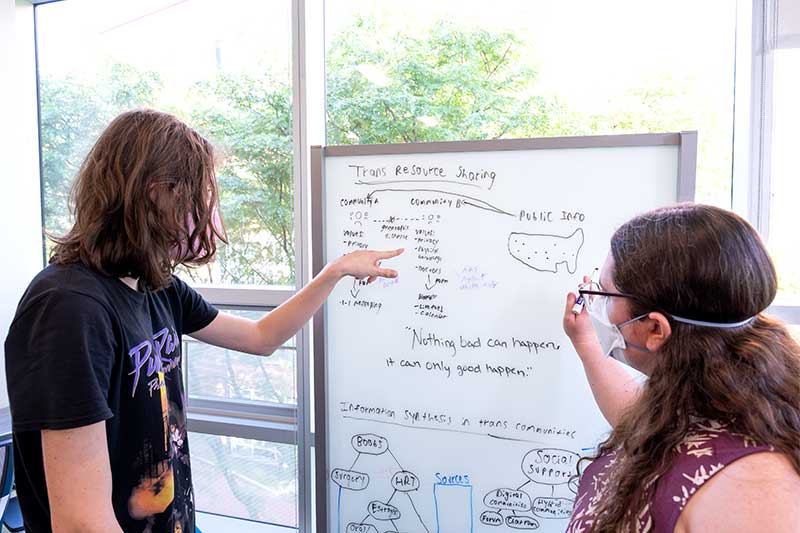
If those ideas sound like they’d work well on mainstream social media, DeVito would agree. Marginalized people often deal with more extreme forms of the problems everyone faces, so solutions that work for edge cases also tend to benefit the center.
“If you work on broad populations without looking into specific groups that are at risk or targeted, it’s like taking cold medicine. NyQuil does not cure a cold, it just handles the worst symptoms so we can move on,” DeVito says. “At the edges, you have to solve the problem. It doesn’t matter how much NyQuil you throw at cancer, it’s not going to help.”
But focusing on edge cases is only half of what gives epistemically just research its insight. The other half is who’s doing the research.
“Research — especially computer science research — has to start from a problem. If you’re coming in as someone outside the community, all you have to hold on to is that problem. You have more potential for balance if you’ve had both positive and negative experiences in the community,” DeVito says. “The thing people claim against epistemic autonomy is, ‘You’re going to be biased writing about your own group.’ But bias comes in when you’re making guesses about a life you don’t know, and all you’ve got to work with are the stereotypes.”
Handling humility
Just because DeVito believes in epistemic justice doesn’t mean she’s always done it right.
In her recent paper “Moving Towards Epistemic Autonomy; A Paradigm Shift for Centering Participant Knowledge,” she offers an example from her grad school days. While studying hijra, a South Asian people who parallel — but are considered distinct from — DeVito’s own transgender community, she relied on a canon penned by white, cisgender academics.
“I now see this as a failure on my part,” DeVito wrote, noting that, contrary to existing research, many hijra view themselves as trans women. “We did not respect the epistemic authority of the hijra, and as a result, we did not even get the chance to consider the nuance that their own diverse understandings of themselves and their needs might have revealed.”
Such examples, DeVito points out, are rarely conscious bigotry. More often, epistemic injustice is an unintended consequence of the traditional research relationship between one who investigates and that which they study.
Aside from the struggle to distinguish stereotypes from reality, this relationship presents a subtler problem: Treating someone as objective doesn’t eliminate their unique worldview. When a researcher’s perspective is treated as objective and authoritative, other perspectives are redefined as subjective, biased, or lesser in relation, and the research can’t be expanded or challenged by new insights from its subjects.
“If you’re doing a traditional quantitative study and something radically surprises you, the design is scuttled; you’ve got to start again,” DeVito says. But within an epistemically just framework, the opposite is true; a radical surprise is a sign of uncovering new knowledge.
While member-researchers are the most straightforward way to respect epistemic autonomy, it’s unrealistic to expect that researchers will only study their own demographic groups. So how can nonmember researchers ensure their methods are just?
The key, says DeVito, is humility.
“You need to get comfortable being wrong,” she says. “A lot of researchers struggle with that because being right is what we’re paid for, but the path to being right involves a lot of being wrong. It’s the first step toward acknowledging you would like to get better.”
Which brings DeVito back to “Moving Towards Epistemic Autonomy.” Published two decades after the hijra study, the new work is co-authored with Indian radical transfeminist Talia Bhatt, who shares her experiences being ignored or harassed when asserting epistemic authority. The paper describes a research culture predicated on superiority and disbelief and lays out actionable ways — like decoupling the ideas of “scientific” and “objective” — that researchers can shift toward justice.
Epistemic justice at Khoury College
When DeVito joined Northeastern in 2023, one of her first acts was to establish the Sociotechnical Equity and Agency Laboratory (SEALab).
“A computer science lab is often based around the type of problem it solves; we’re based around a set of shared values, principles, and tools,” DeVito explains. “We’re methods experts, and the goal is to empower researchers to use accessible, storytelling-based, qualitative, and critical methods to make an impact on the problems directly impacting their communities.”
The lab has attracted graduate students tackling questions that plague queer communities, racialized communities, disabled communities, activist communities, and more.
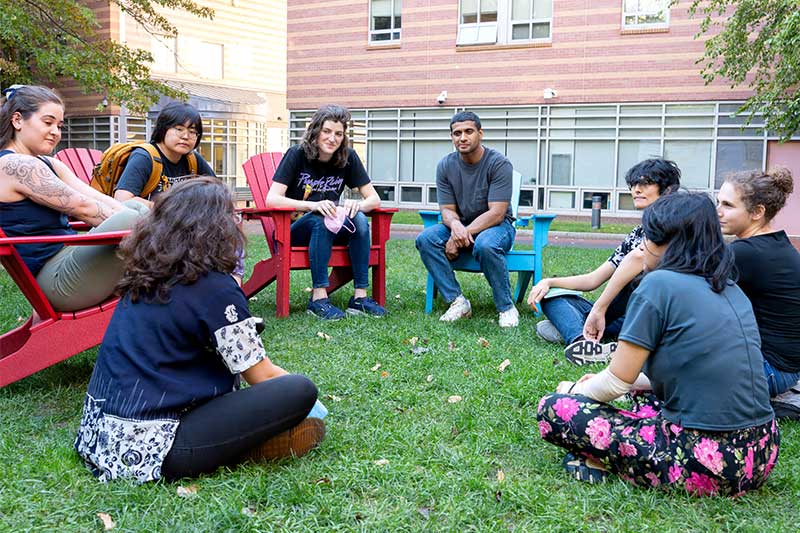
DeVito has also continued to dive deeper into epistemically just research methods, including by spending a year becoming a TikTok influencer to understand how transfeminine TikTok users balance safety and visibility. Since joining Northeastern, she’s also published further theoretical work on epistemic justice and is currently working on an ARC study into asexual and aromantic communities.
DeVito says she’s grateful for the environment at Khoury College, in which she and her students can count on being supported, given opportunities, and treated well, a basic expectation that her trans identity has frequently barred her from.
“It would be foolish to dismiss people’s talent and impact based on immutable identity characteristics; that’s just a given here, in a way I’ve never encountered before,” she said. “Even my colleagues who don’t align with me on larger social issues have trans women in their lab and treat them incredibly well compared to pretty much every other place I’ve ever seen. I think that’s because we have a culture of, ‘Are you good at this? Then we’re going to support you; who cares about the other stuff.’”
Because marginalized people have historically been excluded from academia, DeVito is also excited by Khoury College’s Align program, which welcomes students from nontechnical backgrounds to pursue graduate degrees in computer science.
After spending years focused on research philosophy and design recommendations, DeVito is looking forward to building some of the systems she’s designed, from social media platforms with inclusive, self-determined governance structures to a better sapphic dating app. She’s also excited to see what questions her students tackle with the epistemically just methods she brings into the classroom.
More than anything, she’s excited to see what Khoury culture creates in the coming years.
“Khoury College has something genuinely special,” DeVito says. “If you give people an environment in which they feel safe and heard, most people are pretty damn clever. I think it’s a core piece of what a human is; we all have that potential to discover amazing things, but only if we feel safe enough to do it.”
The Khoury Network: Be in the know
Subscribe now to our monthly newsletter for the latest stories and achievements of our students and faculty
Author: Milton Posner
Date: 10.29.25
The exponential growth of generative AI has sent shock waves through the computing field that created it. With AI now coding at the level of most junior developers, many software engineers are “vibe coding” — focusing on high-level prompting and design while AI generates most of the actual code.
For colleges of computer science, this developing industry practice begs questions. What is the best way to prepare students for this evolving industry? When and how should AI be folded into the curriculum?
“We’re AI-forward in our education,” says Khoury College Dean Elizabeth Mynatt. “We’re embracing our students learning the fundamentals of the field but also understanding how AI tools are transforming the types of software we can create.”
Mynatt characterizes the approach as “crutch to coach to colleague” — a strong belief that while AI cannot replace a rigorous grounding in computer science fundamentals, it will nonetheless be a valuable and ubiquitous coding tool going forward.
“Crutch is when you come in, and you’ve been using AI to fill things in for you, which we know isn’t the right way to learn coding fundamentals,” she explains. “We will expose you to ways that AI can become a coach so you can become a better developer. By the time you graduate, AI will be a colleague you’d work with just as you’d work with other software developers.”
AI use depends on the course
According to Christo Wilson, professor and associate dean of undergraduate programs, each Khoury instructor decides whether AI is forbidden, acceptable, suggested, or required for each assignment or project. However, these decisions are guided by overarching principles.
“Khoury College encourages less — and potentially zero — AI use in introductory courses,” Wilson says. “This approach is because research has shown that unrestricted AI use can hinder learning for beginners.”
READ: Can newbie coders use ChatGPT instead of learning to write code?
“Students who are learning to code,” adds Associate Teaching Professor John Rachlin, “need to struggle and experience firsthand the process of line-by-line coding, testing, and debugging. Then they can level up to eventually use AI effectively and productively.”
Following this pattern, introductory courses like CS 2000 and CS 2100 will emphasize learning and practicing the fundamentals of program design and implementation, with only a brief introduction to the types of tasks AI can do. Iterative assignments, in which students continuously build and improve a project in response to feedback, will hammer these fundamentals home. Only after students grasp these core concepts will they learn to use AI to accelerate coding tasks.
“Effective usage of AI programming assistants requires humans with the ability to specify programs, validate that they do the right thing, and provide constructive feedback to improve them,” says Associate Professor Jon Bell.
In higher-level courses, faculty will incorporate AI in a variety of novel ways. They could explain how to use AI to gather and analyze software requirements, to generate documentation, or to design, implement, and test programs. Some use a “Stump Claude” activity, in which students interrogate the Claude chatbot on course topics to discover where it makes mistakes. Other faculty use AI tools to inject bugs into programming assignments for students to detect.
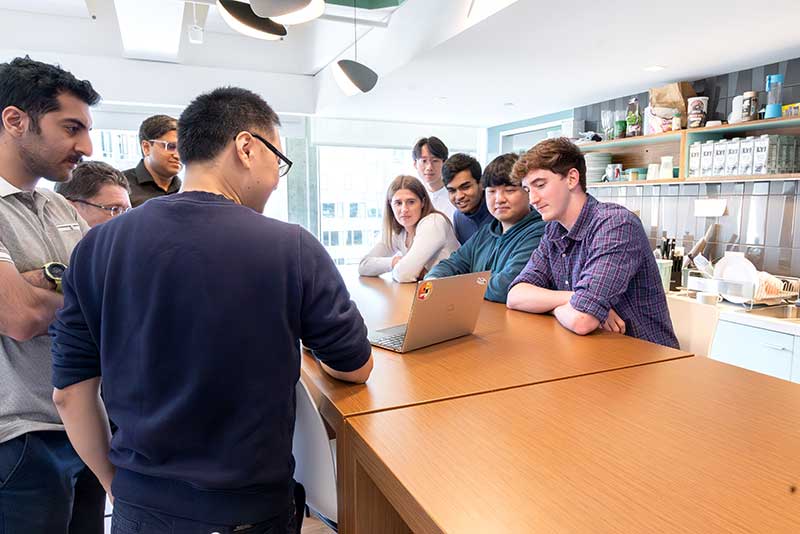
Along the way, faculty will evaluate the efficacy of these approaches by comparing them to established teaching methods.
“This curriculum is also informed by discussions with employers,” Bell adds. “We draw on a significant internal research project at Google that surfaced the tasks that their most productive software engineers use AI for, and the skills and knowledge that they report needing for those tasks.”
By phasing in AI assistance at higher levels where students have already grasped the fundamentals, and by tracking developments in industry, Khoury College ensures that students are prepared for work.
“Due to our co-op program and our collaborations with industry partners, our classrooms are becoming less and less traditional,” Mynatt notes. “Instead of imagining an invisible wall between university and industry, we’re blending the two together. This collaboration helps us keep pace with industry expectations around AI usage because it’s being constantly integrated into our classes.”
Ethics and responsibility
This rapid change also requires a keen eye toward ethics and accountability to ensure that learning remains paramount.
“An ethical approach to AI in the classroom means treating technology not as a replacement for teachers, students, and human effort, but as a supportive tool — a partner that expands what is possible in the classroom and opens new opportunities for learning, reflection, and growth,” says Saiph Savage, assistant professor and director of the Civic AI Lab. “This commitment means choosing AI tools carefully and being transparent about their limitations.
“The rapid development of AI can create fear and urgency,” Savage adds. “Education should not be about adopting every new tool as quickly as possible. The focus should remain on pedagogy and ensuring that technology supports learning goals.”
This learning-first obligation falls on faculty and students alike.

“It is inappropriate to use AI to circumvent the learning outcomes of an assignment,” Rachlin says. “If a student allows AI to do their thinking for them, they are likely relying on AI as a crutch with the narrow aim of getting the program to run correctly. They are ignoring the broader design objectives that are equally important for long-term career success.”
Faculty and TAs are increasingly using in-class, closed-book exams, as well as code reviews that require students to show they understand the work they’ve submitted. Unreadable or poorly designed AI-generated code will likely receive poor marks, and egregious or repeated violations may be referred to Northeastern’s Office of Student Conduct and Conflict Resolution.
By adhering to the spirit of the law, Rachlin argues, students will make themselves indispensable to industry.
“Software design and architectural best practices aim to create code that not only meets specifications, but is also reusable, extensible, efficient, modular, readable, explainable, and secure,” he says. “As of today, generative AI is far less effective at addressing these higher-level design principles.”
For students graduating into a tech sector that’s shifting under their feet, understanding these principles and wielding them to collaborate with AI is the only way forward.
“When other major revolutions arrived in computer science — be they mobile devices, cloud computing, or anything else — we thought of them as new capabilities that were relevant for students, and that we needed to integrate into the fundamentals of what it means to be a computer scientist,” Mynatt says. “We’re thinking about AI in the same way.”
The Khoury Network: Be in the know
Subscribe now to our monthly newsletter for the latest stories and achievements of our students and faculty