Author: Laila Griffin
Date: 1.12.26
From a childhood spent on the water to developing a machine learning application that helps competitive sailors optimize their performance, Nicolai Jacobsen has transformed a lifelong passion into a platform that serves sailors at every level.
Vantage Sailing began as a personal project — a way for Jacobsen to translate his years of sailing experience into useful feedback through data.
Jacobsen, originally from Norway, graduated from Northeastern in 2025 with a degree in data science and business administration. Throughout his time at Northeastern, he continued sailing competitively, seeing many similarities between the complexity of the sport and the problem-solving nature of computer science.
Hailing from a family of Olympic sailors, Jacobsen built on his legacy by finding new ways to enhance performance through technology.
“Sailing is a very technical sport,” Jacobsen said. “You have to adapt and learn how to respond to the changing conditions. It’s kind of like you’re playing chess.”
In the beginning, Jacobsen tried applying simple concepts he learned in class to his own sailing ventures. In using his sailing data to track his performance and give himself feedback, he quickly realized that others were intrigued by his approach and that he might be onto something bigger.
“My friends that I was sailing with, they loved it. So, I decided to do it for a few more people,” he said. “I started thinking to myself, how could I make this into a viable product?”
In the first semester of his fourth year at Northeastern, he created an independent co-op to focus on the project for six months. With the help of Eric Gerber, a Khoury professor whose research interests include sports analytics, Jacobsen refined his idea and began turning it into a practical product.
Having only completed data science classes, Jacobsen approached the business side through trial and error.
“It was a big learning experience,” he said. “That’s the way you learn best, by making mistakes and then figuring it out along the way.”
He collaborated on product testing and user feedback with the Norwegian national sailing team, where his sister Julia competes.
“When I developed the platform early on, I needed someone to test it,” Jacobsen said. “The Norwegian sailing team gave me valuable feedback to help refine the product and usability. They were a huge help.”
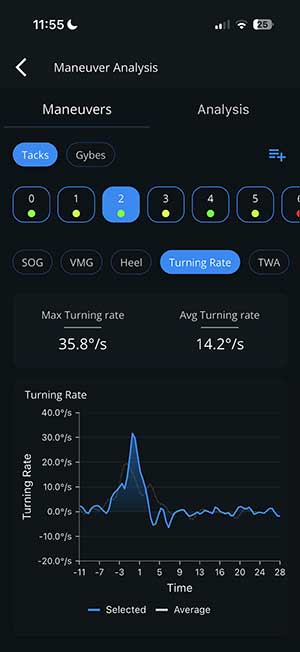
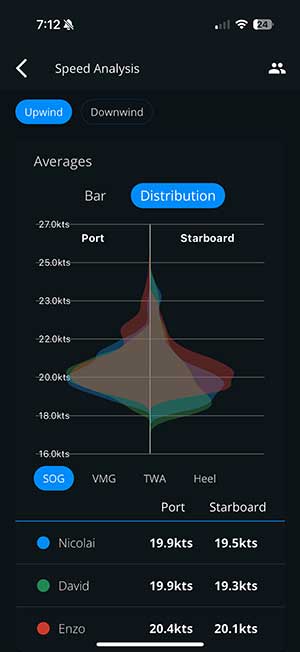
Sailing is particularly data-intensive because there are so many variables at play, including numerous environmental factors. Jacobsen estimates that it would take thousands of sensors to capture everything happening in any given race; fortunately for him, this complexity mirrors the kind of thinking required in data analysis.
“You need to learn a lot of physics to truly understand how a boat works,” Jacobsen said. “That’s always made me think a little bit creatively and critically around the approaches, which has helped in terms of how I look at data algorithms, design, and problem-solving.”
One challenge was designing a user experience that made the data easy to access and understand.
“Because there are so many factors, it is very tempting to go all the way in terms of analytical capabilities — to implement the most advanced AI neural networks and overcomplicate things,” Jacobsen said. “But you need to simplify the insights enough so that sailors and coaches can use it.”
The project started by relying purely on statistical analysis but has since evolved to incorporate more machine learning techniques. A wind prediction algorithm, for example, is trained on data from more than 10,000 uploaded sailing activities.
“The more people use it, the better the algorithm becomes,” Jacobsen said.
Using a random forest algorithm, the model analyzes this data to predict how the wind will shift throughout a session. It’s trained on polar plots, which represent the physical limitations of how fast boats can travel relative to their angle to the wind.
This focus on clarity and usability, Jacobsen says, is where Vantage Sailing sets itself apart. What started as a small project to analyze his own data for competitions now has a team of four and a user base of 1,500 — ranging from amateur sailors to Olympians.
“For a long time, I was the sailor with the most activity uploaded on the app,” Jacobsen said. “Now I’m nowhere close.”
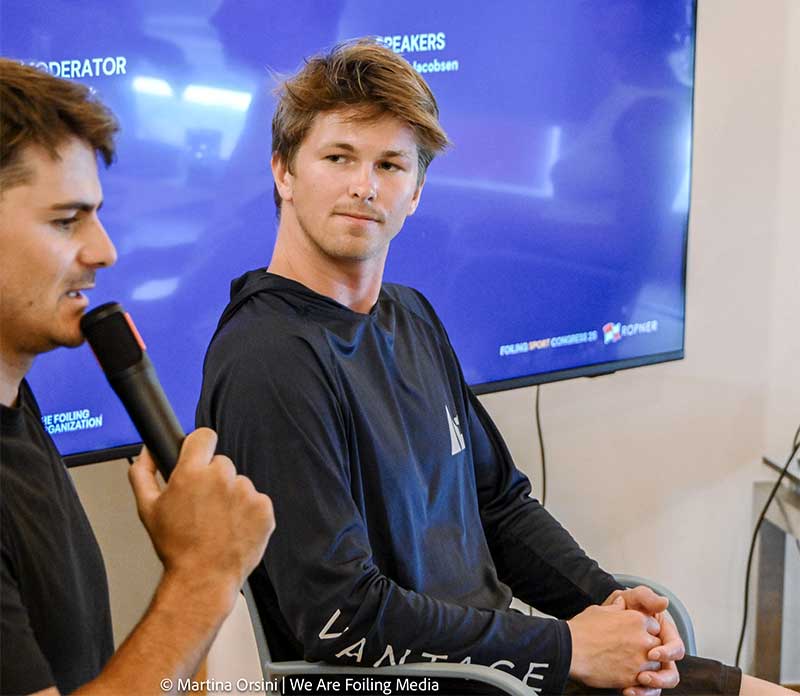
Jacobsen now works at Luna Rossa, Italy’s long-standing challenger team in the America’s Cup — a result of the risk he took to develop the project through a full-time co-op.
“I’ve gone from sailor to performance analyst,” Jacobsen said. “As much as I love competitive sailing, I’ve realized that I love helping aid performance from behind the scenes.”
Looking ahead, Jacobsen hopes to maintain the platform’s user-friendly design while incorporating more advanced tools, with artificial intelligence high on the agenda. Another idea is a virtual coach that can give users even friendlier, more accessible recommendations.
“We’re looking at bringing some of the advanced capabilities behind the scenes and then communicating [those insights] in a natural language form with the user,” Jacobsen said.
Jacobsen also looks forward to incorporating more live processing for a shorter feedback loop where users will get quicker responses.
“Right now it’s a post-training analytics tool,” he said. “What we’re looking to do eventually is bring the insights to on the water.”
As he considers new possibilities, Jacobsen encourages students who are just beginning their journeys to go after their passions.
“So many people have ideas of things they want to do and projects they want to pursue, and it’s very difficult because there’s a really steep learning curve and time commitment in the beginning without seeing any real results,” Jacobsen said. “But you’ve just got to get started.”
The Khoury Network: Be in the know
Subscribe now to our monthly newsletter for the latest stories and achievements of our students and faculty
Author: Madelaine Millar
Date: 1.8.26
For Khoury alumnus Walter Hürsch, the most everyday objects, even a golden semicircle hanging from the ear of a woman nearby, can serve as an inspiration.
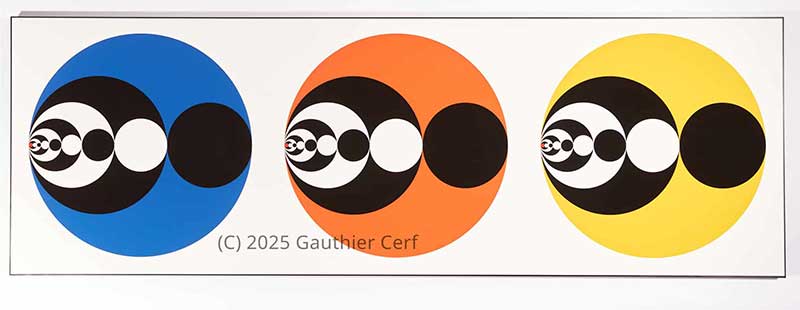
“I started to make a Fibonacci painting based on the semicircles,” Hürsch said. He added more semicircles red and black, arcing out in ever-larger curves along the precise mathematical ratio that defines his work. The design — which Hürsch was still polishing at the time of interview — aims to deliver a sense of harmony, scale, and progression, but “the gold one is where it all begins. That’s the seed where the Fibonacci numbers start, then they grow exponentially to infinity.”
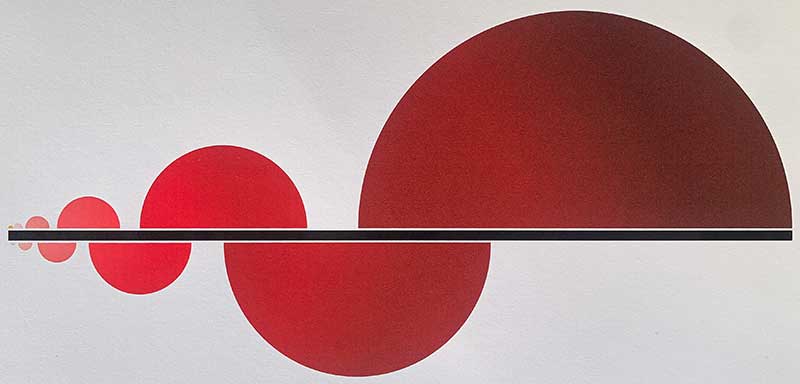
After getting his PhD in computer science in 1995 from Northeastern’s College of Computer Science (now Khoury College), Hürsch spent more than two decades implementing and managing technology services and leading tech startups. Then, in 2021, he launched a second career as an artist, exploring the expansive world of the Fibonacci sequence under the name Gauthier Cerf — a French translation of Hürsch’s name — and using bold abstract compositions to make known mathematical truths into felt aesthetic realities.
Hürsch’s transition into art didn’t come until he was 57. He had finished a six-year term as the CEO of the health care company BlueCare, and a number of other startups were offering board seats, C-suite positions, and venture capital investment proposals. Instead, Hürsch took a month off to hike through Switzerland and clear his head.
“That was the point where I thought, ‘What do I do next?’” Hürsch said. “The tech offers were fascinating, but somehow it was more of the same. I’ve seen technology and I love it, but there was another thing in me that I wanted to do.”
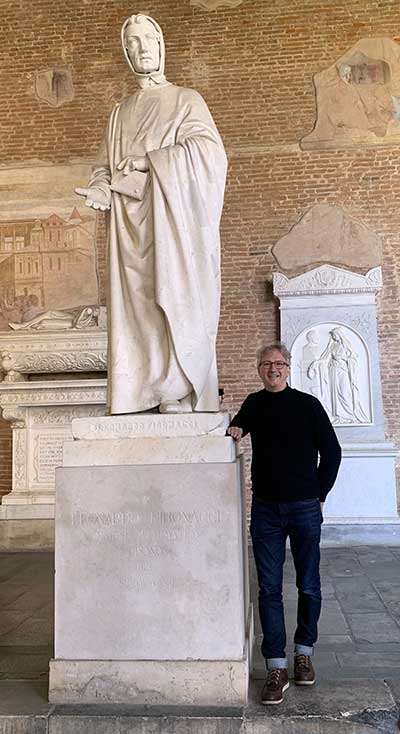
But even as he was ready to explore his artistic side, Hürsch carried his love for math and science, taking an artistic approach to mathematical truths in the form of Fibonacci art.
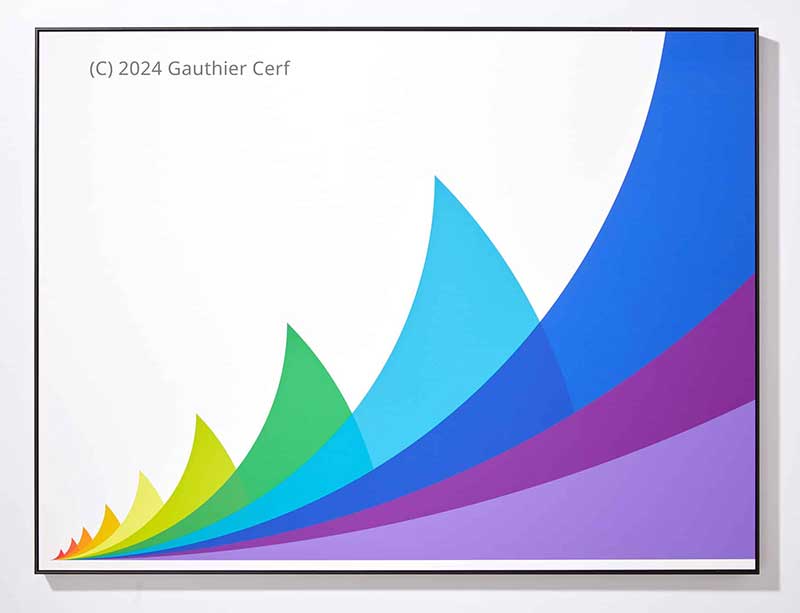
The Fibonacci number sequence — named for 12th-century mathematician Leonardo Bonacci — is reached by adding together the two previous numbers in the sequence: 1, 1, 2, 3, 5, 8, 13, 21, 34, 55, 89, and so on. Fibonacci art is artwork that uses or represents that sequence — in Hürsch’s case, by using bold colors and clear, balanced geometric composition.
“Fibonacci numbers are closely related to the equally famous golden ratio; this makes them harmonious numbers. Miraculously, they appear everywhere in nature,” Hürsch said. “This bridge from mathematics to nature appealed to me a lot.”
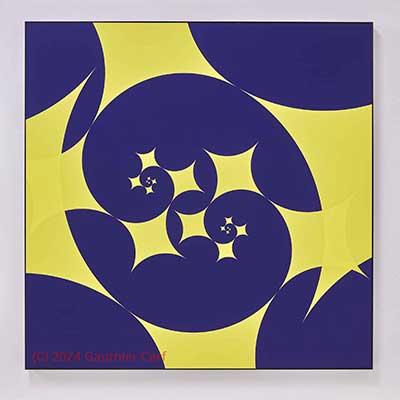
Hürsch began with two-dimensional works, using circles, rectangles, and sweeping curves to visualize various properties of Fibonacci numbers. An old-school mathematician at heart, he starts his process with sketches and equations on paper then moves to computer models and digital art. After a slew of iterations, the final work is printed, framed, and hung.
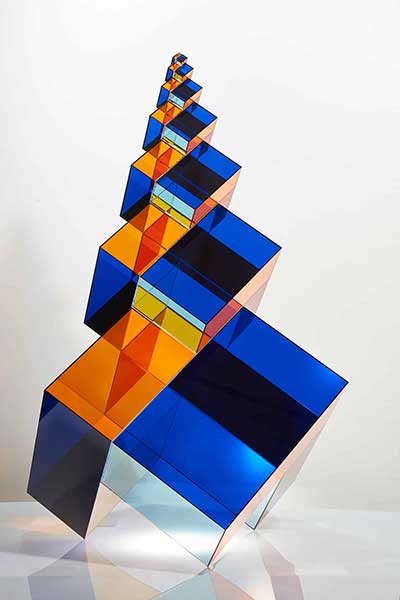
In 2023, Hürsch began adding sculptures to his portfolio. Built from precision-cut acrylic glass in a kaleidoscope of colors, his three-dimensional work is much more expensive and time-consuming to create, but he feels it’s also more impactful for his audience. Unlike a print, viewers can explore Hürsch’s sculptures from a variety of angles, gathering a deeper appreciation for the myriad beautiful ways that Fibonacci numbers interact with one another.
“Using Fibonacci numbers limits me, but the limit also gives me inspiration,” Hürsch said. “This reduction, this abstractness gives me peace.”
Hürsch‘s ambition is to make the inherent beauty of mathematical concepts visible, without requiring audiences to appreciate or understand the concepts themselves. Even so, he is particularly gratified when aesthetically oriented audiences get curious about the math that makes his art function.
Hürsch has displayed his work across Northern Europe and Canada, including twice at the Bridges conference, an international meeting on the intersection of art and mathematics. He enjoys sharing his art with an audience that, like him, finds the natural harmony of mathematical art to be intuitively appealing.
Hürsch is grateful for his time at Northeastern, and in the tech world more generally, for teaching him his considered, methodical, and organized approach to complex tasks. It’s served him well, as he’s found himself applying the skill set across both his careers.
“I observed in many startups that when you scratch the surface and start getting interested in an area, it opens a universe of its own. You go in, and then it gets bigger and bigger, and your head explodes because it’s so broad, but it gives you a lot back because you’re in another world,” Hürsch said. “The same is true with art; there are things like the techniques, how fragile are the colors, do they come off with time or not? It’s like a Fibonacci number. Everything gets bigger.”
On the aesthetic side, Hürsch is looking forward to expanding his portfolio of sculptures; on the business side, he’s excited to secure permanent gallery representation. He’s found that his background in tech startups has been particularly helpful in building the business side of his art career, as branding, marketing, and building relationships with suppliers have come easily to him.
Hürsch advised younger students interested in both art and tech to tackle their passions one at a time, rather than trying to become everything all at once. Approaching art this way meant that his time in tech could inform his second career, rather than competing for his attention.
“I was always interested in art, but I focused my creativity on the tech side for a long time. If you want to become successful, you need to focus on one work,” Hürsch said. “But if you’re open minded, then you can draw from what you learn in one professional world and take that on to another one. That really helps me now, to have all that mindset behind me; it gives me lots of energy.”
Visit Hürsch’s website to explore more of his work.
The Khoury Network: Be in the know
Subscribe now to our monthly newsletter for the latest stories and achievements of our students and faculty
Author: Caroline Baker Dimock
Date: 1.5.26
When a patient is injured on an island hundreds of miles from the nearest hospital, time is everything. Helicopters can fly fast but have a limited range; ships can travel far but move much more slowly. Linking the two efficiencies, in real time and under pressure, has long been a logistical nightmare for militaries and disaster responders alike.
That’s the challenge undertaken by Stanford researchers Mahdi Al-Husseini and Mykel J. Kochenderfer, along with Khoury College Assistant Professor Kyle Wray. Their recent paper, “Semi-Markovian planning to coordinate aerial and maritime medical evacuation platforms,” proposes a way to use artificial intelligence to coordinate helicopters and ships as a single, adaptive evacuation network.
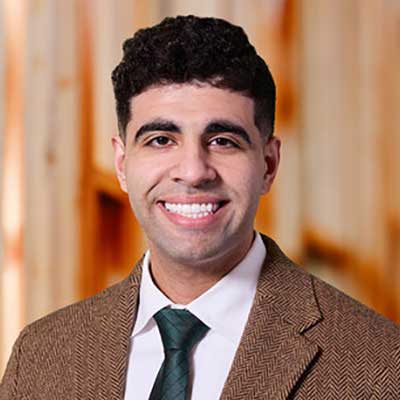
“As an active-duty medical evacuation Black Hawk helicopter pilot, I saw a lot of inefficiencies in the way we move patients in areas where distances are vast and coordination is complex,” said Al-Husseini, who has planned medical evacuations as an aeromedical officer in the US Army. “Our goal was to develop optimal decision-making systems for dispatching medical evacuation aircraft in these challenging environments.”
“Essentially, there’s a medevac challenge,” Wray added. “It can be applied broadly beyond just troops for deployment — it can also be for general use in a natural disaster or other things. In an island scenario, you have several helicopters, several boats, and people who need to be medically evacuated. To get them treatment as quickly as possible, you need to make efficient use of your resources.”
Medical evacuation, or medevac, has always been a race against time, but at sea, the problem becomes even harder. Hospitals may be hundreds of miles apart. Helicopters can’t always make the full journey before refueling. In the middle of the ocean, there are no fixed points to transfer patients. Ships move along their own routes, while helicopters launch from different locations. Each minute spent coordinating adds to a delay, but poor planning risks leaving patients stranded or aircraft unavailable for the next emergency.

“Decision-making can be very challenging, especially when there’s partial observability. You may not know exactly what the environment looks like or where every unit is,” Al-Husseini said. “Our system is designed to make those dispatch decisions in real time, even when communication or information is degraded.”
It’s a juggling act of risk, distance, and readiness. Each helicopter consumes fuel and flight hours that limit future missions. Ships can help bridge the gap by acting as “exchange points” where one aircraft drops off a patient, and another aircraft picks them up — but only if their timing aligns precisely.
To make sense of these moving parts, the researchers built a semi-Markov decision process — a mathematical model that can handle actions taking variable amounts of time. Each “state” in the model represents where every helicopter and ship is, which patients are waiting, and how close each aircraft is to needing maintenance or refueling.
Possible “actions” include sending a helicopter directly to a hospital, dispatching it to meet a ship at sea, or staging it on another island. The model then predicts how long each option will take and how it will affect future readiness.
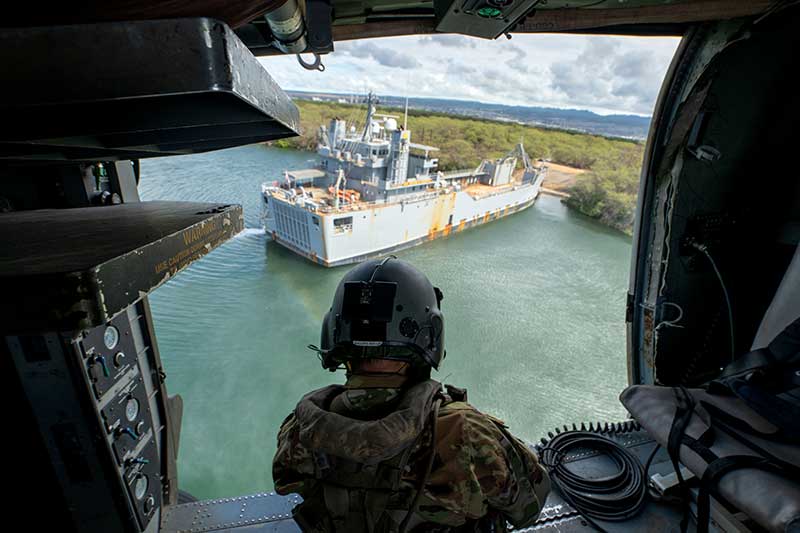
Crucially, the model doesn’t assume ships or aircraft are stationary. It tracks them as they move through the ocean, creating a constantly shifting chessboard.
To weigh competing priorities — patient survival, response time, and fleet sustainability — the researchers defined a reward function that blends medical urgency with logistical pressure. The longer a patient waits, the lower the reward. But overusing an aircraft also carries a penalty in the form of fatigue, maintenance, or future mission risk.
Once the system could simulate the outcome, the next challenge was deciding what to do. For that, the team used a variance of Monte Carlo tree search — an algorithm that runs thousands of simulated futures, tries different dispatch choices, and learns which combinations produce the best overall results. It is from the same family of algorithms that helped computers master complex games such as chess.
“The algorithms allowed us to see tangible gains in the scenarios that are hardest for real-world operators,” Al-Husseini said.
The team tested three strategies: an optimized AI policy that considers both land and ship exchange points, a land-only model that ignores moving ships, and a greedy model that picks the nearest option every time.
They simulated operations between Oahu and Kauai using real Army aircraft and ship specifications. The results were impressive: the AI-optimized approach with ship exchanges improved overall response performance by 35% compared to the land-only plan, and 40% compared to the greedy method. The gains were greatest when helicopters were slower, or casualty loads were high — exactly the situations where real operations struggle most.
The real test came with a live simulation in October 2023. Partnering with the US Army’s 25th Aviation Brigade, the team successfully planned and executed a live demonstration. One Black Hawk helicopter picked up a model patient from shore, flew out to meet a moving logistics support vessel south of Honolulu, and dropped off the stretcher. Minutes later, a second helicopter rendezvoused with the ship to complete the transfer to Tripler Army Medical Center.
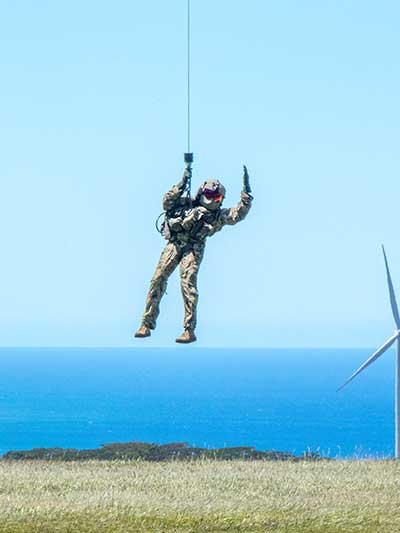
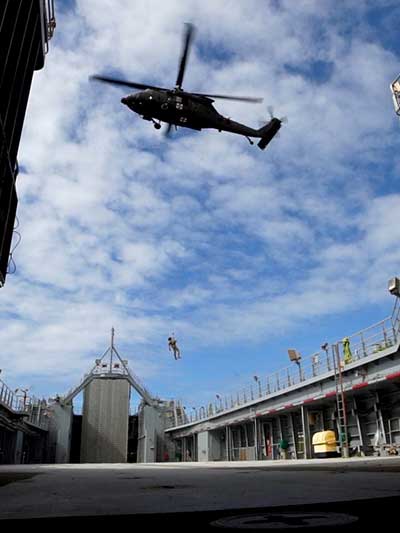
“That live exercise was the culmination of years of collaboration between Stanford, Northeastern, and the Army,” said Al-Husseini, who was stationed in Hawaii at the time. “We used our decision-making system to inform how the mission should unfold, and to respond when the ships weren’t exactly where we thought they would be … Seeing it play out in the field validated that the system isn’t just theoretically optimal — it’s operationally useful.”
“We had been working previously on wildfire fighting,” Wray said. “This work is a natural extension of several of the ideas for how you fight wildfires. It’s coordinating multiple intelligent agents — whether helicopters or drones or boats — to work together to resolve the situation.”
The implications of their research go well beyond the military. In disaster zones, remote island chains, or large-scale humanitarian crises, similar hybrid systems could help coordinate helicopters, drones, and ships for faster rescues.
“There are really two categories of next steps,” Wray added. “On one hand, we’re exploring more of the theoretical foundations — identifying structures and patterns that are common across these kinds of coordination problems. On the other hand, we’re looking at applications — everything from search and rescue to warehouse fulfillment. Coordinating multiple agents efficiently has huge potential across domains.”
It’s also an example of how AI can augment human decision-making rather than replace it. The algorithm doesn’t give orders; it offers recommendations that commanders can accept or override. That combination of machine foresight and human judgment could make emergency logistics faster and safer.
“There’s a saying — a problem well-stated is a problem half-solved,” Wray said. “Framing the problem with a strong theoretical foundation gives you the ability to enter new domains and solve them efficiently. That’s what made this project so exciting; it shows the strength of uniting theory and practice.”
As for Al-Husseini and Wray, their collaboration is far from over.
“I really appreciated Mahdi’s incredible work,” Wray added. “He’s an incredible engineer and student and thank you to him for his service. The collaboration with Stanford has been fantastic and I look forward to continuing our work together.”
“It’s exciting research,” Al-Husseini added. “The system doesn’t remove people from the loop — it gives them a better understanding of what is possible now. That partnership between human experience and algorithmic reasoning is what makes it powerful.”
The Khoury Network: Be in the know
Subscribe now to our monthly newsletter for the latest stories and achievements of our students and faculty