Author: Caroline Baker Dimock
Date: 1.26.26
From flood simulations and autonomous drone systems to computers playing Super Mario, Khoury College’s master’s students contributed research in many fields across Northeastern University’s global network in 2025. And though many of these researchers were based at Northeastern’s largest campus in Boston, their counterparts in Silicon Valley, Vancouver, and Portland, Maine were just as prolific.
Below is a sampling of their projects. To read more, click on any of the following links, or simply read on:
- Scalable Book Recommendation Service
- Interactive Simulation of Lane Merging Strategies at Traffic Signals
- Drone Ranger
- Real World Flooding Simulation System
- A Geo-Meta Ensemble Framework for Robust Cross-Well Pore Pressure Prediction
- NN4SysBench V2: Automatic Specification Generation in Computer System
- Automated Deep Learning Segmentation of Muscle Tissue Degradation in Zebrafish Dystrophy Models
- Learn to Play: Lightweight Generative Modeling for Super Mario
- AI for Organizations: Designing for Cognitive Resilience using the Controlled Exposure Framework
Scalable Book Recommendation Service: Microservices Architecture with Redis Caching
Mansi Modi, Snahil Dasawat, Junyao Han, Theodore Pei
Vancouver
The team designed a service that quickly suggests books to users while retaining speed as more users are added. The team’s primary objective was to solve “cold start” algorithmic challenges and reduce latency through caching strategies and experimentally validated horizontal scaling limitations.
Using a Docker-based FastAPI microservices setup, the team applied collaborative filtering to recommend books based on users’ similarity to one another. A Redis caching layer was added to store frequently requested results, which greatly reduced the time users had to wait for recommendations. Testing showed that caching could increase speed by up to 90%. However, simply adding more servers did not increase overall performance because the database became the main bottleneck. This work highlights why efficient data management is just as important as adding computing power when building scalable systems.
Interactive Simulation of Lane-Merging Strategies at Traffic Signals
Dianna E
Portland
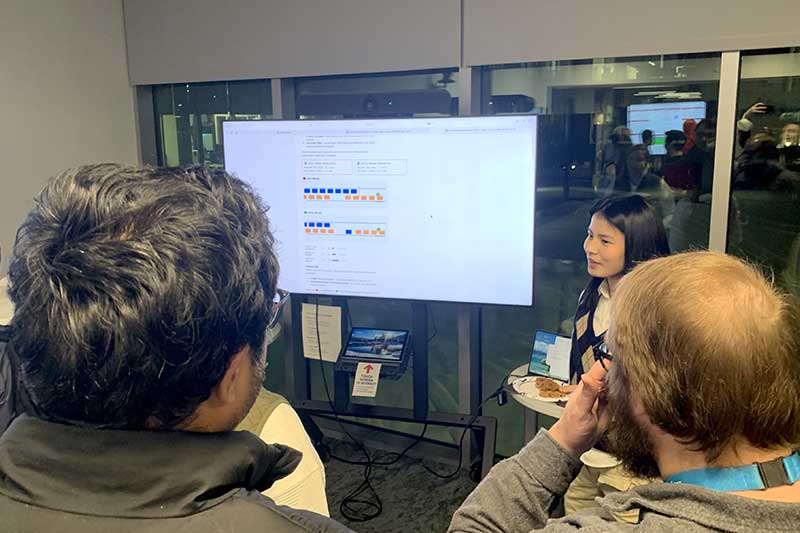
E studied how different lane-merging strategies before a traffic light affect congestion and driver delay. The project compares late merging near a lane drop with early merging farther upstream.
Using a side-by-side animated simulation, E modeled car behavior with simple, intuitive rules such as accelerating when space is available, slowing near traffic, and merging only when safe. Early results suggest that early merging can lead to smoother flow and slightly reduced waiting times under moderate traffic, though outcomes vary because the model does not yet include coordinated “zipper” merging. The project shows how interactive visual simulations can help explore and communicate traffic patterns, with E’s future work aimed at adding more realistic driver behavior and merging algorithms.
Drone Ranger
Renxiang Yin, Chunzhang Liu, Xiaoman Zou, Tanishq Pradhan, Haoran Liu, Jiading Zhou, Zhipeng Ling, Ilmi Yoon
Silicon Valley
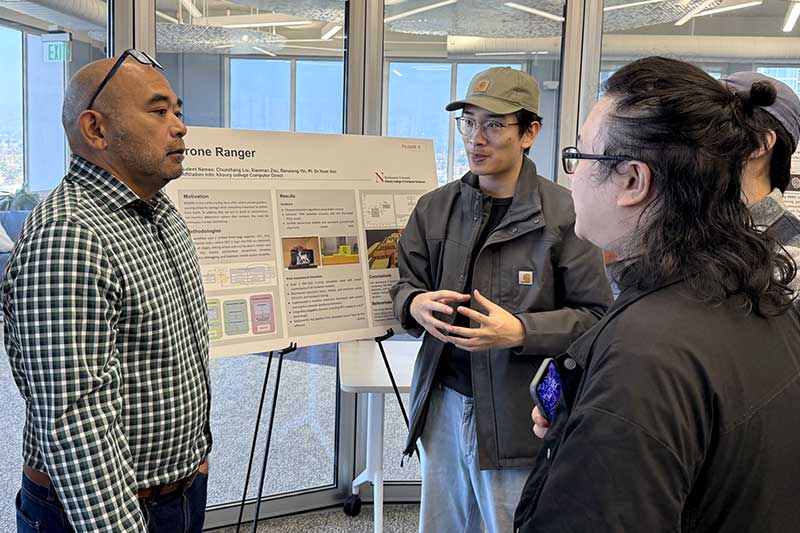
The Drone Ranger project aims to develop an autonomous drone system that can sense its environment, make decisions, and act reliably in real-world settings. The team built reusable autonomy modules using ROS 2 for perception, planning, and decision-making, designed to run identically for both simulated and physical drones.
By testing autonomous behaviors such as obstacle avoidance and navigation in both Unity and real hardware, the project demonstrates a tightly integrated simulation-to-real workflow. Early results show that this unified approach supports rapid iteration, safer testing, and reliable deployment. Future work will strive to expand autonomy features, improve simulation realism, increase real-world testing, and establish Drone Ranger as a flexible platform for scalable autonomous drone research.
Real World Flooding Simulation System
Bhanu Chandra Pachipala
Portland
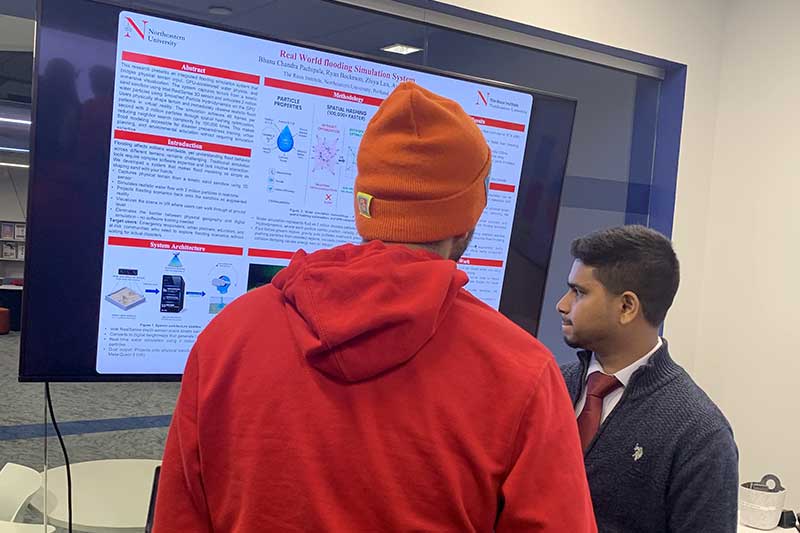
Pachipala developed an interactive simulation system to make flood modeling accessible to non-experts. The project allows emergency responders, urban planners, and students to explore flooding scenarios in an intuitive way by shaping physical terrain with kinetic sand, removing the need for complex simulation tools.
Using a 3D sensor to scan the sandbox in real time, the system simulates realistic water flow with millions of GPU-driven particles and projects the results back onto the sand as augmented reality. The simulation is also streamed to VR headsets for immersive exploration. The project achieved smooth, real-time performance and realistic water behavior, with Pachipala planning for future work to focus on improving VR performance and adding erosion effects for educational use.
A Geo-Meta Ensemble Framework for Robust Cross-Well Pore Pressure Prediction
Pranav Patel, Rohan Benjamin Varghese
Silicon Valley
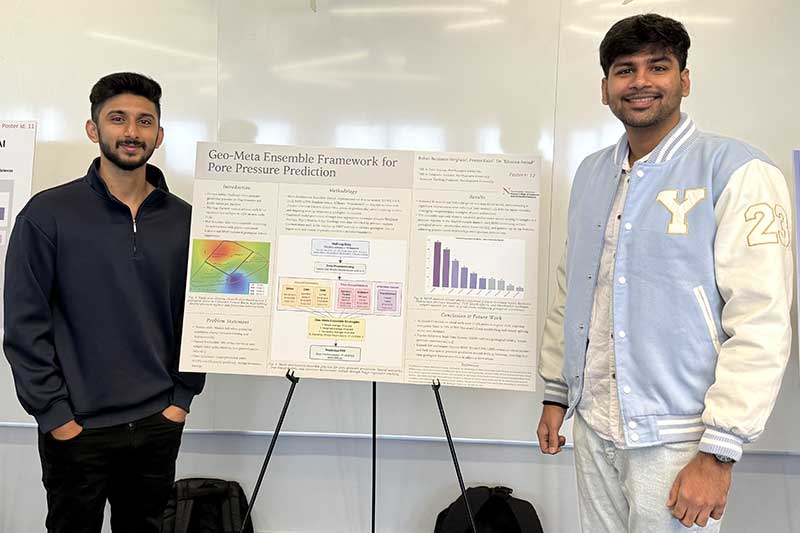
Patel and Varghese developed an AI framework to improve safety in oil and gas drilling. The project addresses a major challenge known as domain shift, where models trained using data from existing wells often fail when applied to new wells with different geological conditions.
The researchers combined multiple machine learning models into a single, robust predictor, which can then use physics-informed features and strict testing on unseen wells. The system achieved strong accuracy on new geological data while remaining fast enough for real-time use; in doing so, it set a new standard for pressure prediction and pointed toward future improvements, which could adapt models based on local geology and extend the approach to other drilling variables.
NN4SysBench V2: Automatic Specification Generation in Computer Systems
Duy Tran, Shuyi Lin, Cheng Tan
Portland
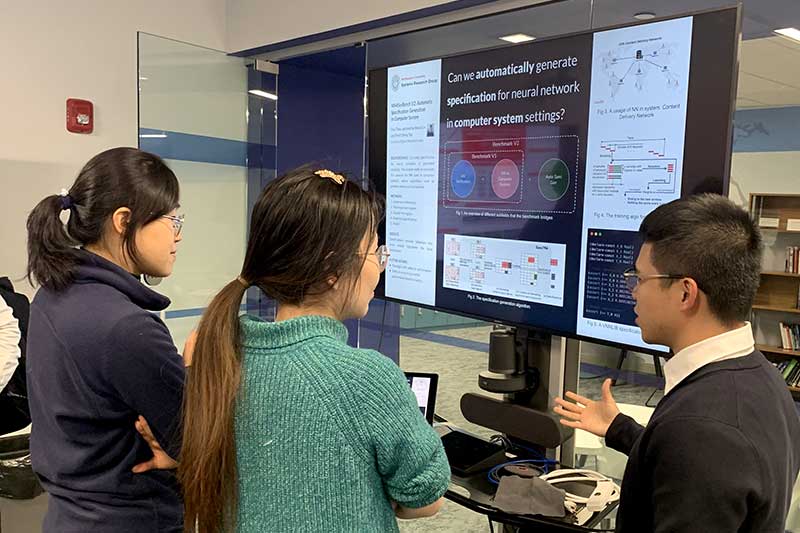
The team developed NN4SysBench V2 to automatically generate specifications for neural networks that could be applied to computer systems tasks. The project bridges neural network verification (which ensures a network meets input-output specifications) and neural networks in systems applications (like cache management or network congestion control), where specifications were traditionally handcrafted.
The system generates specifications by analyzing existing heuristic algorithms, extracting common behaviors, and creating new specifications that better capture the patterns in training and testing data. Initial results show that this method encodes more realistic behaviors than previous approaches. Future work will apply this method to tasks without existing references and shift the focus from safety guarantees to performance-based specifications, ensuring neural networks enhance overall system efficiency.
Automated Deep Learning Segmentation of Muscle Tissue Degradation in Zebrafish Dystrophy Models
Rohan Tanwar, Harshil Bhojwani
Portland
Tanwar and Bhojwani developed a deep learning system to automatically classify muscle fiber degradation in zebrafish models of muscular dystrophy. The goal was to accelerate drug discovery by replacing slow, manual analysis of confocal microscopy images with an automated, high-throughput approach.
Using a transformer-based Swin-Unet model trained on GPU-accelerated clusters, the system segments images into healthy, bad, and degenerated muscle classes. Balanced weighting and focal loss were applied to address severe class imbalance, improving detection of minority classes while maintaining overall accuracy. The pipeline reduces analysis time from hours to minutes per image, enabling faster drug screening. Future work includes expanding the dataset, adding uncertainty quantification for more reliable predictions, and optimizing the model for real-time inference during experiments.
Learn to Play: Lightweight Generative Modeling for Super Mario
Feiyan Zhou, Zhaoyang Lu, Qingzheng Gao
Silicon Valley
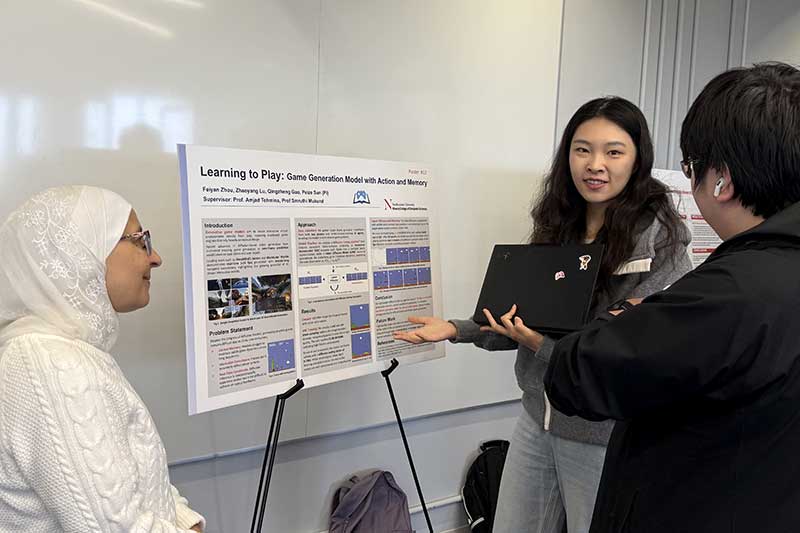
Zhou, Lu, and Gao developed an AI system to learn and generate playable Super Mario levels. The project combines human gameplay data with reinforcement learning to create a compact model that allows students and researchers to experiment without expensive hardware.
The team trained a video model on a 522,000-frame dataset, producing 32-frame sequences that closely mimic real gameplay and correctly reflect player actions more than two-thirds of the time. The system runs at nearly real-time speeds on a single GPU. Future work will improve long-term memory for longer sequences, capture rare gameplay situations, and optimize performance for faster, more accurate generation, supporting affordable and accessible game-based research.
AI for Organizations: Designing for Cognitive Resilience Using the Controlled Exposure Framework
Qingzheng Gao, Shreya Chavan
Silicon Valley
Gao and Chavan developed a framework to help organizations adopt AI tools without undermining human judgment. The Controlled Exposure Framework guides when and how employees interact with AI, ensuring people stay “in the loop” while benefiting from AI assistance.
The framework integrates research on trust, privacy, governance, and change management into three key components: limiting auto-acceptance of AI outputs, inserting short reflection prompts, and providing managers with anonymized trust dashboards to detect overreliance. Pilot planning shows that the framework can be incorporated into existing workplace tools without new infrastructure. Future steps include randomized testing of the framework components, refining dashboard metrics with partner companies, and publishing practical implementation guidelines for HR, compliance, and IT teams.
The Khoury Network: Be in the know
Subscribe now to our monthly newsletter for the latest stories and achievements of our students and faculty
Author: Will Beeker
Date: 1.22.26
About 10 years ago, I took my first job in Hollywood. At that time, if you had asked me where I saw myself in a decade, I might’ve said in the writer’s room of the latest prestige drama series, or collecting my Oscar for Best Original Screenplay. Pursuing a master’s degree wouldn’t have cracked the top 10.
But here I am, an Align master’s student studying computer science at Khoury College and preparing my transition into the tech field. So, why such an abrupt career change?
I had always loved writing and reading, and I developed an interest in filmmaking in high school. I went to film school, then moved to Los Angeles from the Midwest, working assistant jobs in entertainment with the goal of becoming a screenwriter. I worked at a small talent management company, then a bigger one that represented the likes of Adam Sandler and Brad Pitt. Seeing celebrities walk in and out of our offices was a treat — it seemed to be proof I was getting closer to my dream.
But something was missing.
I didn’t realize exactly what it was until I started working as a writer’s assistant on the HBO series Real Time with Bill Maher. I researched and fact-checked for the show and started engaging the left hemisphere of my brain in a way I hadn’t done since high school.
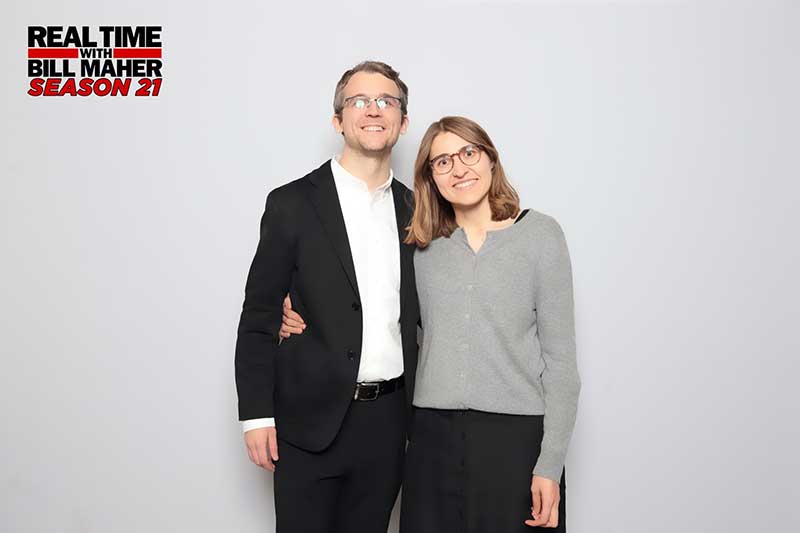
I was doing political, historical, and scientific research — topics I knew very little about — on tight deadlines. In a matter of a few hours, I’d have to get myself up to speed on a new topic so I could provide an intelligent answer to a question from the show’s host or writing staff. I was like ChatGPT set to deep research mode but without the hallucinations. OK, with fewer hallucinations.
Working with statistics and doing that kind of in-depth research satisfied a part of my brain that had gone unfed during my creative pursuits. This opened my mind to a career change, but it wasn’t until my wife was accepted into a PhD program at Harvard and we moved across the country that transitioning to another line of work started to seem possible, and even necessary.
But what exactly could I do, given my background?
I had been into computers for a long time. One of the first things I did after getting my first full-time job was use the money to build a gaming PC. I watched over my wife’s shoulder as she analyzed data in R Studio and asked her to show me how it worked, thinking I could apply it to the statistical research we did on Real Time. Once she introduced me to Python, I felt like a whole new future opened for me.
I delved into YouTube tutorials, Stack Overflow posts, and any guidance I could find online. I wanted to learn everything I could about programming, and there was enough content on the internet to keep me busy forever. I wanted to dive headfirst into a topic without any risk of hitting the bottom, and computer science was a vast ocean for me to explore.
But the flip side of having so much information at your fingertips is how overwhelming it is trying to sift through it all. There also seemed to be a way of talking about coding that was taken for granted, a language I hadn’t had access to. It became clear something was lacking in my self-teaching.
Eventually, I found Khoury College’s Align program. It seemed perfectly designed for someone like me.
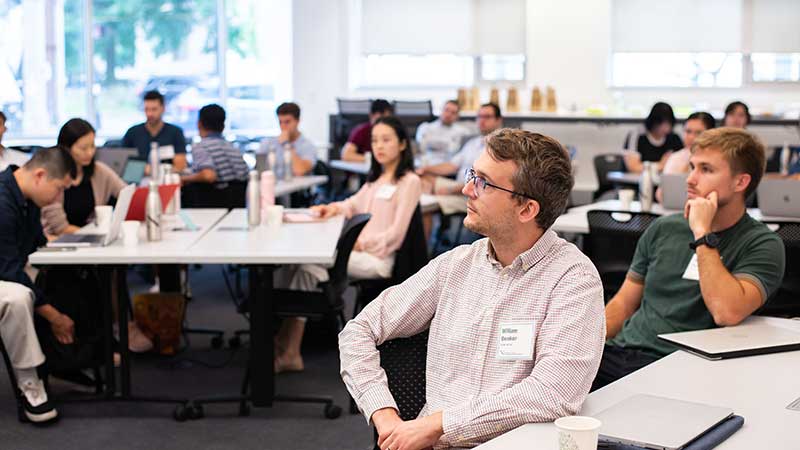
But surely, they were exaggerating. Surely not anyone with any background could get in. When they meant transitioning to tech, they meant transitioning from electrical engineering or biology, not late-night comedy. Then I saw testimonies from alumni with backgrounds in music composition and graphic design, people without much technical background at all, and they had come out of the program fully prepared to enter the world of computer science. Now, more than halfway through the program, I feel confident that I, too, will be fully prepared when I graduate.
Celebrity sightings are less common in Boston, but I’m thrilled with where I’ve ended up. Every day that I learn something new, it reaffirms that I’ve made the right decision.
Just don’t ask me where I see myself 10 years from now.
The Khoury Network: Be in the know
Subscribe now to our monthly newsletter for the latest stories and achievements of our students and faculty
Author: Madelaine Millar
Date: 1.20.26
When Jesse Nava got his first laptop, he didn’t touch it for a year.
“I felt intimidated by that machine,” Nava said. “For two or three semesters, my laptop sat on my bunk, and I said, ‘I’ll just stick to pencil and paper.’ It seemed easier than trying to navigate even logging into a laptop.”
Nava — who is located in California — is one of more than 770,000 people in the United States serving prison sentences of 10 years or longer. Technology is unrecognizable compared with what it was when Nava was first incarcerated more than two decades ago, and he is determined that he and his peers leave prison with the digital skills they need to succeed.
That lived expertise is exactly why Saiph Savage, an assistant professor at Khoury College and director of the Civic AI Lab, invited Nava to co-design the High-Tech Career Reentry Path Project.
“My research lab focuses on creating AI systems that are not replacing workers, but rather giving them human dignity. For example, these individuals who have been removed from society — how do we give them an opportunity to find jobs they find fulfilling?” said Savage, whose previous work has included research tools to measure unpaid crowdsourced labor and intelligent interfaces to help government social workers better serve victims of domestic violence. “It’s all about redefining the future of AI so that it’s not marginalizing people more, but rather creating dignified experiences for humans.”
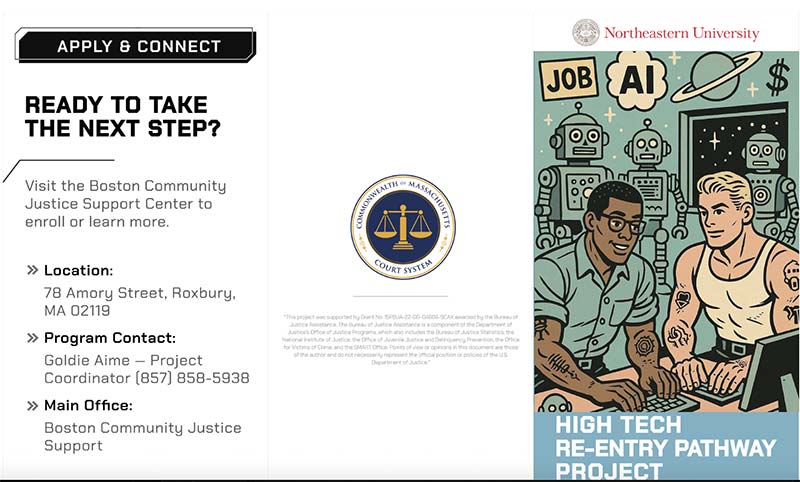
Under Savage’s leadership, and in collaboration with incarcerated project leaders like Nava, the High-Tech Career Reentry Path Project equips incarcerated and formerly incarcerated people with core digital skills like how to operate a laptop or apply for jobs online, as well as an understanding of how AI can support their return to the workforce. Participants also learn to use generative AI to carry out tasks like data mining and data visualization, and to support prediction and decision-making. These AI-enhanced digital skills let participants search for online tech jobs, while Northeastern-issued digital badges help demonstrate those skills to potential employers.
“After being incarcerated for so long, getting out into society and not understanding technology is very intimidating,” Nava said. “We’re trying to bridge that gap, to make people more marketable in a society that has moved forward in giant leaps since they’ve been incarcerated.”

Supported by a grant from the Department of Justice, the project serves currently incarcerated people who are preparing to return to society across Massachusetts, especially those planning to live in Boston. After release, participants continue working with Savage through the Community Justice Support Center in Roxbury, where she and her team collaborate with Vincent Lorenti, director of the Massachusetts probation service, and Goldie Aime, project coordinator of the High-Tech Career Reentry Path Project.
Savage’s work is not the first effort to teach tech skills in prison, but earlier programs often failed because incarcerated people were not involved in creating them. By contrast, Savage’s research often combines participatory design with human-centered AI. It’s her relationships with member–researchers like Nava that provide methods and structure to her goal of redirecting the benefits of technology away from powerful institutions and toward underserved communities.
“Creating human-centered AI research takes a lot of time, and it’s important for Khoury students interested in human-centered AI to recognize that we need to include everyone in the design,” Savage said.

In mid-October, Savage presented the pilot program at Digital Rerum Novarum, the Vatican’s two-day seminar on AI for peace, social justice, and human development. Inspired by Pope Leo XIII’s 1891 Rerum Novarum on workers’ rights during the Industrial Revolution, the interfaith event brought together global experts and faith leaders.
“We all came together to have deep conversations about what the future of AI should look like to ensure dignified futures for people,” Savage said. “Big tech doesn’t make enough profit if they’re designing tools for prisoners, so they don’t necessarily have to care about that population. But the church — thinking about us as humans and about creating dignified experiences for people — has the opportunity to care about what that technology should look like.”
The conversations will continue through the Global AI for Good Network, led by Argentine global governance expert Gustavo Beliz, which Savage encourages Northeastern scholars interested in AI and justice to join. She is excited to continue building AI for good, especially with workers who have historically been excluded from conversations on how AI systems should look.
And for people in the Massachusetts Department of Corrections interested in tech, Nava strongly encourages taking part in the High-Tech Career Reentry Path Project.
“This program means getting out of prison and not feeling like I lost 25 years, because I’m finally up to par in technical literacy,” Nava said. “We want participants who take responsibility and are ready to change — and we deeply value people like Dr. Savage who believe in our journey of redemption and growth.”
The Khoury Network: Be in the know
Subscribe now to our monthly newsletter for the latest stories and achievements of our students and faculty
Author: Yashavi Upasani
Date: 1.15.26
This past September, Mouad Tiahi was named as one of Major League Hacking’s Top 50 Hackers of 2025, the first Northeastern student to make the list. While the accomplishment is impressive, it’s also no surprise considering Tiahi’s history of hackathon wins and the years he spent building his skills.
The third-year computer science and physics combined major began his coding journey long before he started at Northeastern. He grew up just across the Charles River in Cambridge, Massachusetts, where his family’s only computer was an old box-like one from the 1980s. He eventually got the chance to borrow a Raspberry Pi from his elementary school, which he hooked up to his computer and created a version of Slither.io with his favorite animal, kangaroos. This sparked Tiahi’s love of code and computers, and he began spending hours in his school’s computer lab developing his craft.
In high school, Tiahi started participating in programming competitions but left the scene after getting hooked on the creative nature of hackathons and the diversity of competitors he found here.

“It’s very interdisciplinary. A lot of people have this misconception that if you go to a hackathon, you’re only there to code,” Tiahi said. “But now, there have been business majors who have been successful. There have been engineers, chemical engineering majors as well who have been successful. You don’t have to be specifically in computer science to compete.”
But competition hasn’t always been smooth sailing for Tiahi. After being rejected from the first collegiate hackathon he applied to, he began applying to every hackathon he could, eventually going to his first, BostonHacks 2023, with no team and no idea what to do.
“I didn’t know what to expect … I didn’t really know anybody,” Tiahi said. “I ended up teaming with three people who became friends of mine.”
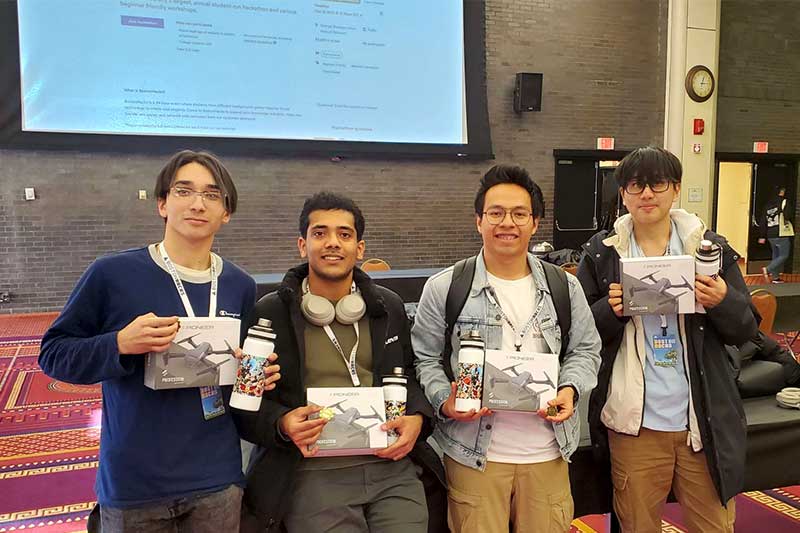
Since then, Tiahi has competed in countless hackathons, most recently winning the sustainability category of HackMIT 2025 after creating a power grid using batteries he and his team created from lead and fertilizer. Despite the thrill of winning big, he stresses that for him, it’s never about finishing first.
“I approach [hackathons] in a way where I’m like, ‘Okay, we’re not here to win. We’re here to do something really cool. Let’s find a unique problem to solve,’” Tiahi said. “And then we play to everyone’s strength on the team.”
Tiahi’s best such example was his final product at HackMIT 2024, where he and his teammates reverse-engineered an Xbox Kinect that allowed people with disabilities — specifically in their hands — to play. Tiahi got to see this in action when a four-fingered hackathon attendee used the sign-language-reading abilities his team created. Even though the team didn’t win, Tiahi found the experience incredibly rewarding.
It’s his commitment to delivering the best, most efficient product possible that landed Tiahi on the Top 50 Hackers list. It’s also a catalyst for his own coding endeavors, where he aims for more ethical means of high-performance computing rather than sticking with traditional, less sustainable ways.
Currently, Tiahi is taking a break from competing and is dedicating his time to mentoring other Northeastern students for hackathons. He has also worked for the past year as a high-performance computing assistant researcher with College of Engineering Distinguished Professor David Kaeli, which has fostered his interest in making computer science and AI more sustainable.
“I want to use my knowledge in high-performance computing, in quantum computing, to develop sustainable solutions for these big tech data centers and just help out with the environmental costs and pushing the boundaries on that,” Tiahi said. “I just want to keep doing, keep learning.”
The Khoury Network: Be in the know
Subscribe now to our monthly newsletter for the latest stories and achievements of our students and faculty