Author: Laila Griffin
Date: 2.11.26
Brianna Dym, an assistant teaching professor with Khoury College at the Roux Institute in Portland, Maine, has found solace in remote populations.
Since beginning her undergraduate education in 2008 at the University of Alaska, she has immersed herself in geographically remote communities to study how isolation, limited resources, and power imbalances impact people’s relationships with technology.
“My research goal has moved to … how do I help people build and use technologies in such a way that they can live autonomously without being dependent upon major tech companies that they can’t push back against or argue with,” Dym said. “Especially when it comes to making sure that their privacy and safety are respected.”
As a qualitative researcher, Dym relies on autoethnography, where she studies her own experiences alongside the experiences of the community. She then combs through interview data, observations, and survey responses to identify common themes, with her latest iteration focusing on members of the LGBTQ+ community.
“It’s a very powerful perspective to do research from, but it’s not without risks, in that your personal wants and needs bias you,” she said. “I think the most important part of being a good researcher is recognizing your bias and then trying to understand what your bias can offer.”
When she was 17, Dym moved to Anchorage, Alaska, where infrastructural deficiencies among rural populations were easy to spot. With many islands accessible only by boat or plane, and with limited road connections on the mainland, food and other goods were far more accessible to those who lived along the road system.
“Rural communities will always have less of a voice than their urban counterparts,” Dym said.
Those geographic constraints were presented again when Dym moved to Maine in 2022. In both places, weak technological systems and physical isolation compound everyday challenges. According to Dym, it can take hours to download files, map and routing data for navigation is difficult to access, and Google applications and YouTube videos are often inaccessible. She wondered how learning at all levels of education could function under these conditions.
“Because remote populations couldn’t access good bandwidth, they couldn’t use the educational tools that people in cities did, so you couldn’t design curricula the same way,” Dym said. “I got very interested in those kinds of problems as an educator.”
Beyond education, the lack of technological access inhibited people’s ability to foster community.
“There are so many really beautiful, cool things people can do when they connect with each other on the internet,” Dym said. “I was running into people living in rural spaces who were having trouble finding those connections.”
She soon realized that many people had no choice but to rely on technology to forge these connections. As information infrastructures have changed, platforms such as Facebook groups and Instagram pages have provided important ways to connect.
“What I found is that people might want to divest themselves from these technologies, but they can’t; we don’t have alternative infrastructures now,” Dym said. “My perspective changed from thinking about advocacy for regulatory changes to ‘How do I put power and control back in other people’s hands?’”
Ultimately, Dym argues that we have more control than we think. Inspired by author Ursula K. Le Guin, she is reminded that technology is something people actively shape and do not have to passively accept.
“I don’t think we are powerless. I think there are ways to push back,” Dym said. “Information technology is literally defined by us. We can define how it operates.”
As she continues her study by talking to people about the tension between privacy versus connection, she has also published curricula and research online through ACM. What began as academic research has evolved into a long-term mission to help communities use tools that allow them to live independently without relying on large technology companies.
“I call it my 20-year project,” Dym said. “The problem I’m interested in solving is the lack of autonomy.”
The Khoury Network: Be in the know
Subscribe now to our monthly newsletter for the latest stories and achievements of our students and faculty
Author: Yashavi Upasani
Date: 2.5.26
Three teams of Khoury College students won big at HackMIT 2025, creating products that allow for accessible gaming, a new means to file insurance claims after significant loss, and an energy-saving micro-grid. In so doing, they secured the number one spot in the event’s entertainment track, sustainability track, and EigenCloud-sponsored competition, respectively.
The annual student-run hackathon, hosted at MIT in Cambridge, Massachusetts, brings together more than 1,000 hackers, coders, and college students, providing makerspaces and energy drinks to keep participants competing for 24 straight hours.
An accessible way to play Minecraft
Tomas D’Avola (mathematics and computer science), Xiaole Su (mathematics and computer science), Troy Gunawardene (computer science and business administration), and Qihong Wu (computer science) competed in the entertainment track under the name “EyeCraft.” Recognizing that players with low hand movement capabilities or who had mobility issues might struggle to play the popular video game Minecraft, the team created a mod that recognized players’ facial features. By opening their mouth, players could move forward. Looking up would make their character look up. Winking with their right eye would let them jump.
“There are better solutions we can create for people who have difficulty accessing the same things that we do,” Gunawardene said. “More people should work on these fun projects in hackathons that have an impact on the world.”
Su, who has made a point of expanding her network of friends and colleagues at Northeastern, brought the team together, knowing they’d be a great fit.
“We had a unique combination of skills,” Gunawardene said. “We had technical talent, we had good pitchers, and we had a good product at the end.”
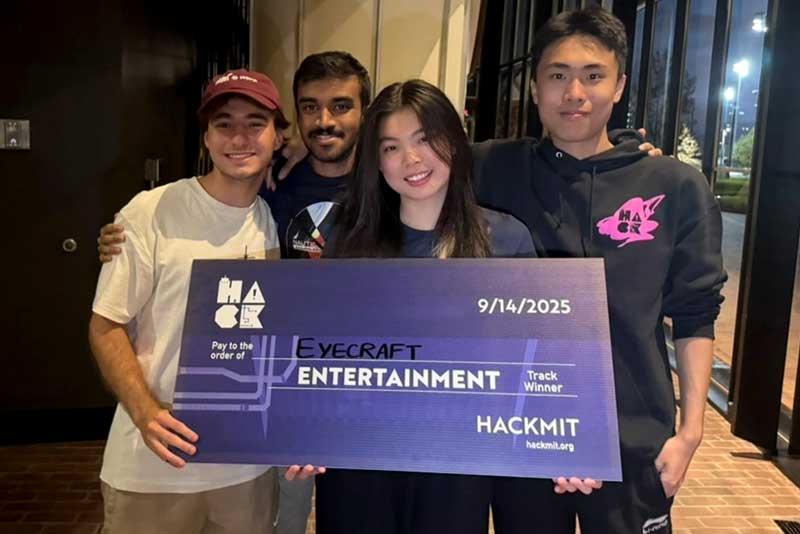
The teammates collaborated on practically every creative step, bouncing ideas off each other and addressing code complications as they arose. They cite their keen understanding of each other’s work processes and skillsets as a major reason for their win.
“Having a successful demo from top to bottom is so rare in hackathons these days because people try to go so above and beyond that nothing works,” Su said. “One thing that really made us stand out is how well the demo worked and how everything flowed together. It was a product that you could use.”
While they haven’t formally celebrated their big win yet, EyeCraft plans to eventually — and possibly to compete in another hackathon together.
Simplifying insurance claims through AI
Arav Budhiraja (computer science) and Rimjhim Singh (computer science and mathematics), competing under the name “Kava,” won in the HackMIT EigenCloud Sponsor Prize Side Track, a HackMIT division sponsored by EigenCloud, a service that aims to create secure, private, and verifiable apps.
After witnessing the complications faced by families in California who lost homes in the January 2025 wildfires, Kava was inspired to create an AI-powered insurance claim generator that allows users to upload documents and quickly create a claim.
“We aimed to simplify the whole insurance process, and I feel like we did it in the best way possible,” Budhiraja said, noting that after uploading housing documents and damage images, users can “have a whole package ready to go in just a couple of minutes.”
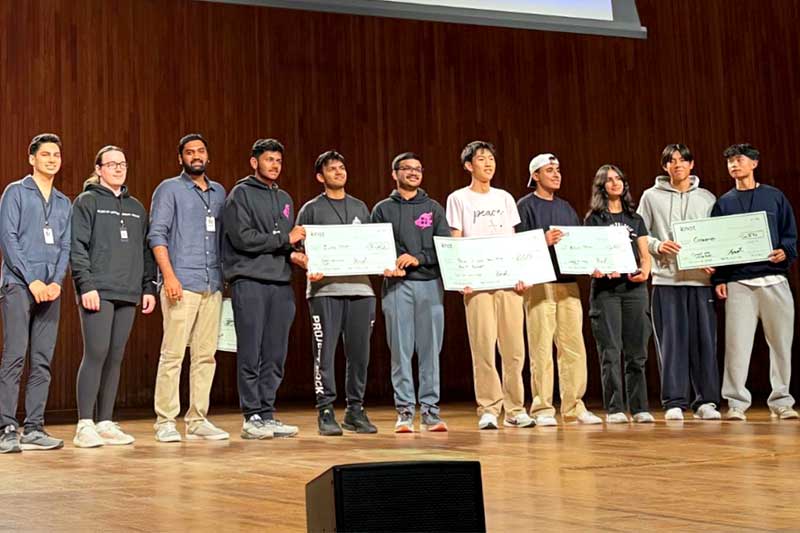
Budhiraja and Singh learned a lot from a hackathon they competed in together in spring 2025, where they ran into several problems that taught them the importance of playing to each other’s strengths, having a clear focus, and managing each other to produce the best possible outcome. At HackMIT, that’s exactly what they did.
“In hackathons, learning how to collaborate with other people is really important because if you push a code that’s breaking the entire thing, when you try to merge your code, that’s when you get a bunch of errors and it’s really annoying,” Singh said.
Throughout the 24 hours of HackMIT, the pair kept coming back to their central message of streamlining the insurance claim process.
“We made this to help people because hiring someone to do it for you is already expensive, and beyond that, losing a house is stressful enough,” Singh said. “And the stress of finding relevant documents is even worse. So we just wanted to help simplify the process.”
Kava plan to continue working together in future hackathons and are excited to see where their ideas take them.
Batteries and grids that save power
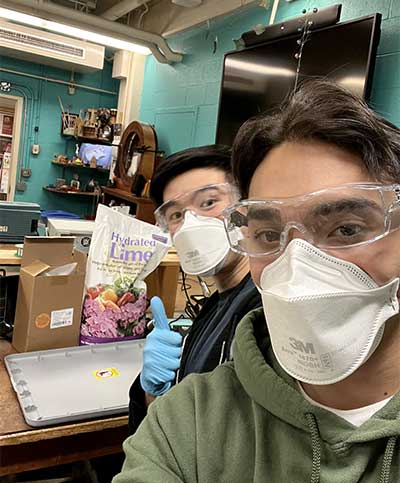
Mouad Tiahi (computer science and physics) and Shresht Bhowmick (computer science and linguistics), competing under the name “Griddy,” took home a win in the sustainability track for their creation of a micro-grid system run on homemade iron-air batteries. By handling dangerous chemicals and pushing their coding skills to the limit, the duo, joined by MIT undergrad William Feng, created a means of powering small areas for longer periods while losing less energy.
READ: Mouad Tiahi started coding on a decades-old computer. Now he’s a 2025 Top 50 Hacker
The team began by looking at the biggest problems facing the US and deciding which one they felt they could tackle.
“One of the issues is energy independence and grid resilience,” Bhowmick said. “The US power grid is really, really bad, and that’s because most of the companies in the US want short-term returns [on the money they spend on energy]. Our iron batteries get you that return while also being extremely resilient long term.”
Using chemicals from fertilizer and other components, the Griddy team created batteries that fit into pieces of wood and metal they cut in one of MIT’s makerspaces. They wore gloves, masks, and protective gear as they handled substances like calcium hydroxide, which poses a severe burn risk.
By the end of the 24 hours, the team had developed a micro-scale model, with batteries, of what a more sustainable power grid could look like in the US — all using accessible materials.
For both Tiahi and Bhowmick, sustainability is a growing point of concern and interest.
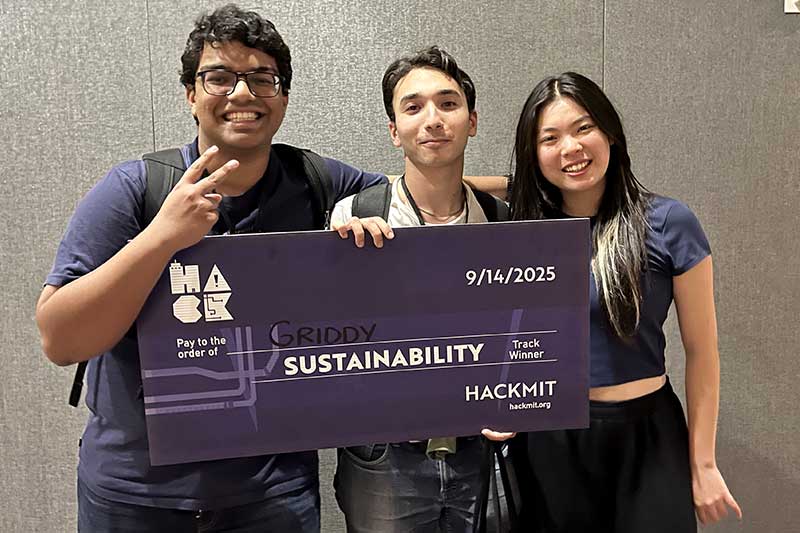
“Most of the approaches that were adopted in regard to sustainability are wholly and entirely wrong,” Bhowmick said. “They’re very small remedies that are trying to pacify consumers into thinking they’re something worthwhile … the vast majority of the problem we’re trying to mitigate through sustainability can be solved by two solutions — increasing energy output exponentially and making sure that you increase said energy output by building only renewable forms of energy.”
The Khoury Network: Be in the know
Subscribe now to our monthly newsletter for the latest stories and achievements of our students and faculty
Author: Milton Posner
Date: 2.2.26
Although human history is full of tectonic technological advances, artificial intelligence stands apart — so widespread that even the field that created AI is feeling the earthquake.
Khoury News sat down with Dean Elizabeth Mynatt to discuss the opportunities and challenges of the AI boom, and what universities have to offer students pursuing careers in tech.
There are fears that AI will reduce the number of tech jobs, especially for entry-level programmers. Do you feel this will be the case?
Absolutely not. Advances in automation inevitably raise our expectations for productivity, creativity, and how computing systems can support a vast range of human activity. Students entering the field today will be on the ground floor of this next wave of technology expansion.
So while we are in a crazy period of transition, workers and companies will respond by doing more, moving faster, and creating software and services that we can barely imagine. The world will still need versatile, capable programmers who can harness AI in a growing number of industries. In many ways, there has never been a better time to join the CS field!
You’ve talked about this new era as an exciting time to study computer science. What AI applications strike you as most promising?

Three key areas come to mind: discovery, complexity, and personalization.
We are just tapping into AI’s role in discovery — for example, drug discovery in pharmaceutical design. As we leverage AI horsepower to exhaustively search possibilities, then combine it with robotics to manipulate physical materials, scientific fields will explode with waves of discovery. Our role is to enable those revolutions.
The software and the computational systems that run our world have been limited by the level of complexity that humans can safely manage. AI tools can raise the complexity ceiling in ways we are just beginning to envision. I’m not talking about vibe coding or even the force multiplier of faster coding; I’m talking about raising the bar substantially for what software systems will achieve across the world. I’m envious of students starting on the ground floor of this new generation of computer science.
The throughline of my career has been to create personalized health services, and these visions are now within our reach. I’m less interested in AI that pretends to be human than I am in AI that can truly understand human beings — not sycophantic chatbots, but systems that learn to provide insightful, personalized care. We still have a long way to go but generative AI is offering new, powerful paths to achieve this vision.
You’ve described the ideal approach to AI education as “crutch to coach to colleague.” What does that look like in practice?
Just as learning to ride a bike requires taking off the training wheels, we must ensure that students learn core computing concepts rather than using AI as a crutch. At Khoury College, our introductory classes carefully guide students on when they should use AI and when they should set it aside to master the field’s foundations.
READ: Khoury College faculty on when — and when not — to use AI in the classroom
Students can then begin to harness AI as a powerful coach to help them try out new ideas, hone their performance, and produce incredible work. Our faculty can combine with AI coaches to collaboratively guide our students.
And finally, as students grow their skills, they can work with AI, not just as a supervisor — that’s boring — but as an inspired and tireless collaborator. By experiencing hybrid human–AI development teams in course projects and co-ops, students will be ready to succeed in a tech industry that is rapidly moving toward this hybrid model.
What about Khoury College allows it to adapt to — and prepare students for — an AI-driven world?
Khoury students grapple not only with what AI can do, but what it should do. We integrate ethical reasoning throughout our projects and assignments — whether on algorithms, software, security, or anything else — to push students to think critically about the design decisions they’ll make in industry.
In a new AI world with few black-and-white answers, these are not binary decisions. They are layered, challenging questions about the systems we build, the data that fuels them, and who informs those design decisions. As such, our mission is to educate future leaders of the field, to reach beyond technical skills and achieve the higher level of critical thinking needed to navigate this new terrain.
Additionally, Khoury College offers options for both undergraduate and graduate students to incorporate AI skills into their larger pursuits. Undergraduates can choose from one of 60 combined majors, where they can blend AI with health care, biology, business, economics, and many other disciplines. Master’s students can gain additional expertise in cutting-edge AI topics, with our PlusOne accelerated programs a popular option.
Khoury researchers are studying and advancing AI in myriad ways. How can students benefit from — and participate in — these efforts?
My advice to students is to visualize AI as a massive wave; it’s much better to ride that wave than to feel it crashing down on you. By getting involved in creating the next generation of AI capabilities and services, you can chart your own career and the future of the field at the same time!
Many Khoury students engage in AI research, whether by working as co-ops in our many labs, interning with our research partners, or completing capstones and independent projects. Like AI itself, these opportunities are constantly evolving and multiplying.
The Khoury Network: Be in the know
Subscribe now to our monthly newsletter for the latest stories and achievements of our students and faculty
Author: Jenny Tran
Date: 1.29.26
Graphical user interfaces (GUI agents) are more familiar to us than we might realize.
Given instructions and some personal information, these agents will automatically or semi-automatically perform a task — even one with multiple steps — with minimal manual work from the user. Buying a pair of snow boots, for instance, can be done with a high-level command: “I want to buy a pair of snow boots, here are some requirements …”
“GUI agents are agents powered by large language models that can manipulate computers’ visual interfaces just like humans can do,” said Zhiping Zhang, a doctoral student at Khoury College. “For example, Operator, developed by OpenAI, uses agents developed by Anthropic to help us do a lot of things like flight booking.”
But while GUI agents can automatically select options for your flight and manually type your credit card number, there is a risk of losing human autonomy. And during these experiences, GUI agents, like human users, tend to meet “dark patterns” — deceptive design practices that manipulate users’ autonomy and steer them toward decisions that benefit the web designer, like agreeing to cookies, accepting the website’s terms and conditions, or even making a purchase.
To investigate the activity of GUI agents in response to dark patterns in e-commerce, social media, and digital entertainment, as well as the influence of human oversight on the process, Zhang — along with fellow Khoury researchers Bingsheng Yao, Dakuo Wang, and Tianshi Li — joined with 12 other researchers from across the country. Their work specifically focuses on standalone GUI agents, which perform tasks on one interface at a time.
In April, the researchers released the first phase of their study, which examined GUI agents’ vulnerabilities to dark patterns. After creating websites with dark patterns, then assigning the GUI agents tasks to complete on those sites, the researchers found that the agents’ vulnerabilities — for example, automatically agreeing to terms and conditions or privacy policies — could risk users’ privacy. While prior research focused on improving productivity of the agents, the team diverted their focus to human users instead, with the goal of understanding and improving GUI agents’ weaknesses.
In June, the team published the second phase, which used the same dark-pattern-filled websites as the first study but incorporated human oversight. The human users were assigned a list of common tasks, such as buying groceries. Users completed some tasks on their own; for other tasks, they observed a recorded video of the GUI agent completing the tasks, with the option of continuing or pausing playback to indicate approval or disapproval of the agent’s choices.

“Humans also fall for these dark patterns that we have seen in past research, but the reason seems to be different from that of GUI agents,” Li said. “Because of the way they process information and operate those interfaces, humans tend to rely more on their gut feelings rather than thoroughly read every word on the websites and process them in a rational way.”
But despite their own shortcomings, when humans supervise the GUI agents’ activities, the humans fall for the dark patterns even more often since their attention is narrowed to the paths that the agents select.
In addressing these weaknesses, the team proposed some solutions that involve technical intervention and human oversight. They recommended that developers create GUI agents that adapt to the way each user navigates web interfaces, and that can notice dark patterns. For human users, the researchers are calling for user literacy, ethics education, and regulations when it comes to using agents powered by large learning models.
These recommendations, they say, are especially relevant as more users make AI-powered agents part of their lives. Although large learning models like ChatGPT are widely used, these chatbots mainly provide information, leaving human users to manually complete tasks.
“With agents, there is a lot of potential to further automate this process. If there is an agent that works really well, we might see a lot of people using it for better utilities, doing things faster at work,” Li said. “Individual users might overlook those risks if productivity is the first thing they experience.”
Many businesses and start-ups are looking into building GUI agents to improve customer experience and productivity on their platforms. But like anything else, if not thoroughly and thoughtfully developed, GUI agents can be detrimental to users’ privacy and autonomy.
“When it happens, it will be very big, in both a professional and personal context,” Li said. “That’s why I think businesses that are building these agents need to think about carefully designing the whole pipeline — from the technical side and the interaction side — to address these issues proactively.”
The Khoury Network: Be in the know
Subscribe now to our monthly newsletter for the latest stories and achievements of our students and faculty