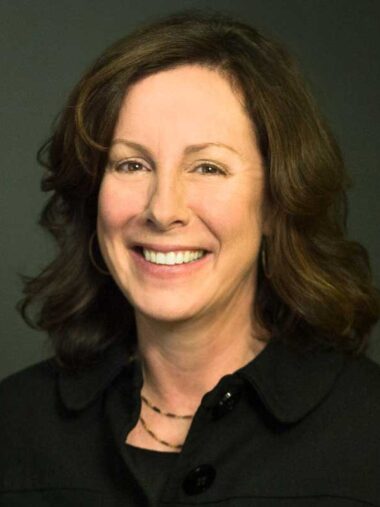
Carla Brodley
During her seven-year tenure as Dean of Khoury College from 2014 to 2021, Carla Brodley achieved a string of accomplishments. There was a record 43% growth in enrollment for first-year women students and a 50% increase in enrollment of groups historically marginalized in tech. Brodley focused on building the faculty of the college, hiring 46 tenure/tenure-track faculty, 5 professors of the practice and 50 teaching faculty; facilitating the creation of the Cybersecurity and Privacy Institute; and doubling the size of the PhD program. As a result, the College moved up to number 12 in in csrankings.org, which is the research ranking publication for Computer Science in the U.S.
Brodley also proved herself to be a prolific fundraiser, raising tens of millions of dollars for student scholarships and to fund the Center for Inclusive Computing, which currently works with 57 universities to increase access for women of all races to the field of computing. In addition, she worked with the faculty to raise money from corporations for research—increasing the industry research engagement from 12 to more than 30 tech companies.
Early in her tenure as Dean at Khoury, Brodley and her team made several strategic moves to increase the number of women and students from historically marginalized races and ethnicities. First off, the College created regular and accelerated versions of its two introductory courses for first-year students, ensuring that students without prior experience in computer science could take the first two classes without feeling like they were starting the program behind other students. The College also centralized undergraduate TA recruitment and training. “TAs are critical to the culture of computer science,” explains Brodley. “We made sure they understood how to be inclusive and create a sense of belonging for each and every student.” These two changes reduced the College’s drop/fail/withdraw rate from 25 percent to five percent, and when students met up again in the third course in the introductory sequence, the College observed no difference in performance between the two groups.
Next, to attract students, the College dramatically increased its combined majors from 12 to 43—leading to a significant increase in women students.
“In the first year we created our mission of ‘CS for everyone,’” said Brodley. “We made sure all our websites and marketing materials reflected all intersectional identities, and that all students feel welcome at Khoury. We also created one of the most interdisciplinary colleges of computer science in the country because the second meaning of our CS for Everyone is that CS touches all fields.” Indeed, 30% of the faculty that Brodley hired have interdisciplinary appointments with other colleges in the University.
One accomplishment that Brodley takes great pride in is the Align Master’s program, designed for students who come from non-technical backgrounds. When Brodley arrived at Khoury College, there were 11 students enrolled in an earlier version of the program on the Seattle campus. Since then, the program has dramatically expanded to seven campuses, including Boston, and currently has 1,721 students enrolled.
In the first year we created our mission of CS for everyone. We made sure all our websites and marketing materials reflected all intersectional identities, and that all students feel welcome at Khoury. We also created one of the most interdisciplinary colleges of computer science in the country because the second meaning of our CS for Everyone is that CS touches all fields
As Brodley puts it, the program creates a “new pathway of talent” that benefits students and regional economies. The program’s success led to scholarship investments from industry and the ability to draw faculty to apply to Khoury College who are motivated by the Align mission.
Since completing her tenure as Dean of Khoury College, Brodley has remained on the Northeastern campus as Dean and Executive Director for the Center for Inclusive Computing, a position that allows her to amplify her mission of making CS available and accessible to everyone.
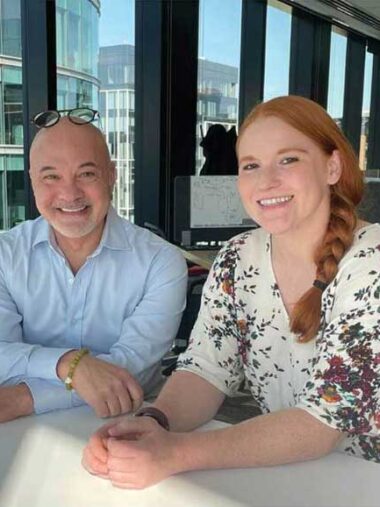
Meet Brecka Fetzer and Wayne Duso
If you introduce a problem to six people from roughly the same background, you often receive six variants of roughly the same solution, says Wayne Duso, former vice president of engineering and product at Amazon Web Services (AWS). But if you give the same problem to six people with wildly different backgrounds, the interplay between their varied perspectives will create ideas you’ve never dreamed of, and you get something much better. And the students that make up Khoury College’s Align program, which provides a pathway to an MS in computer science to students from all undergraduate backgrounds, bring perspectives drawn from everything from psychology to environmental science to English literature. This means they bring exactly what Duso seeks at AWS: diversity of experience and ideas to drive global innovation.
That’s why Duso and Brecka Fetzer, senior program manager, created the Align Career Prep Program. The partnership provides mentorship and support to Align students from all of Northeastern’s network campuses to prepare them to apply for AWS’ Software Development Engineering Internship; it also guarantees them the opportunity to complete the technical screening that is the first step in the hiring process. Align interns who are offered and accept a post-graduation position with AWS will have their final semester paid for by their future employer.
READ: Unique opportunities for Align students bring new CS perspectives to Amazon Web Services
“There’s a lot we offer in terms of how people learn to become an engineer, how to become a team member, owner, and leader,” Duso said. “I had the privilege of doing that years ago in a company that was amazing in terms of its strong culture grounded in pride-of-ownership and quality results as measured by its customers. I wouldn’t have become the engineer I became if I didn’t have a great place to start, with great people who really wanted me to succeed. Our objective is to provide the same opportunity and experience to the Align students.”
The program is the brainchild of Duso, who first began talking about the idea with former dean Carla Brodley after the two reconnected at a University of Massachusetts Amherst dean’s advisory board meeting. Both were struck by how tightly AWS and Khoury College’s cultures meshed, and they each kept an eye out for ways to collaborate. Several years later, the Align Career Prep Program presented itself.
Fetzer manages the program daily — answering student questions, interfacing with her Khoury counterpart Mary Trimarco, and identifying ways to develop the program further.
”I love coming in and getting different perspectives, hearing stories from people and learning from them. You learn so much from folks who come from different walks of life, and I think that’s super important to bring into the workplace,” Fetzer said. “Align interns are very driven and excited … It takes a lot of courage to leave an industry that you’re in and transition into computer science. I’m glad we can help them pursue a career they’re passionate in.”
After starting with just a handful of students three years ago, the program has exploded in popularity since, and AWS is significantly scaling it up this summer. The Align Career Prep Program is also serving as a model for other partnerships, like the one Fetzer and Duso recently launched with Hack Diversity, a nonprofit that breaks down barriers for Black and Latinx tech professionals. Most of Duso’s intern class now arrives through nontraditional pathways like the Align Career Prep Program and Hack Diversity.
Align interns are very driven and excited … It takes a lot of courage to leave an industry that you’re in and transition into computer science. I’m glad we can help them pursue a career they’re passionate in
Brecka Fetzer, Creator of the Align Career Prep Program
The next step, Duso says, is to think about how to scale sustainably.
“Successful relationships like this take commitment from both parties. They take time,” he said. Duso wants to provide opportunities to as many students as possible — and welcome as much diverse talent and their ideas into AWS as possible — without creating a strain that would do harm to the program itself. “For anybody who decides to engage Align, engage it as a relationship, because you are engaging people. If you want to be effective with those people, the algorithm isn’t one of efficiency. It’s one of understanding and completeness.”
Fetzer is excited to watch the program grow further. She’s also thrilled to meet her newest colleagues when they arrive this summer, and grow meaningful relationships with them as they continue to grow their careers.
Meet Ivy Jordan
For Ivy Jordan, Khoury College’s combined majors awakened a passion to try every field adjacent to computer science. Originally pursuing cybersecurity and criminal justice, she switched into computer science and political science before settling on her current major of computer science and design. Now looking ahead to experiential learning opportunities, she’s bringing her appetite for exploration into the field.
Meet Ethan Selinger
When Ethan Selinger felt unsure about his future as a schoolteacher, he met with a career advisor. Over the course of their conversations, he discovered his real passion lay in helping others find clarity within their own careers, and served as Khoury College’s Assistant Director of Align Career Advising.
I help people get jobs, I help people find their direction. I can’t actually do that work, so I am brand new to tech, but it’s a representation of how you can use your strengths to help people, even if their domain knowledge isn’t your domain knowledge
Ethan Selinger, Assistant Director of Align Career Advising
Meet Alan Jamieson
Before coming to the Roux Institute, Alan Jamieson was a theater hand, a small business manager, and a jazz DJ. Now the Director of Computing Programs in Portland, he is passionate about helping Khoury College students discover new disciplines that match their own interests.
I really enjoyed building that experience for students to capture that lightbulb moment … That was the thing that I became passionate about, and it’s what I’ve made my career around
Alan Jamieson, Director of Computing Programs – Portland
Meet Ellen Spertus
Ellen Spertus’s programming journey began in her childhood and led to a 10-year career as a research scientist at Google. While teaching at Northeastern’s Oakland campus, she encourages students to believe in their own potential for success, too.
I like to bring my industry experience and my many decades of computer experience to the classroom, talking with students about what’s done in industry and why we teach what we do
Ellen Spertus, Teaching Professor
Meet Princewill Umeh
After working at J.P. Morgan, Princewill Umeh sought out the Align program to explore his entrepreneurial ambitions outside of finance. The supportive environment he found on Northeastern’s Arlington (VA) campus helped prepare him for co-ops in computer science — and for the job offer he received from CVS Heath after completing a co-op there.
Once I start applying for co-ops, I know that when I’m asked to do something in the job, I’m going to be confident [I can] do it because I gained the experience in the past three semesters
Princewill Umeh, MSCS ’25
Meet Sami Rollins
When Sami Rollins started college, she had no idea she wanted to be a computer scientist. In her role as director of computing programs in Oakland, she enjoyed mentoring a diverse body of students who will uncover their passions.
I think all of us are here because of our excitement about building something new, and it has been
Sami Rollins, Director of Graduate Computing Programs
really wonderful to see the campus community that has begun to evolve and be established here
Meet Angela Mo
After transitioning out of a biology program in Greece, first-year student Angela Mo decided to move to the London campus to take a chance on computer science. The supportive community she’s found there has helped her feel confident that she’ll have a place in the tech industry.
I noticed that everyone in the computer science community, they’re all really inviting and it doesn’t feel like there’s much of a divide between anyone. … I know that I’ll definitely have a place in the industry when I leave college
Angela Mo, BSCS ’26