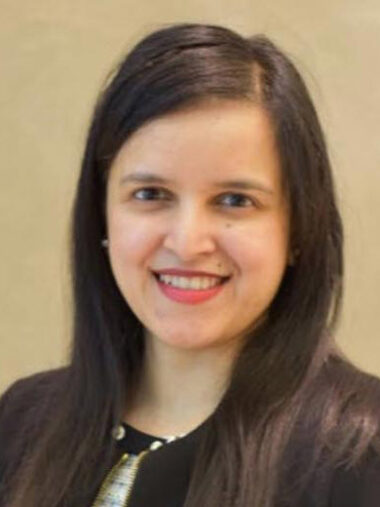
Rekha Kamat
When Rekha Kamat (MSCS ’05) was a young girl with a budding passion for science and technology, little did she imagine that she would one day become a prominent leader in the technology field. She worked with a single-minded focus and drive at every step of her journey, and success followed.
Today, Kamat is the Global Director of marketing for 3DEXPERIENCE Works at Dassault Systèmes, a science-based company and world leader in providing solutions for innovation, generating more than $5 billion in annual revenue. Her journey began in Mumbai, India, where she recalls watching in awe as NASA’s Sojourner Rover landed on Mars in 1997; she aspired to one day build game changing engineering feats.
“Growing up in India, I focused on education,” said Kamat. “Looking back, I think my passion and sense of purpose shaped my journey.”
Kamat’s family emphasized education from a young age, and in particular her mother — who once aspired to become a doctor herself — encouraged Kamat to pursue a future in STEM, despite the many challenges of entering a male-dominated field.
She became the first woman engineer in her family, graduating from the University of Mumbai with a degree in computer engineering. For advanced studies, Kamat decided to come to America for her masters, intent on building a career at the forefront of innovation.
Presented with many options for her graduate studies, Northeastern appealed to Kamat initially because of its location in Boston; she was inspired by Boston while learning of the American Revolution in history class and its centuries-long role in shaping the science and technology fields. What ultimately set Northeastern apart was the university’s wealth of opportunities and resources in cutting-edge areas of computer science.
“As I was reading up and researching schools, I remember there was an article at that time on Northeastern’s website about Agnes Chan. I also read about their programs in artificial intelligence from Professor Mitchell Wand, and their research in security, which all really attracted me to the school in addition to the opportunity to be in Boston and the campus.”
Her experience with the faculty and opportunities while at Northeastern lived up to her hopes when she first applied, paving the way for her career in STEM.
“The artificial intelligence courses I remember distinctly, learning the Lisp programming language that Professor Wand would teach us at that time. Security was another key field then, and the curriculum and teachings of the professors was innovative and inspiring,” Kamat said.
She accepted a role with Dassault Systèmes after graduating from Northeastern, first working on the research and development team before transitioning to sales industry and business consulting positions within the company.
Today, Kamat oversees 3DEXPERIENCE Works Marketing at corporate group level, including leading and managing geography marketing teams in 12 GEOs across the Americas, Europe and Asia. Her strong technology and sales background give her a unique perspective on how to effectively market the product and lead the strategic business initiatives.
“It’s a definite point of differentiation,” said Kamat. “I can look at how our solutions differentiate and add true value to our clients. I understand it both from the technology perspective, and the sales, business perspective.” Kamat is a lifelong learner, having acquired skills and additional qualifications in artificial intelligence, project management and marketing.
In 2018, Kamat was recognized in Boston Business Journal’s 40 Under 40 annual compendium. She was also among 11 young women globally (and one of two based in the U.S.) to be named Outstanding Rising Talent by the Women’s Forum for Economy and Society at their global conference in Paris, France in 2018.
With her prominent role and influence in the industry, Kamat feels a responsibility to empower the next generation of STEM researchers and advocate for gender equality in the field. Kamat is the head of the Women’s Initiative Americas at Dassault Systèmes. The initiative aims to advocate for women in STEM-based leadership roles and provide resources for women to progress from the grassroots level-upwards.
The artificial intelligence courses I remember distinctly, learning the Lisp programming language that Professor Wand would teach us at that time. Security was another key field then, and the curriculum and teachings of the professors was innovative and inspiring
Kamat has also been a recurring judge for the Congressional App Challenge, a U.S. Congress-sponsored nationwide competition for middle and high school students to encourage STEM, and the Technovation Challenge, an initiative to promote girls’ participation in both entrepreneurship and technology. She also serves on the New England Council’s advisory committee for inclusion and diversity.
“We’ve made a lot of progress since I started,” said Kamat. “Now, we have to look at accelerating the pace”.
And, while Kamat’s contributions to the field of STEM are wide-ranging, she hopes to continue leaving her mark by impacting others.
“Civic engagement is something I’ve been passionate about throughout my journey, even as a child growing up in India, I was volunteering and hopefully making an impact in the community,” said Kamat. “Building an inclusive society is important, including changing the narrative and the stereotypes that we see all around us.”
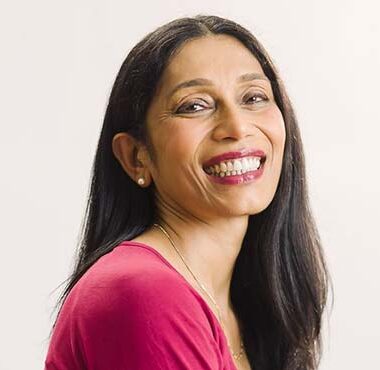
Bela Labovitch
Bela Labovitch is leading the way in technology and mentorship at athenahealth, where she is the VP of engineering. A fierce advocate for women in technology, she speaks regularly at conferences and forums to encourage and support women technologists. She is equally passionate about healthcare interoperability and fixing our healthcare system. In 2019 and 2021, the Healthcare Technology Report named her one of the Top 25 Women Leaders in Healthcare Software.
Labovitch began her computer science journey in high school, where she took a class and fell in love with programming. She later took college-level classes while attending Brandeis University, where inspirational professors cemented her desire to major in computer science.
“Even back then, I had a sense that tech could make a difference in the world,” she says.
After Brandeis, Labovitch was interested in a PhD or master’s program that would lead directly to industry, so she applied to Northeastern.
“I did want to learn; I felt I had gaps,” she recalls. “What I loved about Northeastern was that I could work and get real-world experience while getting my master’s.”
Her decision was helped by Mitchell Wand, who had switched from Brandeis to Northeastern shortly before.
“He was a great professor for me as undergraduate,” Wand says, “and I knew Northeastern must be good if he was going there.”
Following her master’s degree, Labovitch started as a programmer, then became a team lead, an architect, and a director of software engineering — “a fairly typical career,” she says. But before long, she pivoted.
“I had young kids and I felt like it was not my moment yet,” she remembers. “So I went back to being an individual contributor as an architect. Then I had a startup phase, before returning to director-level work after my kids grew older.”
Eventually, Labovitch landed in healthcare software, albeit by accident.
“A friend contacted me to talk to a startup around medication adherence, a huge issue in healthcare that costs this country $500 billion a year,” Labovitch says. “He had this idea of creating an automated pillbox which would remind people to take their medications and convey the data to a centralized care database to enable caregivers and providers to view a patient’s adherence. It was an early internet-of-things device, and it was an exciting journey. I saw firsthand the difference that the pillbox made to the lives of some people. It deeply affected me, and I wanted to stay in healthcare helping patients.”
Now, as a vice president of engineering at athenahealth, she leads a team on a mission to repair our broken healthcare system.
“There’s so much we can do with tech to automate and build interoperability of disparate systems to allow our clinicians to see a full view of their patient’s information,” Labovitch explains. “Right now, patient data is siloed. We want software to talk to each other with APIs, so that a lot of the manual work can be automated. It’s an interesting time in tech with AI and large language models, these can effect big changes in healthcare.”
Labovitch started the Women in Technology initiative at athenahealth to support tech women at the company. She also speaks at conferences and local events to excite women and girls about tech and convince them that it’s an amazing career. She is also an executive sponsor of Girls Who Code, a nonprofit focused on attracting girls to tech early.
“Attracting and keeping women in tech starts early, so we have to address the pipeline problem,” she says. “Once they’re in this field, I focus on keeping them in. Women face specific challenges; we can work on making the environment a hospitable place to grow their careers.”
What I loved about Northeastern was that I could work and get real-world experience while getting my master’s
Labovitch mentions with pride a woman she mentored who changed her major to computer science and joined athenahealth.
“She’s gone on to become a mentor herself and is working on bringing more Latina women into tech,” she says. “I’m proud of the trajectory of her career, but also her trajectory of making a difference for women. I get to view the next generation of women who are helping others at athenahealth and beyond.”
Looking back at Northeastern and Khoury College, Labovitch remarks on how the profiles of both have risen.
“All the kids I know now are trying to get into Northeastern. It was well-known when I was there, but not as well-known as it is now,” she says. “It’s exciting to see its journey these last few years. There have been great initiatives to help support women in CS. I look forward to getting more involved with these initiatives, too.”
And with the rapid developments in machine learning, AI, and big data enabling change in the way core work gets done, she is excited for Khoury College’s future.
“Northeastern graduates are talented, inspired students,” she says. “We see and hire them. They want to change the world, and I love that sentiment coming from the graduates of this generation.”
Reacting to the 40 for 40 honor, Labovitch feels grateful for Northeastern.
“It means a lot to me. I’m truly honored to be recognized, feeling proud for the education I had at Northeastern and grateful for what it’s doing for students today,” she says. “I’m looking forward to staying connected and helping the college. As I went through the 40 for 40 honorees list, I recognized some of the wonderful professors that I had while I was a student, such as Harriet Fell and Betty Salzberg. They were very impactful on me as role models, teachers, and women in computing. They inspired me and my career.”
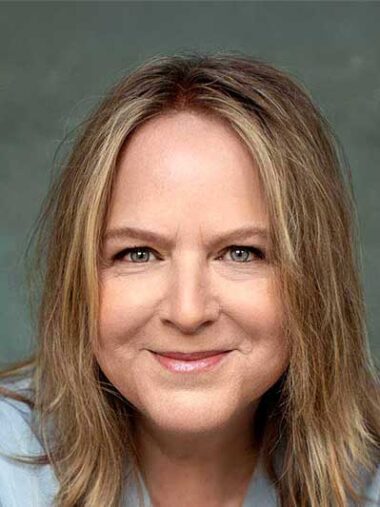
Melody Biringer
Melody Biringer calls herself a connection engineer. “I think about how I can engineer an event so that the audience gets seen and heard and connected to each other, versus going to a keynote at a hotel ballroom where you listen, get inspired, and go home.” Through her WiT Regatta Conference, she collaborates with Khoury College to bring together women in tech from around the world to meet for a week of connection in cities such as Seattle, Vancouver, and Amsterdam, with future conferences planned for Stockholm and others. “I want people to meet their best friend and their new boss at these events. We have our speakers tell real life stories so that people relate to them, then break up everyone into small groups to tell their own stories and be vulnerable with each other.”
The mission has personal value to Biringer. She notes that she did not grow up with sisters or attend university, instead starting her own business at eighteen. “I went through it by myself, having employees and being independent. I woke up one day in my early thirties, and I realized I don’t have many like-minded people to hang out with, I don’t have many friends.” She started the Crave Party, an event set in an upscale dining venue for women entrepreneurs, but everyone had to wear pajamas. “I realized this kind of connection was on everyone else’s mind.” The event was popular, and it grew every subsequent quarter.
In her larger view, loneliness is an epidemic. As adults, introverts have a hard time making friends on their own. “No one likes to walk into a room alone. They need facilitated connections. I believe connections are made one by one over a long time.” While sitting on the board of Women in Tech Seattle, Biringer encountered many women in tech fields that worked for men and heard what they were experiencing at work. She decided to switch her focus to these women. “My skills were needed there.”
In the second year of the WiT Regatta, Khoury College reached out to her, wanting to get involved. Khoury College now hosts half of the event in Northeastern University’s Seattle and Vancouver campuses. For a week, panels take place on technology, leadership, career building, with over two hundred speakers, discussions, and workshops, as well as social events and walks. Khoury College provides technology content with students, staff, and faculty leading discussions.
I hope to live in a world where we don’t have to say, ‘women in tech,’ where we’ve reached parity, where there’s no gender in tech, and we’re all just people
Biringer sees Khoury College as a leader in diversifying tech. “One thing I love about the Regatta and Khoury is the attention we can bring to inspiring role models. Girls at a younger age need the encouragement when they see other girls in every kind of class. I have seen that generation changing in the seven years of the Regatta. I hope to live in a world where we don’t have to say, ‘women in tech,’ where we’ve reached parity, where there’s no gender in tech, and we’re all just people.”
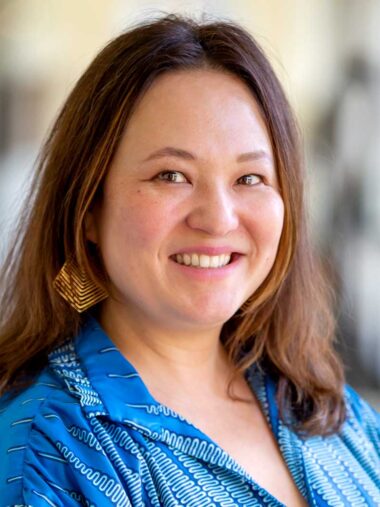
Laurel Yamaguchi
Pivotal Ventures was founded by Melinda French Gates to bring more equality and opportunity to people in the United States. Laurel Yamaguchi, Pivotal’s lead for women and tech innovation, focuses on efforts to increase women’s pathways into the U.S. tech sector.
When Laurel and the Pivotal team learned about the encouraging results of an NSF-funded pilot of the Align MS in Computer Science at the Khoury College of Computer Sciences — a program that provides a bridge for students who didn’t study computing as undergraduates to move into graduate-level computer science majors — they saw an opportunity to make an impact.
“What was interesting to us is how they were using best-known practices to recruit, retain, and graduate women and underrepresented groups in computing,” Yamaguchi said. “It was really encouraging.”
Pivotal launched their support in 2017 with a three-year investment to fund Align scholarships, build out the program’s staff, and develop the MS Pathways to Computing Consortium, a networked learning community of colleges and universities across North America that are investing in “Align-like” bridge programs. After working closely with Northeastern on these projects, Yamaguchi was impressed by the university’s interest in advancing equity.
“They had a willingness to share with others what had worked for them with a commitment to the greater good,” Yamaguchi said. On the strength of the university’s work on Align and the Consortium, Pivotal supported the launch of the Center for Inclusive Computing (CIC) at Northeastern. The CIC’s aim would be to provide financial and technical support to the largest computing departments in the country in order to increase the representation of women graduating with computing degrees. This gets to the heart of Yamaguchi’s goal at Pivotal.
“One of the things that I think is such a big deal about Align and the CIC is that they’re working out the systemic issues that are holding us back,” Yamaguchi said. “It’s not easy work, but they really are getting at the root of some of these issues.”
Throughout her work with Northeastern, Yamaguchi has been a deeply engaged partner, participating in strategy sessions, hosting events, and making connections. Catherine Gill, the CIC’s executive director, emphasizes how much she values Yamaguchi’s approach: “She’s an active advocate, spokesperson, and connector for us. She understands how hard it is to move the needle and she is with us every step of the way.”
I love working with the Center for Inclusive Computing. I learn so much from them constantly because of their deep expertise in higher education. They’re bold and they deliver. It’s really a pleasure to watch them do their thing
As for Yamaguchi, collaborating with Northeastern has been a joyful experience.
“I love working with the Center for Inclusive Computing,” she said. “I learn so much from them constantly because of their deep expertise in higher education. They’re bold and they deliver. It’s really a pleasure to watch them do their thing.”
In looking toward the future, Yamaguchi sees continued growth in the Northeastern approach to engaging any students interested in pursuing computer science degrees.
“They’re always changing, always evolving, doing more,” she notes. “They’re figuring out how to make this systemic and sustainable for the long haul.”

Padmaja Vrudhula
Padmaja Vrudhula considers herself a reluctant technologist. In fact, she originally planned on being a neurosurgeon, but her early experience with an internship at a Seattle software company led her in a different direction.
“I loved the new technology that I was working with, and it was super exciting to develop products that people used,” she explained with a smile. “I did the one thing that Indian parents fear, which was to say, ‘I’m going take a year off to work to save money for med school.’ Fast forward 20-some-odd years, and I’m still working in tech, with med school in the rearview mirror.”
What resonates for Padmaja Vrudhula regarding Khoury and the Align program — and how she got involved — is “trying to bring in students with non-traditional backgrounds.” As an aspiring neurosurgeon turned tech executive, it’s a journey Vrudhula knows well., a global cloud-based data platform. Prior to working at Snowflake, she held a number of industry-facing tech roles at VMware.
While pursuing a career in tech, she has also been active in several nonprofits, primarily geared toward creating opportunities for the economically disadvantaged. Over the last 10 years, this work has evolved into a focus on education and inclusion in technology.
“As a child of Indian immigrant professionals, it never occurred to me that women were supposed to be bad at math and science,” Vrudhula said. “Also, joining tech at a time when credentials weren’t as important as skills and talent, I had a much more diverse experience than those entering the workforce today. This is why I am so focused on ensuring that students have a variety of opportunities to participate in technology.”
To that end, Vrudhula has always enjoyed teaching and mentoring others, whether as an adjunct instructor at the University of Washington or a mentor at the Foster School. She has also helped students in the Align program in Seattle to discover the same spark that led her to pursue a career in technology.
“If there’s one thing I wish I could hear people, particularly women, stop saying is ‘I am not good at math’ or ‘I am not technical,’” said Vrudhula. “The popular notion of math and programming savants needs to be replaced with the idea that it is a learned skill, just like anything else. We are all technical, it is just a matter of degree.”
What resonates for me regarding Khoury and the Align program, and how I got involved, was trying to bring in students with non-traditional backgrounds. These are students who may have had a change in what they wanted to be when they were in their 20s compared to what they want to be in their 30s
“Padmaja has been supporting Aligners since her role at VMWare and now as a VP at Snowflake,” said Mary Trimarco, Khoury College’s business and outreach director. “Her insights are so valuable, and she is a strong advocate for our students.”
Recently at Snowflake, Vrudhula brought in two Align students (both women of color) as interns. They proved their value immediately and will join her team as full-time employees after graduation. For both women, the internship was a way to discover the thrill of problem solving while applying the knowledge they gained during their studies.
Over the past few years, Vrudhula has worked with the Align team to provide math tutorial sessions for students requesting additional support. In addition, she has spoken on panels with Aligners and mentored several students.
“What resonates for me regarding Khoury and the Align program, and how I got involved, was trying to bring in students with non-traditional backgrounds. These are students who may have had a change in what they wanted to be when they were in their 20s compared to what they want to be in their 30s,” Vrudhula said. “As somebody who continuously questions ‘Is this really what I want to do when I grow up?’ that’s something that really resonates with me. This program is also one of the best ways to take action in terms of building diversity in technology, not just from a demographic point of view, but in terms of experience and capabilities.”
Harriet Fell
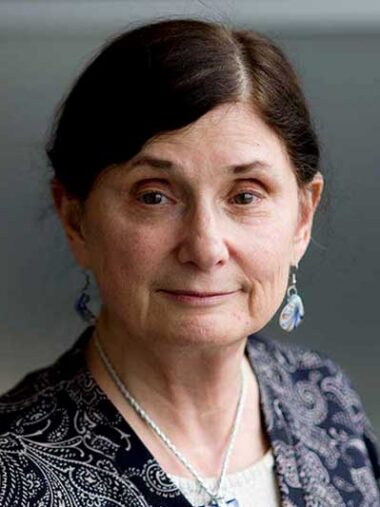
In 1982, the cohort of mathematics professors who founded the College of Computer Science (now Khoury College) included three women and three men, a unique balance in an emerging field that was male dominated. Harriet Fell, a professor at Northeastern since 1971, was one of the professors who chose to take on the challenge of creating this new college, despite having no formal training in computer science. Fell saw an emerging need…and a big opportunity.
Fell worked tirelessly to educate herself in the field while simultaneously collaborating with colleagues to develop courses for first-year students. “When we started the college, we had zero courses,” she said. “We had to create everything as we went.” The curriculum that the group developed went on to become the foundation for the Khoury first-year program and subsequently won national curriculum awards.
One of Fell’s biggest collaborations in her time at Khoury was her work with Linda Ferrier, a professor of speech-language pathology and audiology, to design software for users with disabilities. Over the years, Fell’s students, both undergraduate and graduate, helped to develop the software as part of their coursework. The students’ work on designing solutions to these real-world problems was expanded when Fell and Ferrier were funded by a National Institute of Health grant to develop a technology to identify infants with speech difficulties and then build tools to support them in their communication. Fell received an excellence in teaching award for leading senior projects classes in doing this work.
Bringing her passion for drawing and painting to her computer science work, Fell also developed graphics courses and built up the graphics program at Khoury. The courses were popular with students who were also looking for an opportunity to unite their artistic and computer science interests.
Although Fell retired in 2015, she found that her work was not yet done. Just a week after her retirement, the textbook she had co-written was published, and she began work on developing videos to support the text. Then, three weeks after her retirement, she received an NSF grant jointly with Tim Bickmore that helped support one of her graduate students in his doctoral work. She returned to Khoury to support her student in this four-year project.
Of course returning to support her student is not unexpected from a professor who always gave so much of her time to multiple committees and organizations, including serving for six years as secretary/treasurer of SIGCAPH, now sigACCESS, a special interest group of the national ACM (Association for Computing Machinery) supporting work to help people with disabilities.
When we started the college, we had zero courses. We had to create everything as we went
Ultimately, Fell spent more than 30 years at Khoury, and in that time, she witnessed how it has changed and grown. “[It has] become an outstanding place over the years,” she said. “It was tiny, and we were struggling hard just to exist. It’s very impressive to see what’s happened.”

Molly White
Since graduating from Khoury College, Molly White has continued to pursue her two passions: programming and promoting accuracy in online platforms. In short order, she has proven herself a leader in both areas.
White graduated from Khoury College in 2016 with a bachelor’s in computer science. During her time at Khoury, she had two internships at HubSpot, a marketing software company, which led to a six-year stint there as a software developer.
“Northeastern was where I really discovered my love for software engineering,” explained White. “I started college in the engineering school at Northeastern, thinking I might go into electrical engineering, but it was through classes and co-ops at Northeastern that I realized how much I loved writing software.”
“I also ultimately met a group of close friends at Northeastern who loved coding just for the fun of it,” continued White. “They loved the same kinds of weird and fun projects that I did. Hacking on my personal projects with them was pretty formative.” White was a member of NUHacks and helped organize the Hack Beanpot.
White’s interest on online editing and content accuracy started long before she arrived at Northeastern. White began editing Wikipedia at the age of 13, and it’s something she is still doing today some 15 years later. In fact, she is one of Wikipedia’s most active female editors. While still in high school, she became a site administrator and has written on a range of topics from her favorite bands to women scientists to right-wing extremism. According to her Wikipedia page, she has made more than 100,000 edits as of early 2022. She states on Wikipedia that “this work fulfills her interest in validating information online and her belief that spreading information produces societal change.”
White is now among the most prominent and knowledgeable critics of the crypto and Web3 industries, according to industry experts. She has lectured on the topic, counseled senators on legislation, and is interviewed regularly on news sites and podcasts.
White believes that crypto has exacerbated wealth and access inequalities, giving power and control to a small number of investors, many of whom are already influential in shaping the web landscape, according to 2022 Financial Times article. White believes that federal regulation is urgently needed in the industry; she along with 25 other leading technologists encouraged congressional leaders to pass legislation that would result in crypto currency being regulated by the U.S. Securities and Exchange Commission.
Northeastern was where I really discovered my love for software engineering. I started college in the engineering school at Northeastern, thinking I might go into electrical engineering, but it was through classes and co-ops at Northeastern that I realized how much I loved writing software
White is the editor of the website, Web3 is Going Just Great, a site that explores cases of crypto malfeasance, documenting cases where often unsuspecting investors are duped by false claims.
This spring, she left HubSpot and is currently on a fellowship at the Harvard Library Innovation Lab and is an affiliate at Harvard’s Berkman Klein Center for Internet & Society. The fellowship has given her focused time to work on her research and writing.
After the fellowship is over, what’s next for White? That’s a question she is currently exploring. “When I do return to software, I will probably also try to figure out how I can sustainably work in the kinds of research and writing I enjoy doing on the side, without having to only pack it in around the edges of a full-time software career.”
Carla Brodley
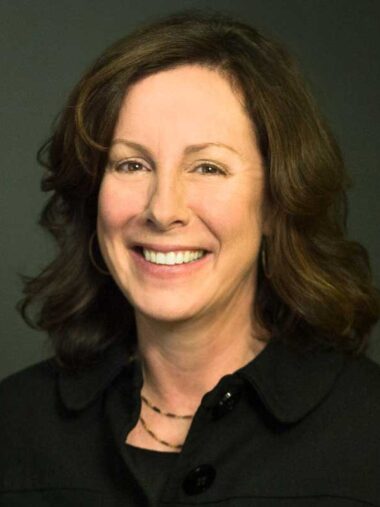
During her seven-year tenure as Dean of Khoury College from 2014 to 2021, Carla Brodley achieved a string of accomplishments. There was a record 43% growth in enrollment for first-year women students and a 50% increase in enrollment of groups historically marginalized in tech. Brodley focused on building the faculty of the college, hiring 46 tenure/tenure-track faculty, 5 professors of the practice and 50 teaching faculty; facilitating the creation of the Cybersecurity and Privacy Institute; and doubling the size of the PhD program. As a result, the College moved up to number 12 in in csrankings.org, which is the research ranking publication for Computer Science in the U.S.
Brodley also proved herself to be a prolific fundraiser, raising tens of millions of dollars for student scholarships and to fund the Center for Inclusive Computing, which currently works with 57 universities to increase access for women of all races to the field of computing. In addition, she worked with the faculty to raise money from corporations for research—increasing the industry research engagement from 12 to more than 30 tech companies.
Early in her tenure as Dean at Khoury, Brodley and her team made several strategic moves to increase the number of women and students from historically marginalized races and ethnicities. First off, the College created regular and accelerated versions of its two introductory courses for first-year students, ensuring that students without prior experience in computer science could take the first two classes without feeling like they were starting the program behind other students. The College also centralized undergraduate TA recruitment and training. “TAs are critical to the culture of computer science,” explains Brodley. “We made sure they understood how to be inclusive and create a sense of belonging for each and every student.” These two changes reduced the College’s drop/fail/withdraw rate from 25 percent to five percent, and when students met up again in the third course in the introductory sequence, the College observed no difference in performance between the two groups.
Next, to attract students, the College dramatically increased its combined majors from 12 to 43—leading to a significant increase in women students.
“In the first year we created our mission of ‘CS for everyone,’” said Brodley. “We made sure all our websites and marketing materials reflected all intersectional identities, and that all students feel welcome at Khoury. We also created one of the most interdisciplinary colleges of computer science in the country because the second meaning of our CS for Everyone is that CS touches all fields.” Indeed, 30% of the faculty that Brodley hired have interdisciplinary appointments with other colleges in the University.
One accomplishment that Brodley takes great pride in is the Align Master’s program, designed for students who come from non-technical backgrounds. When Brodley arrived at Khoury College, there were 11 students enrolled in an earlier version of the program on the Seattle campus. Since then, the program has dramatically expanded to seven campuses, including Boston, and currently has 1,721 students enrolled.
In the first year we created our mission of CS for everyone. We made sure all our websites and marketing materials reflected all intersectional identities, and that all students feel welcome at Khoury. We also created one of the most interdisciplinary colleges of computer science in the country because the second meaning of our CS for Everyone is that CS touches all fields
As Brodley puts it, the program creates a “new pathway of talent” that benefits students and regional economies. The program’s success led to scholarship investments from industry and the ability to draw faculty to apply to Khoury College who are motivated by the Align mission.
Since completing her tenure as Dean of Khoury College, Brodley has remained on the Northeastern campus as Dean and Executive Director for the Center for Inclusive Computing, a position that allows her to amplify her mission of making CS available and accessible to everyone.