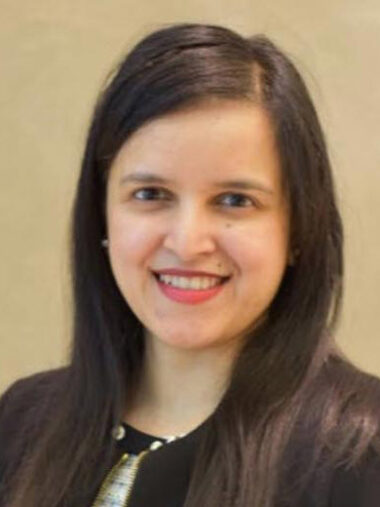
Rekha Kamat
When Rekha Kamat (MSCS ’05) was a young girl with a budding passion for science and technology, little did she imagine that she would one day become a prominent leader in the technology field. She worked with a single-minded focus and drive at every step of her journey, and success followed.
Today, Kamat is the Global Director of marketing for 3DEXPERIENCE Works at Dassault Systèmes, a science-based company and world leader in providing solutions for innovation, generating more than $5 billion in annual revenue. Her journey began in Mumbai, India, where she recalls watching in awe as NASA’s Sojourner Rover landed on Mars in 1997; she aspired to one day build game changing engineering feats.
“Growing up in India, I focused on education,” said Kamat. “Looking back, I think my passion and sense of purpose shaped my journey.”
Kamat’s family emphasized education from a young age, and in particular her mother — who once aspired to become a doctor herself — encouraged Kamat to pursue a future in STEM, despite the many challenges of entering a male-dominated field.
She became the first woman engineer in her family, graduating from the University of Mumbai with a degree in computer engineering. For advanced studies, Kamat decided to come to America for her masters, intent on building a career at the forefront of innovation.
Presented with many options for her graduate studies, Northeastern appealed to Kamat initially because of its location in Boston; she was inspired by Boston while learning of the American Revolution in history class and its centuries-long role in shaping the science and technology fields. What ultimately set Northeastern apart was the university’s wealth of opportunities and resources in cutting-edge areas of computer science.
“As I was reading up and researching schools, I remember there was an article at that time on Northeastern’s website about Agnes Chan. I also read about their programs in artificial intelligence from Professor Mitchell Wand, and their research in security, which all really attracted me to the school in addition to the opportunity to be in Boston and the campus.”
Her experience with the faculty and opportunities while at Northeastern lived up to her hopes when she first applied, paving the way for her career in STEM.
“The artificial intelligence courses I remember distinctly, learning the Lisp programming language that Professor Wand would teach us at that time. Security was another key field then, and the curriculum and teachings of the professors was innovative and inspiring,” Kamat said.
She accepted a role with Dassault Systèmes after graduating from Northeastern, first working on the research and development team before transitioning to sales industry and business consulting positions within the company.
Today, Kamat oversees 3DEXPERIENCE Works Marketing at corporate group level, including leading and managing geography marketing teams in 12 GEOs across the Americas, Europe and Asia. Her strong technology and sales background give her a unique perspective on how to effectively market the product and lead the strategic business initiatives.
“It’s a definite point of differentiation,” said Kamat. “I can look at how our solutions differentiate and add true value to our clients. I understand it both from the technology perspective, and the sales, business perspective.” Kamat is a lifelong learner, having acquired skills and additional qualifications in artificial intelligence, project management and marketing.
In 2018, Kamat was recognized in Boston Business Journal’s 40 Under 40 annual compendium. She was also among 11 young women globally (and one of two based in the U.S.) to be named Outstanding Rising Talent by the Women’s Forum for Economy and Society at their global conference in Paris, France in 2018.
With her prominent role and influence in the industry, Kamat feels a responsibility to empower the next generation of STEM researchers and advocate for gender equality in the field. Kamat is the head of the Women’s Initiative Americas at Dassault Systèmes. The initiative aims to advocate for women in STEM-based leadership roles and provide resources for women to progress from the grassroots level-upwards.
The artificial intelligence courses I remember distinctly, learning the Lisp programming language that Professor Wand would teach us at that time. Security was another key field then, and the curriculum and teachings of the professors was innovative and inspiring
Kamat has also been a recurring judge for the Congressional App Challenge, a U.S. Congress-sponsored nationwide competition for middle and high school students to encourage STEM, and the Technovation Challenge, an initiative to promote girls’ participation in both entrepreneurship and technology. She also serves on the New England Council’s advisory committee for inclusion and diversity.
“We’ve made a lot of progress since I started,” said Kamat. “Now, we have to look at accelerating the pace”.
And, while Kamat’s contributions to the field of STEM are wide-ranging, she hopes to continue leaving her mark by impacting others.
“Civic engagement is something I’ve been passionate about throughout my journey, even as a child growing up in India, I was volunteering and hopefully making an impact in the community,” said Kamat. “Building an inclusive society is important, including changing the narrative and the stereotypes that we see all around us.”
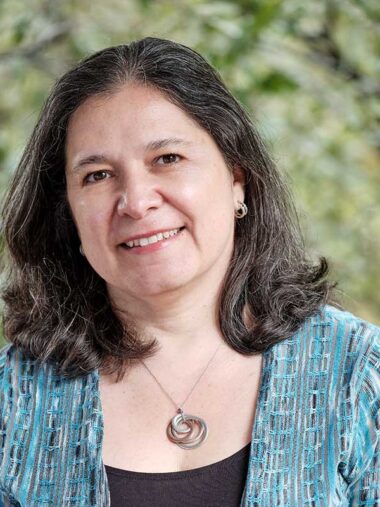
Natasha Noy
Research has been a driving force of Natasha Noy’s career. After completing her bachelor’s degree at Moscow State University, Noy began applying for United States-based PhD programs in computer science while still living in Moscow in the 1990s. Boston was one of the cities she had heard of, and she says, “It was mostly Boston where I wanted to go, and to the program that gave me full assistance — which was Northeastern.”
Noy first experienced “how to do real research” at Northeastern. Her research assistance came out of a grant with several professors collaborating on it. “I was immediately exposed to multiple points of view. There were a lot of firsts for me as part of that research. It grew into my dissertation.” The grant was focused on using knowledge representation methods to find information in medical and biology text. Noy’s dissertation was ultimately titled “Knowledge representation for intelligent information retrieval in experimental sciences.”
After completing the program, Noy taught for a year at Northeastern. She fondly recalls teaching an introductory computer science class where students wrote game programs. “The last day of the semester, they spent the whole night in the lab playing each other’s games.”
Her research led to a move to Stanford for a post-doctoral position working on knowledge representation and systems, “AI as it was perceived back then.” She worked as part of a group of computer scientists in the medical school. Their work became the Protégé ontology editor, which helped scientists build ontologies describing their domains.
Northeastern set me on the path of being a researcher, asking interesting questions, finding something new. In some sense, my research at Google goes back to what I was doing when I was at NU: helping users find information
After fifteen years as a research scientist at Stanford, she was looking for a change. She was enjoying the applied research, so she joined a research team at Google, one of the “bigger and more exciting labs for me.” Having joined a company built around searching the web, she eventually started Dataset Search – a search engine for datasets, akin to what Google Scholar is for papers.
Noy says, “Northeastern set me on the path of being a researcher, asking interesting questions, finding something new. In some sense, my research at Google goes back to what I was doing when I was at NU: helping users find information.” Noy was elected as an AAAI Fellow in 2020.
Assessing Northeastern today, Noy is impressed by its growth in stature. “I’ve moved across the country, and seeing NU from afar with its new professors, programs, and alumni, I’ve seen the PhD become even more valuable over time. Being selected as part of 40 for 40 is really special. It’s humbling to receive this award.”
Meet Dian Wang
When AlphaGo revealed its advanced Go-playing AI in 2016, it was a shock for Dian Wang. Wishing to understand the complexities of artificial intelligence, he entered Khoury College’s PhD program, where he found support among professors for his research at the intersection of machine learning and robotics.
Khoury is very supportive for interdisciplinary research. … I would like to be a good professor like my advisor some day
Dian Wang, PhD in CS ’25
Meet Anshul Mathew
For Anshul Mathew, proximity to industry is key. While pursuing his master’s degree at Northeastern’s Oakland campus, he’s taken advantage of the vibrant tech scene in the Bay Area to make new connections and advance his career.
I believe in the power of proximity. … There are a lot of conferences that happen in San Francisco. … I met people who … can actually help me get ahead in my career. … I feel I’m blessed being here
Anshul Mathew, MSCS ’22
Meet Eddie Wang
For Eddie Wang, instant feedback is key. As a mechanical engineer, long project cycles made it tough to receive feedback on his work, but his satisfaction was met when he started coding software. Now, through the Align program, he’s completed impactful internships at Meta, Amazon, and SAP Concur, allowing him to transition into tech with ease.
The Align [network] is a very good resource while you are looking for different jobs. … Don’t be afraid of new things, and you will be more and more confident in future jobs
Eddie Wang, Align MSCS ’18
Meet Aida Sharif Rohani
Aida Sharif Rohani was ready to shift away from chemical engineering, but she struggled to find a master’s program in computer science that didn’t require a matching bachelor’s degree. Discovering the Align program opened a door for her to pursue her interests, ultimately leading her to a supportive community at NASA, where she currently works as a machine learning engineer.
All of my coworkers at NASA Ames and USRA, they were very welcoming … I had some doubts to … starting a master’s, but right now where I am I’m happy that I made that choice. Especially for people like me without the background in computer science, it’s a great opportunity
Aida Sharif Rohani, Align MSCS ’21