
Marina Moskowitz
When Marina Moskowitz arrived at Northeastern University in 2014, she was undecided about her major. Although she knew she wanted to study business, she also wanted to explore her other passions. The combined majors program at Northeastern, which offered her the flexibility to pursue two disciplines, played a crucial role in her decision to attend the university.
One of her interests was computer science, but she had no prior experience in programming. So she enrolled in the course Fundamentals I at Khoury College, which introduced her to computing and programming.
“It was extremely difficult,” she said. “My brain was not used to thinking in that way, but I fell in love with the field because it taught me how to think objectively and independently.”
By the end of her first semester, Moskowitz declared a combined major in computer science and business. As she progressed in her studies, her focus shifted from pursuing grades to learning for learning’s sake. This allowed her to not only retain information better and understand the subjects more deeply, but also to explore them more extensively.
The success I have achieved is a direct result of my experiences at Khoury College, where I fell in love with learning. I was taught how to think objectively, at the most fundamental level, about what cybersecurity and artificial intelligence can do for us in the future
This refined ability to think quickly and apply her computer science knowledge became valuable during her four co-ops at the Department of Defense, as well as her two internships at Apple focusing on cybersecurity and machine learning. Although she had no experience in these fields, she was welcomed into these positions because of her aptitude for fast learning.
“I’m fortunate to have been in positions where I was given problems for which my manager said, ‘This doesn’t have a solution. If you fail, that’s okay,’” Moskowitz recalled.
Moskowitz explored these problems and soon fell in love with the work. By the end of her co-ops at the Department of Defense, Moskowitz had earned several awards for developing tools that the organization still uses. At Apple, during her first internship, she leveraged her skills in machine learning and natural language processing to create a tool that identified critical threats in Apple’s network. This tool was then implemented on a third-party vendor website, allowing anyone to benefit from the algorithm. During her second internship, she built upon this tool to pinpoint the location of vulnerable systems and machines within Apple’s network.
After each internship and co-op, Moskowitz returned to Northeastern to take advanced classes that allowed her to delve deeper into each new subject, further expanding her knowledge. Additionally, during her senior year, and under the supervision of Professor Alina Oprea, she conducted an independent research project in which she applied machine learning to find red flags in a network. She concluded her time at Northeastern having earned several awards, including being recognized as a Young Global Leader and as one of the most 100 influential students at Northeastern University (the Huntington 100).
Today, Moskowitz holds the position of AI and cyber security engineer at Apple’s Information Security department, where she writes algorithms to help protect Apple’s internal network from threats and vulnerabilities. Her focus is on reinforcement learning, an emerging field in artificial intelligence. She is also pursuing her master’s degree in machine learning and data science at the University of California, Berkeley.
Given the impact of rapid advancements in cybersecurity and artificial intelligence, Moskowitz believes that students exploring these fields must be prepared for a lifelong journey of continuous learning. She stresses the importance of students learning to think independently as they master foundational course material.
“The success I have achieved is a direct result of my experiences at Khoury College, where I fell in love with learning,” she said. “I was taught how to think objectively, at the most fundamental level, about what cybersecurity and artificial intelligence can do for us in the future.”
Meet Julie Rakas
For those aiming to switch to computing at the master’s level and secure jobs at large tech firms, impostor syndrome can be a struggle. But for Julie Rakas, who interned at AWS through the company’s partnership with Khoury College — and who now works there full time — the support she received made the transition into a positive one.
The type of person who chooses to transition to computer science from a totally different field — they’re so interesting to talk to. It’s been so cool to talk to people who were brave enough to take that leap
Julie Rakas, MSCS ’23
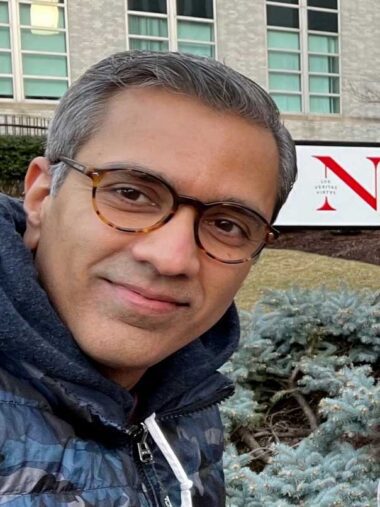
Meet Mani Sundaram
For Mani Sundaram (MS ’99), attendance at Northeastern was somewhat happenstance. After getting an undergraduate degree in India, he was set on coming to the US for graduate work. His father made something clear to his ambitious son: he only had enough money to support a one-way ticket. Due to cost of college applications, Sundaram applied to just four colleges. He got into Northeastern with a scholarship, though he thought he was applying to Northwestern, he admits now.
In the end, Sundaram could not be happier, as he credits Northeastern as a key factor in his professional achievements.
“What I learned at Northeastern gave me the foundation for what I do right now,” Sundaram said. “Without clearly understanding the foundations of computer science, it’s hard to be a security practitioner.”
After completing his MS degree, Sundaram was hired during an on-campus interview for Stratus Technologies, and later moved to Virtify. The bulk of his career, however, has been spent at Akamai, a web and internet security company. He is currently executive vice president and general manager of the Security and Technology Group, overseeing strategy and product direction for Akamai’s security solutions, as well as the business and platform security units’ core functions of engineering, product development, and product management.
Sundaram finds the security field very engaging because it is always changing and presenting new opportunities.
“The opportunities are boundless,” he said, noting that he’s approached each opportunity he’s been given with “the explicit goal of learning as much as possible.”
Since graduating, Sundaram has remained connected to Northeastern as an alumnus and donor. He and his wife Meena sponsor six students in the College of Professional Studies’ “A2M for Tech” program, which provides financial assistance to community college students continuing their studies at Northeastern. “It’s a joy to sponsor these students,” they said.
What I learned at Northeastern gave me the foundation for what I do right now. Without clearly understanding the foundations of computer science, it’s hard to be a security practitioner
Mani Sundaram, MSCS ’99
In addition, numerous Northeastern students have pursued co-op opportunities at Akamai during Sundaram’s tenure.
“The one thing I have always admired about Northeastern students is they are very pragmatic,” Sundaram said. “They come in talking about how to get things done, something they are able to do on day one.”
Meet Rachit Mehta
For Rachit Mehta, experiential learning is the key to a well-rounded education. Between his internship at Amazon Web Services and his classes in the Align program, he built confidence in multiple areas at once — and set himself up for post-graduation success.
The whole goal of the AWS internship is that they’re gonna teach me what it’s like to be a developer in a full-time capacity … It puts things in perspective that you can still make a difference even if it’s a big organization
Rachit Mehta, Align MSCS ’23
Meet Hasti Gheibi Dehnashi
At AWS, Align alumnus Hasti Gheibi Dehnashi works as an SDE1 – Amazon’s equivalent of an entry level software engineer. Although her position at the company is fairly new, she feels a tremendous sense of responsibility toward her work in protecting clients’ data.
As soon as I started, my opinion was this is what I want. I want to come back to AWS and work here full time. I feel a great sense of responsibility towards the individuals who will consume or use the products and services that I create
Hasti Gheibi Dehnashi, Align MSCS ’21
Meet Victoria Bowen
Within only one month of starting her co-op at Outcomes4Me, Victoria Bowen noticed others at the company were starting to ask her for guidance, a credit to her skills as a quick learner and the lessons she learned from Khoury College on how to be a responsible team member. Empowered by the supportive environment at Outcomes4Me, she wants to advocate for other young women to gain access to tech opportunities like hers.
Computer science is constantly changing. So when you go into the workplace, you’re going to be learning new technologies that maybe you haven’t seen in the classroom. It’s good that you have that base of knowing how to collaborate and work in a team environment
Victoria Bowen, BSCS ’23
Meet Sam Wu-Ochs
For Sam Wu-Ochs, a company’s mission is key. Impressed with Outcomes4Me’s drive to democratize cancer care, he applied for a co-op at the company as an undergraduate student. Now, he works there full time and is helping shape the company’s future.
Northeastern really does have an impressive network that would be difficult to find in other places as a college student. I think ultimately the goal of Khoury College is to give you the fundamental skills that are gonna prepare you for a career in computer science
Sam Wu-Ochs, BSCS ’22
Meet Christina Rong
Like many Khoury College alumni, Christina Rong was initially attracted to the college for its career-accelerating co-op program. Now working full time at Outcomes4Me, her former co-op, she leverages her software engineering experience to improve patients’ access to cancer treatment.
It’s pretty rewarding to work with a team that prioritizes patients and wants to help improve their lives. I’m pretty happy with where I am right now
Cristina Rong, BSCS ’21
Meet Becky Mashaido
For Becky Mashaido, the draw of Align was straightforward — a master’s program in computing that offered access to San Francisco’s tech pioneers, but did not require an undergraduate CS degree. And after finding a unique and uplifting sense of community there, she made it her mission to uplift others.
I took the help that I received, and now I’m giving it back to other students … it’s an awesome environment
Becky Mashaido, Align MSCS ’22