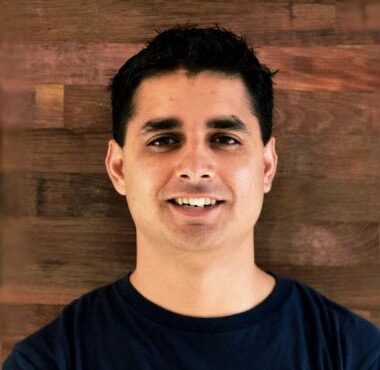
Praful Mathur
Since his childhood days, Praful Mathur relished computer science. He just didn’t always know what to do with it.
“I wanted to do anything with computers. I would stay up writing software, and I ended up not working on some school assignments so I could work on projects instead,” he recalls. “Then I broke through the school’s admin systems. It was fun, but I got into some trouble, and I realized I had to figure out where I could align my strengths.”
He initially set his sights on San Francisco, and tried to convince his parents that he wasn’t college material. But after the family toured a handful of Boston colleges and his mom insisted they check out Northeastern, the university struck a chord with Mathur.
“The thing that struck me was the co-op program,” he explains. “At my core, I’m a hacker, and Northeastern was incredible in the sense that I could apply that immediately. I knew I’d have extra projects, and to do that in the wild was really attractive.”
Now, more than a decade later, that impulse lingers. Mathur has made his living in entrepreneurship, founding multiple companies with computing at their core. And it all began during his time at Khoury College, where he joined the first cohort of coaches at venture accelerator IDEA and wrote the curriculum for the first Husky Startup Challenge.
“I wanted to be around other people who were thinking about building businesses,” he says. “It was rare on campus, and the fact that two groups were getting started simultaneously was exciting.”
By the summer after his first year, he co-founded his first company, this time in collaboration with fellow Northeastern computer science student Sergey Grabkovsky and their colleague Sumant Yerramilly. Called Amp Idea, it aimed to place advertising and credit card machines on taxicabs. Mathur, who had purchased initial equipment using money he’d saved while working, quickly found himself competing against big-name companies for Boston city contracts. They carved out the second-largest market share in the space before eventually selling the company to Verifone.
His next venture, Shotput, came soon after Mathur graduated Northeastern in 2011. It began as a more research-oriented venture based around self-driving cars, but morphed into a logistics company that aided other companies in creating product warehouses. Although it attracted some well-known customers including the Wall Street Journal, Samsung, and Red Bull, the team also made some key mistakes, and the company paid the price.
“I became cocky because I’d built my first company and sold it, so I thought I could just do it again, and that I was in my mid 20s and nothing could stop me. I just lost my way,” Mathur admits. “I learned to stick to my strengths, to know who I was and why I was doing things, and to choose the right partners and investors.”
The next few years saw Mathur involve himself with ComFreight, a freight factoring company that aids truck drivers with invoicing and collection.
“I ended up raising $3.5 million for them, as well as building out the team and initial product,” he says. “But it was just a pit stop for me. I wasn’t going to stay too long because I wanted to start something again in software.”
And after Mathur founded a nonprofit called AI on the Beach for researchers interested in animal communication, his wife gave him the spark he needed.
“She said, ‘You keep talking about dolphin communication, but you can’t tell me what our dog Kai is saying,’” Mathur remembers.
I’ve become the type of person I admired when I was in college, and a lot of it was because of Khoury College. I wouldn’t have accomplished any of this and have this kind of life without it. It has this emphasis on making things work in production, in real-life situations
Thus was born Sarama, Mathur’s latest venture, in which he strives to use AI to translate dogs’ barks into messages and alerts that pet parents can understand.
“I can get back to my core roots in software and deep tech,” Mathur says. “I think animal communication will be mainstream by the end of the decade. But it’s a niche thing right now. So my goal is to build a company that can take the research and commercialize it so there can be a sustained way of getting resources behind it.”
And as he builds momentum behind Sarama while advising other startups on how to clear the mental and psychological hurdles that often plague new operations, he can’t help but look back to the first place where he focused his own drive for computing.
“I’ve become the type of person I admired when I was in college, and a lot of it was because of Khoury College. I wouldn’t have accomplished any of this and have this kind of life without it,” Mathur says. “It has this emphasis on making things work in production, in real-life situations. And now, even in companies I advise, the top engineers are all Northeastern grads.”

Molly White
Since graduating from Khoury College, Molly White has continued to pursue her two passions: programming and promoting accuracy in online platforms. In short order, she has proven herself a leader in both areas.
White graduated from Khoury College in 2016 with a bachelor’s in computer science. During her time at Khoury, she had two internships at HubSpot, a marketing software company, which led to a six-year stint there as a software developer.
“Northeastern was where I really discovered my love for software engineering,” explained White. “I started college in the engineering school at Northeastern, thinking I might go into electrical engineering, but it was through classes and co-ops at Northeastern that I realized how much I loved writing software.”
“I also ultimately met a group of close friends at Northeastern who loved coding just for the fun of it,” continued White. “They loved the same kinds of weird and fun projects that I did. Hacking on my personal projects with them was pretty formative.” White was a member of NUHacks and helped organize the Hack Beanpot.
White’s interest on online editing and content accuracy started long before she arrived at Northeastern. White began editing Wikipedia at the age of 13, and it’s something she is still doing today some 15 years later. In fact, she is one of Wikipedia’s most active female editors. While still in high school, she became a site administrator and has written on a range of topics from her favorite bands to women scientists to right-wing extremism. According to her Wikipedia page, she has made more than 100,000 edits as of early 2022. She states on Wikipedia that “this work fulfills her interest in validating information online and her belief that spreading information produces societal change.”
White is now among the most prominent and knowledgeable critics of the crypto and Web3 industries, according to industry experts. She has lectured on the topic, counseled senators on legislation, and is interviewed regularly on news sites and podcasts.
White believes that crypto has exacerbated wealth and access inequalities, giving power and control to a small number of investors, many of whom are already influential in shaping the web landscape, according to 2022 Financial Times article. White believes that federal regulation is urgently needed in the industry; she along with 25 other leading technologists encouraged congressional leaders to pass legislation that would result in crypto currency being regulated by the U.S. Securities and Exchange Commission.
Northeastern was where I really discovered my love for software engineering. I started college in the engineering school at Northeastern, thinking I might go into electrical engineering, but it was through classes and co-ops at Northeastern that I realized how much I loved writing software
White is the editor of the website, Web3 is Going Just Great, a site that explores cases of crypto malfeasance, documenting cases where often unsuspecting investors are duped by false claims.
This spring, she left HubSpot and is currently on a fellowship at the Harvard Library Innovation Lab and is an affiliate at Harvard’s Berkman Klein Center for Internet & Society. The fellowship has given her focused time to work on her research and writing.
After the fellowship is over, what’s next for White? That’s a question she is currently exploring. “When I do return to software, I will probably also try to figure out how I can sustainably work in the kinds of research and writing I enjoy doing on the side, without having to only pack it in around the edges of a full-time software career.”

Fiona McCrae
“Fiona’s list of accomplishments is so long, and stretches back so far, that it makes me question how I spent my time in high school and college,” says professor and director of the BS in cybersecurity program, Christo Wilson. In addition to graduating Summa Cum Laude with a major in cybersecurity and minor in political science, Fiona McCrae made herself an invaluable asset to the Northeastern community and will undoubtedly do the same in her post-graduate endeavors.
Shortly after beginning her freshman year, McCrae secured a spot on the highly competitive Collegiate Cyber Defense Competition (CCDC) team. In 2019, the team was a local winner in the DOE CyberForce competition at Brookhaven National Laboratory; and in 2020 when the competition went remote, McCrae individually ranked 20th out of 400 competitors. Every year, the team qualified for the Northeast Regional CCDC competitions, and in 2022, the team was one of only 10 schools in the country to attend Nationals in San Antonio.
She was also on the e-board the NU Security Club and a member of the Khoury Student Advisory Board. In all her activities, McCrae says, “Having the chance to interact with younger cybersecurity students to help form a community within the major has been something I am so proud to have contributed to, even if there is no concrete landmark event for that.”
She also brilliantly worked two competitive co-ops in cyber resiliency at MITRE in Bedford, Massachusetts, where has she is now working as a cybersecurity engineer. During her co-ops there, she helped develop pen test software and payloads for satellites and attended testing for Satellite Penetration Evaluation and Environment Demonstration (SPEED). She has also contributed to the development of research papers and policy-related briefings for government officials during her time at MITRE.
McCrae’s contributions to NU extend beyond cybersecurity. She was the events coordinator for CoSMO, the computer science mentoring organization that works to connect students across the discipline. She was also a teaching assistant for Discrete Structures, Foundations of Cybersecurity, and Object-Oriented Design. Professor Jason Hemann worked with McCrae in 2020 and says, “She went out of her way to create detailed guides and documentation to help students learn better in this new modality. When there’s a problem lurking, or a solution that needs to be implemented, Fiona steps up.”
Without legal and political guidance based on the needs of people using technology, there is no way to define what and how we need to secure technology. On the other hand, without a technological understanding, we can’t make and act out laws and policies that are realistic or helpful for the people that rely on, use, and protect technology
“Fiona’s warm, outgoing, witty, strong, personable, dependable, and honest,” Professor Hemann says. “She’s the kind of person that other people want to be around.”
Going forward, she hopes to remain connected to both the technical and legal aspects of cybersecurity. In her words, “Without legal and political guidance based on the needs of people using technology, there is no way to define what and how we need to secure technology. On the other hand, without a technological understanding, we can’t make and act out laws and policies that are realistic or helpful for the people that rely on, use, and protect technology.”

Chris Jelly
Northeastern students are known for their remarkable ideas, but outside of the classroom it can be challenging to scramble for resources to bring their ideas to fruition. Based on his own experiences as a student at the Khoury College of Computer Sciences, alumnus Chris Jelly (BSCS ’14) recognized the need for a dedicated fund to support students’ self-directed projects.
With this need in mind, Jelly created the Jelly Incubation Fund for Khoury College in 2017 with a $25,000 donation. He has characterized the fund’s purpose as “no-strings-attached cash grants to students with unique, self-directed ideas that are related to computer science in some way.” He views the fund as a conduit for compelling student ideas and projects.
Back when he was an undergraduate, Northeastern had funding opportunities for students outside of the classroom, such as IDEA and the Provost’s Award, but nothing that worked specifically the way the Jelly Fund works. “Lots of students want to build their own product or conduct research, so I wanted to create a fund that would be all-encompassing,” Jelly explained.
Lots of students want to build their own product or conduct research, so I wanted to create a fund that would be all-encompassing
The fund is open to full-time Khoury College undergraduate students. In their proposals, which are assessed on the scope of the proposed idea and its relevance to both the College and the student applicants, they provide an outline of their project, including a budget, timeline, and a defined goal. Expenses typically covered by the fund include supplies, equipment, lab space, labor costs, or personal remuneration.
Collaborations with the Khoury College major gifts team and central university advancement, along with donations from parents, staff, and alumni of Northeastern, helped the Jelly Fund to award over $20,000 in project money in 2020 alone. Jelly also reached out and developed a partnership with Amazon’s Web Services (AWS) so that each grantee automatically receives an additional $5,000 in AWS credits via AWS Activate. These credits can be used for web services from infrastructure technologies like computing, storage, and databases–to emerging technologies, such as machine learning and artificial intelligence, data lakes and analytics, and the Internet of Things.
Jelly is involved in the selection of recipients of the Jelly Fund, and he serves on the selection committee along with faculty, staff, and alumni. He credits Doreen Hodgkin, former associate dean of Khoury College, with the idea of having students apply to the fund instead of him personally selecting specific projects.
One of the many fund recipients is Code4Community, a student-run organization dedicated to providing custom software solutions to local non-profits at no cost to them. The club partners with organizations needing software to increase their efficiency, scope, and ultimately their impact. (To learn more about Code4Community, go to c4cneu.com.)
Former club president, data science major Floris Dobber, reported that Code4Community is immensely grateful for the financial support they’ve received. “The Jelly Fund donation has made it possible for us to provide our services to our partners at no cost. Their donation, and the associated AWS credits, covers all our development costs and allows us to use industry standard development environments,” he said.
Preston Rakovsky, a computer science and business major and another Jelly Fund recipient, has created an iOS app called “Food Flock,” which seeks to solve the age-old problem of where to go out to eat. “Users can swipe through a collection of these cards with their partner, until all individuals swipe right, or ‘match’, on the same restaurant,” Rakovsky explained. “Because of the Jelly Fund, we were able to host our app on cloud resources, purchase design assets and, once we go live, we will be able to use the remaining funding to market and advertise our app on various social media platforms.”
Student recipients of the funding are unanimously grateful to Chris Jelly and the Jelly Fund team. Khoury College leadership is grateful, too, for how the grants help bring student ideas to life.
“The Jelly Fund has made it possible to fuel our students’ entrepreneurial spirit and creativity while supporting their experiential learning goals and preparing them for the world of work. Khoury College and the students are grateful for Chris Jelly’s generosity and his ongoing support of our students,” said Ben Hescott, Khoury College teaching professor and senior associate dean of undergraduate academic programs and student experience. Jelly is the Head of Software Engineering at Vestaboard, the owner of Jelly Consulting where he advises startups on product and engineering strategies, as well as a Founding Engineer at MirrorTab.