Artificial Intelligence at Khoury College of Computer Sciences
The science behind the AI technology that is revolutionizing everyday life
Artificial intelligence is reshaping our world at a pace comparable to the advent of the World Wide Web — but at Khoury College, researchers aren’t just building AI; they’re unlocking its mysteries, questioning its ethics, and ensuring it serves humanity safely and equitably.
From the mathematical foundations of trustworthy machine learning to real-world applications that improve lives, Khoury researchers are not merely participating in the AI revolution — they’re steering it toward a future where AI is powerful, comprehensible, and fundamentally aligned with human values.
Transforming the way we design, build, teach, and communicate
AI is changing how people work across nearly every sector — automating routine tasks and freeing people to focus on higher-order thinking and problem-solving. At the same time, it’s accelerating scientific discovery, making sense of datasets at scales that were previously unmanageable and opening new frontiers in drug discovery, medical research, and materials science.
AI is also reshaping computer science itself, touching every research area at Khoury College. Software development looks different than it did even five years ago — and Khoury researchers and students are helping define what comes next.
Sample research areas
- Interpretability
- Large language model science
- AI in health care
- AI in software development
- Cognitive, emotional, social, and physical behavior models
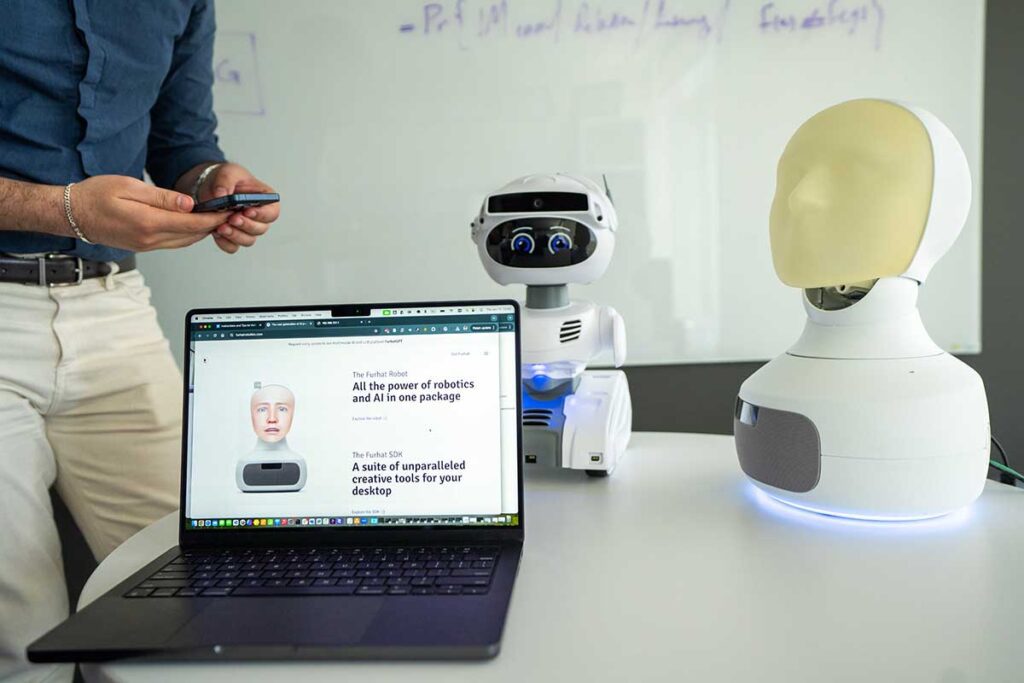
- Robotic systems capable of flexibly interacting with the world
- Design of virtual humans capable of interacting with people using verbal and nonverbal behavior
- Sociotechnical aspects of AI
Khoury researchers: At the forefront
Current project highlights
Large neural networks can perform tasks of extraordinary complexity — but how they do it is one of the greatest mysteries in science today.
Why? Because unlike ordinary computer programs, machine learning systems are trained from data instead of being designed by a programmer. As a result, the internal workings of these systems are inscrutable to humans; they are black boxes, even to programmers.
The US National Science Foundation (NSF) has announced a $9 million grant to Northeastern University to launch National Deep Inference Fabric (NDIF), a new national-scale research computing infrastructure project that will enable researchers to delve into the mysteries of large-scale AI systems and address a growing gulf between the efficacy of machine learning and scientists’ ability to explain it.
As AI increasingly mediates gig work — shaping which jobs workers are offered, how their labor is tracked, and how they are compensated — gig workers themselves often lack access to the data and tools needed to understand or respond to these systems. This research develops AI-enhanced tools that give gig workers visibility into their own workplace data, helping them identify pay discrepancies, algorithmic patterns, and broader workforce trends. Rather than replacing human judgment, these tools are designed to surface insights and support collective action, empowering workers and unions to engage meaningfully with the technologies shaping their livelihoods. The work extends globally, with ongoing collaborations across North America and Latin America to study how AI impacts workers in diverse labor markets.
Imagine you’re learning to cook a new recipe and you have an AR headset that can watch your technique and compare it to an expert’s demonstration — then tell you exactly where you went wrong. That’s the vision behind this work. Researchers developed an AI system that can watch two videos side by side — a reference “how-to” video and a video of someone attempting the same task — and identify the key differences between them. To train this system, researchers automatically generated a large dataset of video pairs from real instructional content, teaching the AI to spot when steps are skipped, done out of order, or performed incorrectly, and even to judge how serious those mistakes are. This kind of technology could power the next generation of personalized, real-time coaching in augmented and virtual reality.